
Astronomy & Space study guide · Lesson 6 of 13
Jupiter
The Giant Itself · Storms and Magnetism · The Galilean Moons
This is the lesson's study guide from the FlashFeed app, plus its key facts and a self-test.
What you'll be able to do
- Characterize Jupiter and its major moons
The Giant Itself
Start with mass. Everything else about Jupiter follows from it.
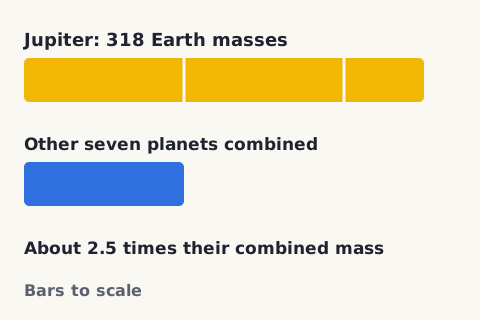
Jupiter carries about 318 times Earth's mass — more than every other planet put together. NASA calls it more than twice the combined material of the other bodies; the ratio is close to 2.5 times the combined mass of the other seven. So the eight planets are not eight comparable objects that differ in size. After the Sun, the Solar System is Jupiter plus debris, and Earth is in the debris.
It sits 5.2 astronomical units from the Sun on average and takes 11.86 Earth years to go round once, which NASA rounds to twelve.
Size is a separate argument from mass. The mean radius is 69,911 km, about 11 times Earth's. Eleven times wider is not eleven times bigger: volume scales as the cube, so eleven cubed is well over a thousand Earths' worth of room inside.
Nor does 318 Earth masses mean 318 times the gravity. At the cloud tops it is 2.364 times Earth's, because gravity goes as mass divided by radius squared and the radius is enormous. Escape velocity is the figure that stays extreme: 59.5 km/s against Earth's 11.19.
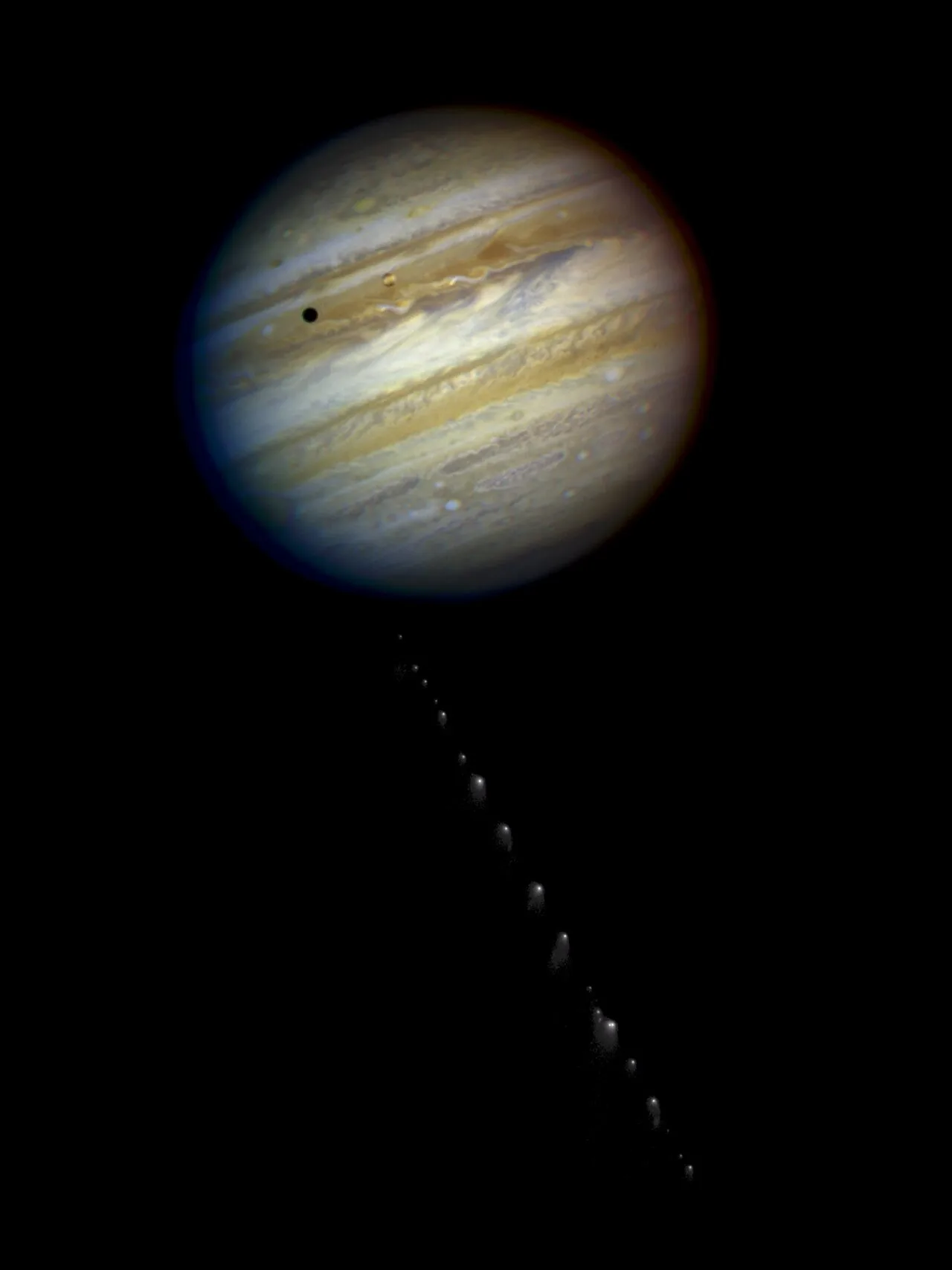
That mass reaches outward. In July 1994 comet Shoemaker-Levy 9 broke into some 21 fragments that struck Jupiter over six days — the first collision between two Solar System bodies humanity watched happen. Whether Jupiter shields Earth from such things is unsettled: simulations by Horner and Jones found a giant planet can significantly enhance Earth's asteroid impact rate, though the same authors found the Oort-cloud comet rate falling as the giant's mass rises.
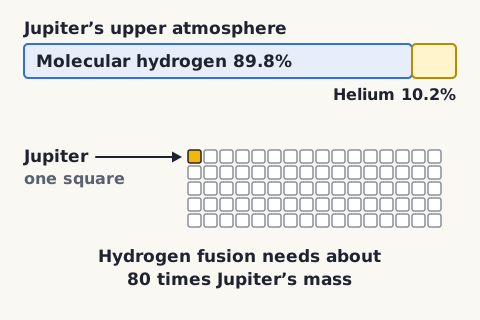
The composition is less exotic than the pictures suggest — 89.8 percent molecular hydrogen and 10.2 percent helium in the upper atmosphere, with methane and ammonia as traces, close to stellar proportions. The colors are trace compounds sitting on plain hydrogen and helium.
There is no true surface. The gas thickens with depth into hot, dense liquid, so nothing lands on Jupiter, and every radius and temperature quoted for it belongs to an agreed pressure level — the 1-bar level — rather than to any ground. Cloud tops are about minus 145 degrees Celsius.
Deeper, pressure strips electrons off the hydrogen and the liquid begins conducting electricity. That is metallic hydrogen: still hydrogen, not iron, but behaving like a metal because the electrons are free. Juno found the core larger than expected and not solid, but partly dissolved into it.
Same ingredients as a star, and it never lit. Not nearly — fusion needs roughly 80 times Jupiter's mass. "Failed star" is a slogan, not a near miss.
It also spins: one turn in 9.925 hours, the shortest day of any planet.
Storms and Magnetism
That spin deforms the planet. The equatorial radius is 71,492 km against a polar radius of 66,854 km — an ellipticity of 0.06487, about twenty times Earth's flattening. A fast-spinning fluid body is not a sphere but a measurably squashed ellipsoid.
The stripes are weather. The pale bands are zones, the dark ones belts. On the simplest interpretation zones are where gas rises and is topped with bright ammonia-ice cloud, while belts are where it sinks and deeper, darker cloud shows through. Treat that as a cloud-top picture only: Juno's microwave sounding indicates the circulation is stacked and can reverse with depth. Either way, belts and zones change appearance from year to year.
The Great Red Spot is a single storm watched for more than 300 years and still wider than the Earth. With no continents and no ocean surface to drain its energy, a Jovian storm can outlive every human who has observed it.
It is also shrinking, which makes any single size a dated snapshot. Observations from the late 1800s put its long axis near 25,500 miles; Voyager measured 14,500 miles in 1979; Hubble measured about 10,250 miles in 2014, the smallest ever measured to that date. "Twice as wide as Earth" is a decades-old description.
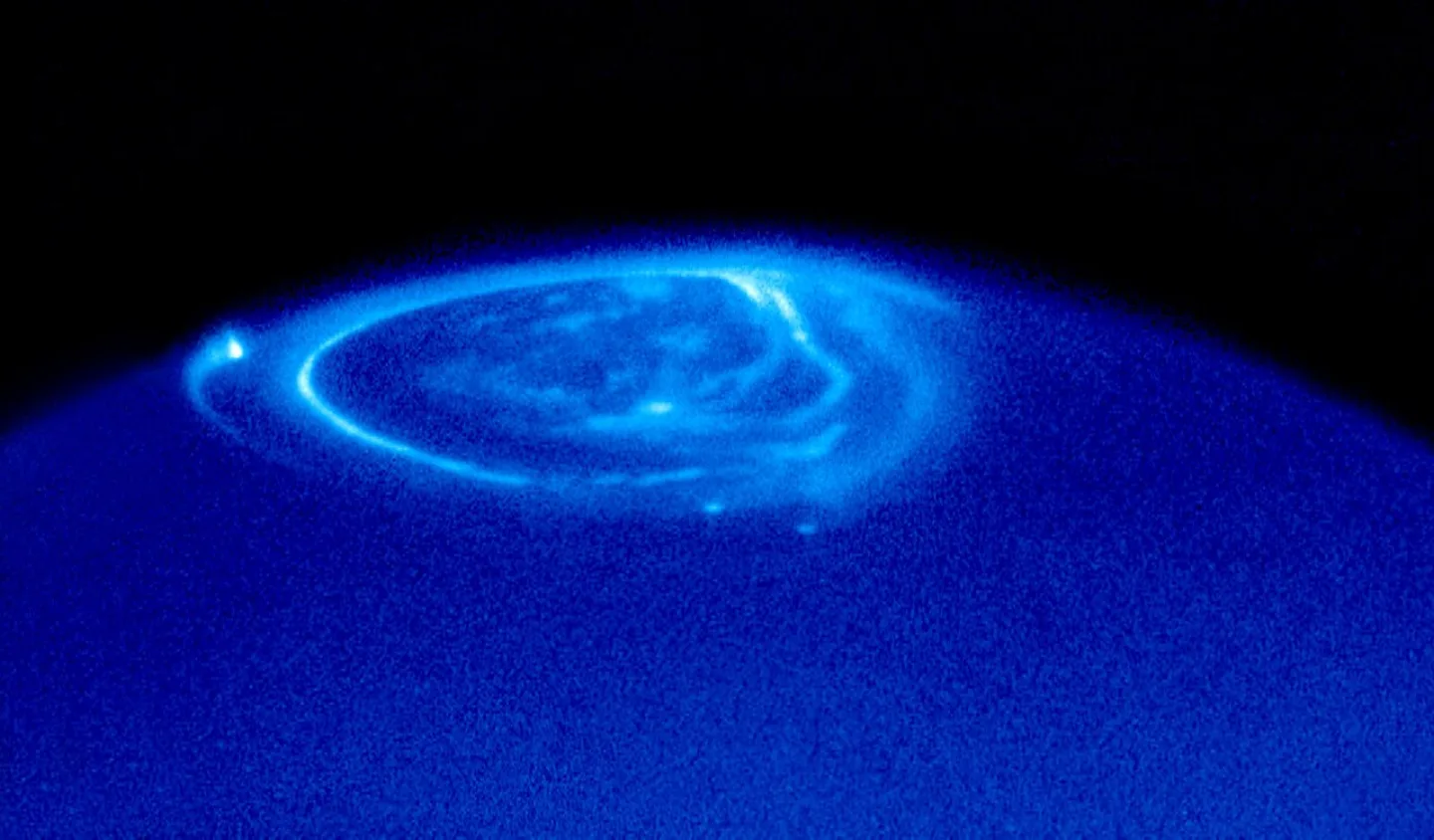
Circulating metallic hydrogen makes a dynamo, and this one is the strongest in the Solar System — NASA puts Jupiter's field at 16 to 54 times as powerful as Earth's. No iron core is involved. A planet does not need one.
The field inflates a magnetosphere about 5.3 million km across on average, 150 times wider than Jupiter itself and almost fifteen times wider than the Sun. Its tail streams downwind far beyond the orbits of the big moons. A magnetic field does not hug its planet.
Inside it, trapped charged particles form radiation belts fiercer than anywhere but the Sun. The material is mostly not solar: it is volcanic gas escaping Jupiter's moon Io, which loads the magnetosphere with as much as 1,000 kg of new material every second. A moon feeds its planet's radiation belts. That is why Juno, in orbit since 4 July 2016, flies a looping polar orbit diving through the gap between the belts and the planet rather than circling the equator.
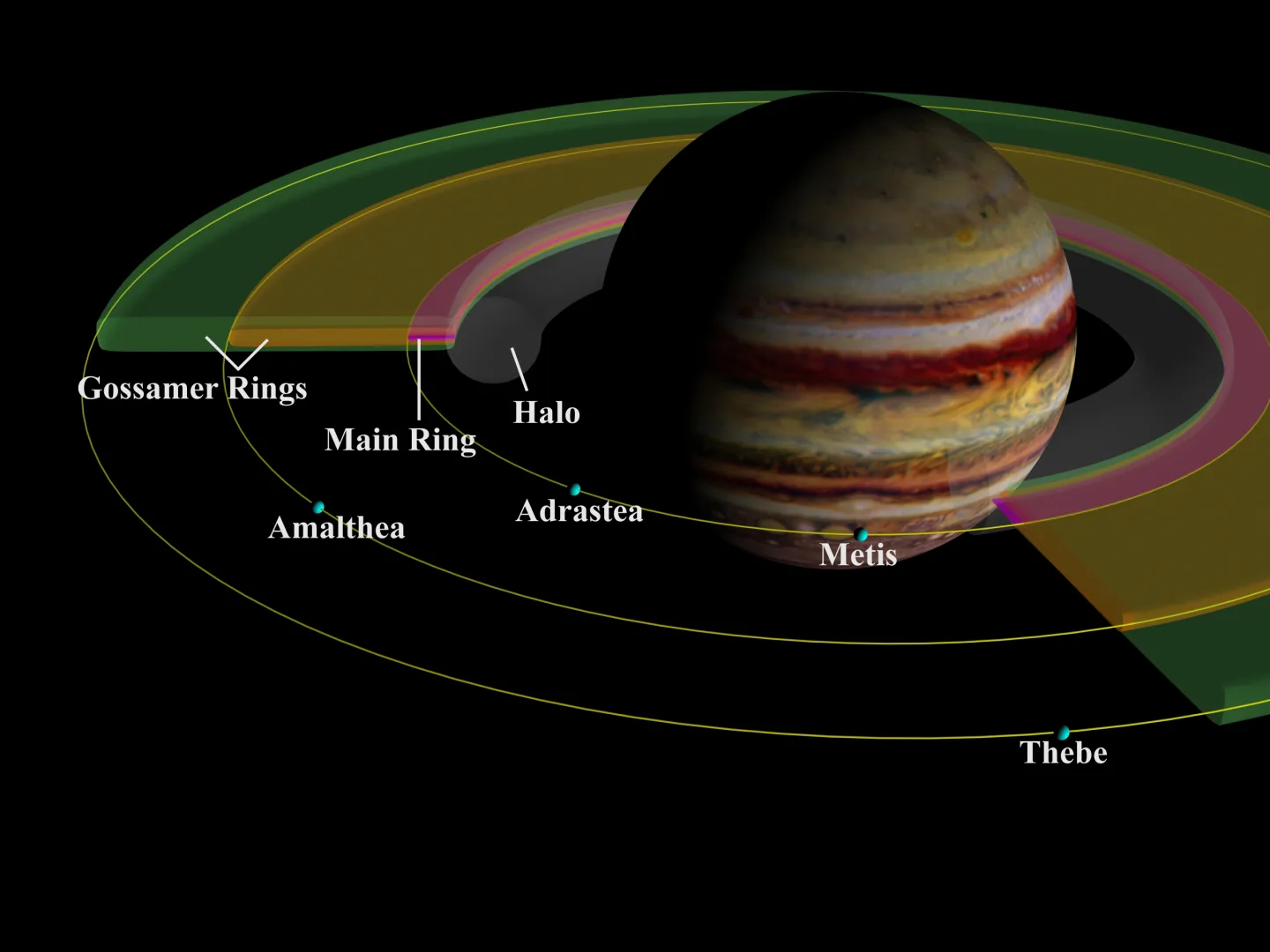
Two smaller things. Jupiter has rings, found by Voyager 1 in 1979 — faint, mostly small dark dust, in an inner halo, a thin main ring and two broad gossamer rings. Saturn's are exceptional for being bright and icy, not for existing. And the moon count moves: NASA lists 101 moons recognized by the IAU as of March 2026, while confirmed-detection catalogs listed 115 as of April 2026.
Four of those moons are not small at all.
The Galilean Moons
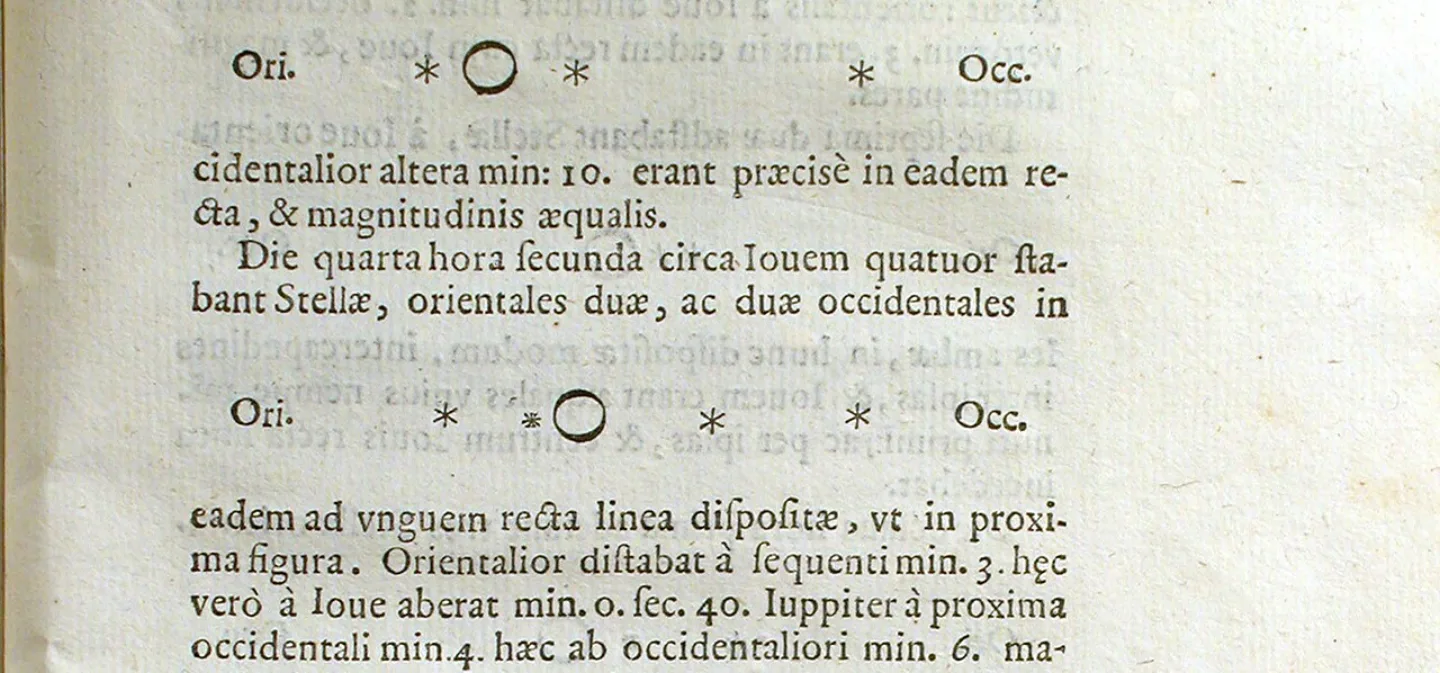
On 7 January 1610 Galileo Galilei pointed an improved homemade telescope at Jupiter and found four objects beside it, published that March in Sidereus Nuncius. The argument was geometric, not rhetorical: four things plainly circling something that was not the Earth. That did not prove the Earth goes round the Sun. It proved something narrower and harder to argue with — that not everything goes round us.
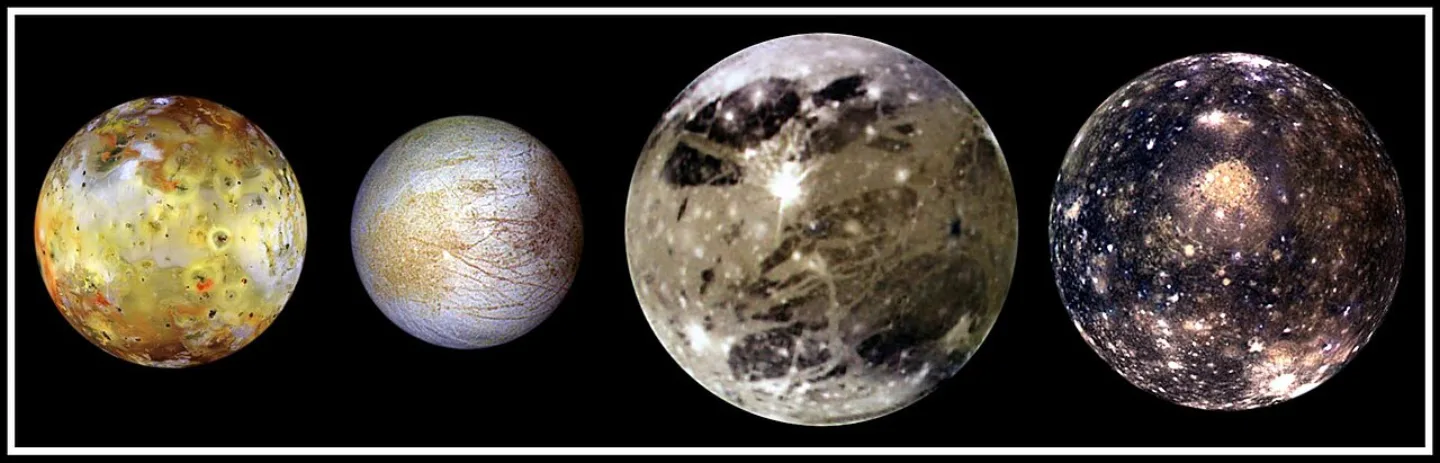
The four are the Galilean moons, and the way to hold them apart is as a sequence, because what separates them is how much heat each gets, and so how thoroughly its surface has been remade.
The heat is not sunlight. The three inner moons are locked in a 1:2:4 rhythm — Io orbits in about 1.77 days, Europa in about 3.55, Ganymede in about 7.155 — while Callisto, outside the lock, takes about 16.7 days. Those ratios are not coincidence but a self-sustaining gravitational relationship, and they hold the inner orbits slightly stretched. A stretched orbit flexes the moon as it travels, and flexing makes heat. That is tidal heating.
Io takes the worst of it, caught between Jupiter's gravity pulling one way and the precisely timed tugs of Europa and Ganymede. It is only a little larger than our own Moon, yet it is the most volcanically active world in the Solar System, with over 400 active volcanoes and sulfur plumes rising as high as about 500 km. It is also nearly uncratered: eruptions resurface it faster than impacts can scar it. Distance from the Sun does not make a world cold and dead.
Europa is slightly smaller than our Moon, its surface near minus 160 °C. Beneath the ice it is thought to hide a saltwater ocean holding twice as much water as Earth's oceans combined. How far beneath is an estimate with a wide range: roughly 10 to 30 km of solid ice over an ocean perhaps 100 km deep. That range is why a spacecraft had to go. Europa Clipper launched on 14 October 2024 and is due at Jupiter in April 2030, where it will orbit Jupiter and make 49 close flybys of Europa. It does not land and does not drill.
Ganymede, the largest of the four, is about 5,262 km across against Mercury's 4,880 km. Bigger than a planet — and yet only about 45 percent of Mercury's mass, because it is largely ice and rock rather than metal. It is also the only moon known to generate its own magnetic field.
Callisto, outermost and least heated, is the most heavily cratered object in the Solar System. That does not mean it was hit more often than its neighbors. Its terrain is around 4.5 billion years old and its crater density is near saturation — a new impact tends to erase an older one — because nothing out there ever resurfaced anything.
Io by fire, Europa by ice, Ganymede partly, Callisto not at all.
Key terms
- Metallic hydrogen
- A liquid squeezed until its electrons run free, so it conducts electricity like a metal while remaining the lightest element — no iron involved
- Radiation belt
- A zone where a planet's magnetic field traps and accelerates charged particles — at Jupiter stocked mainly by a volcanic moon rather than by the Sun
- Tidal heating
- Warmth made inside a body by the flexing of a stretched orbit, rather than by sunlight
Key concepts
Io
- The innermost of the four large moons Galileo found beside Jupiter, only a little larger than Earth's Moon.
- It sits deepest in Jupiter's radiation belts and feeds a doughnut of sulfur and oxygen ions that circles the whole planet.
- Over 400 active volcanoes and sulfur plumes about 500 km high; eruptions resurface it faster than impacts can scar it, leaving it nearly uncratered.
Europa
- Slightly smaller than Earth's Moon, second out from Jupiter among the four large ones, with a surface near minus 160 °C.
- Its outer crust of solid ice is estimated at roughly 10 to 30 km thick — a range wide enough that a spacecraft had to be sent to narrow it.
- Under that ice it is thought to hide a saltwater ocean holding about twice as much water as all of Earth's oceans combined.
Ganymede
- The largest of the four moons Galileo found, about 5,262 km across — wider than the planet Mercury.
- It outsizes that planet yet holds only about 45 percent of its mass, because it is largely ice and rock rather than metal.
- It is the only moon known to generate a magnetic field of its own, something usually found on planets.
Callisto
- The outermost and least heated of the four large moons, taking about 16.7 days to circle Jupiter — outside the orbital lock that binds the other three.
- Its terrain is around 4.5 billion years old, because nothing out there ever resurfaced anything.
- The most heavily cratered object in the Solar System, with crater density near saturation: a new impact tends to erase an older one.
Europa Clipper
- It left Earth on 14 October 2024 and is not due to arrive at Jupiter until April 2030.
- It will orbit Jupiter rather than the moon it studies, which keeps it clear of the worst radiation.
- The plan is 49 close flybys of one ice-covered moon, to test whether that moon could support life; it does not land and it does not drill.
Sidereus Nuncius
- Not a world at all but a document, rushed into print in March 1610, two months after the nights it describes.
- Its author had improved a homemade telescope, and what he reported seeing beside the largest planet is why his name is attached to four moons.
- Direct evidence against an Earth-centered cosmos, in print and circulating within weeks — which is what made it impossible to ignore.
Key facts
Jupiter Plus Debris
Jupiter carries about 318 times Earth's mass. NASA puts that at more than twice the combined material of the other bodies orbiting the Sun; against the other seven planets alone the ratio is close to 2.5 times their combined mass. So the eight planets are not eight comparable objects that happen to differ in size. After the Sun, the Solar System is Jupiter plus debris — and Earth is in the debris. It sits 5.2 astronomical units out.
Eleven Wide, Thousand Deep
Jupiter's mean radius is 69,911 km, about 11 times Earth's. Eleven times wider is not eleven times bigger: volume scales as the cube, so eleven cubed leaves well over a thousand Earths' worth of room inside. The planet also bulges — the equatorial radius is 71,492 km — so even "the radius" is a choice of which one you mean.
Nowhere to Land
Jupiter has no true surface. There is no boundary where atmosphere stops and ground begins; the gas simply thickens with depth into hot, dense liquid, so nothing lands on it. Every radius and temperature quoted for Jupiter therefore belongs to an agreed pressure depth — the 1-bar level — rather than to any ground. At the cloud tops it is about minus 145 °C, while the interior runs to thousands of degrees. A planet like this has no single temperature.
Star Ingredients, Never Lit
The upper atmosphere is 89.8 percent molecular hydrogen and 10.2 percent helium, with methane and ammonia as traces — close to stellar proportions. The colors are trace compounds sitting on plain hydrogen and helium, not exotic chemistry. Same ingredients as a star, and it never lit. Not nearly: hydrogen fusion needs roughly 80 times Jupiter's mass. "Failed star" is a slogan, not a near miss.
Twenty-One Fragments
In July 1994 comet Shoemaker-Levy 9 broke into some 21 pieces that struck Jupiter over six days — the first collision between two Solar System bodies humanity was able to watch happen. Whether that reach shields Earth is genuinely unsettled: simulations by Horner and Jones found a giant planet can significantly enhance Earth's asteroid impact rate, while the same authors found the Oort-cloud comet rate falling as the giant's mass rises.
Spin Made Visible
Jupiter's equatorial radius is 71,492 km against a polar radius of 66,854 km — an ellipticity of 0.06487, about twenty times Earth's flattening. That 4,638 km bulge is the fast spin made visible, and it is large enough to see through an amateur telescope. A fast-spinning fluid body is not a sphere but a measurably squashed ellipsoid.
The Stripes Are Weather
The pale bands are zones, the dark ones belts. On the simplest interpretation zones are where gas rises and is topped with bright ammonia-ice cloud, while belts are where it sinks and deeper, darker cloud shows through. Treat that as a cloud-top picture only: Juno's microwave sounding indicates the circulation is stacked and can reverse with depth. Either way the bands are not paint — belts and zones change appearance from year to year.
A Dynamo Without Iron
Circulating metallic hydrogen makes a dynamo, and this one is the strongest in the Solar System — NASA puts Jupiter's field at 16 to 54 times as powerful as Earth's. No iron core is involved; a planet does not need one. The field inflates a magnetosphere about 5.3 million km across on average, about 38 times Jupiter’s own diameter and nearly four times the width of the Sun, with a tail streaming downwind far beyond the orbits of the big moons.
Rings, and a Moving Count
Jupiter has rings, found by Voyager 1 in 1979 — faint, mostly small dark dust, arranged as an inner halo, a thin main ring and two broad gossamer rings. Saturn's are exceptional for being bright and icy, not for existing. The moon count moves too: NASA lists 101 moons recognized by the IAU as of March 2026, while confirmed-detection catalogs listed 115 as of April 2026. Any figure here needs a date attached to it.
Four Points Beside Jupiter
On 7 January 1610 Galileo Galilei pointed an improved homemade telescope at Jupiter and found four objects beside it, published that March in Sidereus Nuncius. The argument was geometric, not rhetorical: four things plainly circling something that was not the Earth. That did not prove the Earth goes round the Sun. It proved something narrower and much harder to argue with — that not everything goes round us.
A Lock That Makes Heat
The three inner moons are locked in a 1:2:4 rhythm — Io orbits in about 1.77 days, Europa in about 3.55, Ganymede in about 7.155 — while Callisto, outside the lock, takes about 16.7 days. Those ratios are not coincidence but a self-sustaining gravitational relationship, and they hold the inner orbits slightly stretched. A stretched orbit flexes the moon as it travels, and flexing makes heat. That is tidal heating, and it is why distance from the Sun does not make a world cold and dead.
Matched pairs
Each item on the left goes with the one on the right.
- Jupiter's day
- 9.925 hours — the shortest of any planet
- Jupiter's year
- 4,332 days — about 11.86 Earth years
- Jupiter's magnetosphere
- 5.3 million km across — about 38 times the planet
- Juno's looping orbit
- Dives through the gap under the radiation belts
- Europa's ice shell
- Estimated 10-30 km of ice over the ocean
Self-test
Answer each question from memory, then check your work against the answer key.
1. How much more massive would Jupiter have to be before hydrogen fusion could begin?
- AAbout 8 times its own mass
- BAbout 25 times its own mass
- CAbout 80 times its own mass
- DAbout 2 times its own mass
2. Jupiter holds 318 Earths' worth of material. What is the pull at its cloud tops?
- AAbout 318 times Earth's
- BAbout 11 times Earth's
- CAbout 59 times Earth's
- DAbout 2.4 times Earth's
3. What supplies most of the material trapped in Jupiter's radiation belts?
- ADebris from comet impacts
- BVolcanic gas from Io
- CDust from the ring system
- DThe solar wind
4. What generates the strongest magnetic field of any planet in the Solar System?
- ACirculating metallic hydrogen
- BCharged dust in the rings
- CFriction between cloud bands
- DA molten iron core
5. What separates Io's violent surface from Callisto's ancient one?
- ADistance from Jupiter, and tides
- BThe size of each moon
- CHow often each has been hit
- DHow much ice each began with
Go deeper
- WatchJupiter Plus Debris Jupiter carries about 318 times Earth's mass: about 2.5 times all the other planets combined.
- WatchThe Storm Watched for 300 Years The Great Red Spot is one storm, watched for more than 300 years. It's still wider than Earth.
- WatchGalileo's Four Moons In 1610, Galileo saw 4 moons circling Jupiter. Not everything goes around us.
- StudyAstronomy & Space in the FlashFeed app
Answer key
- 1. C About 80 times its own massFusion needs roughly 80 Jupiter masses, so Jupiter falls short by a factor of about 80 — not by a little. At 2, 8 or 25 times its mass it would still be a planet or a brown dwarf and never a star. "Failed star" is a slogan, not a near miss.
- 2. D About 2.4 times Earth'sGravity goes as mass divided by radius squared, and the radius is enormous: 23.12 m/s² at the 1-bar equator, 2.364 times Earth's. 318 mistakes mass for gravity, 11 is the width ratio, and 59 is the escape velocity in km/s — a speed, not a gravity.
- 3. B Volcanic gas from IoIo loads the magnetosphere with as much as 1,000 kg of new material every second. The solar wind is the usual answer at Earth but not the dominant source here; the rings are faint dark dust, not feedstock; and comet impacts are occasional events, not a steady supply.
- 4. A Circulating metallic hydrogenJupiter's dynamo is a churning shell of hydrogen made conductive by pressure, which is why "a field needs iron" is wrong — there is no iron core to melt. Cloud bands are weather that changes yearly, and the rings are faint dust; neither drives a field 16 to 54 times Earth's.
- 5. A Distance from Jupiter, and tidesIo sits closest and is held in a resonance that keeps its orbit stretched, so it is kneaded continuously and resurfaces faster than impacts can mark it. Callisto orbits outside that lock, is barely flexed, and keeps a 4.5-billion-year-old face. Both were hit at similar rates.
Sources
- NASA Science — Jupiter Facts — science.nasa.gov/jupiter/facts/
- NASA Science — Jupiter Facts — science.nasa.gov/jupiter/jupiter-facts/
- NASA GSFC — Jupiter Fact Sheet (Radio JOVE Project) — radiojove.gsfc.nasa.gov/education/jupiter/basics/jfacts.htm
- NASA Science — The Lasting Impacts of Comet Shoemaker-Levy 9 — science.nasa.gov/science-research/planetary-science/the-lasting-impacts-comet-shoemaker-levy-9/
- Wikipedia — Atmosphere of Jupiter — en.wikipedia.org/wiki/Atmosphere_of_Jupiter
- Mission Juno (NASA/SwRI) — Magnetosphere — www.missionjuno.swri.edu/jupiter/magnetosphere/
- NASA Science — Juno — science.nasa.gov/mission/juno/
- NASA — 415 Years Ago: Astronomer Galileo Discovers Jupiter's Moons — www.nasa.gov/general/415-years-ago-astronomer-galileo-discovers-jupiters-moons
- Wikipedia — Io (moon) — en.wikipedia.org/wiki/Io_(moon)
- NASA Science — Io — science.nasa.gov/jupiter/moons/io/
- NASA JPL Solar System Dynamics — Planetary Satellite Physical Parameters — ssd.jpl.nasa.gov/sats/phys_par/
- NASA Science — Callisto — science.nasa.gov/jupiter/moons/callisto/
- NASA Science — Europa — science.nasa.gov/jupiter/moons/europa/
- NASA Science — Ganymede — science.nasa.gov/jupiter/moons/ganymede/
- NASA Science — Europa Clipper — science.nasa.gov/mission/europa-clipper/
Image credits
- Jupiter Plus Debris: FlashFeed original diagram · CC-BY-4.0
- Star Ingredients, Never Lit: FlashFeed original diagram · CC-BY-4.0
- Twenty-One Fragments: NASA, ESA, H. Weaver and E. Smith (STScI) and J. Trauger and R. Evans (NASA's Je · Public domain — commons.wikimedia.org/wiki/File:Comet_Shoemaker-Levy_9_Approaching_Jupiter_in_1994.jpg
- A Dynamo Without Iron: NASA, ESA & John T. Clarke (Univ. of Michigan) · Public domain — commons.wikimedia.org/wiki/File:Uncovering_the_mysteries_of_Jupiter%27s_aurora_(heic0009a).jpg
- Rings, and a Moving Count: Wikimedia Commons · NASA/JPL/Cornell University · Public domain — commons.wikimedia.org/wiki/File:PIA01627_Ringe.jpg
- Four Points Beside Jupiter: History of Science Collections, University of Oklahoma Libraries · CC BY 4.0 — commons.wikimedia.org/wiki/File:Sample_of_Sidereus_Nuncius_drawings_of_Jupiter_and_the_Medicean_Stars_(medicean_stars_iautheme).jpg
- A Lock That Makes Heat: NASA/JPL/DLR · Public domain — commons.wikimedia.org/wiki/File:PIA01400_The_Galilean_Satellites.jpg


