
Astronomy & Space study guide · Lesson 7 of 13
Saturn
The Planet That Would Float · The Rings · The Moons of Saturn
This is the lesson's study guide from the FlashFeed app, plus its key facts and a self-test.
What you'll be able to do
- Characterize Saturn, explain its rings, and place Titan and Enceladus
The Planet That Would Float
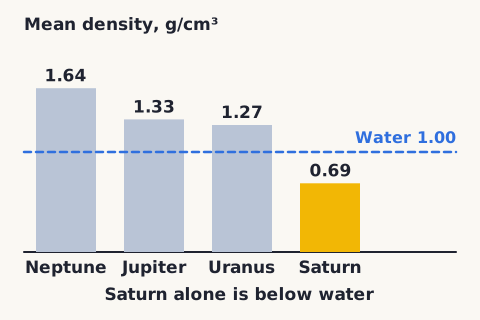
Saturn's mean density is 0.6871 grams per cubic centimeter — about 30 percent less than liquid water, and the only planet in the Solar System under it. The reason is two numbers that refuse to keep pace: Saturn is 9.4 times Earth's width but only 95 times Earth's mass. That gap is what hydrogen and helium, the two lightest elements, look like spread through an enormous volume. It is not a prediction that Saturn would float in a bathtub — that is a statement about an average, and the deep interior is compressed far past the density of water.
There is nothing to float on. Saturn has no true surface: the atmosphere thickens downward into liquid with no sharp boundary, then into a shell of liquid metallic hydrogen, which NASA's interior model credits with the magnetic field, around a core of heavy elements.
That absence makes a simple question hard. With no surface to time, the usual method is watching a tilted magnetic field wobble round — and Saturn's is almost perfectly aligned with its spin axis, so it fails. The day was pinned instead by ring seismology: Cassini data showed vibrations inside the planet driving waves in the C ring, and reading those back gives 10 hours 33 minutes 38 seconds, several minutes shorter than the Voyager-era radio estimate. JPL's table still carries the old figure.
Spin that fast, held together that weakly, and a planet bulges. Its polar radius falls nearly 10 percent short of its 60,268 km equatorial one, making Saturn the most oblate of the giant planets, visibly squashed in photographs. Two limits on that: the polar figure rests on a secondary source, and the published ranking covers the giants only.
The year is the opposite extreme — 29.4 Earth years, from an orbit 9.5 AU out — so Saturn spins some 24,000 times per year. A long year does not imply a long day. The 26.73-degree tilt gives seasons about seven years long, and because the rings lie in the equatorial plane it also sets how open they look: twice per orbit they turn edge-on and all but vanish. The rings are not changing shape. Our angle on them is.
At the north pole sits the hexagon, a six-sided jet stream 30,000 km across with winds near 200 miles per hour — not an object and not a rendering artifact, but a fast river of air whose wave pattern closes into six sides, and it has held for decades.
One correction before the rings. All four giant planets have rings. Saturn's are simply the brightest, reflecting roughly 60 percent of the light that hits them against about 5 percent for Uranus's and Neptune's.
The Rings
They are almost entirely water ice — billions of separate chunks, from grains smaller than sand to boulders the size of houses, each on its own orbit. Nothing is joined. That near-purity makes them bright, and the brightness turns out to be evidence about their age.
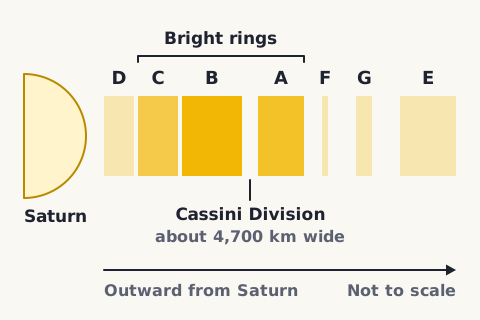
The seven main rings are lettered in order of discovery rather than position, which is why the sequence looks scrambled: outward from Saturn, D, C, B, A, F, G and E. A, B and C are the bright ones. The Cassini Division, about 4,700 km wide, is the largest gap, separating B from A. It is low density rather than vacuum, and it is named for the 17th-century astronomer who first glimpsed it in 1675 — the spacecraft was named after him too.
Then the dimension that does not sound real. The main rings reach about 140,000 km from Saturn's center — some 280,000 km edge to edge — while they are of the order of 10 meters thick. Published figures disagree — NASA about 10 m, OpenStax an average of 20 m, NASA's own rings page under 100 m in most places — so take the order of magnitude, not a value.
A sheet that thin is maintained, not inherited. Shepherd moons do the work: Pan, mean radius about 14 km, orbits inside the Encke Gap and holds it open, while Prometheus and Pandora flank the narrow F ring less tidily than the textbook picture suggests. Gaps are actively cleared, not places where nothing ever formed.
Where the rings came from is a mechanism we understand applied to an event we do not. Inside a planet's Roche limit, tidal forces tear a large body apart and stop loose particles gathering into one. NASA lists three candidate histories — debris that never coalesced, a moon that wandered too close, a moon shattered by impacts — and picks none.
Age is the live argument. Cassini's Grand Finale, 22 orbits threading the gap between cloud tops and innermost ring, separated the gravity of planet and rings for the first time. The rings came out at about 1.54 × 10^19 kg, roughly 0.41 times the mass of the small moon Mimas. Interplanetary dust darkens ice at a roughly known rate, so rings this bright and this light cannot have sat there for 4.5 billion years: the modeled age is 10 to 100 million years. That is contested. Crida and colleagues argued in 2019 that some unknown process may preferentially eject dust and organics, "cleaning" the rings so genuinely ancient ones look young. Treat the age as an inference, not a measurement.
They are also draining away. Charged ice grains ride Saturn's magnetic field into the upper atmosphere as ring rain — enough water, NASA says, to fill an Olympic swimming pool every half hour. That alone would clear the system in about 300 million years; the equatorial infall Cassini measured brings it under 100 million. One group's estimate, which NASA calls a worst case.
One ring runs the other way. The faint E ring — largest of Saturn's bright rings, about a million kilometers across, from Mimas's orbit to Titan's — is being manufactured right now, by a moon.
The Moons of Saturn
NASA records 274 confirmed moons as of March 2025, after the Minor Planet Center recognized 128 in one announcement that month; 11 more followed in March 2026. Date the figure whenever you use it — it tracks telescope sensitivity and confirmation backlog, not Saturn, and published counts disagree because their definitions differ. Almost all are irregular fragments a few kilometers across. Nine are worth knowing individually, and each has one feature that fits nothing else.
The spine is size — mean radii from the JPL table: Titan 2,575 km, then Rhea 764, Iapetus 734, Dione 561, Tethys 531, Enceladus 252, Mimas 198. Cube those and Titan holds roughly 14 times the volume of the other six together.
Titan is the only moon with a substantial atmosphere — about 95 percent nitrogen — and the only world besides Earth with standing surface liquid: lakes and seas of methane and ethane, one of which Cassini's radar sounded to 160 meters. It is wider than Mercury but carries about 40 percent of Mercury's mass, being largely ice. ESA's Huygens probe measured a surface pressure 1.47 times Earth's at about −180 °C and landed on 14 January 2005, still the most distant landing achieved.
Enceladus, roughly 500 km across, vents water vapor, ice grains, salts and organics from four fractures — the tiger stripes — across its south pole, fed by a global ocean under the crust. Each stripe is about 135 km long, and NASA describes them as relatively warm, with the jets rising near their hottest spots. Cassini found silica nanograins in the plume that form only where water meets rock above about 90 °C: evidence of hydrothermal vents on the ocean floor, which is a habitable setting, not life. Most of the plume falls back and repaints the surface, which is why Enceladus is the most reflective body in the Solar System and why it is the moon building the E ring.
Mimas, its neighbor and near-twin in size, is the counter-example: gray, ancient, battered. Its clue is Herschel, a crater 130 km wide on a moon 394 km across, with a central peak still standing 6 km high.
Tethys carries an outsized crater too — Odysseus, 400 km on a body of about 1,060 — so "huge crater" identifies neither moon. Odysseus has collapsed to a shallow basin with no standing peak. What only Tethys has is Ithaca Chasma, a canyon roughly 2,000 km long running most of the way round the globe.
Dione's clue is not its bright streaks: those are ice cliffs, torn walls of tectonic fractures rather than frost, and Rhea has the same. Its discriminator is gravitational — NASA states Dione holds Enceladus in a 1:2 orbital resonance, locked at exactly half its own period, and that repeated tug is the pump keeping the Enceladus ocean liquid.
Rhea is the second-largest, and that ordinal is the safe clue. Cassini captured an oxygen exosphere there in 2010, the first direct capture of oxygen molecules at a world other than Earth — but it found one at Dione the same year, so the gas does not identify Rhea; the first does.
Iapetus is two-toned: a leading hemisphere as dark as coal, reflecting 3 to 5 percent of the light, against 50 to 60 percent for the trailing side. Its second clue is an equatorial ridge about 10 km high and 1,300 km long, giving the moon a walnut profile. How it formed is unresolved — four live hypotheses, no winner.
Phoebe's clue is direction: retrograde, circling backwards nearly 13 million km out. Moons that condense around a forming planet inherit its spin, so one going the other way was almost certainly caught later. Do not clue Phoebe on darkness — at 6 percent reflectivity it is brighter than Iapetus's dark face. Phoebe supplies the Phoebe ring, found in infrared by Spitzer in 2009 and tilted 27 degrees to the main rings: the largest ring structure of any kind here. It circles opposite to Iapetus, which therefore ploughs into the dust head-on and collects it on the face that always leads.
Hyperion looks like nothing else — NASA describes a punched-in surface resembling a sponge or a wasp nest. Porosity above 40 percent is offered as a possible explanation, not a settled one: an impactor punches a deep hole and compacts the ice instead of throwing out an ejecta blanket. It also rotates chaotically, its orientation in space unpredictable. Its dimensions and density disagree three ways across sources, so keep the shape and let the figures go.
All nine were found from Earth, Titan first, by Christiaan Huygens in 1655. Almost everything beyond the bare numbers came from Cassini, which reached Saturn in 2004 and on 15 September 2017 was deliberately flown into the planet — not a failure, but the only way to guarantee it could never contaminate Enceladus or Titan.
Key terms
- Oblateness
- The equatorial bulge a spinning world takes on, given as the fraction of the equatorial radius by which it exceeds the polar one
- Roche limit
- The distance from a planet inside which tidal forces tear a large body apart and stop loose particles from gathering into one
- Tiger stripes
- The four roughly 135-km fractures crossing Enceladus's south pole — relatively warm cracks, with the plume's jets rising near their hottest spots
Key concepts
Titan
- The second-largest moon in the Solar System, about 2,575 km in radius — roughly 14 times the volume of Saturn's six other round moons put together.
- It is the only moon with a substantial atmosphere — about 95 percent nitrogen — and at ground level that air presses about half again as hard as Earth's.
- Lakes and seas of methane and ethane stand on its surface, and ESA's Huygens probe landed there on 14 January 2005, the most distant landing ever achieved.
Enceladus
- Only about 500 km across, and the most reflective body in the Solar System — most of what it throws into space falls back and repaints the surface with clean ice.
- Water vapor, ice grains, salts and organics erupt from four fractures across its south pole, fed by a global ocean beneath the crust.
- Silica nanograins in that plume imply hydrothermal vents on the ocean floor, and the fraction of ice that escapes builds Saturn's faint E ring.
Mimas
- Gray, ancient and battered, this small inner moon is about 394 km across — a near twin in size of its far brighter, far more active neighbor.
- One crater, Herschel, is 130 km wide — a third of the whole moon — with outer walls about 5 km high.
- That crater still carries a central peak standing 6 km high, which is why the moon is so often compared to the Death Star.
Tethys
- About 1,060 km across and almost pure water ice: at 0.98 times the density of water it is the only one of Saturn's seven large round moons that comes in under that mark.
- Its 400-km impact scar, Odysseus, has collapsed into a shallow basin with no standing central peak.
- Ithaca Chasma, a canyon roughly 2,000 km long and about 100 km wide, runs most of the way round the globe.
Dione
- A mid-sized icy moon, mean radius 561 km, with a density of 1.48 times water — proportionally more rock inside than most of Saturn's ice moons.
- It orbits between Tethys and Rhea, and the bright fracture network sits on its trailing side while the leading side takes the heavier cratering.
- It is the reason Enceladus still has plumes: NASA states it holds Enceladus locked at exactly half its own orbital period, and that repeated 1:2 tug keeps the smaller moon's ocean liquid.
Rhea
- A heavily cratered ice moon, second in size among Saturn's family though still under a third the width of the largest.
- Its density of 1.24 times water makes it mostly water ice, with noticeably less rock inside than its neighbor Dione.
- In 2010 Cassini captured molecules of an oxygen exosphere here — the first direct capture of oxygen at a world other than Earth.
Iapetus
- Mean radius 734 km, the third-largest of Saturn's moons, and the one Giovanni Cassini could see on one side of the planet in 1671 but not on the other.
- Its leading hemisphere is as dark as coal, reflecting 3 to 5 percent of the light, while the trailing hemisphere reflects 50 to 60 percent.
- A chain of mountains about 10 km high runs along its equator for some 1,300 km, giving it a walnut profile that four competing hypotheses still fail to settle.
Phoebe
- A small outer moon, mean radius about 106 km, circling Saturn nearly 13 million km out on a steeply tilted orbit.
- It travels the wrong way round — backwards relative to Saturn's spin — which is why it is thought to be a captured body rather than a moon that formed here.
- Dust shed from it forms a vast faint disc that Spitzer found in infrared in 2009, tilted 27 degrees to the main rings and orbiting backwards with it.
Hyperion
- A lopsided, irregular lump a few hundred kilometers across and markedly less dense than water — published dimensions disagree across sources.
- NASA describes its surface as curiously punched in, like a sponge or a wasp nest — possibly because more than 40 percent of it is empty space.
- It tumbles chaotically: its spin axis wobbles so much that its orientation in space cannot be predicted from one week to the next.
Key facts
Lighter Than Water
Saturn's mean density is 0.6871 g/cm³ — about 30 percent below liquid water, and the only planet in the Solar System under it. The planet carries 95 times Earth's mass spread through about 760 times Earth's volume, because hydrogen and helium, the two lightest elements, spread that mass through an enormous volume. It is not a bathtub prediction: Saturn's own deep interior is compressed far past the density of water.
No Ground To Land On
Saturn has no true surface. The atmosphere thickens downward into liquid with no sharp boundary, then into a shell of liquid metallic hydrogen — which NASA's interior model credits with generating the magnetic field — wrapped around a dense core of heavy elements. There is no hidden rocky floor waiting under the clouds for a probe to stand on.
Telling Time By Rings
With no surface to time, and a magnetic field almost perfectly aligned with its spin axis, Saturn defeated the usual method of watching a tilted field wobble round. Cassini data showed vibrations inside the planet driving waves in the C ring; reading those back gives a day of 10 hours 33 minutes 38 seconds, several minutes shorter than the Voyager-era radio estimate. JPL's table still carries the old figure.
Ten Meters Of Ice
The main rings span about 280,000 km edge to edge — some 140,000 km from Saturn's center to the F ring — while they are of the order of 10 meters thick: a sheet tens of millions of times wider than it is deep. Scaled to a sheet of paper 0.1 mm thick, it would stretch nearly 3 km edge to edge. Published figures disagree — NASA about 10 m, OpenStax an average of 20 m, NASA's own rings page under 100 m in most places — so hold the order of magnitude, not a value.
Lettered By Discovery
The seven main rings carry letters in the order they were found, not by position, which is why the sequence looks scrambled: outward from Saturn they run D, C, B, A, F, G and E. A, B and C are the bright ones. The Cassini Division, about 4,700 km wide, is the largest gap, separating B from A — not an empty vacuum, though what fills it is not settled here — and named for the 17th-century astronomer who first glimpsed it in 1675, not for the spacecraft.
Younger Than The Planet?
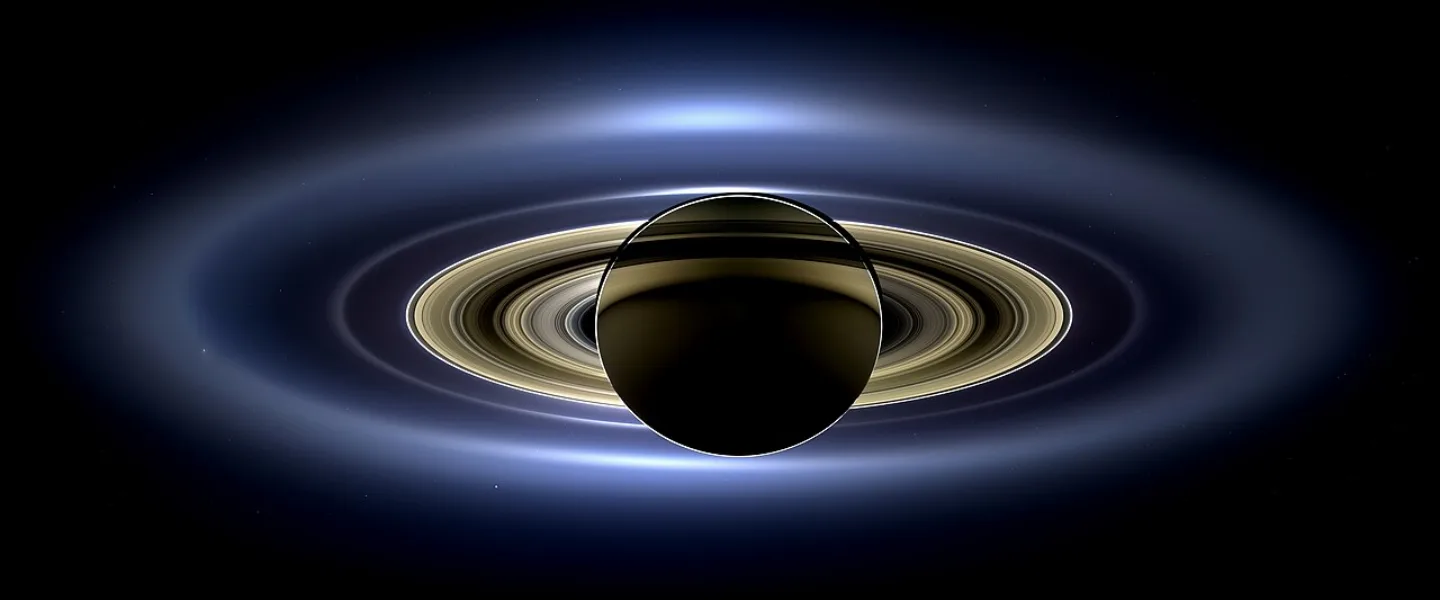
Cassini's Grand Finale weighed the rings at about 1.54 × 10¹⁹ kg, roughly 0.41 times the mass of the small moon Mimas. Interplanetary dust darkens ice at a roughly known rate, so rings this bright and this light cannot have sat there for 4.5 billion years: the modeled age is 10 to 100 million years. Crida and colleagues argued in 2019 that some unknown process may be cleaning the rings, making genuinely ancient ones look young. Treat the age as an inference, not a measurement.
A Count With A Date
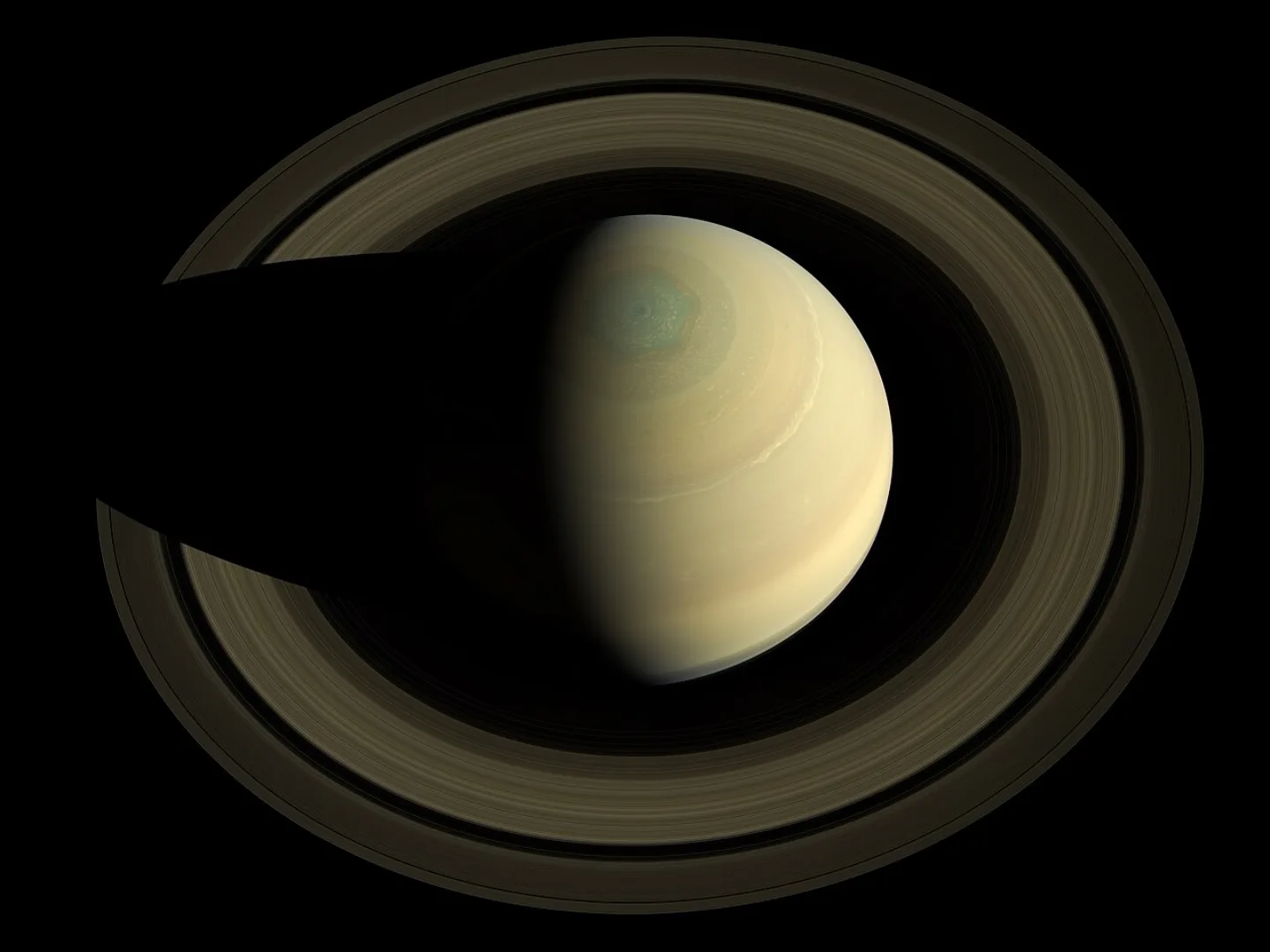
NASA records 274 confirmed moons as of March 2025, after the Minor Planet Center recognized 128 in one announcement that month; 11 more followed in March 2026. Date the figure whenever you use it — it tracks telescope sensitivity and confirmation backlog, not Saturn, and published counts disagree because their definitions differ. Almost all are irregular fragments a few kilometers across.
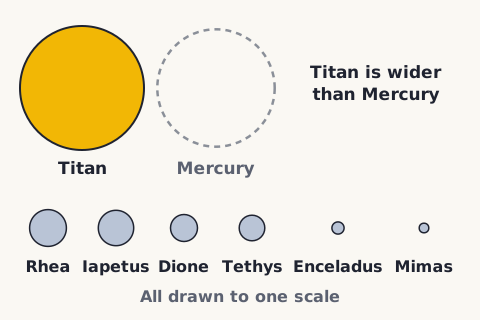
One Rung Above The Rest
Saturn itself is about 60,250 km in radius. Its large round moons line up by mean radius: Titan 2,575 km, then Rhea 764, Iapetus 734, Dione 561, Tethys 531, Enceladus 252 and Mimas 198. Cube those and Titan holds roughly 14 times the volume of the other six put together — and Titan is wider than the planet Mercury. It is not merely first in the list; it is in a different class.
Found From The Ground
Every one of Saturn's nine best-known moons was found from Earth, the first of them three and a half centuries before a spacecraft arrived. Christiaan Huygens found Titan in 1655; Giovanni Cassini found Iapetus, Rhea, Tethys and Dione between 1671 and 1684; William Herschel added Mimas and Enceladus in 1789; Hyperion came in 1848, and Phoebe — the first moon anywhere found by photography — in 1898-99.
The Deliberate Ending
Cassini launched on 15 October 1997, reached Saturn in 2004, and on 15 September 2017 was deliberately flown into the planet. That was not a failure. Rather than risk an uncontrolled crash once the fuel ran out, NASA destroyed the spacecraft in Saturn's atmosphere so it could never contaminate Enceladus or Titan. Almost everything here beyond the bare numbers came from those 13 years in orbit.
Matched pairs
Each item on the left goes with the one on the right.
- Saturn from the Sun
- 9.5 astronomical units — nearly twice as far out as Jupiter
- Saturn's axial tilt
- 26.73 degrees, giving seasons about seven Earth years long
- Cassini's Grand Finale
- 22 orbits threaded between the cloud tops and the innermost ring
- Ring rain
- Charged ice grains spiralling down into the upper atmosphere
Self-test
Answer each question from memory, then check your work against the answer key.
1. Saturn takes 29.4 Earth years to circle the Sun. How long does it take to spin once?
- AAbout 10.7 Earth days
- BAbout 24 hours
- CAbout 29 Earth days
- DAbout 10.7 hours
2. All four giant planets have rings. Why does only Saturn's system stand out?
- AIts rings reflect far more light
- BThe others orbit edge-on to us
- CIts rings alone are solid
- DThe other three formed far later
3. What accounts for the Encke Gap in the A ring?
- ASunlight pushing ice grains out
- BMaterial never gathered there
- CA small moon orbiting inside it
- DSaturn's magnetic field
4. What are Saturn's rings actually made of?
- AOne solid frozen sheet
- BCountless separate ice chunks
- CRock ground down by impacts
- DA continuous band of fine dust
5. What fills the standing seas at Titan's poles?
- AMethane and ethane
- BMolten sulfur brine
- CWater and ammonia
- DLiquid nitrogen
6. What did silica nanograins in Enceladus's plume point to?
- ASalt crystals left by the plume
- BIce grinding in the fractures
- CDust falling in from the E ring
- DVents on its ocean floor
7. About what fraction of Titan's thick atmosphere is nitrogen?
- AAbout 40 percent
- BAbout 10 percent
- CAbout 95 percent
- DAbout 60 percent
8. Which probe made the most distant landing ever achieved, touching down on Titan in January 2005?
- AVoyager 1
- BHuygens
- CGalileo
- DCassini
9. Why is Enceladus the most reflective body in the Solar System?
- APlume material falls back and repaints the surface
- BA thick ozone layer scatters incoming sunlight
- CIts interior ocean is visible through clear ice
- DIt has no craters to darken its surface
10. The material from Enceladus's plume that does not fall back to its surface mainly goes on to feed what?
- ATitan's atmosphere
- BSaturn's E ring
- CSaturn's Cassini Division
- DSaturn's magnetic field
Go deeper
- WatchLess Dense Than Water Saturn's average density is about 0.69 grams per cubic centimeter: about 30% less than water.
- Watch280,000 Kilometers Wide, 10 Meters Thick Saturn's rings are almost entirely water ice: billions of separate chunks, from tiny grains to boulders the size of houses.
- WatchLakes on Titan, Spray on Enceladus Saturn has 274 confirmed moons, as of March 2025. Two stand out.
- StudyAstronomy & Space in the FlashFeed app
Answer key
- 1. D About 10.7 hoursRing seismology gives 10 h 33 m and the older Voyager figure 10 h 39 m; NASA's own fact page rounds this to about 10.7 hours. The 24-hour option is Earth's, borrowed by habit; 10.7 Earth days and 29 Earth days both assume a long year forces a long day. The two are unrelated.
- 2. A Its rings reflect far more lightSaturn's rings return about 60 percent of the light that hits them; Uranus's and Neptune's return about 5 percent, which is why they went unseen until the 1970s and 80s. All four systems are particles rather than solid sheets, all four are ancient, and none is hidden by its viewing angle.
- 3. C A small moon orbiting inside itPan — mean radius about 14 km — orbits inside the Encke Gap and holds it open. Gaps like this are actively cleared, not places where material never gathered, and NASA credits the moon, not sunlight pressure or Saturn's magnetic field, with the work.
- 4. B Countless separate ice chunksNASA describes them as almost completely chunks of water ice, from sand grains to house-sized boulders, each on its own orbit. A solid frozen sheet and a continuous dust band both deny that independence; ground-down rock misses that the material is overwhelmingly ice.
- 5. A Methane and ethaneCassini's radar sounded Ligeia Mare to 160 meters and found it predominantly methane. Nitrogen makes up about 95 percent of Titan's air but stays gaseous; at about −180 °C water, ammonia or not, is rock-hard ice rather than a sea; and no sulfur is involved.
- 6. D Vents on its ocean floorSilica nanograins of that size form only where liquid water meets rock above about 90 C, which points to hydrothermal vents on the ocean floor. Grinding ice makes ice, not silica; the E ring is fed BY the plume rather than into it; and salt was a separate detection.
- 7. C About 95 percentTitan is the only moon with a substantial atmosphere, and it is about 95 percent nitrogen.
- 8. B HuygensESA's Huygens probe landed on Titan on 14 January 2005, still the most distant landing achieved.
- 9. A Plume material falls back and repaints the surfaceMost of Enceladus's vented plume falls back and repaints the surface, making it the Solar System's most reflective body.
- 10. B Saturn's E ringEnceladus is the moon building Saturn's faint E ring from its escaping plume material.
Sources
- NASA Science — Cassini at Enceladus — science.nasa.gov/mission/cassini/science/enceladus/
- JPL Solar System Dynamics — Planetary Physical Parameters — ssd.jpl.nasa.gov/planets/phys_par.html
- NASA Science — Saturn Facts — science.nasa.gov/saturn/facts/
- JPL — NASA's Cassini Spacecraft Obtains Best Views of Saturn Hexagon — www.jpl.nasa.gov/news/nasas-cassini-spacecraft-obtains-best-views-of-saturn-hexagon/
- NASA Science — Scientists Finally Know What Time It Is on Saturn — science.nasa.gov/solar-system/scientists-finally-know-what-time-it-is-on-saturn/
- Las Cumbres Observatory — Saturn — lco.global/spacebook/solar-system/saturn/
- OpenStax Astronomy (SUNY) — Planetary Rings — courses.lumenlearning.com/suny-astronomy/chapter/planetary-rings/
- NASA Science — Cassini: Saturn Rings — science.nasa.gov/mission/cassini/science/rings/
- NASA — Saturnian Rings Fact Sheet — nssdc.gsfc.nasa.gov/planetary/factsheet/satringfact.html
- NASA Science — Saturn's Rings — science.nasa.gov/resource/saturns-rings-2/
- JPL — NASA's Cassini Data Show Saturn's Rings Relatively New — www.jpl.nasa.gov/news/nasas-cassini-data-show-saturns-rings-relatively-new/
- NASA Science — Cassini FAQ — science.nasa.gov/mission/cassini/faq/
- NASA Science — Cassini's Grand Finale: Overview — science.nasa.gov/mission/cassini/grand-finale/overview/
- NASA Science — NASA Research Reveals Saturn is Losing Its Rings at 'Worst-Case-Scenario' Rate — science.nasa.gov/solar-system/nasa-research-reveals-saturn-is-losing-its-rings-at-worst-case-scenario-rate
- NASA Science — Pan — science.nasa.gov/saturn/moons/pan/
- JPL Solar System Dynamics — Planetary Satellite Physical Parameters — ssd.jpl.nasa.gov/sats/phys_par/
- NASA Science — Titan Facts — science.nasa.gov/saturn/moons/titan/facts/
- NASA Science — Cassini mission — science.nasa.gov/mission/cassini/
- NASA Science — Enceladus — science.nasa.gov/saturn/moons/enceladus/
- NASA Science — Mimas — science.nasa.gov/saturn/moons/mimas/
- NASA Science — Tethys — science.nasa.gov/saturn/moons/tethys/
- NASA Science — Dione — science.nasa.gov/saturn/moons/dione/
- NASA Science — Rhea — science.nasa.gov/saturn/moons/rhea/
- NASA Science — Iapetus — science.nasa.gov/saturn/moons/iapetus/
- NASA Science — Phoebe — science.nasa.gov/saturn/moons/phoebe/
- NASA Science — Hyperion — science.nasa.gov/saturn/moons/hyperion/
Image credits
- Lighter Than Water: FlashFeed original diagram · CC-BY-4.0
- Lettered By Discovery: FlashFeed original diagram · CC-BY-4.0
- Younger Than The Planet?: NASA / JPL-Caltech / Space Science Institute · Public domain — commons.wikimedia.org/wiki/File:PIA17172_Saturn_eclipse_mosaic_bright_crop.jpg
- A Count With A Date: Wikimedia Commons · NASA / JPL-Caltech / SSI / Cornell · Public domain — commons.wikimedia.org/wiki/File:Top_view_of_the_rings_of_Saturn_by_Cassini_-_October_10,_2013.jpg
- One Rung Above The Rest: FlashFeed original diagram · CC-BY-4.0

