
Astronomy & Space study guide · Lesson 8 of 13
Uranus and Neptune
Why Ice Giant Is a Real Category · The Tipped World · Neptune, Found With Mathematics
This is the lesson's study guide from the FlashFeed app, plus its key facts and a self-test.
What you'll be able to do
- Distinguish the ice giants from the gas giants, and say why Uranus is tipped over
Uranus and Neptune get less attention than the planets closer in, and there is a reason: one spacecraft has flown past each of them, once, decades ago. That is why several numbers below arrive as a range rather than a value.
Why Ice Giant Is a Real Category
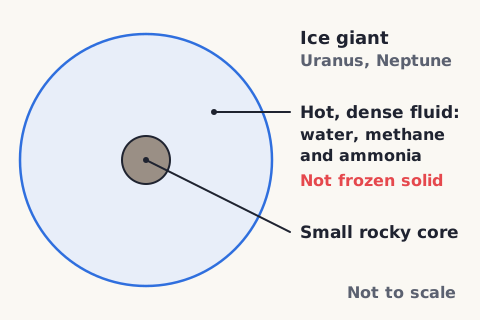
The four outer planets are not one kind of object. Jupiter and Saturn are gas giants, mostly hydrogen and helium, the same material as the Sun. Uranus and Neptune are ice giants: a hot, dense fluid of water, methane and ammonia over a small rocky core. Nothing in there is frozen solid. Those compounds are called ices because out here they are normally frozen, not because they are solid inside the planet.
The classes do not overlap in size, and the ice giants sit between the rocky planets and the gas giants. Uranus is 51,118 km wide at the equator — four times Earth's width, about a third of Jupiter's diameter. Neptune is 49,528 km, very slightly the smaller.
Then the mass ordering flips. Uranus is 14.5 Earth masses, Neptune 17.1 Earth masses: more matter in the smaller ball. Four times Earth's width is not four times its mass either, since width cubes into volume.
What flips the ordering is bulk density, the cheapest test of what a planet is made of. Neptune is the densest of the four giants at 1.638 g/cm3, ahead of Jupiter at 1.326, Uranus at 1.270 and Saturn at 0.687, so Neptune holds proportionally more rock and heavy material. Note what the ladder does not say: Uranus is not denser than Jupiter despite being icier, because Jupiter's own weight squeezes its hydrogen to a comparable density. Only Neptune beats it.
Uranus orbits at about 19 astronomical units, Neptune at about 30 astronomical units — the distance that also marks the inner edge of the Kuiper Belt. Neptune's orbit is a boundary marker, not an outer wall.
Uranus's year is 84 Earth years, so a Uranian season runs about 21 of ours. Neptune's is 164.79 Earth years: discovered in 1846, it completed its first circuit since discovery only on 12 July 2011. Days run the other way — about 17 hours on Uranus and 16 hours on Neptune, both faster than Earth's despite the size. It is the small inner worlds that crawl.
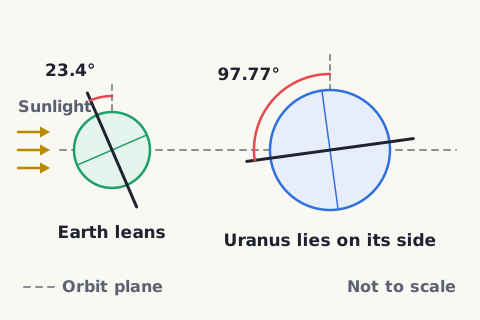
One number breaks the symmetry. Neptune's axis is tilted 28 degrees, near enough to Earth's 23.4. Uranus's is tilted 97.77 degrees.
The Tipped World
Past 90 degrees, an axial tilt changes the geometry in kind rather than in degree. Uranus does not stand upright and lean, as Earth and Neptune do. Its equator sits nearly at a right angle to its orbital plane, so it rolls along its orbit like a barrel, poles pointing roughly at and away from the Sun. The poles, not the equator, become the hottest places.
Each pole then gets a long unbroken day and a long unbroken night. How long is not settled even within NASA: JPL's Night Sky Network gives 42 years of each, half the orbit, while NASA's Uranus facts page describes a 21-year dark winter, a quarter of it. Neither shows its working, so take the qualitative fact and leave the figure open. Nor is decades of daylight warmth — Uranus has the coldest atmosphere of any planet.
The tilt also disposes of an oddity usually listed separately. Uranus rotates retrograde, opposite to most planets, Venus being the only other. That needs no second explanation: any obliquity past 90 degrees is retrograde by definition, and a spinning top tipped past upright is turning backwards. Some references quote 82.23 degrees and call the rotation prograde — the same planet under a different sign convention.
What tipped it is the giant-impact hypothesis, and hypothesis is the right word. Smoothed-particle-hydrodynamics simulations find that an impactor of at least about 2 Earth masses could give the post-impact planet its rapid rotation, while the alternative, a slow spin-orbit resonance, struggles to reach 98 degrees even under conditions chosen to favor it. NASA's own wording is that the tilt "may be" the result of a collision. The case rests on simulations reproducing the tilt, not on any trace of an impactor.
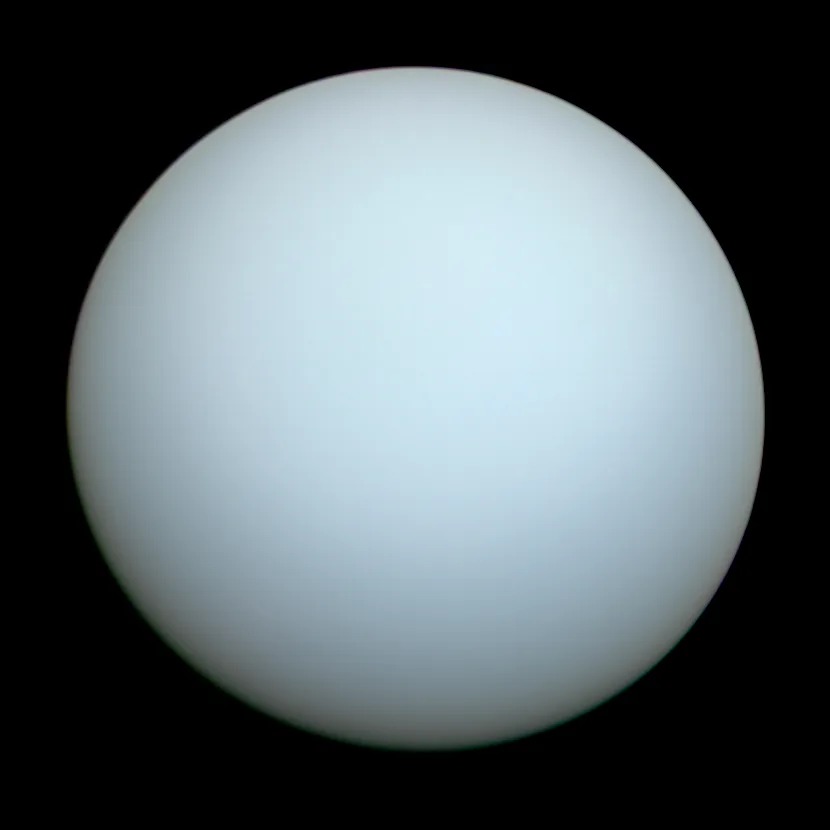
Color is a separate mechanism. Both planets look blue-green because methane absorbs red light and lets blue and green scatter back out — gas absorption, not water. Yet Uranus is the paler, milkier cyan, and the two hold almost the same methane. The current explanation, recent and still being tested, is haze: the layer thickens in Uranus's sluggish air, while Neptune's more turbulent atmosphere churns methane into it, where it condenses onto the particles and drags them down as methane snow.
That difference in vigor shows in the energy books. Neptune radiates more internal heat relative to the sunlight it absorbs than any other giant planet, so its weather runs on its own furnace rather than on a Sun 30 AU away; one recent measurement puts Uranus's emitted-to-absorbed ratio at 1.15 ± 0.06. Why the twin lacks that outflow is unresolved.
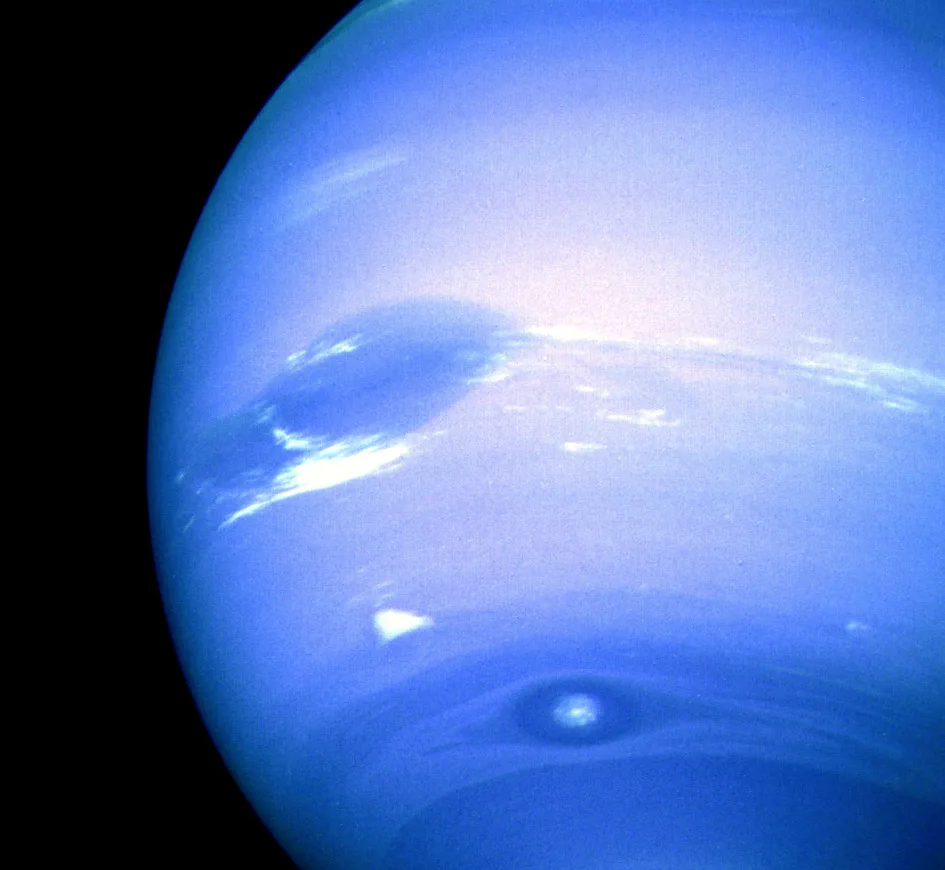
Neptune accordingly has the fastest winds in the Solar System, more than 2,000 kilometers per hour on NASA's facts page, faster than sound on Earth — other NASA pages give lower peaks, so treat the figure as approximate. Voyager 2 photographed an Earth-sized storm there in 1989, the Great Dark Spot; Hubble found it gone by 1994. Neptune's dark storms last a few years, unlike Jupiter's centuries-old Great Red Spot.
Uranus has 28 known moons by NASA's count and 29 by Wikipedia's, so read any count as a snapshot. It is the only planet whose moons take literary rather than mythological names, from Shakespeare and Alexander Pope: outward, Miranda, Ariel, Umbriel, Titania and Oberon. They orbit the tilted equator rather than the orbital plane, so the family circles like a dartboard — tipped along with the planet.
Miranda, about 500 km across, carries three coronae: lightly cratered collections of ridges and valleys of a kind seen on no other moon, alongside fault canyons up to twelve times as deep as the Grand Canyon. NASA offers two models for that and settles on neither.
Neptune, Found With Mathematics
Uranus was found by accident. William Herschel spotted it on 13 March 1781 and first took it for a comet — the first planet ever added to a Solar System that had consisted of the six worlds visible to the naked eye.
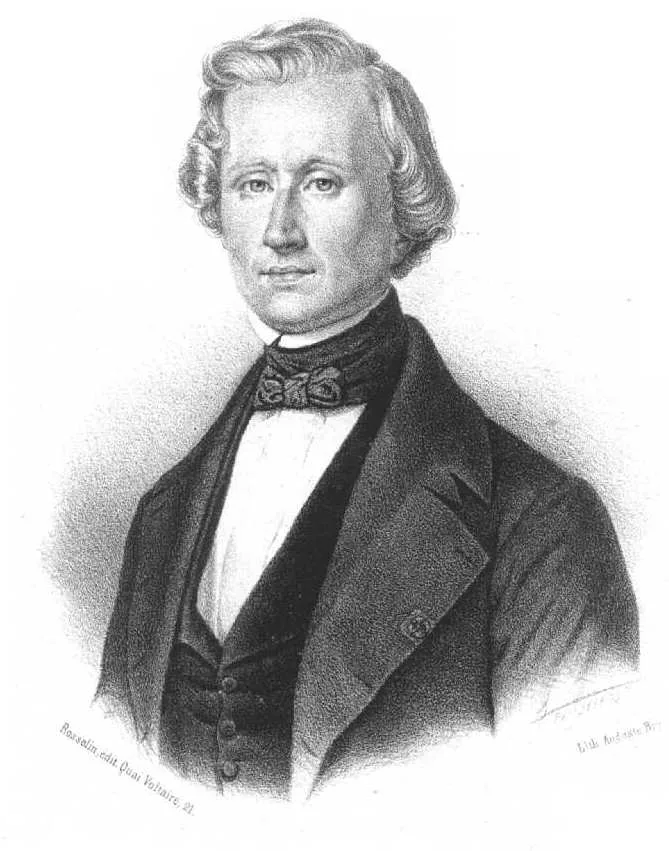
Neptune was found the other way round. Uranus's orbit did not behave as it should, and Urbain Le Verrier in France, independently John Couch Adams in England, calculated where an unseen planet must be to explain the discrepancy. Johann Galle in Berlin turned a telescope on Le Verrier's figure on 23 September 1846 and found the planet on his first night of looking, within about a degree of the prediction. That is the moment gravity stopped being a description and became a prediction. Credit is less evenly split than usually told: Adams acknowledged that Le Verrier published first and that Galle used Le Verrier's numbers.
Neptune's rings memorialize those people — at least five main ones, named Galle, Le Verrier, Lassell, Arago and Adams — and the outermost carries bright clumped arcs named Liberté, Égalité, Fraternité and Courage. They are not continuous bands.
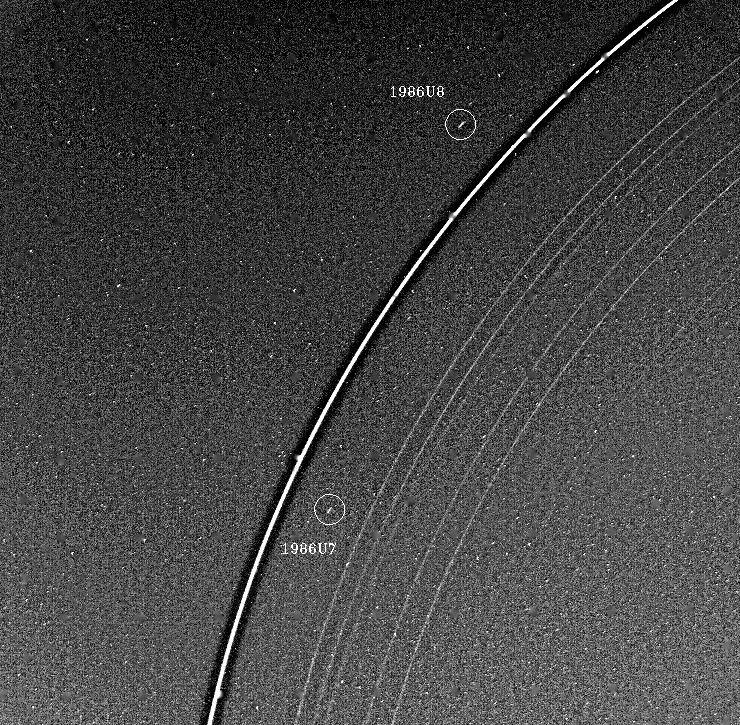
Uranus's rings were found on 10 March 1977 by occultation rather than by looking: as Uranus passed in front of the star SAO 158687, the starlight blinked out several times before and after the planet itself covered it. They are extremely dark and very narrow, and the count is unsettled — NASA describes nine inner rings plus two outer ones, while Wikipedia lists thirteen. The telescope was airborne, and nine years early for Voyager 2.
Neptune's 16 known moons are named for lesser sea gods and nymphs of Greek mythology, matching the planet's Roman sea god; NASA's own Triton page still says 13. Triton, about 2,700 km across, dominates them. William Lassell found it on 10 October 1846, 17 days after the planet, and it holds more than 99.5 percent of all the mass known to orbit Neptune.
Triton orbits backwards, the only large moon circling its planet against the planet's own spin. That is the observation, and it is firm. The interpretation is separate: a moon condensed from a disc around a forming planet would inherit its spin direction, so Triton is thought to have been captured, most likely from the Kuiper Belt. NASA and Wikipedia both phrase this as what scientists think; no capture was observed, and the mechanism is still argued over.
Backwards has a consequence. Tides drain energy from the orbit rather than adding to it, so Triton is spiralling inward and should eventually be torn into a ring. When is not settled: estimates run from about 3.6 billion years to about 28 billion.
Triton is also geologically active. Voyager 2 saw geysers venting nitrogen gas and dark dust from below the surface at about minus 235 degrees Celsius. Cold is not dead; at that temperature nitrogen ice does what rock does on warmer worlds.
All of it comes from one spacecraft. Voyager 2 passed Uranus on 24 January 1986 at about 81,500 km from the cloud tops, and Neptune on 25 August 1989 at about 4,800 km. Neither planet has ever had an orbiter. Where this lesson says something is unresolved — Uranus's missing internal heat above all — it is because the data does not exist yet, not because the physics is mysterious.
Key terms
- Ice giant
- A giant planet whose bulk is a hot fluid of water, methane and ammonia over a rocky core, not the hydrogen and helium of a gas giant
- Coronae
- Lightly cratered patchworks of ridges and valleys on Uranus's moon Miranda, a landform of a kind seen on no other moon
- Occultation
- One body passing in front of a star, where the pattern of the starlight's dimming maps structures far too faint to photograph
Key facts
Ices That Are Not Frozen
Jupiter and Saturn are gas giants, mostly hydrogen and helium — the same material as the Sun. Uranus and Neptune are ice giants: a hot, dense fluid of water, methane and ammonia over a small rocky core. Those compounds are called ices because out here they are normally frozen, not because they are solid inside the planet.
Four Earths Wide
Uranus measures 51,118 km across at the equator — four times Earth's width, but only about a third of Jupiter's diameter. Neptune measures 49,528 km, very slightly the smaller of the two. The ice giants are near-twins, within about 3 percent of each other in width, and the two giant classes do not overlap in size at all.
The Smaller, Heavier Twin
Then the ordering flips. Uranus holds 14.5 Earth masses, Neptune 17.1 — more matter in the smaller ball. What flips it is bulk density: Neptune is the densest of the four giants at 1.638 g/cm3, ahead of Jupiter at 1.326, Uranus at 1.270 and Saturn at 0.687. Note what the ladder does not say — Uranus is not denser than Jupiter despite being icier, because Jupiter's own weight squeezes its hydrogen to a comparable density.
One Orbit Since Discovery
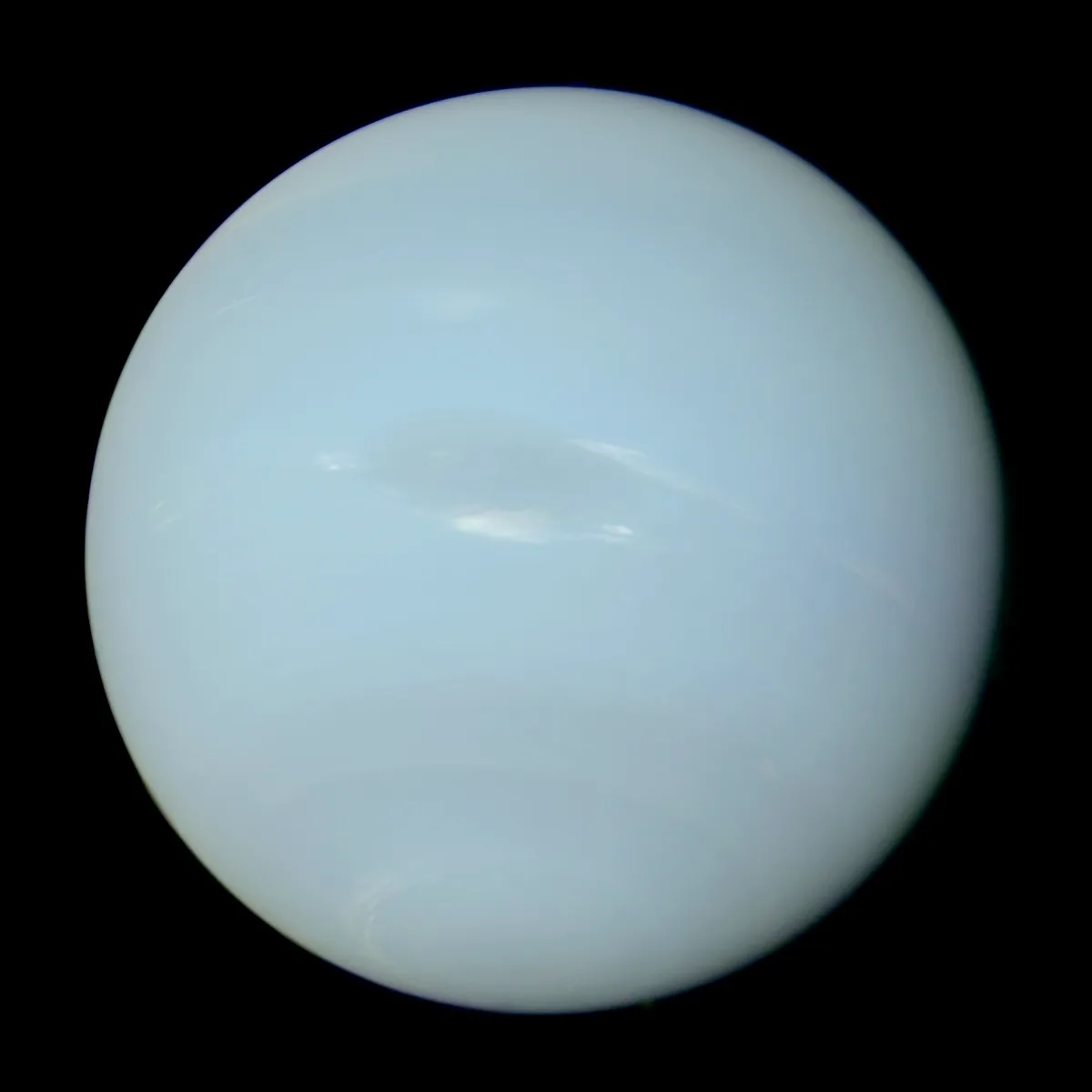
Uranus orbits at about 19 astronomical units, Neptune at about 30 — the distance that also marks the inner edge of the Kuiper Belt. Uranus's year runs 84 Earth years, so a single season lasts about 21 of ours. Neptune's runs 164.79: discovered in 1846, it completed its first circuit since discovery only on 12 July 2011.
A Planet On Its Side
Uranus's axis is tilted 97.77 degrees, against 23.4 for Earth and 28 for Neptune. Past 90 degrees the geometry changes in kind, not in degree: Uranus does not stand upright and lean, it rolls along its orbit like a barrel, poles pointing roughly at and away from the Sun. Each pole receives more sunlight across an orbit than the equator does, though measured temperatures do not follow that simply — and any tilt past 90 degrees is retrograde by definition, so the backwards spin needs no second explanation.
Hypothesis, Not History
NASA's own wording is that the tilt "may be" the result of a collision. Smoothed-particle-hydrodynamics simulations find that an impactor of at least about 2 Earth masses could give the post-impact planet its rapid rotation, while the alternative — a slow spin-orbit resonance — struggles to reach 98 degrees even under conditions chosen to favor it. The case rests on simulations reproducing the tilt, not on any trace of an impactor.
Why One Blue Is Paler
Both planets look blue-green because methane absorbs red light and lets blue and green scatter back out — gas absorption, not water, and there is no ocean to see. Yet Uranus is the paler, milkier cyan, and the two hold almost the same methane. The current explanation is haze: the layer thickens in Uranus's sluggish air, while Neptune's more turbulent atmosphere churns methane into it, where it condenses onto the particles and drags them down as methane snow.
A Storm That Left
Voyager 2 photographed an Earth-sized storm in Neptune's southern hemisphere in 1989 — the Great Dark Spot, about 13,000 by 6,600 km. When Hubble looked in 1994 it had vanished. Neptune's dark storms last only a few years each, and the later ones have been separate, short-lived storms; Jupiter's Great Red Spot has persisted for well over a century.
Found On Paper First
Uranus was found by accident: William Herschel spotted it on 13 March 1781 and first took it for a comet. Neptune was found the other way round. Uranus's orbit misbehaved, so Urbain Le Verrier in France and, independently, John Couch Adams in England calculated where an unseen planet must be. Johann Galle in Berlin turned a telescope on Le Verrier's figure on 23 September 1846 and found it that first night, within about a degree of the prediction.
Rings Found By Blinking Starlight
On 10 March 1977 astronomers watched Uranus pass in front of the star SAO 158687. The starlight blinked out several times before and after the planet itself covered it — Uranus has rings. They are extremely dark and very narrow, and the count is unsettled: NASA describes nine inner rings plus two outer ones, while Wikipedia lists thirteen. The telescope was airborne, and nine years early for Voyager 2.
Matched pairs
Each item on the left goes with the one on the right.
- A day on Uranus
- About 17 hours — and about 16 for Neptune
- Moons with literary names
- Uranus's — Miranda, Ariel, Umbriel, Titania and Oberon
- Neptune's five main rings
- Galle, Le Verrier, Lassell, Arago and Adams
- Neptune's moons are named for
- Lesser sea gods and nymphs of Greek myth
Self-test
Answer each question from memory, then check your work against the answer key.
1. Neptune is narrower than Uranus yet denser. What does that say about it?
- AIt holds more heavy elements
- BIt spins fast enough to compress
- CIt is much hotter inside
- DIt has a thicker hydrogen skin
2. Neptune is slightly narrower than Uranus yet holds more matter. Which measurement accounts for that?
- ARotation period
- BBulk density
- CEscape velocity
- DSurface gravity
3. Across a full Uranian orbit, which part receives the most sunlight?
- AThe tropics
- BThe equator
- CThe mid-latitudes
- DThe poles
4. Which planet has the fastest winds in the Solar System?
- AUranus
- BSaturn
- CNeptune
- DJupiter
5. How was Neptune first located?
- ABy calculating where it must be
- BBy an accidental sighting
- CBy a systematic sky survey
- DBy watching it move nightly
6. Which spacecraft has flown past both ice giants?
- ACassini
- BVoyager 2
- CJuno
- DGalileo
Go deeper
- WatchIce Giants Aren't Frozen Uranus and Neptune aren't gas giants. They're ice giants.
- WatchThe Planet That Rolls Uranus is tilted almost 98°. It rolls along its orbit like a barrel.
- WatchFound With Mathematics Uranus was found by accident, in 1781. Neptune was found with mathematics.
- StudyAstronomy & Space in the FlashFeed app
Answer key
- 1. A It holds more heavy elementsNeptune is 1.638 g/cm3 against Uranus's 1.270 — the densest of the four giants. More mass in less volume means a larger share of heavy elements, which is what separates an ice giant from a gas giant. Spin flattens a planet rather than compacting it.
- 2. B Bulk densityMass per unit volume is what differs: 1.638 g/cm3 against Uranus's 1.270, so 17.1 Earth masses fit inside 49,528 km. Equatorial diameter is the measurement that makes Neptune the smaller one, not the heavier; sidereal orbital period and axial tilt describe motion, not packing.
- 3. D The polesTipped 97.77 degrees, Uranus rolls along its orbit with each pole pointing roughly at and away from the Sun. The equator, the tropics and the mid-latitudes all take the Sun low and glancing — the reverse of Earth, whose 23.4-degree tilt keeps the equator most directly lit.
- 4. C NeptuneNASA puts Neptune's peak winds near 2,000 km/h. Saturn's reach about 1,800, Uranus's about 900 and Jupiter's about 600 — the largest planet is nowhere near the windiest. Neptune gets the least sunlight yet radiates over twice the energy it absorbs, and that heat drives the winds.
- 5. A By calculating where it must beLe Verrier's figures told Galle where to point, and the planet stood within about a degree of the prediction on his first night. Watching something move confirms a planet but will not find one at 30 AU; no survey was involved; and nothing about it was accidental.
- 6. B Voyager 2It passed Uranus on 24 January 1986 at about 81,500 km from the cloud tops and Neptune on 25 August 1989 at about 4,800 km — the only close visits either planet has had. Cassini orbited Saturn; Galileo and Juno went to Jupiter. Neither ice giant has ever had an orbiter.
Sources
- NASA Science — Planets — science.nasa.gov/solar-system/planets/
- JPL Solar System Dynamics — Planetary Physical Parameters — ssd.jpl.nasa.gov/planets/phys_par.html
- NASA Science — Uranus Facts — science.nasa.gov/uranus/facts/
- Kegerreis et al. (2018), ApJ 861, 52 — giant impacts on early Uranus — iopscience.iop.org/article/10.3847/1538-4357/aac725
- NASA Science / Hubble — Hubble Tracks the Lifecycle of Giant Storms on Neptune — science.nasa.gov/missions/hubble/hubble-tracks-the-lifecycle-of-giant-storms-on-neptune/
- NASA Science — Miranda — science.nasa.gov/uranus/moons/miranda/
- NASA Science — Neptune Facts — science.nasa.gov/neptune/facts/
- NASA Science — Uranus: Exploration timeline — science.nasa.gov/uranus/exploration/
- NASA Science — Triton — science.nasa.gov/neptune/neptune-moons/triton/
- NASA Science — Neptune Moons — science.nasa.gov/neptune/neptune-moons/
- NASA Science — Voyager 2 — science.nasa.gov/mission/voyager/voyager-2/
Image credits
- Ices That Are Not Frozen: FlashFeed original diagram · CC-BY-4.0
- One Orbit Since Discovery: Wikimedia Commons · NASA / Voyager 2 / PDS / OPUS / Ardenau4 · CC0 — commons.wikimedia.org/wiki/File:Neptune_Voyager2_color_calibrated.png
- A Planet On Its Side: FlashFeed original diagram · CC-BY-4.0
- Why One Blue Is Paler: Wikimedia Commons · Ardenau4 · CC0 — commons.wikimedia.org/wiki/File:Uranus_Voyager2_color_calibrated.png
- A Storm That Left: Wikimedia Commons · NASA/Voyager 2 Team · Public domain — commons.wikimedia.org/wiki/File:Neptune_storms.jpg
- Found On Paper First: User Magnus Manske on en.wikipedia · Public domain — commons.wikimedia.org/wiki/File:Urbain_Le_Verrier.jpg
- Rings Found By Blinking Starlight: NASA · Public domain — commons.wikimedia.org/wiki/File:Uranus_rings_and_two_moons.jpg


