
Astronomy & Space study guide · Lesson 9 of 13
Asteroids, Meteors and Dwarf Planets
The Asteroid Belt · Meteoroid, Meteor, Meteorite · Dwarf Planets and the 2006 Vote
This is the lesson's study guide from the FlashFeed app, plus its key facts and a self-test.
What you'll be able to do
- Place the asteroid belt, meteors and dwarf planets, and apply the IAU planet definition
Three things people are confidently wrong about are gathered here: that the asteroid belt is a crowded rock field, that a meteor is something you could pick up, and that Pluto was demoted for being small. Each has the same repair — find out what decides membership of the category.
The Asteroid Belt
Start with the absence. No planet formed between Mars and Jupiter, and the reason is Jupiter. Its gravity kept the local planetesimals agitated so they could never coalesce into a planetary core; instead of merging they collided and fragmented, and those fragments are the asteroids. The belt is an unfinished planet, not a broken one.
The distinction matters because the alternative story — an exploded world — fails on arithmetic. Everything in the asteroid belt put together weighs less than Earth's Moon, and a single object, Ceres, accounts for about 25 percent of that total. There was never enough material there to build a planet. Nor is the belt a band: the greatest concentration lies between about 2.12 and 3.3 astronomical units from the Sun, a depth greater than the width of Earth's own orbit.
Spread through that volume, an estimated 1.1 to 1.9 million asteroids larger than 1 km amount to almost nothing. Spacecraft cross with virtually no chance of a collision — Pioneer 10 entered the belt in July 1972 and emerged in February 1973. The film version has it backwards: reaching even one asteroid takes deliberate aim.
The rocks are not all the same rock. C-type asteroids are carbonaceous — dark clay and silicate, and the most common. S-type asteroids are stony, silicates with nickel-iron. M-type asteroids are metallic nickel-iron. The letters come from how sunlight reflects off a surface, not from a sample, and the usual proportions — over 75 percent C-type, about 17 percent S-type — are estimates from reflectance surveys. S-types are commoner inside about 2.5 AU and C-types dominate the outer belt, a gradient recording how hot it was where each body formed.
Not every asteroid is in the belt. Jupiter's Trojan asteroids do not orbit Jupiter. They share its orbit around the Sun, in two swarms that lead and trail the planet by 60 degrees at the L4 and L5 Lagrange points — each swarm at the third corner of an equilateral triangle with Jupiter and the Sun. They are gravitational parking spaces, and together the swarms may rival the main belt in number. NASA's Lucy mission, launched in October 2021, is the first to visit them.
Ceres, Vesta and Pallas hold roughly half the belt's mass between them, and Pallas orbits on a plane tilted 34.9 degrees to the one the planets share — the belt is a thick torus, not a disc. Vesta, about 523 km, is the largest asteroid — a title it holds only because Ceres was reclassified as a dwarf planet in 2006 — and the odd one: it is differentiated, having melted early and separated into crust, mantle and core like a small planet. Remember that: some meteorites appear to have come from it.
Meteoroid, Meteor, Meteorite
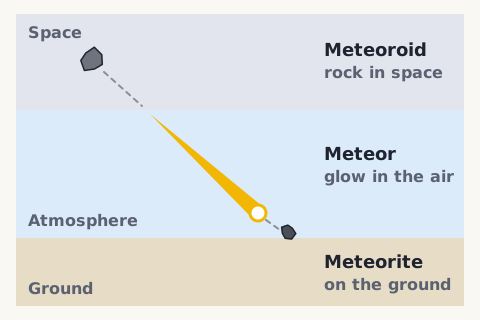
Three words for three locations. A meteoroid is the rock while it is still in space, anything from a dust grain to a small asteroid. A meteor is the streak of light made when that rock enters the atmosphere at speed and burns up. A meteorite is what is left if a fragment survives the fall and reaches the ground.
The middle word is the one that trips people. A meteor is not an object at all — it is light, the glow of heated air and vaporized rock. Nothing lands in a garden except a meteorite.
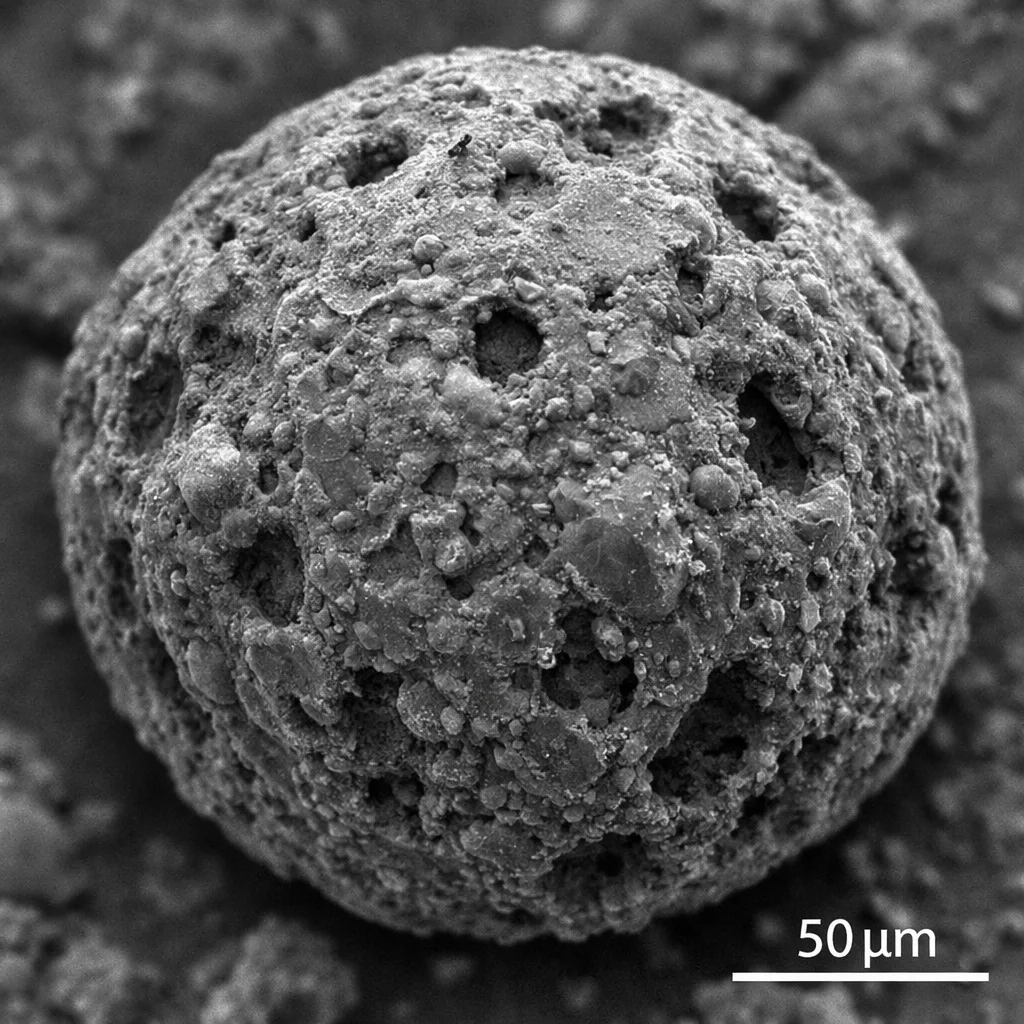
Arrival is continuous and almost invisible. NASA estimates that about 44 tonnes of meteoritic material falls on Earth every day, nearly all of it dust too small to notice. Treat that as an estimate: Royal Museums Greenwich gives about 14 tonnes a day for space dust, and published figures span roughly 5 to 50 tonnes depending on what particle sizes get counted.
An annual meteor shower is Earth crossing a stream of dusty debris shed by a comet along its orbit, which is why the same showers return on the same dates. The Perseids peak on 12–13 August, and every Perseid is a fragment of comet 109P/Swift-Tuttle, whose nucleus is about 26 km across. NASA's own pages disagree on its period — the Perseids page says 133 years, the meteors overview says 135. A shower is named for its radiant, the constellation the meteors appear to stream from — a perspective effect, not an origin.
Debris is thickest near the comet rather than spread evenly along the trail, which is why showers differ. The Leonids, from comet 55P/Tempel-Tuttle, are modest most years, but roughly every 33 years — the comet's own period — Earth meets freshly laid dust and they can storm: thousands a minute for about 15 minutes over the Americas in 1966.
The Geminids break the rule that showers come from comets. Their parent is 3200 Phaethon, a near-Earth asteroid about 5 to 6 km across on an orbit that carries it within 0.14 AU of the Sun, closer than Mercury. It grows no tail and its spectrum looks rocky, hence the nickname rock comet: it appears to shed material by being roasted and cracked rather than by ices boiling off.
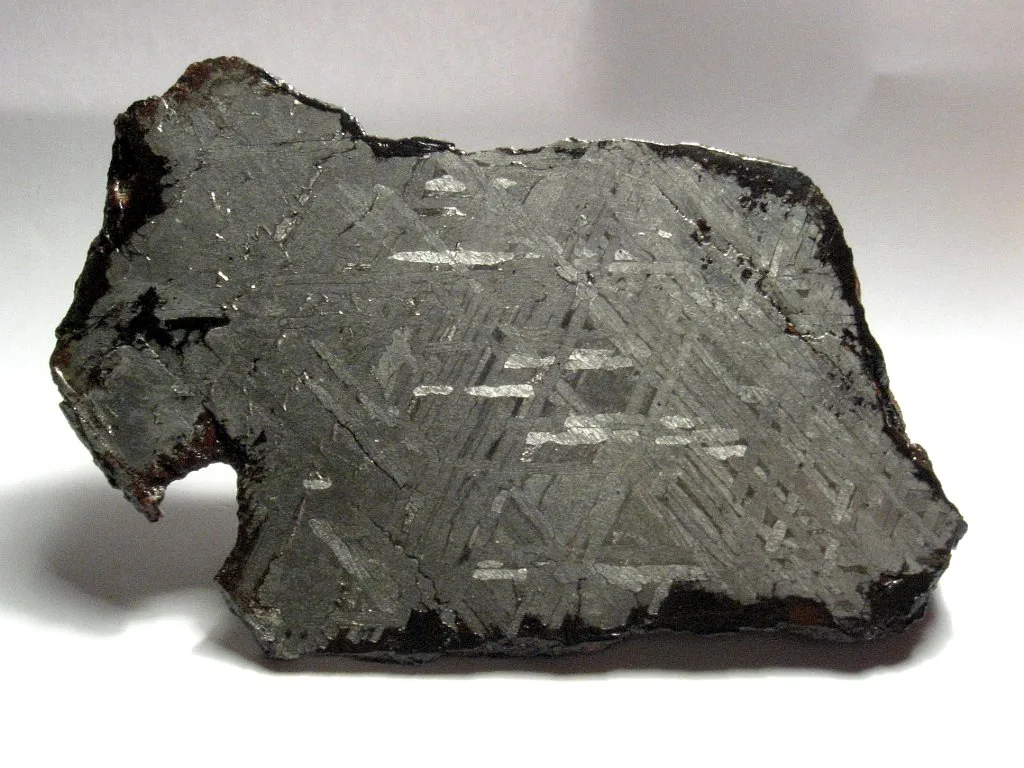
What lands comes in three kinds. Stony meteorites are mainly silicate rock, iron meteorites mainly iron-nickel metal, stony-iron roughly equal parts of both. More than 95 percent of meteorites seen to fall are stony; irons are over-represented in collections because they weather slowly and look nothing like Earth rock, so they keep being picked up as finds long after landing.
Be careful what that implies. Irons are thought to be fragments of the cores of small bodies that melted and let their metal sink, stony-irons to sample the core-mantle region. The reading does not extend to the stony class: most stony meteorites are chondrites, which never melted or differentiated at all. The howardite, eucrite and diogenite meteorites are the exception, and they appear to come from Vesta specifically.
Dwarf Planets and the 2006 Vote
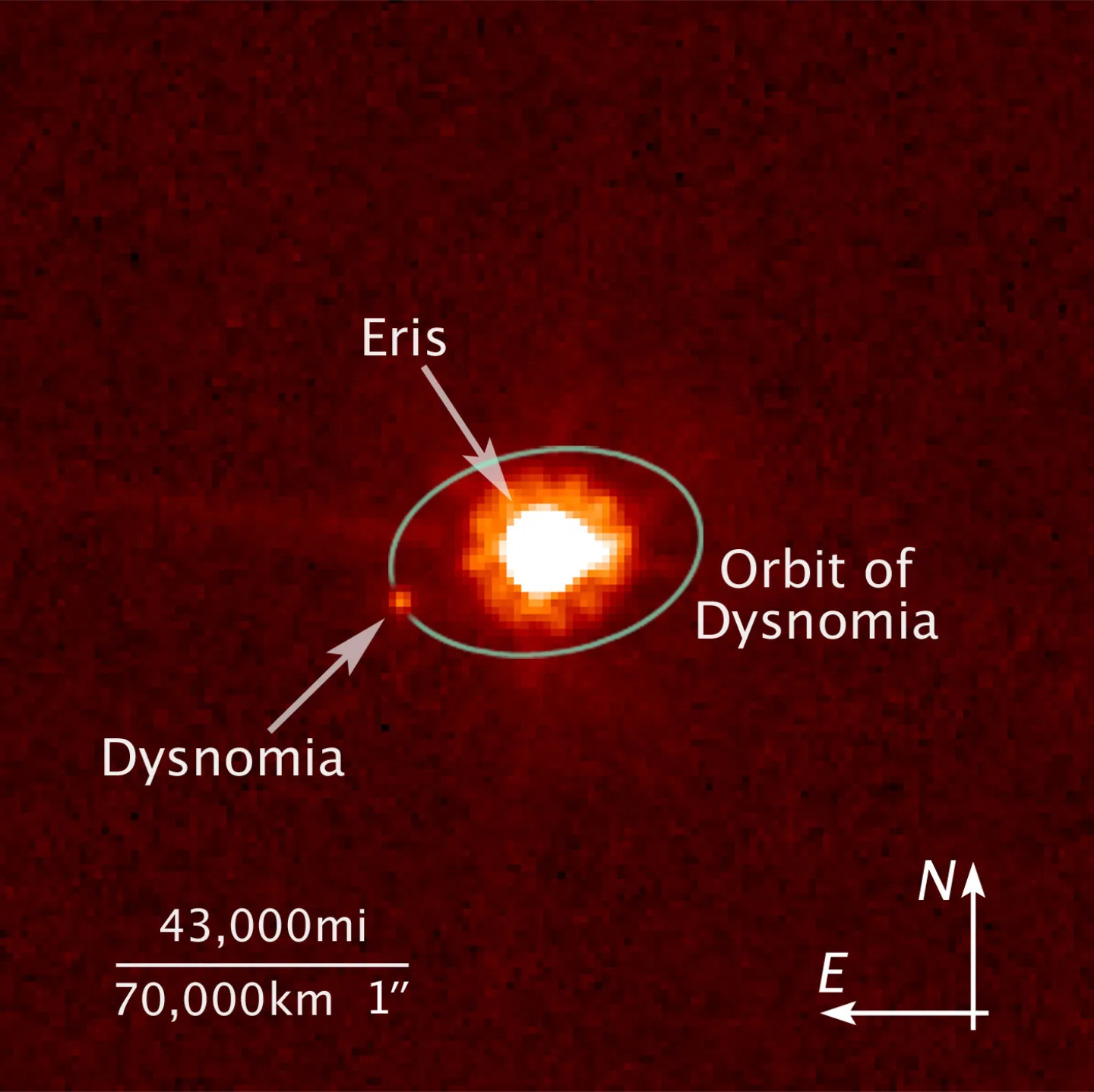
In January 2005 Mike Brown, Chad Trujillo and David Rabinowitz identified an object on images taken two years earlier. Eris is roughly 2,400 km across against Pluto's 2,377 km and, from timing the 16-day orbit of its moon Dysnomia, about 27 percent more massive. That forced the question: admit a tenth planet, and an eleventh and twelfth as the surveys continued, or write a definition.
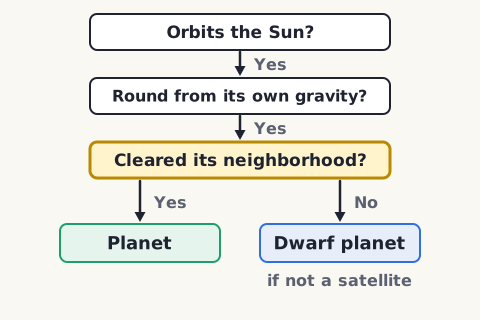
The definition the International Astronomical Union adopted in 2006 sets three tests. A planet orbits the Sun. It has enough mass for its own gravity to pull it into a nearly round shape — hydrostatic equilibrium. And it has cleared the neighborhood around its orbit. A body that passes the first two, fails the third and is not a satellite is a dwarf planet. Everything else orbiting the Sun that is not a satellite is a Small Solar-System Body.
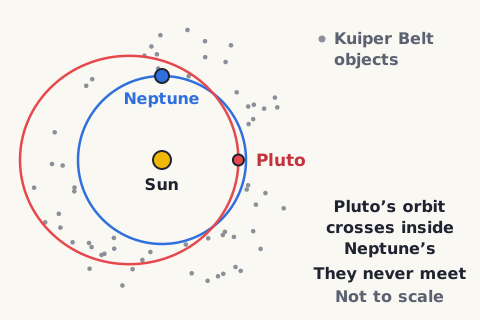
The third test does the work, and it is not about size. It asks whether a body gravitationally dominates its orbital zone. Pluto, orbiting at an average of about 39 times Earth's distance from the Sun, sits inside the Kuiper Belt among objects that cross its path, so it fails — and the IAU recognizes it as the prototype of the trans-Neptunian objects. Nothing about Pluto changed. What changed was what turned up next door.
Five bodies are officially recognized, in order of distance: Ceres, Pluto, Haumea, Makemake and Eris. Five is bookkeeping, not a measurement: the IAU says there may be over a hundred more, and several known objects almost certainly qualify without being designated.
Ceres is the only one in the inner Solar System, 939 km across, inside the asteroid belt; Dawn reached it in 2015, the first dwarf planet visited, and found bright sodium-carbonate deposits in Occator Crater left by salty water rising from about 40 km down. Haumea rotates once every four hours, among the fastest of any large body in the Solar System, and the spin has stretched it to roughly 1,740 km along its long axis, which shows how much latitude "nearly round" allows. Makemake, about 1,430 km, is the second-brightest object in the Kuiper Belt after Pluto — a fact about its methane frost rather than its size.
All five are smaller than Earth's Moon — but that is not why they are dwarf planets: there is no size threshold in the definition. The diameters come from stellar occultations and thermal measurements rather than photographs, so they carry real uncertainty: Pluto and Eris are close enough that successive measurements have swapped which is larger, and only the mass ordering is settled. Their years run 4.6 for Ceres, 248 for Pluto, 285 for Haumea, 305 for Makemake and 557 for Eris. A period is a distance in disguise, and Eris has been watched through less than one percent of one orbit.
Key terms
- Differentiated
- Melted early enough that dense metal sank and light rock floated, leaving a body sorted into crust, mantle and core
- Rock comet
- An asteroid that feeds a meteor shower by cracking and shedding dust in the Sun's heat, growing no tail of boiled-off ice
- Dwarf planet
- A round body orbiting the Sun that has not cleared its orbital zone of other objects, and is not a moon of anything
Key facts
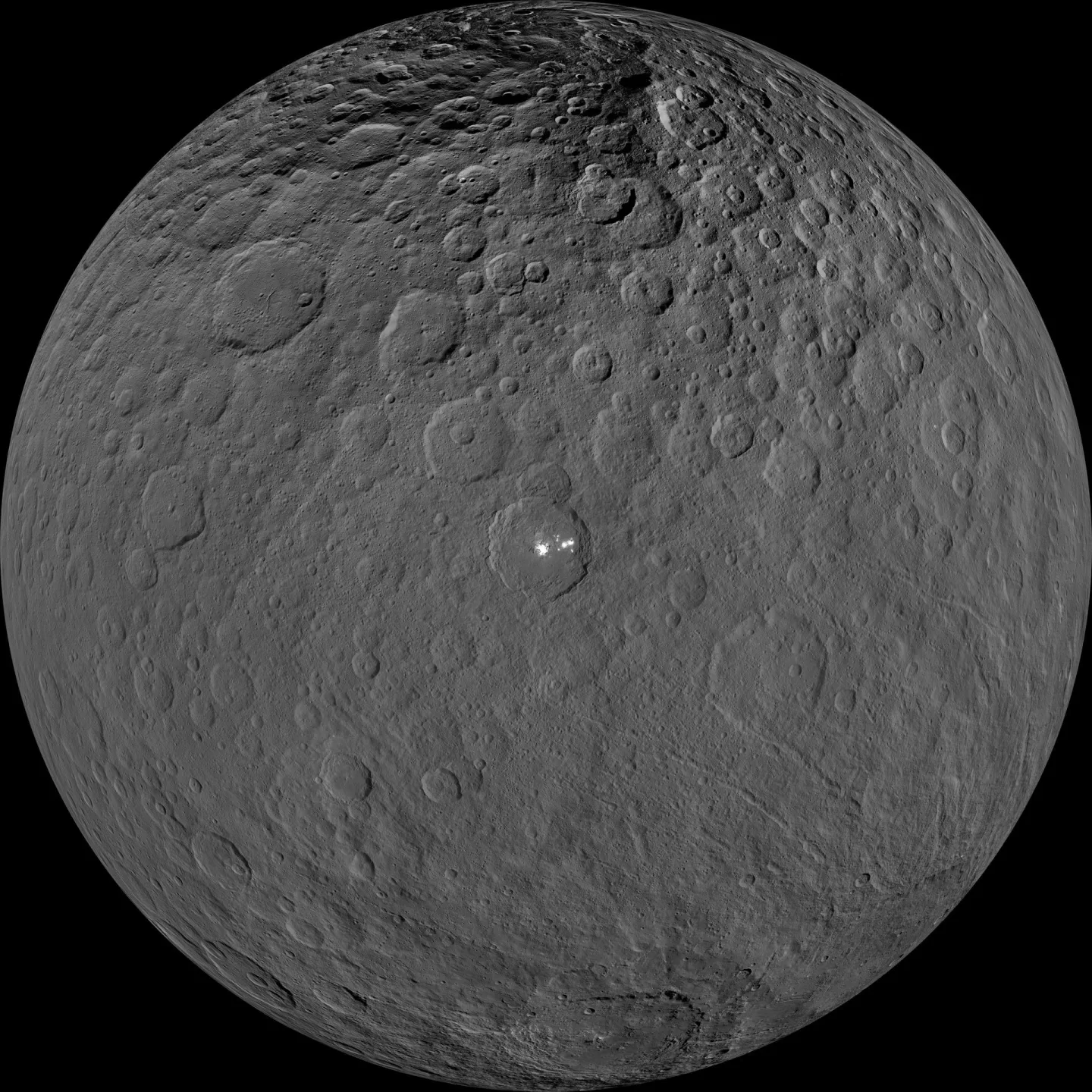
An Unfinished Planet
No planet formed between Mars and Jupiter because Jupiter's gravity kept the local planetesimals agitated — instead of merging they collided and fragmented, and those fragments are the asteroids. The belt is an unfinished planet, not a broken one, and the arithmetic agrees: everything in it put together weighs less than Earth's Moon, with Ceres alone holding about 25 percent of that total.
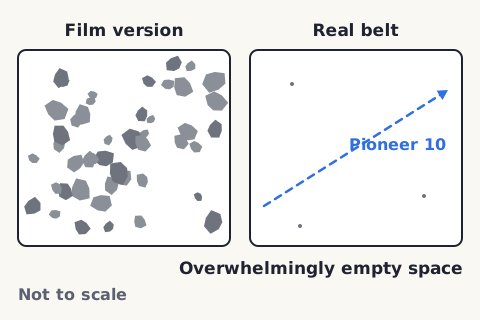
Emptier Than It Looks
The main belt holds an estimated 1.1 to 1.9 million asteroids larger than 1 km and is still overwhelmingly empty space. Spacecraft cross it with virtually no chance of a collision: Pioneer 10 entered the belt on 15 July 1972 and emerged in February 1973. The film version has it backwards — reaching even one asteroid takes deliberate aim.
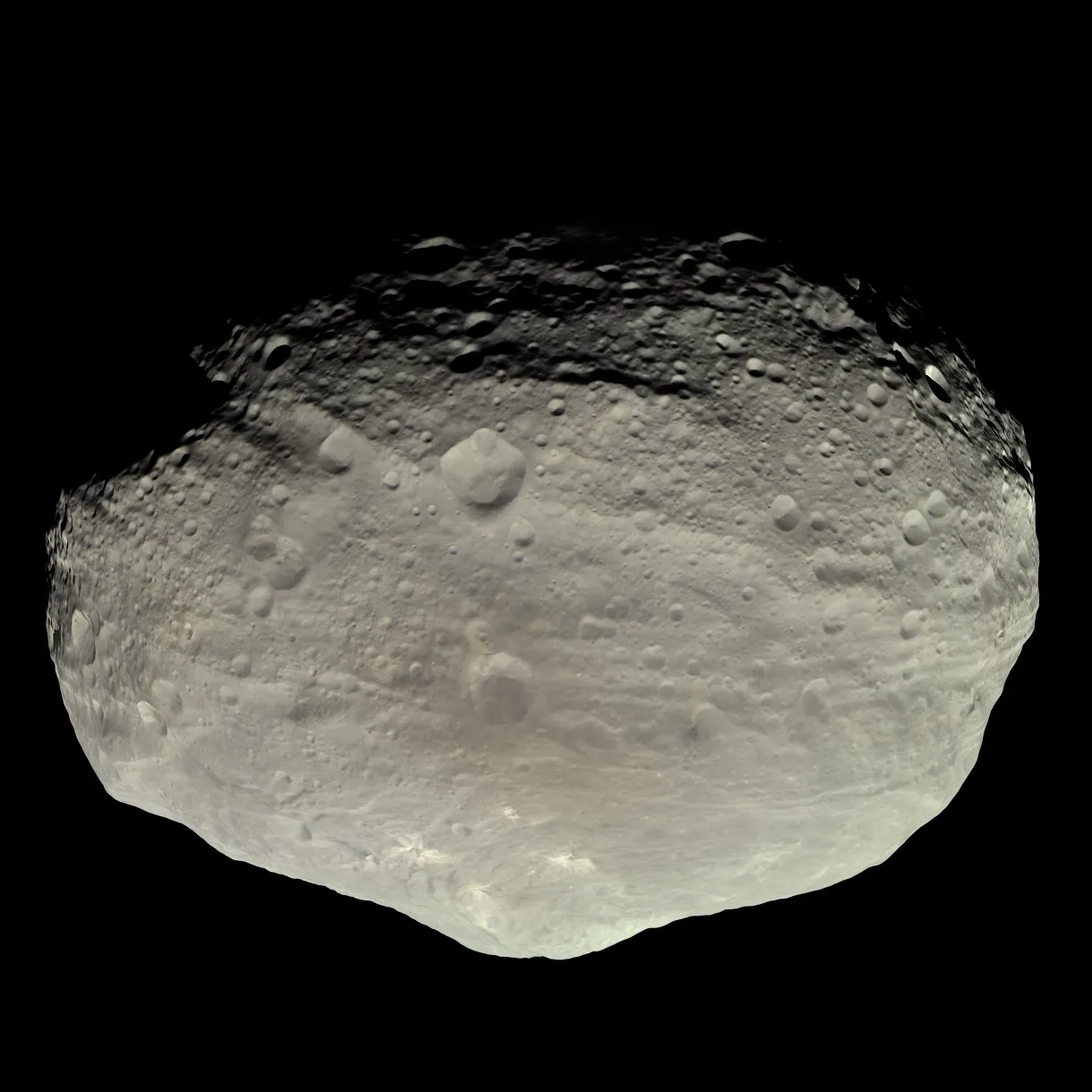
The Asteroid That Melted
Vesta, about 523 km across, is the largest asteroid and the odd one out. Most asteroids are unprocessed rubble; Vesta is differentiated — it melted early and separated into crust, mantle and core, like a small planet. NASA's Dawn orbited it from 16 July 2011 to 5 September 2012 before flying on to Ceres — the one body in the belt more massive still, and the reason Vesta holds the title of largest asteroid at all: at 939 km Ceres was reclassified as a dwarf planet in 2006 and stopped counting as one.
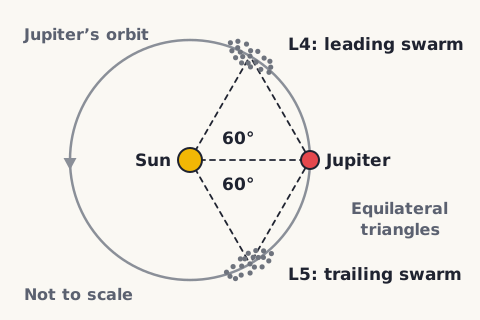
Parking Spaces at Sixty Degrees
Jupiter's Trojan asteroids do not orbit Jupiter. They share its orbit around the Sun in two swarms that lead and trail the planet by 60 degrees, at the L4 and L5 Lagrange points — each swarm sitting at the third corner of an equilateral triangle with Jupiter and the Sun. Together the swarms may rival the main belt in number; the largest Trojan is about 250 km wide. NASA's Lucy, launched 16 October 2021, is the first mission to visit them.
Three Words, Three Places
A meteoroid is the rock while it is still in space — anything from a dust grain to a small asteroid. A meteor is the streak of light made when that rock enters the atmosphere at speed and burns up. A meteorite is what is left if a fragment survives the fall and reaches the ground. The middle word is the one that trips people: a meteor is not an object at all, it is the glow of heated air and vaporized rock.
Forty-Four Tonnes a Day
NASA estimates that about 44 tonnes of meteoritic material falls on Earth every day, and almost all of it is dust too small to notice. Treat that as an estimate rather than a measurement: Royal Museums Greenwich quotes about 14 tonnes a day for space dust specifically, and published figures span roughly 5 to 50 tonnes depending on which particle sizes get counted.
Named for a Perspective
An annual meteor shower is Earth crossing a stream of dusty debris shed along the orbit of a comet — or, more rarely, an asteroid, which is why the same showers return on the same dates. The Perseids peak on 12–13 August, and every Perseid is a fragment of comet 109P/Swift-Tuttle, whose nucleus is about 26 km across. A shower is named for its radiant, the constellation the meteors appear to stream from — a perspective effect, not an origin.
Stony Falls, Iron Finds
What lands comes in three kinds: stony meteorites are mainly silicate rock, iron mainly iron-nickel metal, stony-iron roughly equal parts of both. More than 95 percent of meteorites seen to fall are stony. Irons are over-represented in collections because they weather slowly and look nothing like Earth rock, so they keep being picked up as finds long after landing.
The Test That Decides
The International Astronomical Union's 2006 definition sets three tests. A planet orbits the Sun. It has enough mass for its own gravity to pull it into a nearly round shape — hydrostatic equilibrium. And it has cleared the neighborhood around its orbit. A body that passes the first two, fails the third and is not a satellite is a dwarf planet. The third test is not about size: it asks whether a body gravitationally dominates its orbital zone.
The Object That Forced It
In January 2005 Mike Brown, Chad Trujillo and David Rabinowitz identified Eris on images taken two years earlier. Timing its moon showed Eris is about 27 percent more massive than Pluto — a body beyond Neptune that outweighed the ninth planet. Either Eris was a planet too, or the word needed a definition. The IAU chose the definition in 2006.
Nothing About Pluto Changed
Pluto orbits at an average of about 39 times Earth's distance from the Sun, inside the Kuiper Belt, among objects that cross its path — so it fails the third test. The IAU recognizes it as the prototype of the trans-Neptunian objects. Nothing about Pluto itself changed in 2006; what changed was what turned up next door.
Five Is Bookkeeping
Five bodies are officially recognized as dwarf planets. In order of distance from the Sun: Ceres, inside the asteroid belt, then Pluto, Haumea, Makemake and Eris, all beyond Neptune. Five is not a measurement — the IAU says there may be over a hundred more still to be found, and several known objects almost certainly qualify without having been designated.
Matched pairs
Each item on the left goes with the one on the right.
- Main asteroid belt
- Densest between about 2.12 and 3.3 AU from the Sun
- Pallas
- Tilted 34.9 degrees out of the planets' plane
- Leonids
- Comet 55P/Tempel-Tuttle's dust, which can storm roughly every 33 years
- Chondrites
- The stony meteorites that never melted or sorted into layers
- Small Solar-System Body
- Not a planet, not a dwarf planet, not a moon
- Ceres
- The only dwarf planet inside the asteroid belt
- Pluto
- The IAU's prototype of the trans-Neptunian objects
- Haumea
- Spun to an egg shape by a four-hour rotation
- Makemake
- Second-brightest in the Kuiper Belt, from methane frost
- Eris
- 27 percent heavier than the ninth planet; forced the 2006 vote
Self-test
Answer each question from memory, then check your work against the answer key.
1. Why is there no planet in the main asteroid belt?
- AJupiter's gravity stirred it up
- BA passing star pulled it away
- CThe Sun boiled the material away
- DA planet there was blown apart
2. What share of visible asteroids are the dark carbonaceous kind?
- AUnder 5 percent
- BOver 75 percent
- CAbout 17 percent
- DAbout 40 percent
3. Which of these words names light rather than an object?
- AMeteoroid
- BMeteorite
- CChondrite
- DMeteor
4. What sheds the debris behind the December Geminids?
- AA long-period comet
- BA stream of interstellar dust
- CA near-Earth asteroid
- DA short-period comet
5. Why is Pluto not counted among the eight planets?
- ANew measurements shrank it
- BIt is smaller than Earth's Moon
- CIt shares its orbital zone
- DIt lies beyond Neptune
Go deeper
- WatchMostly Empty In films, the asteroid belt is a crowded field of rock. The real one is mostly empty.
- WatchThree Words, Three Places Three words for three places. A meteoroid is the rock while it's still in space.
- WatchThe Third Test In 2005, astronomers found Eris: about as wide as Pluto, and about 27% more massive.
- StudyAstronomy & Space in the FlashFeed app
Answer key
- 1. A Jupiter's gravity stirred it upEverything in the belt together weighs less than Earth's Moon, so no planet was ever blown apart to supply it — and neither the Sun nor a passing star is involved. Jupiter's pull kept the planetesimals colliding and fragmenting instead of merging.
- 2. B Over 75 percentC-types are the commonest class by a wide margin. About 17 percent is the S-type share, while 40 percent or under 5 percent would leave the stony and metallic classes badly misweighted. The letters come from reflectance surveys, so treat the figures as estimates.
- 3. D MeteorA meteor is the glow of heated air and vaporized rock, not something you could hold. A meteoroid is the rock while it is still in space, a meteorite is what reaches the ground, and a chondrite is a stony meteorite that never melted.
- 4. C A near-Earth asteroidTheir parent is 3200 Phaethon, about 5 to 6 km across, which grows no tail and whose spectrum looks rocky — hence 'rock comet'. Comets supply the Perseids and the Leonids, but not this shower, and its debris comes from neither the Moon nor beyond the Solar System.
- 5. C It shares its orbital zonePluto sits inside the Kuiper Belt among bodies that cross its path, so it fails the third IAU test. Being smaller than the Moon disqualifies nothing — there is no size rule, and every recognized dwarf planet is smaller. No measurement shrank it, and distance is not a criterion.
Sources
- ESA — Asteroids — www.esa.int/Science_Exploration/Space_Science/Asteroids
- NASA Science — Asteroid Facts — science.nasa.gov/solar-system/asteroids/facts/
- JPL Small-Body Database — 4 Vesta (physical parameters) — ssd-api.jpl.nasa.gov/sbdb.api?sstr=4%20Vesta&phys-par=true
- Swinburne University COSMOS — Main Asteroid Belt — astronomy.swin.edu.au/cosmos/*/Main+Asteroid+Belt
- JPL Small-Body Database — 2 Pallas (physical and orbital parameters) — ssd-api.jpl.nasa.gov/sbdb.api?sstr=2%20Pallas&phys-par=true
- Wikipedia — Asteroid belt / C-type asteroid (retrieved 2026-08-09) — en.wikipedia.org/wiki/C-type_asteroid
- NASA Science — Meteors and Meteorites — science.nasa.gov/solar-system/meteors-meteorites/
- NASA Science — Perseids — science.nasa.gov/solar-system/meteors-meteorites/perseids/
- NASA ARES — What are Meteorites? — ares.jsc.nasa.gov/meteorite-falls/what-are-meteorites/
- NASA Science — Leonids — science.nasa.gov/solar-system/meteors-meteorites/leonids/
- NASA Science — Geminids — science.nasa.gov/solar-system/meteors-meteorites/geminids/
- IAU — 2006 General Assembly: Result of the IAU Resolution votes (iau0603) — iauarchive.eso.org/news/pressreleases/detail/iau0603/
- Caltech — The Dwarf Planet Known as Eris is More Massive than Pluto — www.caltech.edu/about/news/dwarf-planet-known-eris-more-massive-pluto-new-data-shows-1293
- NASA Science — Dwarf Planets — science.nasa.gov/dwarf-planets/
- JPL Small-Body Database — 1 Ceres — ssd-api.jpl.nasa.gov/sbdb.api?sstr=1%20Ceres&phys-par=true
- NASA Science — Haumea — science.nasa.gov/dwarf-planets/haumea/
- NASA Science — Makemake — science.nasa.gov/dwarf-planets/makemake/
Image credits
- An Unfinished Planet: Wikimedia Commons · Unknown author · Public domain — commons.wikimedia.org/wiki/File:Ceres_global_hires.jpg
- Emptier Than It Looks: FlashFeed original diagram · CC-BY-4.0
- The Asteroid That Melted: Wikimedia Commons · NASA / JPL / MPS / DLR / IDA / Björn Jónsson · Public domain — commons.wikimedia.org/wiki/File:Vesta_in_natural_color.jpg
- Parking Spaces at Sixty Degrees: FlashFeed original diagram · CC-BY-4.0
- Three Words, Three Places: FlashFeed original diagram · CC-BY-4.0
- Forty-Four Tonnes a Day: AI-generated (gpt-image-1.5)
- Stony Falls, Iron Finds: H. Raab (User:Vesta) · CC BY-SA 3.0 — en.wikipedia.org/wiki/Widmanst%C3%A4tten_pattern
- The Test That Decides: FlashFeed original diagram · CC-BY-4.0
- The Object That Forced It: Wikimedia Commons · NASA, ESA, and M. Brown (California Institute of Technology) · Public domain — commons.wikimedia.org/wiki/File:Hubble_Dysnomia_orbit_overlay.jpg
- Nothing About Pluto Changed: FlashFeed original diagram · CC-BY-4.0


