
Astronomy & Space study guide · Lesson 10 of 13
The Kuiper Belt, Comets and the Outer Edge
The Kuiper Belt · Comets · Where Does the Solar System End?
This is the lesson's study guide from the FlashFeed app, plus its key facts and a self-test.
What you'll be able to do
- Place the Kuiper Belt, comets and the Oort Cloud, and order the outer Solar System
Everything as far as Neptune has been visited, photographed and weighed. Past Neptune, the Solar System is a region we have sampled rather than surveyed: one flyby of one small body, a few thousand cataloged objects, and a good many numbers that are model outputs rather than measurements. Where a figure here is an estimate, it is named as one.
The Kuiper Belt
Beyond Neptune the disc of the Solar System does not stop. It thins.
The Kuiper Belt is a thick, doughnut-shaped ring of icy leftovers whose main region runs from about 30 to 50 AU — the asteroid belt's idea, twenty times further out and built of ice rather than rock. It is not a thin flat band, and it is not the Oort Cloud. NASA puts its whole mass at no more than about a tenth of Earth's.
It is a population, not a shortlist. NASA estimates millions of icy bodies there, including hundreds of thousands wider than 100 km. That is an estimate: only a few thousand trans-Neptunian objects have actually been observed and cataloged. The gap between the two numbers is a limit of telescopes, not of the belt.
Gerard Kuiper proposed such a belt in 1951, and for forty-one years it stayed a prediction. Confirmation came in 1992, when David Jewitt and Jane Luu found 1992 QB1, later named 15760 Albion — the first trans-Neptunian object found after Pluto and Charon.
Pluto was the first Kuiper Belt object discovered, in 1930, though nobody could have known it then. NASA now describes it as a member of the belt: 2,377 km across, averaging 39 AU from the Sun, 248 years to a lap. Its 2006 reclassification was not a demotion invented by committee; it was the recognition that Pluto has neighbors. Eris, about 2,400 km at 68 AU, is so close in size that NASA's own pages leave the two effectively tied.
Pluto's orbit crosses inside Neptune's, and the two can never collide, because they are locked in a 3:2 resonance: Pluto goes round the Sun twice for every three Neptune orbits, so it always reaches the crossing point when Neptune is elsewhere. A resonance is a repeating timing agreement. Objects sharing this one are called plutinos, the most populous known resonant class.
One belt object has been visited. On 1 January 2019 New Horizons passed within 3,538 km of Arrokoth, a body about 35 km end to end — the most distant object any spacecraft has reached. Arrokoth is a contact binary: two rounded lobes touching, poles and equators aligned. That alignment reads as a co-orbiting pair which merged gently at low speed, offered as support for the pebble-cloud collapse model of planet-building rather than the older picture of bodies crashing together and growing. It is a model fitted to evidence, not recorded history.
Arrokoth is also very red, redder than Pluto, and much the same color all over, which argues it assembled from one small, well-mixed cloud. Methanol ice and organics are securely detected; water ice is not, since the published analysis reports none while NASA's own page says it was found.
Comets
A comet is a cosmic snowball of frozen gases, rock and dust that spends nearly all its orbit in deep freeze, so its material preserves the composition of the disc the planets formed from. Nothing about it burns: the glow is scattered and re-emitted sunlight.
The comet proper is the nucleus, usually under about 16 km across — a frozen block the size of a town. What you see is not that. Sunlight drives gas and dust off it into a coma, a glowing head that can swell to hundreds of thousands of kilometers, larger than most planets. The bright fuzzy object is almost entirely material that has already left the comet.
Then the tails, and there are two. The bluish ion tail is charged gas swept out by the solar wind, pointing directly away from the Sun. The whitish dust tail is heavier grains pushed by the pressure of sunlight; they keep some of the comet's orbital motion, so that tail lags and curves. Two forces, two tails, fanning apart at slightly different angles. Neither is a wake: the direction is set by the Sun, not by the comet's motion, so on the outbound leg a comet travels tail-first.
An orbit says where a comet came from. Short-period comets take less than 200 years and come from the Kuiper Belt, arriving along the plane of the planets. Long-period comets take far longer and arrive from any direction at all.
Halley's Comet returns on average every 76 years — an average, not a timetable; the giant planets tug the orbit and the real gap has run from 74 to 80 years. It last rounded the Sun in February 1986 and returns in 2061, with a first certain record from 240 BCE. Its shed dust rings the whole orbit, and Earth's path cuts that ring twice a year: the Eta Aquarids in May and the Orionids in October. A meteor shower does not mean a comet is nearby.
Hale-Bopp stayed naked-eye visible for 18 months across 1996 and 1997, not because it came close to Earth but because its nucleus is around 60 km across, four times Halley's. Its period runs to a few thousand years — NASA gives 2,534, JPL about 2,361 — so "roughly two and a half thousand years" is as precise as the sources allow. NEOWISE, by contrast, was found only three months before it brightened in 2020, which is normal: a long-period comet stays dark and tiny until the Sun heats it.
ESA's Rosetta made the first rendezvous with a comet, 67P, in 2014; its lander Philae made the first landing that November, bouncing several times before settling. 67P is two lobes joined at a neck and mostly empty — ESA quotes 70 to 80 percent porosity and a density of 470 kg per cubic meter, other sources 533, both far under water's 1,000, so a comet nucleus would float. Rosetta's measured deuterium-to-hydrogen ratio for 67P is about three times the value in Earth's oceans, which weakened the case that comets delivered Earth's water. Hartley 2's ratio did match, so the question is open.
Where Does the Solar System End?
JPL's Small-Body Database listed just over 4,000 known comets in August 2026 — a running total that climbs every year — while NASA estimates there are likely billions in the Kuiper Belt and Oort Cloud. Most of the outer Solar System is inferred, not seen, which is part of why its edge is a question about definitions.
Three answers are defensible, and they measure three different things.
The Kuiper Belt's outer edge, near 50 AU, is where the planet-forming disc thins out. It is the softest of the three, because the belt does not simply stop. Beyond it is the scattered disc: objects flung by Neptune onto stretched, tilted orbits that still dip back to about 30-35 AU but reach outward towards 1,000 AU, and thought to be the source of the short-period Jupiter-family comets. Further out sit detached objects such as Sedna, which never comes nearer than about 76 AU — too far for Neptune to have put it there, which is why "detached" is a category separate from "scattered". JPL's solution carries Sedna out to about 1,010 AU, NASA's page to roughly 1,200. The near point is firm; the far point is not.
The heliopause, near 120 AU, is where the Sun's outflowing solar wind is finally stopped by the gas between the stars. Voyager 1 crossed it on 25 August 2012 at about 122 AU, the first spacecraft to leave the heliosphere. Voyager 2 crossed on 5 November 2018 — six years later, somewhere else, and at a different point in the Sun's roughly 11-year activity cycle, over which the boundary itself moves. NASA gives its distance only as slightly more than 18 billion km from Earth, with no AU figure. Crossing the heliopause is not leaving the Solar System; both probes are still held by the Sun's gravity.
The Oort Cloud is the third answer, and the one NASA states outright: the boundary of the Solar System is considered to lie beyond its outer edge. It is a theorized spherical shell around the whole system, inferred from the orbits of long-period comets and never observed directly. Its inner edge is model-dependent, quoted as 2,000-5,000 AU on one NASA page and about 1,000 AU on another; its outer edge is put somewhere between 10,000 and 100,000 AU. Every one of those figures is an estimate.
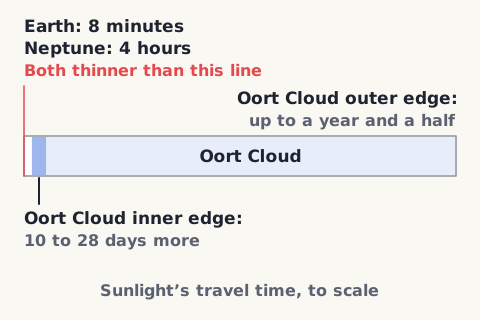
Light restores the scale that AU stop conveying. Sunlight reaches Earth in about eight minutes and Neptune in about four hours. It takes a further 10 to 28 days to reach the Oort Cloud's inner edge, and as much as a year and a half to pass its outer one. The planets occupy the innermost fraction of one percent of the Solar System's radius.
Key terms
- Trans-Neptunian object
- Any body cataloged on an orbit beyond the eighth planet's — the main belt, the scattered disc and everything past them, not just the crowded classical belt
- Coma
- The glowing head of gas and dust already driven off a comet — hundreds of thousands of kilometers wide, and not the solid body buried inside it
- Heliopause
- Where the Sun's outflowing wind is finally halted by the gas between the stars — a plasma transition, and not the end of the Sun's gravitational reach
Key facts
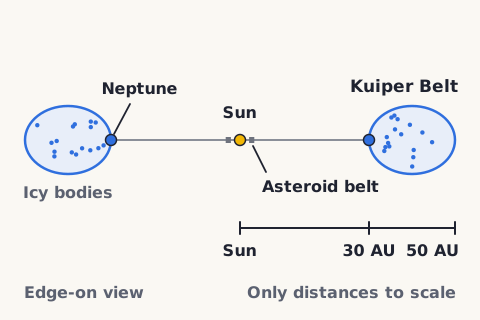
Ice, Twenty Times Out
Beyond Neptune the disc of the Solar System does not stop — it thins. The Kuiper Belt is a thick, doughnut-shaped ring of icy leftovers whose main region runs from about 30 to 50 AU: the asteroid belt's idea, twenty times further out and built of ice rather than rock. It is not a thin flat band, and it is not the Oort Cloud. For all that reach, NASA puts the whole belt's mass at no more than about a tenth of Earth's.
Millions, Thousands Seen
The belt is a population, not a shortlist. NASA estimates millions of icy bodies out there, including hundreds of thousands wider than 100 km. Only a few thousand trans-Neptunian objects have actually been observed and cataloged. The gap between those two numbers is a limit of telescopes, not of the belt — the famous names are simply the ones bright enough to have been found.
Forty-One Years a Prediction
Gerard Kuiper proposed a belt of leftovers beyond Neptune in 1951, and for forty-one years it stayed a prediction. Confirmation came in 1992, when David Jewitt and Jane Luu found 1992 QB1 — later named 15760 Albion — the first trans-Neptunian object discovered after Pluto and Charon. JPL puts its orbit at 44.1 AU and about 293 years. Almost everything we know about the outer Solar System has been found since.
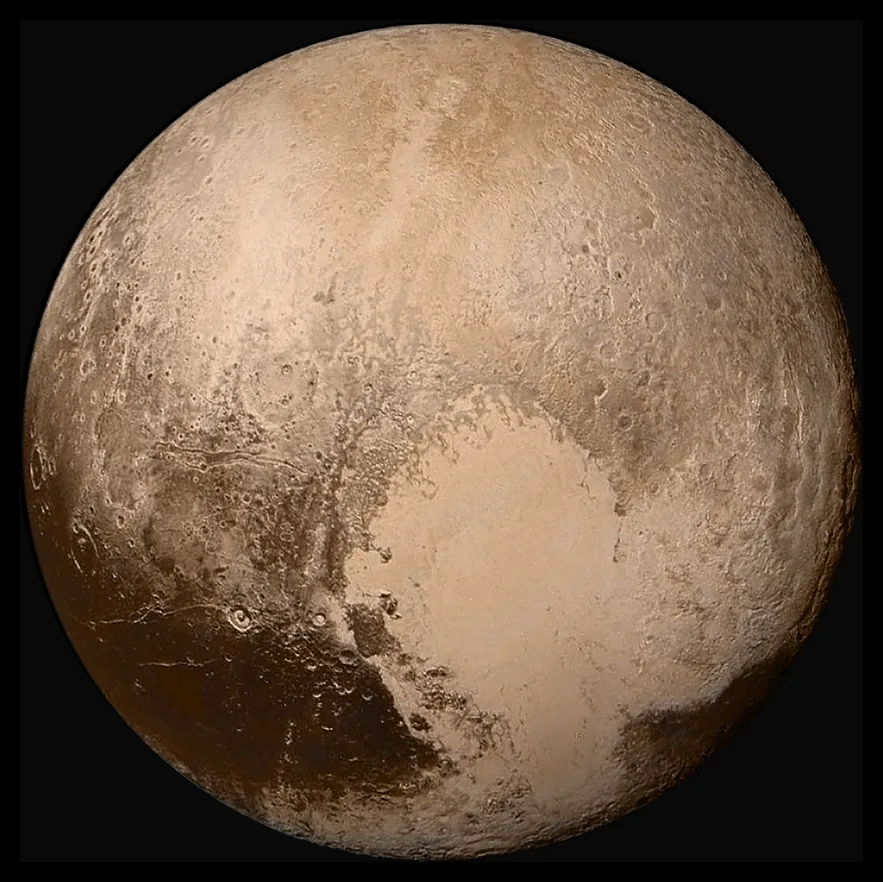
Pluto Has Neighbors
Pluto was the first Kuiper Belt object ever discovered, in 1930, though nobody could have known it then. NASA now describes it as a member of the belt: 2,377 km across, averaging 39 AU from the Sun, 248 years to a lap. The 2006 reclassification was not a demotion invented by committee — it was the recognition that Pluto has company. Eris, about 2,400 km at 68 AU, is so close in size that NASA's own pages leave the two effectively tied.
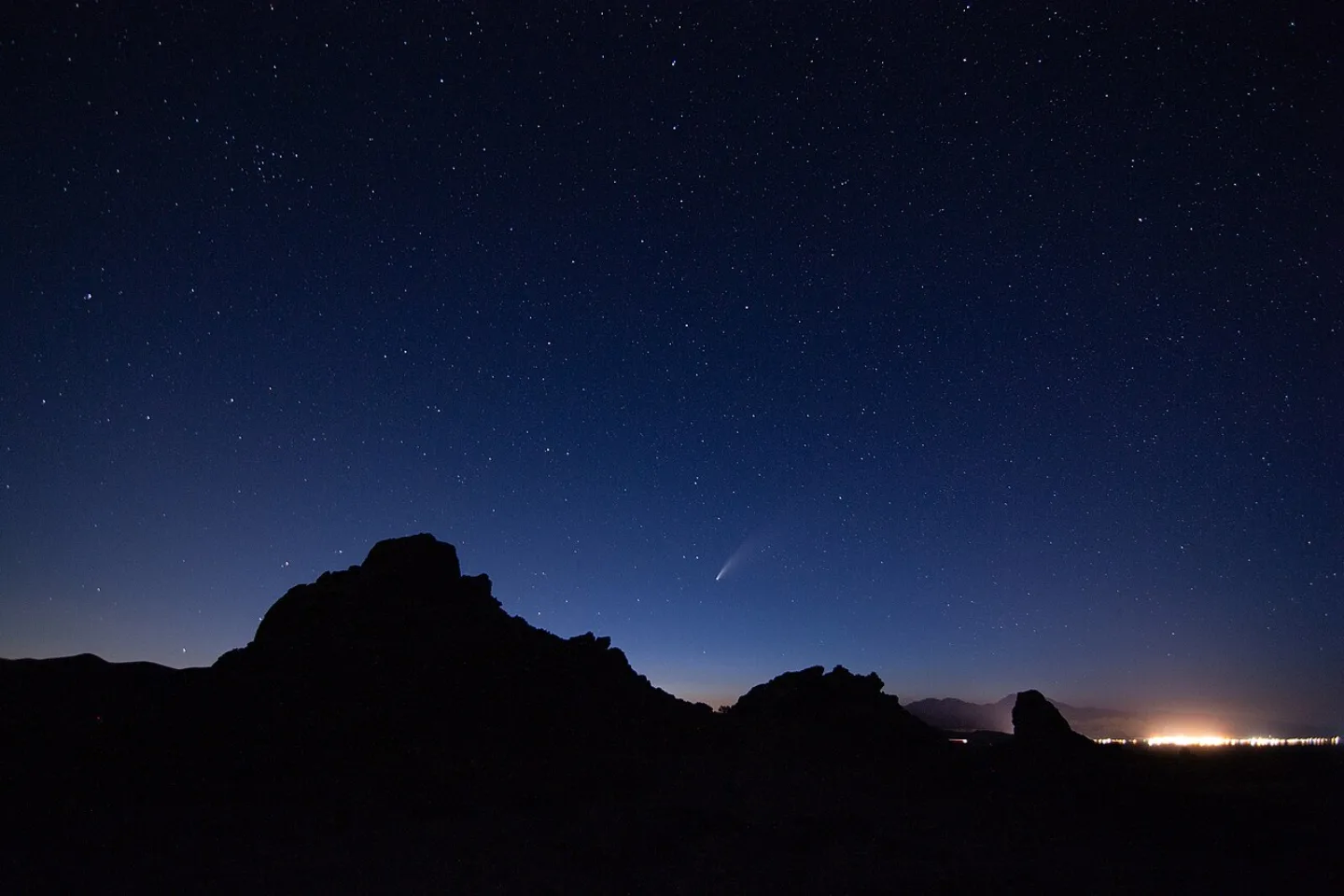
Nothing About It Burns
A comet is a cosmic snowball of frozen gases, rock and dust. Nothing about it is on fire: the glow is sunlight scattered and re-emitted, not combustion. Because a comet spends nearly all of its orbit in deep freeze far from the Sun, its material still holds the composition of the disc the planets formed from — each one is a 4.6-billion-year-old sample that delivers itself to the inner Solar System.
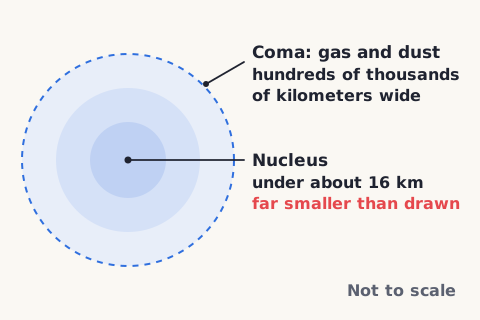
Bigger Than Most Planets
The comet proper is the nucleus, usually under about 16 km across — a frozen block the size of a town. What you see is not that. Sunlight drives gas and dust off the nucleus into a coma, a glowing head that can swell to hundreds of thousands of kilometers, larger than most planets. The bright fuzzy object in the sky is almost entirely material that has already left the comet.
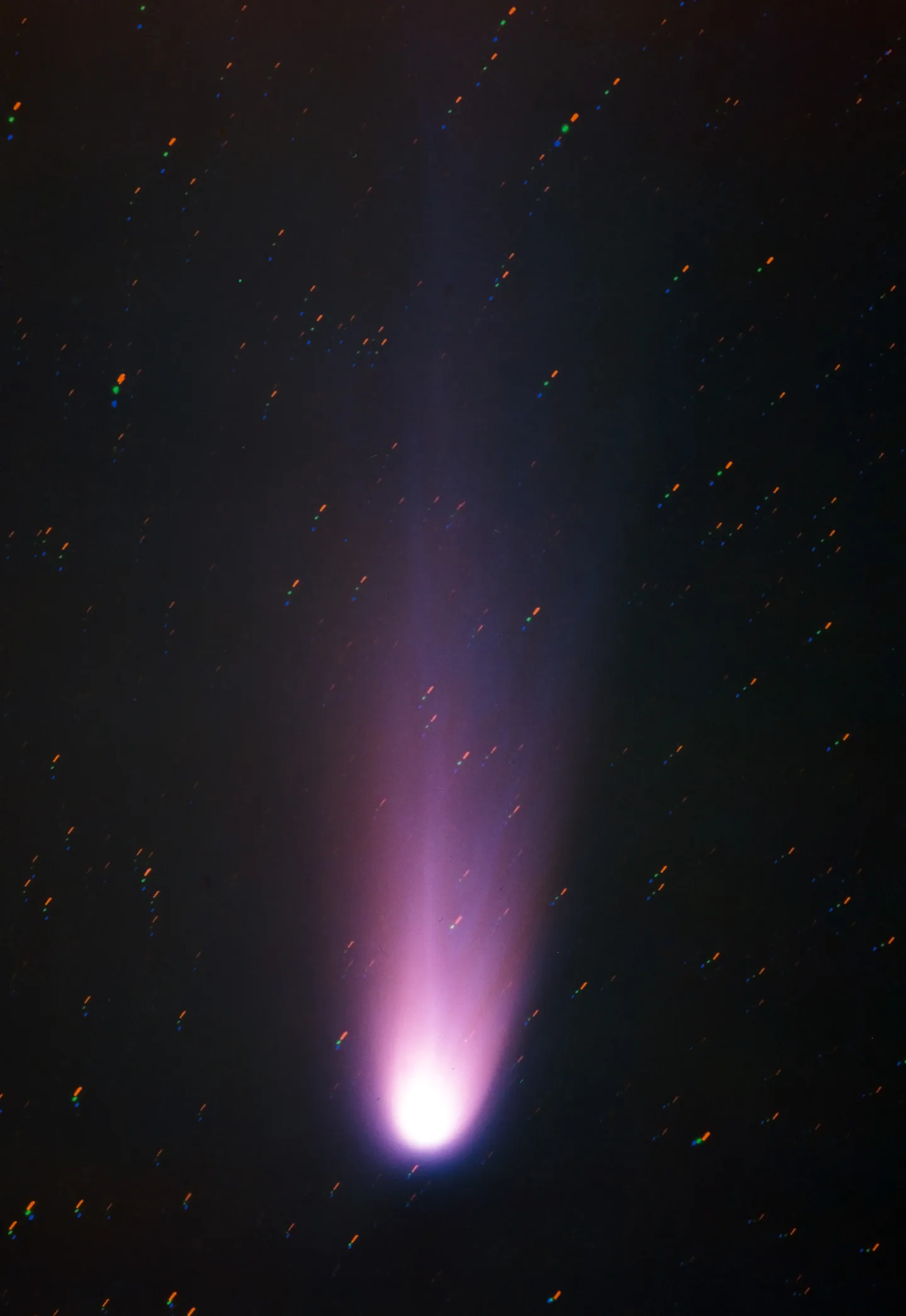
An Average, Not a Timetable
Halley's Comet returns on average every 76 years — an average, not a schedule: the giant planets tug the orbit and the real gap has run from 74 to 80 years. Its first certain record is from 240 BCE, it last rounded the Sun in February 1986, and it returns in 2061. Its shed dust rings the whole orbit, and Earth's path cuts that ring twice a year: the Eta Aquarids in May and the Orionids in October. A meteor shower does not mean a comet is nearby.
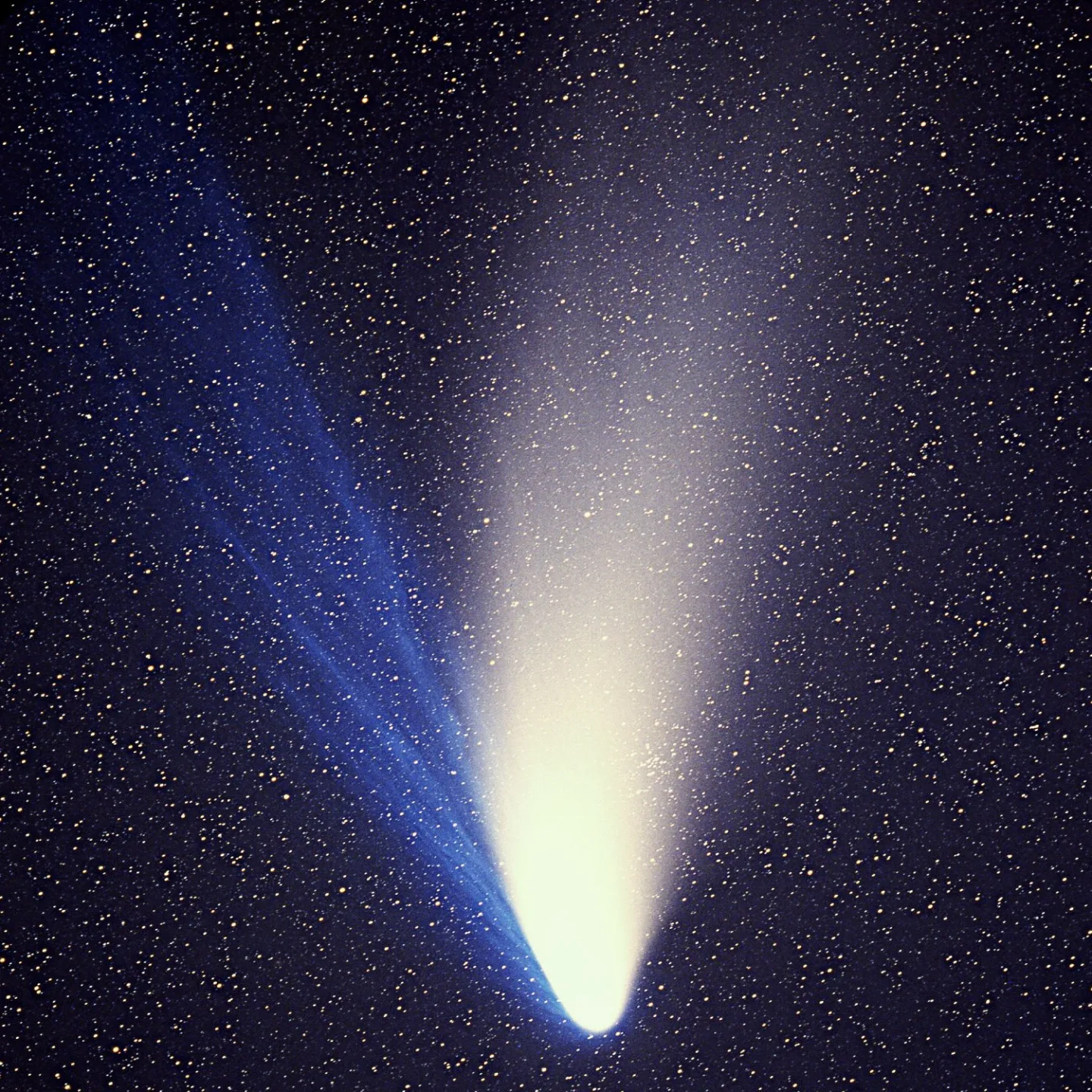
Big Nucleus, Long Show
Hale-Bopp stayed visible to the naked eye for 18 months across 1996 and 1997 — not because it came close to Earth, but because its nucleus is around 60 km across, roughly four times Halley's. A great comet can be made by size and activity rather than by proximity — Hyakutake, in the same decade, was the other way round. NEOWISE, whose nucleus is about 5 km, was found only three months before it brightened in 2020. That is normal: a long-period comet stays dark and tiny until the Sun heats it.
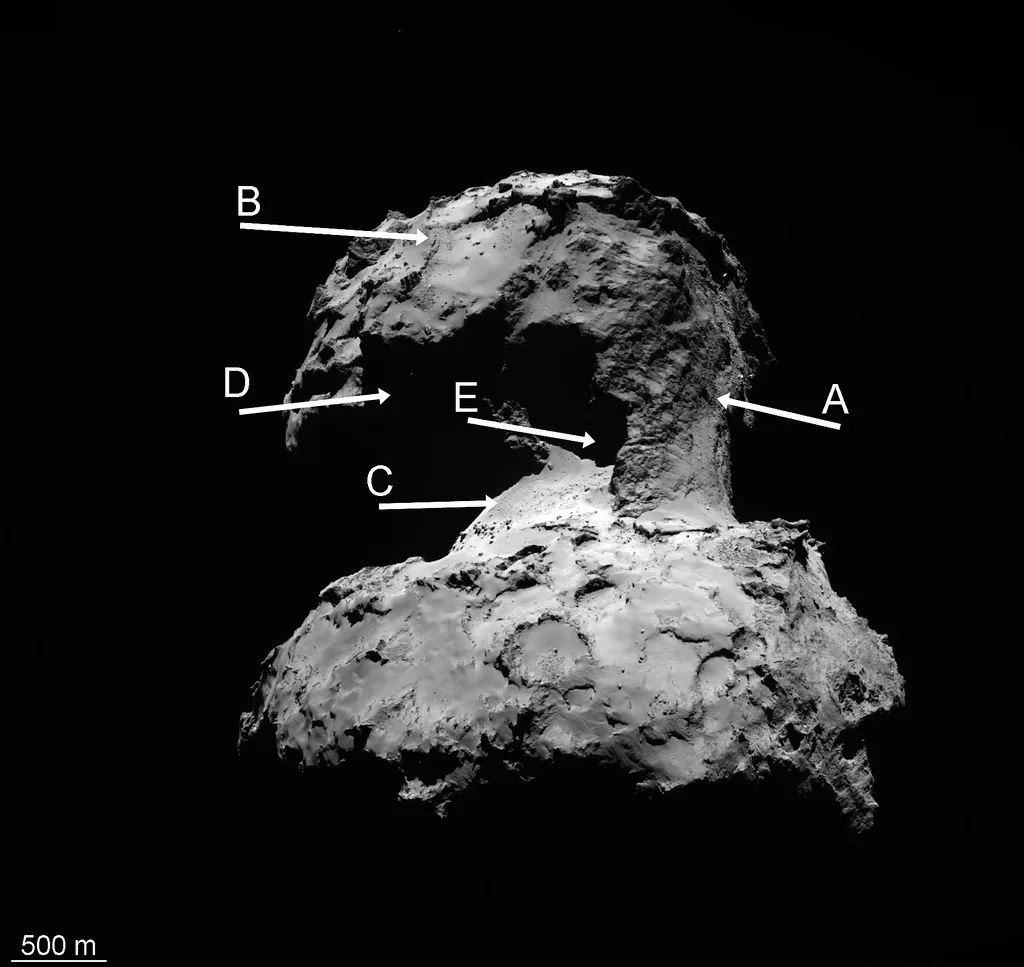
A Comet Would Float
ESA's Rosetta made the first rendezvous with a comet, 67P, in 2014; its lander Philae made the first landing that November, bouncing several times before it settled. 67P is two lobes joined at a neck and mostly empty — ESA quotes 70 to 80 percent porosity and a density of 470 kg per cubic meter, well under water's 1,000. Rosetta also measured its water: about three times the deuterium share of Earth's oceans, which weakened the case that comets filled our seas.
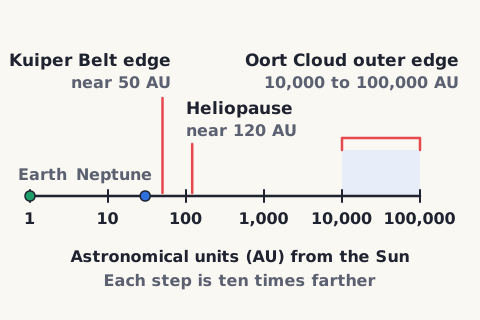
Three Edges, Three Answers
Ask where the Solar System ends and three answers are defensible, because they measure three different things. The Kuiper Belt's outer edge near 50 AU is where the planet-forming disc thins out. The heliopause near 120 AU is where the Sun's wind is stopped by the gas between the stars. The Oort Cloud is the third, and the one NASA states outright: the boundary is considered to lie beyond its outer edge, somewhere between 10,000 and 100,000 AU.
Crossing Is Not Leaving
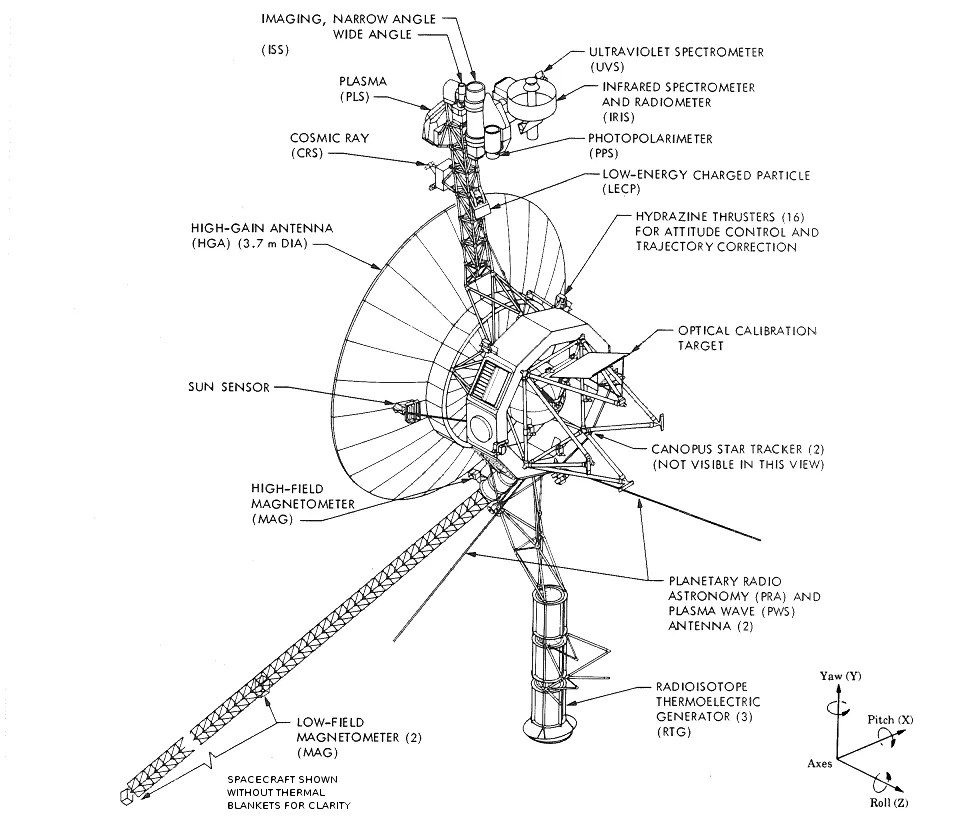
Voyager 1 crossed the heliopause on 25 August 2012 at about 122 AU, the first spacecraft to leave the Sun's wind-blown bubble. Voyager 2 crossed on 5 November 2018 — six years later, somewhere else, and at a different point in the Sun's roughly 11-year activity cycle, over which the boundary itself moves. NASA gives Voyager 2's distance only as slightly more than 18 billion km, with no figure in AU. Neither probe has left the Solar System: the Sun's gravity still holds both.
Scattered, Then Detached
The belt does not simply stop. Beyond it lies the scattered disc: objects flung by Neptune onto stretched, tilted orbits that still dip back to about 30-35 AU but reach outward towards 1,000 AU, and thought to be the source of the short-period Jupiter-family comets. Further out sit detached objects such as Sedna, which never comes nearer than about 76 AU — too far for Neptune to have put it there. That near point is firm; JPL carries Sedna out to about 1,010 AU, NASA's page to roughly 1,200.
Light Restores the Scale
AU stop meaning much past a hundred, so use light instead. Sunlight reaches Earth in about 8 minutes and Neptune in about 4 hours — the whole planetary system fits inside a four-hour light journey. It takes a further 10 to 28 days to reach the Oort Cloud's inner edge, and as much as a year and a half to pass its outer one. The planets occupy the innermost fraction of one percent of the Solar System's radius.
By the numbers
- The Kuiper Belt's main outer edge
- 50 AU
- Sedna at its closest to the Sun
- 76 AU
- Voyager 1's distance when it crossed the heliopause
- 122 AU
- How far out the scattered disc reaches
- 1000 AU
- The Oort Cloud's inner edge, near end of NASA's main range
- 2000 AU
- The Oort Cloud's inner edge, far end of NASA's main range
- 5000 AU
- The Oort Cloud's outer edge, far end of NASA's range
- 100000 AU
Matched pairs
Each item on the left goes with the one on the right.
- Plutinos
- Belt objects sharing the 3:2 lock on Neptune
- The Kuiper Belt's total mass
- No more than about a tenth of Earth's
- Short-period comets
- One lap in under 200 years, out of the Kuiper Belt
- A comet's nucleus
- The solid frozen block, usually under 16 km wide
Self-test
Answer each question from memory, then check your work against the answer key.
1. Pluto's orbit crosses inside Neptune's. What timing keeps the two apart?
- APluto is too small to matter
- BTheir orbits are tilted apart
- CNeptune's gravity repels it
- DThey keep a 3:2 timing lock
2. How many trans-Neptunian objects have astronomers actually cataloged?
- AHundreds of thousands
- BSeveral billion
- CA few thousand
- DAbout thirty thousand
3. Which way do a comet's tails point?
- ABackwards along its path
- BAway from the Sun
- CWhichever way the nucleus spins
- DStraight toward the Sun
4. Why did Hale-Bopp stay a naked-eye object for 18 months?
- AIts nucleus was unusually big
- BIt sat inside our orbit a year
- CIt broke apart near the Sun
- DIt passed very close to Earth
5. Voyager 1 crossed the heliopause in 2012. Has it left the Solar System?
- AYes, it is beyond the planets
- BNo, the Sun still holds it
- CYes, NASA says interstellar
- DYes, it entered the Oort Cloud
6. Which boundary does NASA call the edge of the Solar System?
- AThe Kuiper Belt's outer edge
- BNeptune's orbit
- CThe heliopause
- DThe far side of the Oort Cloud
Go deeper
- WatchThe 3:2 Resonance Pluto's orbit crosses inside Neptune's. Yet the two can never collide.
- WatchTail-First A comet's tail isn't a trail behind it. The Sun sets its direction.
- WatchThree Edges Voyager 1 crossed the heliopause in 2012. That's where the gas between the stars stops the solar wind.
- StudyAstronomy & Space in the FlashFeed app
Answer key
- 1. D They keep a 3:2 timing lockPluto goes round the Sun twice for every three Neptune orbits, so it always reaches the crossing point when Neptune is somewhere else. Tilt alone would not hold that pattern, size has nothing to do with whether two orbits meet, and gravity attracts.
- 2. C A few thousandOnly a few thousand trans-Neptunian objects have been observed and logged. NASA estimates millions are out there, hundreds of thousands of them wider than 100 km — but those are estimates, not sightings. Thirty thousand overshoots the catalog; billions overshoot the estimate.
- 3. B Away from the SunSunlight pressure and the solar wind push escaping gas and dust outward, so a tail always points away from the Sun — on the outbound leg a comet travels tail-first rather than trailing like smoke. Spin orients the jets, not the tail, and nothing drives material inward.
- 4. A Its nucleus was unusually bigAt around 60 km across, roughly four times Halley's width, it stayed active far longer than most comets. It never came especially close to Earth, it did not break up, and it spent only a few months inside Earth's orbit — size and activity did the work.
- 5. B No, the Sun still holds itNASA does say Voyager 1 entered interstellar space — but that means it passed where the solar wind stops, not where the Sun's gravity stops, and it is still bound. Passing the planets is not the accepted edge, and the Oort Cloud is roughly 300 years away yet.
- 6. D The far side of the Oort CloudNASA states the boundary is considered to lie beyond the outer edge of the Oort Cloud. The heliopause near 120 AU only marks where the solar wind stops, the belt near 50 AU is where the planet-forming disc thins, and past Neptune lie the scattered disc and more.
Sources
- NASA Science — Kuiper Belt Facts — science.nasa.gov/solar-system/kuiper-belt/facts/
- JPL Small-Body Database — 15760 Albion (1992 QB1) — ssd-api.jpl.nasa.gov/sbdb.api?sstr=15760&full-prec=false
- NASA Science — Pluto Facts — science.nasa.gov/dwarf-planets/pluto/facts/
- NASA Science — Arrokoth Facts — science.nasa.gov/solar-system/kuiper-belt/arrokoth-2014-mu69/facts/
- NASA Science — Comets — science.nasa.gov/solar-system/comets/
- NASA Space Place — What Is a Comet? — spaceplace.nasa.gov/comets/en/
- NASA Science — 1P/Halley — science.nasa.gov/solar-system/comets/1p-halley/
- NASA Science — C/1995 O1 (Hale-Bopp) — science.nasa.gov/solar-system/comets/c-1995-o1-hale-bopp/
- ESA — Getting to know Rosetta's comet — www.esa.int/Science_Exploration/Space_Science/Rosetta/Getting_to_know_Rosetta_s_comet
- NASA Science — Comet Facts — science.nasa.gov/solar-system/comets/facts/
- NASA/JPL — NASA's Voyager 2 Probe Enters Interstellar Space — www.jpl.nasa.gov/news/nasas-voyager-2-probe-enters-interstellar-space/
- NASA Science — Voyager Interstellar Mission — science.nasa.gov/mission/voyager/interstellar-mission/
- NASA Science — Neptune Facts — science.nasa.gov/neptune/neptune-facts/
- JPL Small-Body Database — 90377 Sedna (2003 VB12) — ssd-api.jpl.nasa.gov/sbdb.api?sstr=90377&full-prec=true
- NASA Science — Oort Cloud Facts — science.nasa.gov/solar-system/oort-cloud/facts/
Image credits
- Ice, Twenty Times Out: FlashFeed original diagram · CC-BY-4.0
- Pluto Has Neighbors: NASA/JHUAPL/SwRI · Public domain — commons.wikimedia.org/wiki/File:Global_LORRI_mosaic_of_Pluto_in_true_colour.jpg
- Nothing About It Burns: Wikimedia Commons · RuggyBearLA · CC BY 2.0 — commons.wikimedia.org/wiki/File:Comet_NEOWISE_from_Trona_Pinnacles_-_50685737367.jpg
- Bigger Than Most Planets: FlashFeed original diagram · CC-BY-4.0
- An Average, Not a Timetable: ESO (Openverse) · by 4.0 — commons.wikimedia.org/w/index.php?curid=26499690
- Big Nucleus, Long Show: Wikimedia Commons · E. Kolmhofer, H. Raab; Johannes-Kepler-Observatory, Linz, Austria · CC BY-SA 3.0 — commons.wikimedia.org/wiki/File:Comet_Hale-Bopp_1995O1.jpg
- A Comet Would Float: europeanspaceagency (Openverse) · by-sa 4.0 — www.flickr.com/photos/37472264@N04/16342569642
- Three Edges, Three Answers: FlashFeed original diagram · CC-BY-4.0
- Crossing Is Not Leaving: Voyager_spacecraft_structure.jpg: NASA derivative work: Mirecki (talk) · Public domain — commons.wikimedia.org/wiki/File:Voyager_spacecraft_structure.png
- Light Restores the Scale: FlashFeed original diagram · CC-BY-4.0


