
Astronomy & Space study guide · Lesson 11 of 13
How the Solar System Formed
From Cloud to Disc · Building Planets · Reading the Evidence
This is the lesson's study guide from the FlashFeed app, plus its key facts and a self-test.
What you'll be able to do
- Trace how the Solar System formed and why the frost line sorted it
Nobody watched this happen. Everything in this lesson is reconstruction — read backwards from rocks we can weigh, orbits we can measure, and other stars we can see doing it now. Some of that reconstruction is solid enough to state plainly. Some of it is a model: a story that fits the evidence and might still be wrong. This lesson keeps those two apart, because the difference matters more than any single fact in it.
From Cloud to Disc
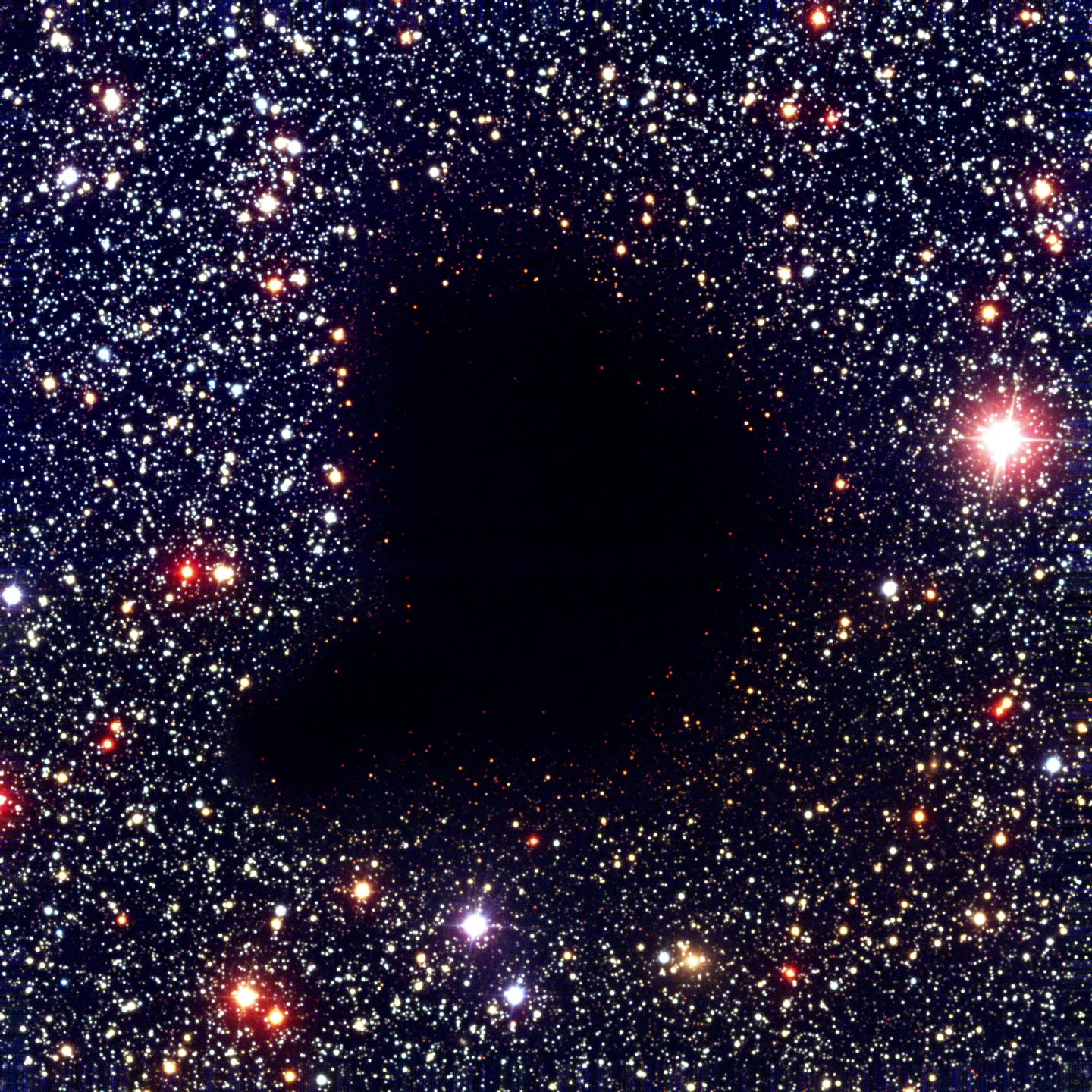
The Solar System formed about 4.6 billion years ago, when a dense cloud of interstellar gas and dust collapsed under its own gravity.
That sentence hides a problem. A cold cloud can sit for a very long time without collapsing — gravity pulls inward, but gas pressure and turbulence push back, and the standoff can last millions of years. Something probably pushed. The leading idea is a shock wave from a nearby exploding star, and the evidence for it is chemical rather than visual: the oldest meteorites contain the decay products of aluminum-26 and iron-60, radioactive isotopes with half-lives so short that they must have been made shortly before the Solar System formed, and a dying massive star is the obvious factory. That is a strong argument. It is not an eyewitness.
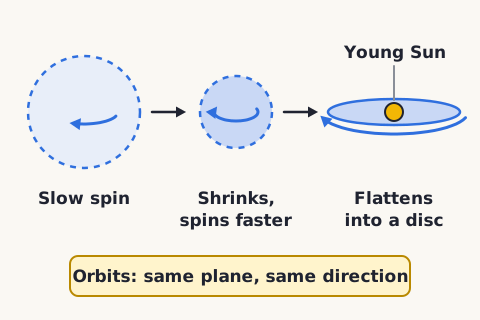
Once collapse began, the physics is unavoidable. A cloud that is rotating even slightly spins faster as it shrinks, and a spinning collapsing cloud flattens. The result is the solar nebula — a disc of gas and dust around the young Sun. This is why the planets today all orbit in nearly the same plane and in the same direction: they were assembled from a spinning plate, and they still carry its motion.
Within that disc, planets were built by accretion. Dust grains stuck together, clumps collided and grew into kilometer-sized planetesimals, and the largest of those swept up the rest.
The disc was not chemically uniform, and that is what decided everything afterwards. The frost line — also called the snow line — is the distance from a young star beyond which water stops being vapor and freezes into solid ice. Inside it, only rock and metal could stay solid, so there was very little material to work with and the inner planets came out small and rocky. Beyond it, water ice was available in bulk, so bodies grew large enough to capture hydrogen and helium directly. That single boundary is why the four inner planets are terrestrial, with surfaces you could stand on, and the four outer ones are giants with no ground at all.
One number frames the whole system: the Sun holds 99.8 per cent of the Solar System's mass. Every planet, every moon, the asteroid belt, the Kuiper Belt and all the comets together make up the remaining fifth of one per cent.
Building Planets
That 99.8 per cent creates a genuine puzzle, and it is still open. It is called the angular momentum problem: the Sun holds nearly all the mass but only a small share of the system's spin, while the planets hold almost no mass and nearly all of it. Something moved angular momentum outward. Magnetic coupling between the young Sun and the disc is the usual candidate. It is not settled.
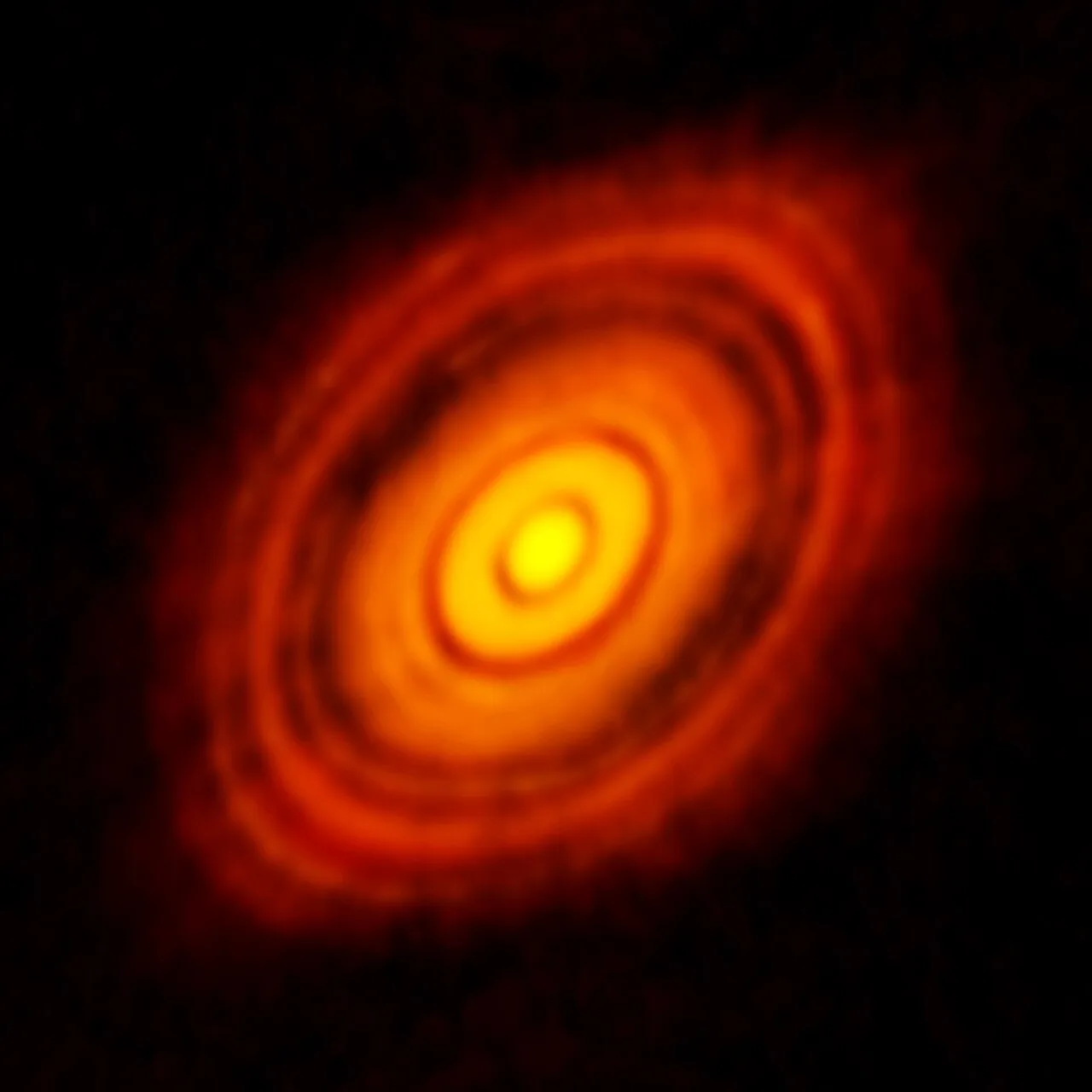
The timings we can pin down are surprisingly short. Theory puts the disc's flattening at roughly the first 100,000 years, and observation agrees — Webb's image of L1527, a protostar in Taurus, shows exactly that structure in progress. The gas was on a clock: dating of meteorite grains shows the disc was making solids for only about 3 million years before the young Sun's wind cleared what was left.
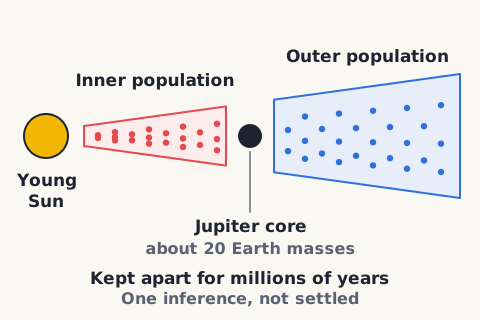
Jupiter appears to have gone first. An isotopic study of iron meteorites by Kruijer and colleagues (2017) found two chemically distinct populations that stayed separated for a stretch of the disc's life — most simply explained by a large body already massive enough to keep them apart. That is one study, and it is attributed here rather than stated as established history.
The order of events, start to finish: a cold cloud collapses; it spins up and flattens into a disc; dust grains stick together; planetesimals collide and grow; and the survivors clear their orbits.
The ages come from a specific object. Calcium-aluminum-rich inclusions — millimeter-sized white specks inside primitive meteorites — are the oldest solids we have, and they date to 4.567 billion years. The method is radiometric dating: a radioactive parent isotope decays into a daughter element at a fixed rate, so the ratio between them is a clock. Earth is slightly younger than the system that made it, at about 4.5 billion years.
The Moon is thought to be wreckage from that assembly. NASA's account is that around 4.5 billion years ago something roughly the size of Mars struck the young Earth, and the debris coalesced. The evidence is in the Apollo rocks: Moon and Earth rocks are chemically very similar, and lunar basalts closely resemble Earth's. Similar, not identical — which is why this remains the best explanation rather than a closed case.
Reading the Evidence
Two of this lesson's best-known stories are less settled than their fame suggests.
The Late Heavy Bombardment — a proposed spike of impacts across the inner Solar System around 3.9 billion years ago — is now seriously contested. It was inferred largely from Apollo samples, and the newest test came from the Moon's far side: China's Chang'e-6 returned material from the South Pole–Aitken basin, including impact-melt rock, precisely to check whether the spike is real or an artifact of where Apollo happened to land.
The Nice model and the Grand Tack are models, not records. The Nice model proposes that the giant planets formed on tighter, more circular orbits and later migrated by scattering leftover material. The Grand Tack has Jupiter migrating inward to about 1.5 AU and then reversing, which would explain why Mars is so small. Both are attempts to explain observations. Neither is history.
The strongest outside check came from other stars. In October 1995, Michel Mayor and Didier Queloz found 51 Pegasi b, the first planet orbiting a Sun-like star. Three decades and more than 6,000 confirmed planets later, the lesson is humbling: our arrangement is not the default. Hot Jupiters — giants orbiting closer than Mercury — were not supposed to exist, and finding them is what made migration a serious idea rather than an epicycle.
Real gaps remain, and they are worth naming. Nobody has a settled account of how millimeter dust grains got past meter size, where a growing body drifts inward through the disc faster than it can grow. The frost line itself is not fixed — in a typical young disc water stays gaseous out to roughly 3 AU, but the boundary moves as the disc cools.
And the whole timeline rests on material we can actually weigh. Apollo, the Soviet Luna landers and Chang'e-5 together returned about 383 kg of Moon rock. Everything above is read off that, off meteorites, and off other stars caught in the act.
Key terms
- Frost line
- The distance from a young star beyond which water stops being vapor and freezes into solid grains — a temperature boundary that travels, not a fixed wall
- Radiometric dating
- Reading an age from the ratio of a decaying parent isotope to its daughter — it times when a rock last closed up, not when its atoms were made
- Hot Jupiter
- A gas giant that circles its star in days rather than years, roasting closer in than Mercury sits to the Sun — a class with no counterpart in our own system
Key facts
One Cloud, One Birthday
The Sun, the planets, the moons, the asteroids and the comets all date from a single event about 4.6 billion years ago, when a dense cloud of interstellar gas and dust collapsed under its own gravity. The Sun did not form first and then gather up planets that were already wandering about — everything here condensed out of the same collapse.
Why The Orbits Line Up
A cloud rotating even slightly spins faster as it shrinks, and a spinning collapsing cloud flattens. The result was the solar nebula: a disc of gas and dust around the young Sun. That is why the planets today all orbit in nearly the same plane and in the same direction — they were assembled from a spinning plate and still carry its motion. Randomly tilted, randomly directed orbits were never on the table.
Isotopes With A Deadline
A cold cloud can sit for a very long time without collapsing, so something probably pushed. The evidence for a dying star nearby is chemical: the oldest meteorites hold the decay products of aluminum-26 and iron-60. Iron-60's half-life is 2.60 million years — far too short to have survived from the early universe, so it must have been made shortly before the Solar System's first solids froze. It is made in quantity essentially only inside massive stars. A strong argument, not an eyewitness.
The Boundary That Sorted Everything
Inside the frost line only rock and metal could stay solid, so the inner planets had very little to work with and came out small. Beyond it water froze into ice in bulk — and further out still, methane and ammonia — giving those bodies vastly more solid material and letting them grow into giants. That one boundary is why the four inner planets are terrestrial, with surfaces you could stand on, and the four outer ones have no ground at all. Size was not luck.
One Star, Plus Debris
The Sun holds 99.8 per cent of the Solar System's mass. Every planet, every moon, the asteroid belt, the Kuiper Belt and all the comets together make up the remaining fifth of one per cent. Jupiter, the largest planet, is about a thousandth of the Sun's mass. That single number is why the Sun's gravity, and not any planet's, governs almost every orbit in the system.
Mass Here, Spin There
That 99.8 per cent creates a genuine puzzle, still open: the angular momentum problem. The Sun holds nearly all the mass but only a small share of the system's spin — roughly 99 per cent of the angular momentum sits in the planets' orbits, most of it in the outer planets'. A cloud that simply fell inwards would have left the Sun spinning near break-up. Magnetic braking by the young Sun's wind is the favored way it shed the excess: a proposed mechanism, not something observed.
Three Million Years, Then Nothing
Dating of meteorite grains shows the disc was making solids for only about 3 million years, and the young Sun's wind and radiation had cleared the remaining gas within roughly 3 to 10 million years. The Atacama Large Millimeter Array (ALMA)'s picture of HL Tauri — a star no more than a million years old, already carved into concentric rings separated by gaps — shows how fast the process runs. That deadline is why there are only four giants: anything that grew large later found nothing left to grab.
Jupiter Went First
An isotopic study of iron meteorites by Kruijer and colleagues (2017) found two chemically distinct populations that stayed separated for millions of years. The simplest explanation is a large body already massive enough to keep them apart: Jupiter's core reaching about 20 Earth masses within the first million years, splitting the disc in two. That is one research group's inference, not settled history — but on this reading the planets did not form in the order they orbit.
Wreckage That Became A Moon
NASA's account is that around 4.5 billion years ago something roughly the size of Mars — or a series of objects — struck the young Earth and threw enough molten and vaporized debris into orbit to build the Moon, about 60 million years after the Solar System began forming. The Apollo rocks agree: lunar basalts closely resemble Earth's mantle basalts, and lunar rock is depleted in the elements that boil off when heated. Similar, not identical — the best explanation, not a closed case.
A Textbook Fact In Trouble
The Late Heavy Bombardment — a proposed spike of impacts across the inner Solar System around 3.9 billion years ago — is now seriously contested. It was inferred from a cluster of Apollo sample ages, and a 2016 analysis showed a steadily declining impact rate produces that same apparent cluster. A 2017 review found the lunar record fits prolonged bombardment from about 4.2 to 3.4 billion years ago instead. The craters are not in doubt; the sudden late surge is.
The Planet Nobody Expected
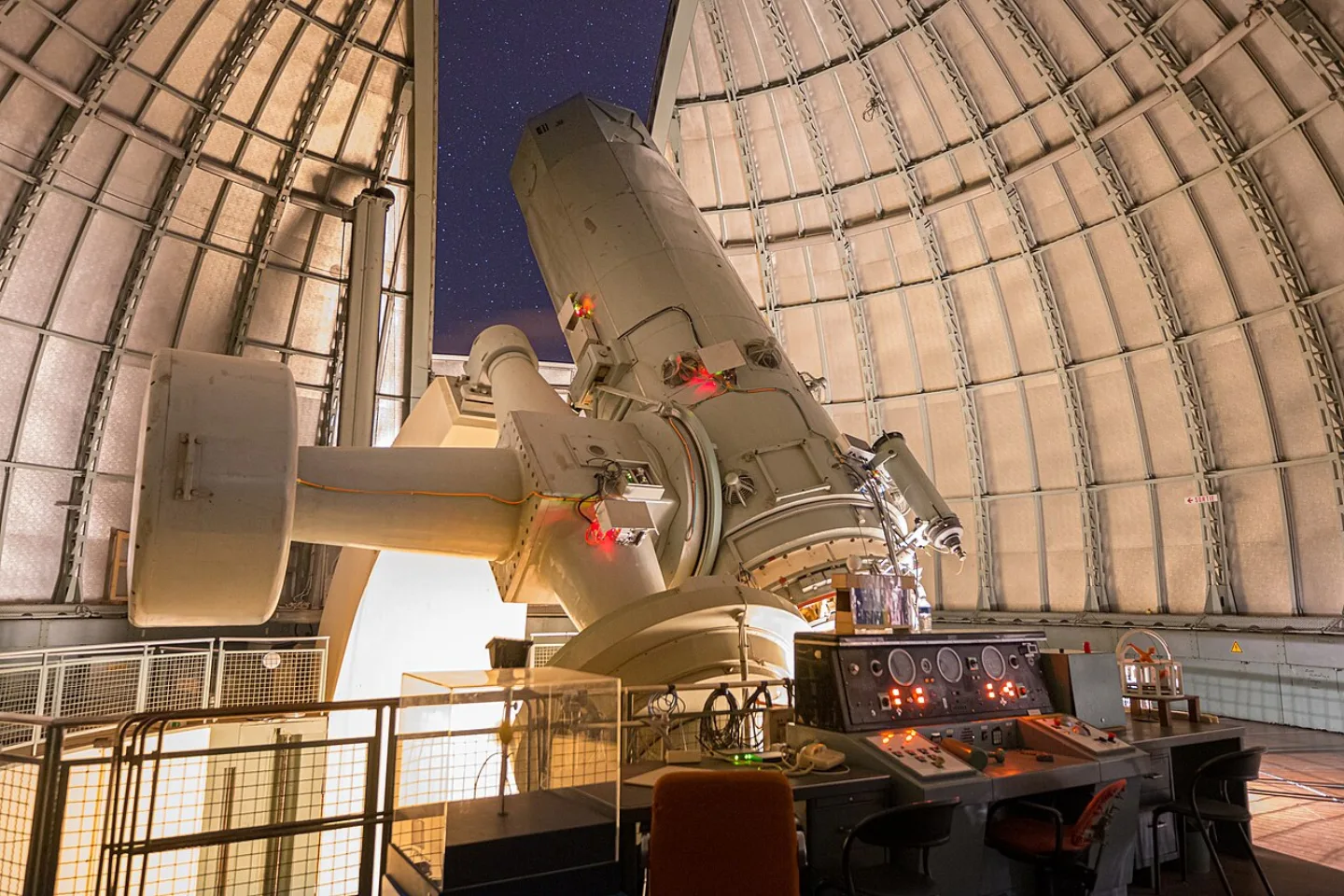
In October 1995 Michel Mayor and Didier Queloz found the first planet orbiting a Sun-like star: 51 Pegasi b, a gas giant of about 0.46 Jupiter masses circling its star every 4.2 days at 0.0527 AU — far closer in than Mercury orbits the Sun. Frost-line reasoning says a giant cannot assemble there, where it is far too hot for ice to survive. It was not an interesting new planet; it was a contradiction. They shared the 2019 Nobel Prize in Physics for it.
The Step Nobody Can Explain
Nobody has a settled account of how millimeter dust grains got past meter size. At around a meter a growing body drifts inward through the disc fast enough to be swallowed by the star before it can grow further — the meter-sized barrier problem. The streaming instability is described in the literature as a leading candidate, not the answer, and one review lists the growth of the first planetesimals among five unresolved bottlenecks. 'Planets grow by sticking together' is not a complete explanation.
The Line That Moves
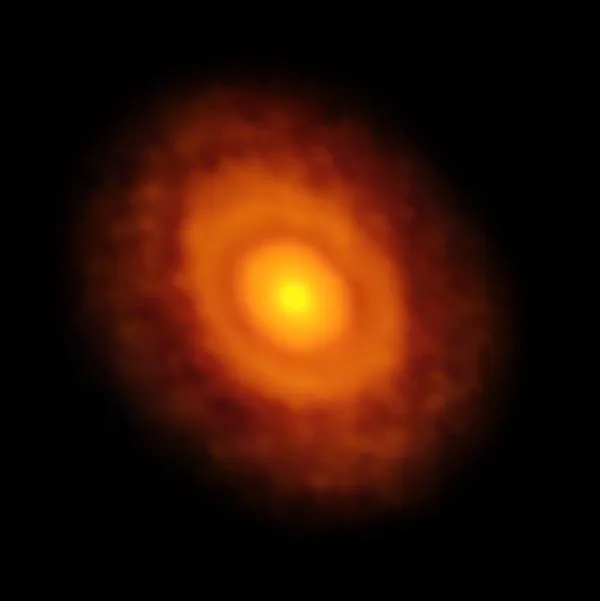
The frost line is a temperature contour, so it travels. In a typical young disc water stays gaseous out to roughly 3 AU — about 450 million km — but the boundary shifts as the disc's temperature changes. ALMA caught this directly at the young star V883 Orionis, where an outburst of brightness pushed the water snow line out to around 40 AU, roughly the size of Pluto's orbit. Models show it drifts inward again as a disc's accretion rate falls.
Matched pairs
Each item on the left goes with the one on the right.
- Planetesimals
- Kilometer-sized clumps built from dust that stuck together
- The asteroid and Kuiper Belts
- Original building material never used — rockier close in, icier further out
- The oldest dated solids
- Calcium-aluminum-rich specks in meteorites, 4,567 million years
- All the Moon rock we hold
- About 385 kg, from Apollo, Luna and both Chang'e missions
Self-test
Answer each question from memory, then check your work against the answer key.
1. Why are the planets nearest the Sun so small?
- AThey had less time to grow
- BIce was scarce all over the disc
- COnly rock and metal stayed solid
- DThe solar wind stripped them
2. What supports the idea that a nearby exploding star squeezed the cloud?
- AThe Sun's 99.8 per cent share
- BDecayed isotopes in meteorites
- CThe Sun's high metal content
- DThe flat plane of the orbits
3. Why does Earth date younger than the oldest meteorite grains?
- AThose grains predate the system
- BIt formed from a later cloud
- CDecay rates changed over time
- DIt took longer to finish forming
4. What makes the giant-impact story awkward rather than closed?
- AIt matches Earth's rock too well
- BLunar rock is rich in volatiles
- CNo impactor debris on Earth
- DThe Moon has no magma history
5. What is the current standing of the proposed 3.9-billion-year impact spike?
- AConfirmed by Chang'e-6 samples
- BSeriously contested
- CContested, then confirmed
- DContested only on timing
6. What did three decades of exoplanet hunting show about our own layout?
- AThe commonest we have found
- BStill too early to say
- CThe only one of its kind so far
- DOne outcome among many
Go deeper
- WatchA Spinning Plate About 4.6 billion years ago, a cloud of gas and dust collapsed under its own gravity.
- WatchWreckage The oldest solids we have are tiny white specks inside primitive meteorites. They date to 4.567 billion years.
- WatchNot the Default In October 1995, Michel Mayor and Didier Queloz found 51 Pegasi b: the first planet orbiting a Sun-like star.
- StudyAstronomy & Space in the FlashFeed app
Answer key
- 1. C Only rock and metal stayed solidInside the frost line only rock and metal stayed solid, so there was very little to build with. They had the same time as everyone else; the solar wind strips atmospheres rather than rock; and ice was abundant beyond that boundary rather than scarce everywhere.
- 2. B Decayed isotopes in meteoritesAluminum-26 and iron-60 decay far too fast to be primordial, so their daughter products date their making to just before the first solids froze. High metal content shows earlier generations of stars in general, not one nearby blast. The flat plane records the disc.
- 3. D It took longer to finish formingThe first solids froze at 4.567 billion years; Earth needed tens of millions of years of collisions after that, giving about 4.5 billion. Melting resets one rock's clock, not a planet's formation date; the grains formed inside the same event, not before it; and decay rates are fixed.
- 4. A It matches Earth's rock too wellA Mars-sized impactor should have left the Moon made mostly of the impactor, yet the two are nearly identical isotopically. Debris from it was never expected to survive on Earth. The Moon does have a magma-ocean history, and its rocks are notably POOR in volatiles.
- 5. B Seriously contestedThe spike is seriously contested: it was inferred largely from Apollo samples, and Chang'e-6 returned far-side rock to test whether it is real or an artifact of where Apollo landed. It has not been confirmed, and the doubt is whether it happened at all, not just when.
- 6. D One outcome among manyMore than 6,000 confirmed planets show arrangements with no counterpart here — hot Jupiters roasting days from their stars. Ours is one arrangement among many, and not the commonest. Nor is it unique: surveys reach only a thin, biased slice of the galaxy.
Sources
- NASA Science — Solar System Facts — science.nasa.gov/solar-system/solar-system-facts/
- ESA — Comets and how the Solar System formed — www.esa.int/ESA_Multimedia/Images/2013/12/Comets_and_how_the_Solar_System_formed
- Physics World — Nailing the half-life of iron-60 (Wallner et al. 2015) — physicsworld.com/a/nailing-the-half-life-of-iron-60/
- NASA Space Place — How Did the Solar System Form? — spaceplace.nasa.gov/solar-system-formation/en/
- NASA Science — Sun Facts — science.nasa.gov/sun/facts/
- ESO — Stellar Outburst Brings Water Snow Line Into View — www.eso.org/public/unitedkingdom/news/eso1626/
- NASA Science — Asteroid Facts — science.nasa.gov/solar-system/asteroids/facts/
- University of Oregon, AST 121 — Origin of the Solar System — pages.uoregon.edu/jschombe/ast121/lectures/lec23.html
- NASA Science / Webb — Webb Catches Fiery Hourglass as New Star Forms — science.nasa.gov/missions/webb/nasas-webb-catches-fiery-hourglass-as-new-star-forms/
- Connelly et al. 2012, Science — Absolute chronology of solids in the solar protoplanetary disk — pubmed.ncbi.nlm.nih.gov/23118187/
- University of Münster — Jupiter is the oldest planet of the Solar System (Kruijer et al. 2017) — www.uni-muenster.de/news/view.php?cmdid=8953
- NASA Science — How the Moon Formed — science.nasa.gov/moon/formation/
- USGS — Geologic Age: Using Radioactive Decay to Determine Geologic Age — www.usgs.gov/educational-resources/geologic-age-using-radioactive-decay-determine-geologic-age
- NASA Science — Earth Facts — science.nasa.gov/earth/facts/
- Boehnke & Harrison 2016, PNAS — Illusory Late Heavy Bombardments — pubmed.ncbi.nlm.nih.gov/27621460/
- Yue et al. 2026, Science Advances — Lunar chronology model with the Chang'e-6 farside samples — pmc.ncbi.nlm.nih.gov/articles/PMC12871470/
- NASA Science — Exoplanet Catalog: 51 Pegasi b — science.nasa.gov/exoplanet-catalog/51-pegasi-b/
- Lim et al. 2024, ApJ — Streaming Instability and Turbulence: Conditions for Planetesimal Formation — iopscience.iop.org/article/10.3847/1538-4357/ad47a2
- NASA Science — Exoplanets — science.nasa.gov/exoplanets/
- Li et al. 2024, National Science Review — Chang'E-6 lunar far-side samples — pmc.ncbi.nlm.nih.gov/articles/PMC11495410/
Image credits
- One Cloud, One Birthday: Wikimedia Commons · ESO · CC BY 4.0 — commons.wikimedia.org/wiki/File:Barnard_68.jpg
- Why The Orbits Line Up: FlashFeed original diagram · CC-BY-4.0
- Three Million Years, Then Nothing: ALMA (ESO/NAOJ/NRAO) · CC BY 4.0 — commons.wikimedia.org/wiki/File:HL_Tau_protoplanetary_disk.jpg
- Jupiter Went First: FlashFeed original diagram · CC-BY-4.0
- The Planet Nobody Expected: José Rodrigues · CC BY-SA 4.0 — commons.wikimedia.org/wiki/File:T193_in_observations.jpg
- The Line That Moves: Wikimedia Commons · ALMA (ESO/NAOJ/NRAO)/L. Cieza · CC BY 4.0 — commons.wikimedia.org/wiki/File:ALMA_image_of_the_protoplanetary_disc_around_V883_Orionis_(eso1626b).jpg


