
Astronomy & Space study guide · Lesson 12 of 13
The Lives of Stars
How Stars Are Born · Mass Decides Everything · How Stars Die
This is the lesson's study guide from the FlashFeed app, plus its key facts and a self-test.
What you'll be able to do
- Classify a star by mass and color, and predict whether it ends as a dwarf, neutron star or black hole
A star is a fight between two things: gravity pulling inward and pressure pushing out. Everything a star ever does — how brightly it burns, how long it lasts, what it leaves behind — follows from how much material it started with. One number decides the whole biography, and that number is mass.
How Stars Are Born
Stars form inside molecular clouds: cold, dense regions of the interstellar medium holding between about 1,000 and 10 million times the mass of the Sun. They are the coldest places around, at 10 to 20 kelvin — roughly minus 263 to minus 253 Celsius. A cloud above about 100,000 solar masses earns the name giant molecular cloud, and they range from under a light-year to about 300 light-years across.
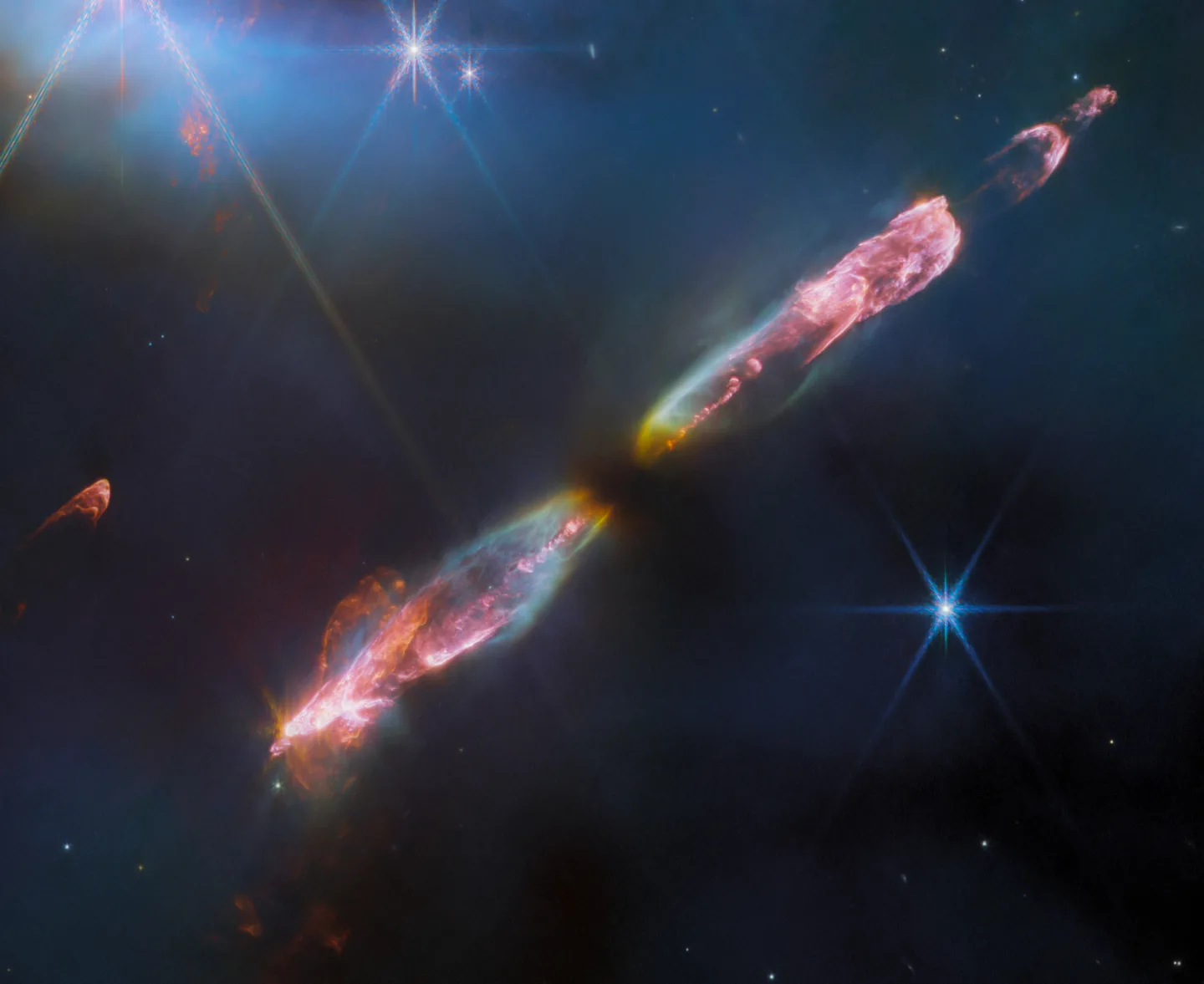
Gravity pulls the densest clumps inward. Infalling material heats as it compresses, and the hot contracting ball at the center is a protostar. It glows — reaching 2,000 to 3,000 K, hot enough to shine red — long before it is a star, because compression alone will do that. Birth is not gentle: only about 10 percent of protostars survive their birth region, the rest disrupted by nearby radiation and outflows before they finish.
The moment that changes everything is when the core reaches about 15 million degrees and hydrogen fusion begins. Now the star has an engine, and the fight becomes a standoff. Fusion pressure pushing out exactly balances gravity pulling in — a state called hydrostatic equilibrium — and a star will hold that balance for as long as its fuel lasts.
How it fuses depends on temperature. The proton-proton chain dominates in stars like the Sun. The CNO cycle takes over in hotter, heavier stars, because its rate rises roughly as temperature to the 20th power while the proton-proton rate rises only as the 4th. A modest temperature increase barely moves one and transforms the other.
Mass Decides Everything
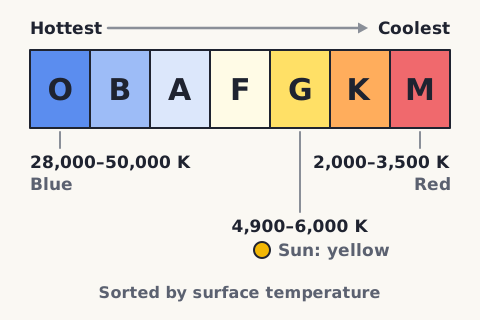
Sort stars by surface temperature and they fall into a sequence: O, B, A, F, G, K, M. O-class stars run 28,000–50,000 K and burn blue; G-class, our Sun's class, sits at 4,900–6,000 K and looks yellow; M-class runs 2,000-3,500 K and glows red.
The letters are out of alphabetical order for an entirely human reason. Edward Pickering first ranked stars A, B, C by the strength of their hydrogen lines, and Annie Jump Cannon later reordered them by temperature, keeping the old labels. The sequence is a fossil of its own history.
Two facts about that sequence are worth holding onto. About 90 percent of stars sit on the main sequence — the diagonal band of hydrogen-burning stars on the Hertzsprung-Russell diagram, which plots surface temperature against luminosity and tells you a star's stage and mass from its position alone. And the typical star is nothing like the Sun: red dwarfs, the coolest M-class stars, make up around 75 percent of the Milky Way.
Now the relationship that runs the lesson. On the main sequence, luminosity scales roughly as mass to the power 3.5 to 4 — so doubling a star's mass makes it something like eleven to sixteen times brighter. Reputable sources give both exponents, and the disagreement is real rather than sloppy; it is quoted here as a range rather than averaged into false precision.
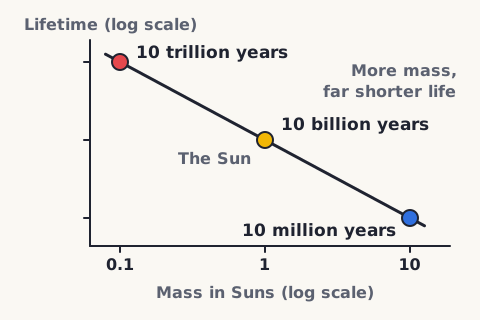
The consequence is the interesting part. Because luminosity rises far faster than mass, a heavier star burns through its fuel disproportionately fast, and main sequence lifetime falls as roughly mass to the power −2.5. A star ten times the Sun's mass does not last a tenth as long. It lasts about a thousandth as long:
| Mass | Main-sequence life |
|---|---|
| 10 × Sun | ~10 million years |
| 1 × Sun | ~10 billion years |
| 0.1 × Sun | ~10 trillion years |
The red dwarfs that dominate the galaxy will still be burning long after every star like the Sun has finished.
Mass also fixes the ending. A star that begins life above roughly 8 solar masses is heavy enough to run its core all the way to iron and collapse; below that it dies quietly. That figure is a teaching approximation rather than a line — modeling puts it near 8.3 at low metal content and about 9.5 at the Sun's.
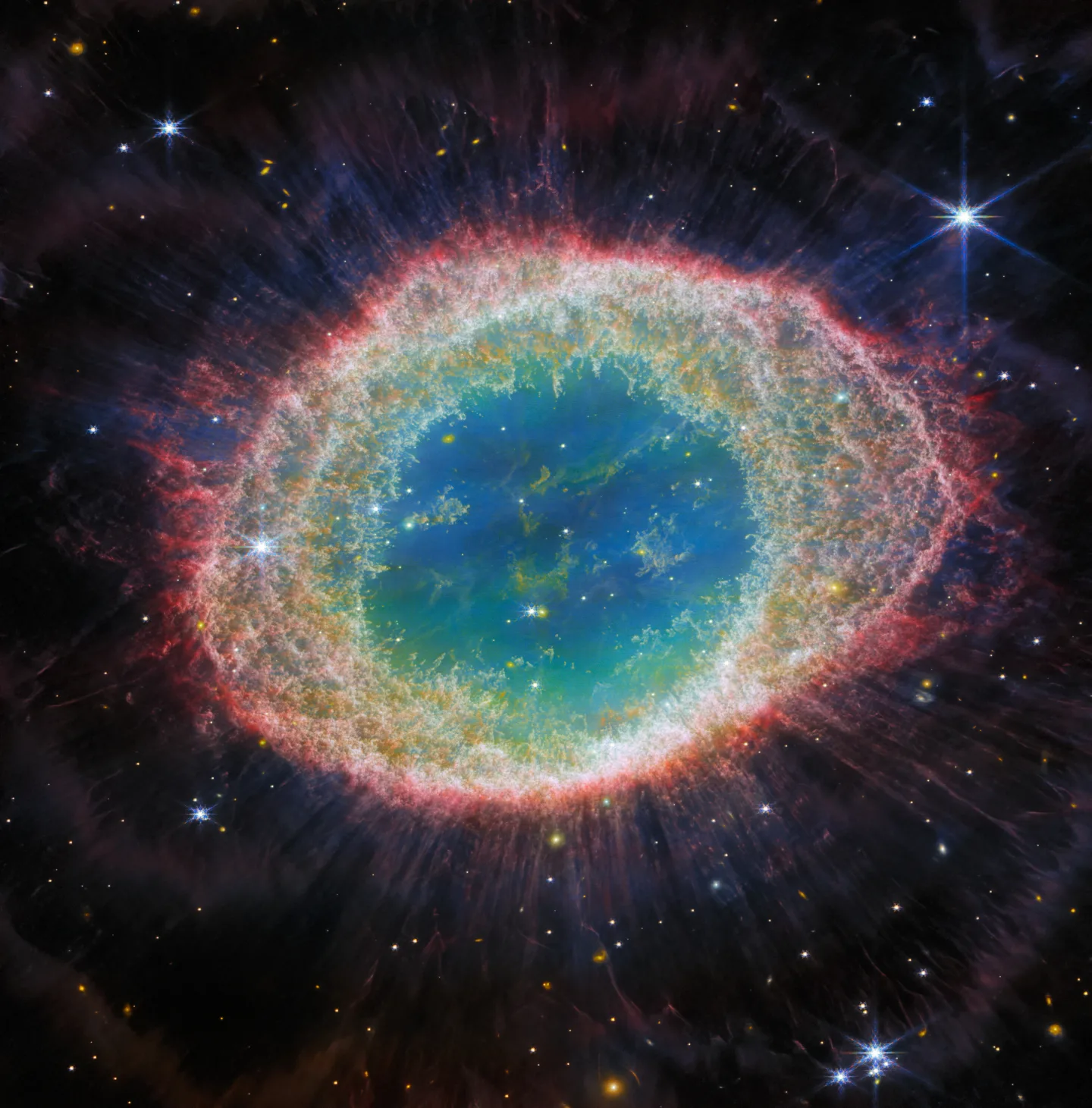
For a Sun-like star the ending is quiet. It swells into a red giant, then sheds its outer layers as a planetary nebula — which glows for only about 20,000 years before dispersing, and has nothing whatever to do with planets; the name is an eighteenth-century mistake about what they looked like through small telescopes. What remains is the exposed core: a white dwarf, roughly Earth-sized, about a billion kilograms per cubic meter, cooling for tens to hundreds of billions of years.
How Stars Die
There is a ceiling on how heavy a white dwarf can be. The Chandrasekhar limit — about 1.4 solar masses, given as 1.44 by NASA — is the point above which electron degeneracy pressure can no longer hold the core up.
Stars that begin life above roughly 8 solar masses take the other route. Such a star builds heavier elements in shells until it makes iron, and there the engine stops: fusing iron yields no net energy. Around 10¹⁰ K the iron itself comes apart, the core loses its support, and it collapses. A core-collapse supernova releases about 10⁴⁶ joules in seconds — and roughly 99 percent of that leaves as neutrinos, in a burst about ten seconds long. The light show is the leftover.
What the collapsed core becomes depends on its mass: below about 1.4 solar masses a white dwarf, between roughly 1.4 and 3 a neutron star, above that a black hole.
Those thresholds are approximate, and the honest version says so. CSIRO notes the neutron-star upper limit is not well defined and may reach 5 solar masses in some models. The Tolman-Oppenheimer- Volkoff limit — the most mass a non-rotating neutron star can hold — is constrained to roughly 2.0 to 2.2 solar masses, but the value depends on the behavior of matter at densities we cannot reproduce or fully calculate.
A neutron star packs more than the Sun's mass into a sphere about 20 kilometers across. A sugar cube of the material would weigh about a billion tons. What is inside one is genuinely unresolved: NASA's own NICER team pose it as an open question — neutrons all the way down, or something stranger.
Betelgeuse is the nearby example of a star at the end of this road: a red supergiant about 700 light-years away and roughly 15 times the Sun's mass. It will end as a core-collapse supernova. Not imminently, whatever you may have read — NASA's estimate is within about the next 100,000 years.
Key terms
- Protostar
- A contracting ball of infalling gas that already glows from compression alone, before any fusion has started in its core
- Main sequence
- The diagonal band of stars still fusing hydrogen in the core — the long stable middle of a star's life rather than a type of star, which is why around 90 percent are caught in it
- Chandrasekhar limit
- The heaviest a white dwarf can be, about 1.4 solar masses — a ceiling on the leftover core rather than on the star it came from, set by where electron degeneracy pressure loses to gravity
Key concepts
White dwarf
- The lightest of the three objects a collapsed stellar core can end up as.
- It is the ending for a leftover core below about 1.4 solar masses; a heavier core cannot stop there.
- What holds it against gravity is electron degeneracy pressure, and NASA puts the ceiling on that pressure at 1.44 solar masses.
Neutron star
- The middle of the three possible endings: what a leftover core between roughly 1.4 and 3 solar masses becomes.
- More than the Sun's mass inside a sphere about 20 kilometers across; a sugar cube of the material would weigh about a billion tons.
- NASA's NICER mission sized a 2.1-solar-mass example at roughly 25 to 27 kilometers wide, depending on which analysis team's model you take.
Black hole
- The heaviest of the three possible endings: what a leftover core above about 3 solar masses becomes
- NASA says our own star would need to be roughly 20 times more massive to finish this way
- Not even light escapes once the core passes the limit that neutron pressure can hold
Core-collapse supernova
- About 10^46 joules released in a matter of seconds — some 50 times more than the Sun will put out in 10 billion years.
- It is not a star running out of fuel — it is a star whose remaining fuel would cost more energy to burn than it gives back.
- The blinding flash everyone points a telescope at is only about one percent of what it releases; the rest leaves invisibly.
Neutrinos
- Particles that carry away roughly 99 percent of the energy of an exploding massive star, in a burst about ten seconds long.
- They pass straight through everything in their path — the dying star's own outer layers, the Earth, and you — which is why so few are ever caught.
- Just 25 of them were caught on Earth from a single such event in 1987.
Iron
- The last element a massive star manages to build in its shells, and the point at which its engine stops paying.
- Fusing it yields no net energy — because of its nuclear structure, the reaction costs energy instead of releasing it.
- Around 10 billion K it comes apart under the radiation around it, the support beneath the star's outer layers disappears, and what is left falls inward at tens of thousands of kilometers per second.
Key facts
Gravity Lights It First
Gravity pulls the densest clumps of a cloud inward, and the infalling material heats as it is compressed. The hot contracting ball at the center is a protostar — already at 2,000 to 3,000 K with no fusion at all — hot enough to glow red, though the dust cocoon around it blocks that light, so protostars are found in the infrared rather than by eye. Birth is not gentle: only about 10 percent of protostars survive their birth region, the rest disrupted by nearby radiation and outflows. Gravity does the heating first; nuclear physics takes over later.
Fifteen Million Degrees
A protostar becomes a star at a definable moment: when its core reaches about 15 million degrees and hydrogen fusion begins. That is an operational definition, not a vague label. Before ignition there is a contracting ball of gas that happens to glow. After it, there is an engine.
Temperature to the Twentieth
How a star fuses depends on how hot its core is. The proton-proton chain dominates in stars like the Sun, and its rate climbs only as temperature to the 4th power. The CNO cycle rate climbs as roughly temperature to the 20th power, so it takes over above about 1.1 solar masses. A modest temperature rise barely moves one reaction and transforms the other — which is why a heavier star does not simply have more fuel, it also burns a far more temperature-hungry one.
Color Is a Thermometer
Sort stars by surface temperature and they fall into a sequence: O, B, A, F, G, K, M. O-class stars run 28,000–50,000 K and burn blue. G-class, the Sun's class, sits at 4,900–6,000 K and looks yellow. M-class bottoms out around 2,000 K and glows red. Taps and warning lights have trained you backwards: in stars, blue is the hot end and red is the cool one.

A Fossil of Its History
The letters are out of alphabetical order for an entirely human reason. Edward Pickering first ranked stars A, B, C by the strength of their hydrogen lines. Annie Jump Cannon later realized the same stars could be sorted by temperature instead, reordered the surviving classes, and kept the old labels. OBAFGKM is not a random jumble, and the letters stand for nothing — the sequence is a fossil of its own history.
Sixteen Times the Light
On the main sequence, luminosity scales roughly as mass to the power 3.5 to 4 — so doubling a star's mass makes it something like eleven to sixteen times brighter, not twice as bright. Reputable sources give both exponents, so this is a rule of thumb rather than a law. Brightness is not proportional to mass; it is a steep power of it.
Live Fast, Die Young
Because luminosity rises far faster than mass, a heavier star spends its fuel disproportionately fast: main sequence lifetime falls as roughly mass to the power −2.5 to −3 — sources give both. A star ten times the Sun’s mass lasts somewhere between 316 and 1,000 times less long, not ten times. Ten solar masses buys roughly 10 million years; the Sun gets about 10 billion; a 0.1-solar-mass red dwarf, on the order of 10 trillion. Six orders of magnitude of lifetime out of two orders of magnitude of mass.
The Quiet Ending
A red giant sheds its outer layers as a planetary nebula, which glows for only about 20,000 years before dispersing — a flicker, which is why so few exist at any moment. The name is an eighteenth-century telescope error; these have nothing whatever to do with planets. What is left is the exposed core: a white dwarf, roughly Earth-sized, about a billion kilograms per cubic meter, with no fusion at all, cooling for tens to hundreds of billions of years.
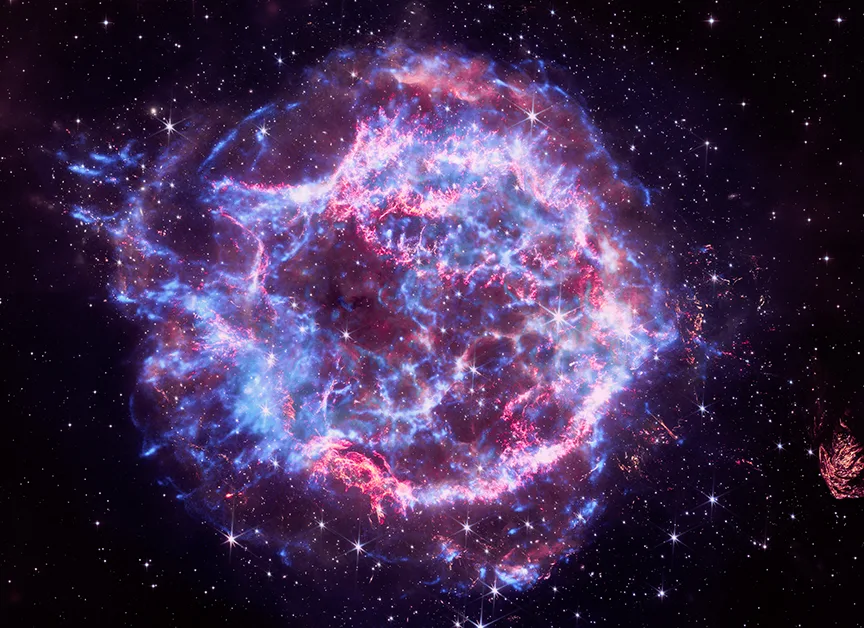
Where Fusion Stops Paying
A massive star builds heavier elements in shells until it makes iron, and there the engine stops: because of iron's nuclear structure, fusing it yields no net energy. Around 10 billion K the iron itself comes apart, the support under the star's outer layers vanishes, and the core falls inward at tens of thousands of kilometers per second. The star does not explode because it ran out of fuel. It explodes because its remaining fuel would cost energy to burn.
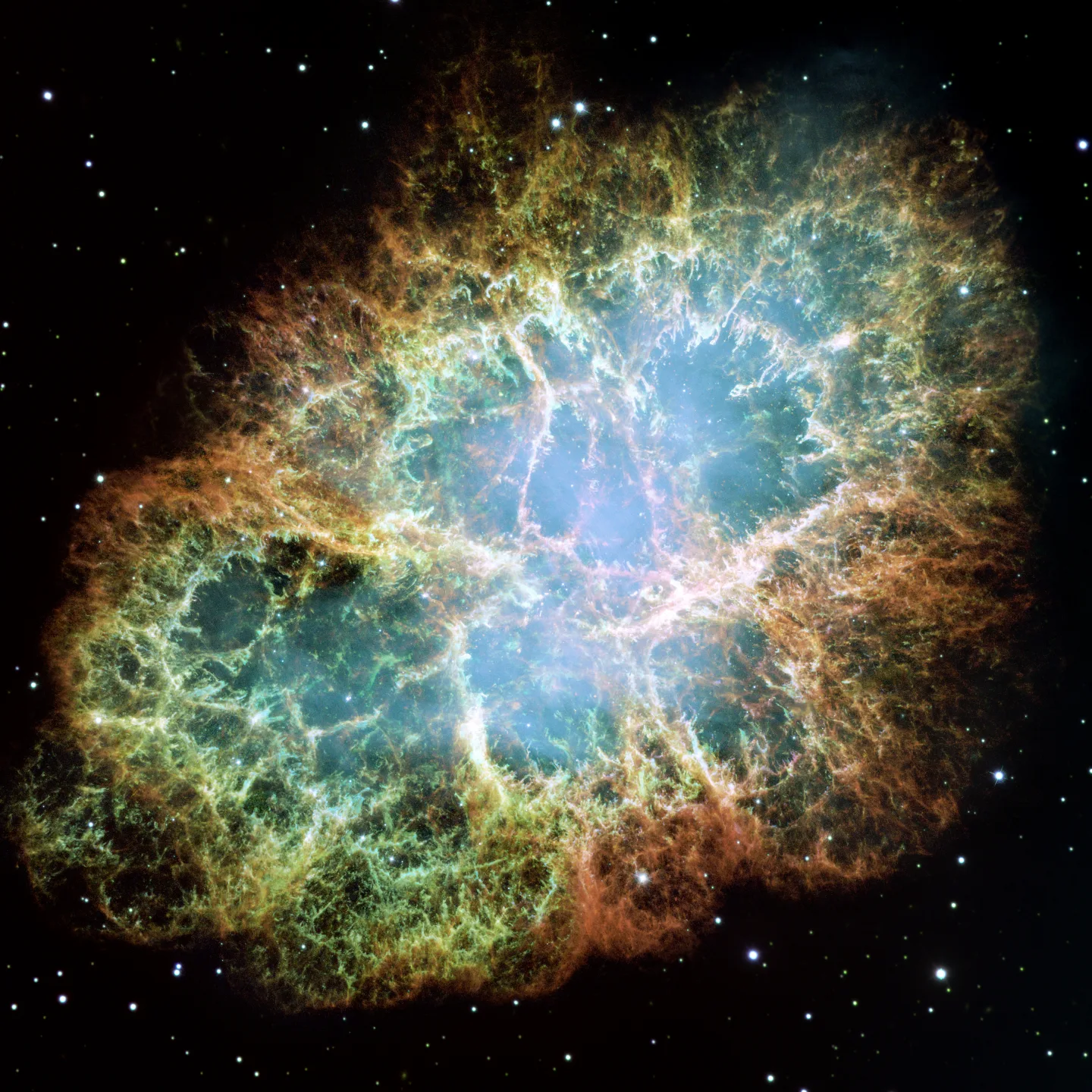
Three Endings, One Number
What a collapsed core becomes depends on a single number — its own mass. Below about 1.4 solar masses it is a white dwarf. Between roughly 1.4 and 3, a neutron star. Above that, a black hole. Not every star can take the last route: NASA notes the Sun would need to be about 20 times more massive to end its life as one. Mass decides, and the Sun does not qualify however long it lives.
Not Constants of Nature
Those thresholds are approximate, and the honest version says so. CSIRO notes the neutron-star upper limit is not well defined and may reach 5 solar masses in some models. NASA puts core-collapse progenitors at roughly 8 to 20 solar masses for a neutron star, with heavier stars still collapsing to a black hole — and the boundary between the two outcomes is a modeling question, not a measured line.
By the numbers
- Blue O-class stars, at their hottest
- 50000 K
- Blue O-class stars, at their coolest
- 28000 K
- Yellow G-class stars, at their hottest
- 6000 K
- Yellow G-class stars, at their coolest
- 4900 K
- Red M-class stars, at their hottest
- 3500 K
- Red M-class stars, at their coolest
- 2000 K
Matched pairs
Each item on the left goes with the one on the right.
- Giant molecular cloud
- Any such body above about 100,000 solar masses
- Protostar survival
- About 1 in 10 gets out of the birth region — one widely cited estimate
- Red dwarfs
- About 75 percent of the Milky Way's stars
- Hertzsprung-Russell diagram
- Surface temperature plotted against luminosity
- Tolman-Oppenheimer-Volkoff limit
- Roughly 2.0 to 2.2 solar masses, and still being pinned down
Self-test
Answer each question from memory, then check your work against the answer key.
1. What temperature is the gas that star formation starts in?
- AAround 300 kelvin
- BAbout 15 million kelvin
- C10 to 20 kelvin
- D2,000 to 3,000 kelvin
2. Why does a protostar already shine before it is a star?
- AIts cloud was warm to start
- BHydrogen fusion has begun
- CIt reflects nearby starlight
- DCompression heats the gas
3. How steeply does the CNO cycle's rate climb with core temperature?
- AAs the 20th power
- BAs the 4th power
- CIn direct proportion
- DAs the 8th power
4. How does a 10-solar-mass star's time on the main sequence compare with the Sun's?
- AAbout three times shorter
- BHundreds to a thousand times
- CVery slightly shorter
- DAbout ten times shorter
5. How heavy must a star be at birth to end in core collapse?
- AAbout 2 solar masses
- BAbout 80 solar masses
- CAbout 8 solar masses
- DAbout 25 solar masses
6. How much heavier would the Sun need to be to end as a black hole?
- AAbout 3 times its mass
- BAbout 12 times its mass
- CAbout 50 times its mass
- DAbout 20 times its mass
7. What carries away about 99 percent of a core-collapse supernova's energy?
- AThe expanding debris
- BNeutrinos
- CX-rays
- DVisible light
8. Why does a massive star's core give way at the end?
- AFusing iron would cost energy
- BIt has no fuel left at all
- CIts outer layers crush it
- DIt spins itself apart
Go deeper
- WatchBorn Cold Stars form in the coldest places around: molecular clouds at 10 to 20 kelvin.
- WatchA Thousandth as Long A star 10 times the Sun's mass doesn't last a tenth as long. It lasts about a thousandth as long.
- WatchA Billion Tons Stars that begin above roughly 8 times the Sun's mass end in a core-collapse supernova.
- StudyAstronomy & Space in the FlashFeed app
Answer key
- 1. C 10 to 20 kelvinMolecular clouds are the coldest, densest part of the interstellar medium. 2,000 to 3,000 K is the protostar once it is already contracting, and 15 million is the core at ignition — both come later. 300 K is about room temperature, far too warm for gravity to win.
- 2. D Compression heats the gasInfalling material heats as it is squeezed — gravity does the work before nuclear physics does. Fusion has not begun; that waits for 15 million degrees. Reflection could never reach 2,000 to 3,000 K. And the cloud it forms in is 10 to 20 kelvin, the coldest gas around.
- 3. A As the 20th powerThe 4th power is the proton-proton chain's dependence, not this one's. Direct proportion and an 8th-power climb both badly understate it: the gap between 4 and 20 is exactly why a modest temperature rise barely moves one reaction and transforms the other.
- 4. B Hundreds to a thousand timesLifetime falls as mass to roughly the power -2.5 to -3, so ten times the mass buys between about 316 and 1,000 times less time: ~10 million years against the Sun's ~10 billion. Ten times and three times both assume lifetime tracks mass directly, which is the mistake.
- 5. C About 8 solar massesBelow roughly that figure a star ends quietly instead. It is a teaching approximation, not a line: modeling puts the minimum near 8.3 at low metal content, rising to about 9.5 at solar metallicity. The 2, 25 and 80 options all sit far from where the transition happens.
- 6. D About 20 times its massNASA puts it at about 20 times the Sun's mass. Three is a limit on the leftover CORE, not the star that made it. Twelve would give a supernova, but the core left behind would settle as a neutron star. Fifty would do it — the question asks the least it would take.
- 7. B NeutrinosThey leave in a burst roughly ten seconds long, passing straight through everything in their path. The visible flash, the X-rays and the expanding debris share the remaining one percent between them — the light show is the leftover, not the explosion.
- 8. A Fusing iron would cost energyIron is where fusion stops paying: its nuclear structure means fusing it yields no net energy. The core is not empty — it is full of iron it cannot afford to burn. The outer layers fall in only after the support beneath them vanishes, and spin plays no part.
Sources
- Chandra X-ray Center — Giant Molecular Clouds and Protostars — chandra.harvard.edu/edu/formal/stellar_ev/story/index2.html
- NASA Imagine the Universe — Background: Life Cycles of Stars — imagine.gsfc.nasa.gov/educators/lessons/xray_spectra/background-lifecycles.html
- Case Western Reserve University — Nuclear Reactions in Stars — burro.case.edu/Academics/Astr221/StarPhys/nuclear2.html
- NASA Science — Stars — science.nasa.gov/universe/stars/
- CSIRO Australia Telescope National Facility — Spectral Classification — www.atnf.csiro.au/outreach/education/senior/astrophysics/spectral_class.html
- Chandra X-ray Center — What do the initials of OBAFGKM mean? — chandra.harvard.edu/resources/faq/astrophysics/astrophysics-56.html
- Penn State ASTRO 801 — The Mass-Luminosity Relationship — courses.ems.psu.edu/astro801/content/l7_p3.html
- ESA/Hubble — Planetary Nebula — esahubble.org/wordbank/planetary-nebula/
- NASA Science — Star Types — science.nasa.gov/universe/stars/types/
- ESO — Hertzsprung-Russell Diagram — www.eso.org/public/images/eso0728c/
- CSIRO ATNF — The Death of Stars I: Solar-Mass Stars — www.atnf.csiro.au/resources/education/senior-astrophysics/stellarevolution/deathlow/
- Fermilab — All Things Neutrino: Supernova Neutrinos — neutrinos.fnal.gov/sources/supernova-neutrinos/
- CSIRO ATNF — The Death of Stars II: High-Mass Stars — www.atnf.csiro.au/resources/education/senior-astrophysics/stellarevolution/deathhigh/
- Rezzolla, Most & Weih 2018 — Constraining the maximum mass of neutron stars (ApJL 852, L25) — arxiv.org/abs/1711.00314
- NASA Imagine the Universe — The Life Cycles of Stars — imagine.gsfc.nasa.gov/educators/lifecycles/LC_main3.html
- NASA — Why the Sun Won't Become a Black Hole — www.nasa.gov/image-article/why-sun-wont-become-black-hole/
- NASA Imagine the Universe — Neutron Stars — imagine.gsfc.nasa.gov/science/objects/neutron_stars1.html
Image credits
- Gravity Lights It First: ESA/Webb, NASA, CSA, T. Ray (Dublin Institute for Advanced Studies) (Openverse) · by 4.0 — commons.wikimedia.org/w/index.php?curid=137627717
- Color Is a Thermometer: FlashFeed original diagram · CC-BY-4.0
- A Fossil of Its History: Smithsonian Institution from United States · No restrictions — commons.wikimedia.org/wiki/File:Annie_Jump_Cannon_sitting_at_desk.jpg
- Live Fast, Die Young: FlashFeed original diagram · CC-BY-4.0
- The Quiet Ending: Wikimedia Commons · ESA/Webb, NASA, CSA, M. Barlow, N. Cox, R. Wesson · CC BY 4.0 — commons.wikimedia.org/wiki/File:Webb_captures_detailed_beauty_of_Ring_Nebula_(NIRCam_image)_(weic2320b).jpg
- Where Fusion Stops Paying: Wikimedia Commons · NASA/CXC/SAO; NASA/ESA/CSA/STScI · Public domain — commons.wikimedia.org/wiki/File:NASA%27s_Chandra_Releases_%27Red,_White,_and_Blue%27_Universe_for_US_250th_(Cassiopeia_A_composite).jpg
- Three Endings, One Number: Wikimedia Commons · NASA, ESA, J. Hester and A. Loll (Arizona State University) · Public domain — commons.wikimedia.org/wiki/File:Crab_Nebula.jpg


