
Astronomy & Space study guide · Lesson 13 of 13
Galaxies, Distance and Spacetime
The Milky Way · Measuring the Universe · Gravity, Spacetime and Expansion
This is the lesson's study guide from the FlashFeed app, plus its key facts and a self-test.
What you'll be able to do
- Order cosmic distances and explain how gravity and spacetime shape what is there.
Everything so far has been local. This lesson steps outside — first to our own galaxy, then to the question of how anyone knows how far away anything is, and finally to what gravity turns out to be once distances get large enough to notice.
The Milky Way
We live inside a barred spiral galaxy: a flat disc of stars with spiral arms and a straight bar of stars crossing the center. The disc is about 100,000 light-years across.
It is also astonishingly thin. A thin disc roughly 700 light-years high sits inside a thick disc about 3,000 light-years high — so the galaxy is something like a hundred times wider than it is deep. The Sun sits about 26,000 light-years from the galactic center, roughly halfway out, and takes about 250 million years to complete one orbit. The Solar System has been around the galaxy perhaps eighteen times.
How many stars are in it is a genuinely rough number: on the order of one hundred billion to a few hundred billion. That range is not caution for its own sake — most of the galaxy is obscured by dust from where we sit, and the count depends on how many faint red dwarfs you assume are hiding.
At the center is Sagittarius A*, a supermassive black hole of about four million solar masses. Two pieces of evidence make that concrete. The star S2 orbits it every 16 years, and at closest approach its light is stretched to longer wavelengths by exactly the amount general relativity predicts. And on 12 May 2022 the Event Horizon Telescope released an image of it — which is worth describing precisely, because it is almost always described wrongly. It is not a photograph of a black hole. It is a dark central shadow ringed by glowing gas, with the ring produced by light bent around the object. You are looking at the hole's effect on everything else.
Ours is one kind of galaxy among several. Edwin Hubble's 1926 classification sorts them by appearance: ellipticals from E0 (nearly round) to E7 (very elongated), and spirals Sa to Sc by how tightly the arms wind. Ellipticals are less common than spirals and are thought to be built by collisions and mergers. A lenticular galaxy (S0) has a spiral's central bulge and disc but no arms, which is why it sits at the join of the tuning-fork diagram. Irregular galaxies have no orderly shape at all.
One correction, because the diagram invites the error: the Hubble sequence is descriptive, not evolutionary. Galaxies do not march along the tuning fork from one type to the next. The labels "early" and "late" survive from a superseded idea and mean nothing about age.
About two-thirds of spirals are barred — including both the Milky Way and Andromeda.
Measuring the Universe
Every distance quoted so far rests on a chain of methods, each calibrated by the one below it. The chain is called the cosmic distance ladder, and it needs rungs because no single technique works at every range.
First, the vocabulary, because one term is almost universally misunderstood. A light-year is a distance, not a time: how far light travels in a year, about 9.46 trillion kilometers, at 186,000 miles per second. A parsec is the distance at which a star's parallax shift would be exactly one arcsecond — about 3.26 light-years, or roughly 31 trillion kilometers.
Parallax is the bottom rung and the only purely geometric one. As Earth moves to the opposite side of its orbit every six months, a nearby star appears to shift slightly against the more distant background, and simple trigonometry converts that shift into a distance. Nothing is assumed about the star itself.
Beyond parallax's range you need objects whose true brightness you can work out. Cepheid variables are pulsating stars whose period is tied to their intrinsic brightness, so timing the pulse tells you how luminous the star really is; comparing that with how bright it looks gives the distance. Type Ia supernovae — the thermonuclear detonation of a white dwarf — all peak at close to the same intrinsic brightness, which makes them standard candles visible across enormous distances.
Each rung is calibrated by the one beneath it, which is why the ladder is a ladder and not a menu.
Applied outward: the Milky Way belongs to the Local Group, a gravitationally bound collection of more than 30 galaxies spread across roughly 10 million light-years. Andromeda lies about 2.5 million light-years away and is approaching at roughly 250,000 miles per hour.
Whether the two will actually collide is an open question, and the popular answer is out of date. Hubble measurements in 2012 predicted a merger in about 4 billion years; more recent analysis puts it closer to even odds that no merger happens within 10 billion years. If it does happen, individual stars will almost certainly not hit each other — the distances between stars are vastly greater than the stars themselves.
Gravity, Spacetime and Expansion
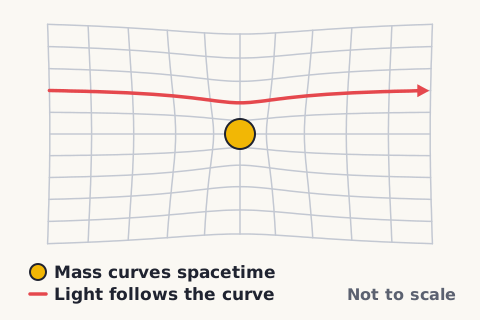
General relativity replaces gravity-as-a-force with geometry. Mass and energy curve spacetime, and objects — including light, which has no mass — simply follow the curvature. The Earth is not being pulled around the Sun by an invisible rope; it is traveling as straight as it can through a region that is bent.
That sounds unfalsifiable until you notice it makes predictions nothing else does. Gravitational lensing is the visible one: a massive foreground object such as a galaxy cluster bends spacetime enough to distort and magnify the light of whatever lies behind it, producing arcs and multiple images of a single galaxy.
The everyday one is in your pocket. A GPS satellite clock runs about 45 microseconds a day fast because it sits in weaker gravity, and about 7 microseconds a day slow because of its speed. The system corrects for both. Without those corrections satellite navigation would drift out of usefulness within hours.
Finally, expansion. Distant galaxies are redshifted — their light stretched toward longer wavelengths — and the reason is subtler than it is usually told. Space itself expands and stretches the light in transit. The galaxies are not flying outward through space like debris; the space between them is growing.
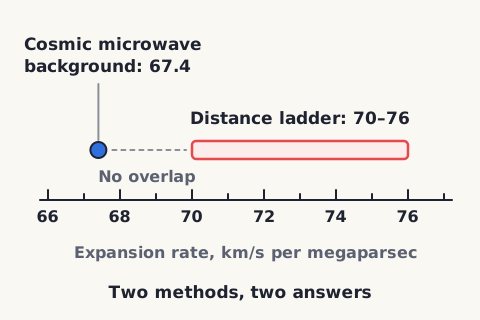
How fast is an open problem, and it has a name. The Hubble tension is a disagreement between two good measurements: distance-ladder methods give an expansion rate of around 70–76 km/s per megaparsec, while measurements of the cosmic microwave background give 67.4. Both camps have checked their work. Either one method has an unknown systematic error, or the standard cosmological model is missing something. Nobody yet knows which.
Key terms
- Irregular galaxy
- A galaxy with no disc, no arms and no smooth ellipse — the ragged fourth category the tuning fork cannot hold
- Standard candle
- An object whose true brightness can be worked out from something observable about it, so comparing that with how bright it looks gives its distance
- Spacetime
- The single geometry of space and time together, which mass and energy curve and which everything then travels through, gravity being the shape rather than a force
Key facts
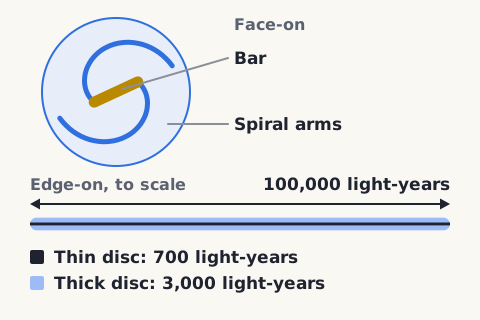
A Hundred Times Wider
We live inside a barred spiral: a flat disc of stars with spiral arms and a straight bar of stars crossing the center. About two-thirds of spirals are barred, so a bar is the normal condition, not a curiosity. The disc runs about 100,000 light-years across but is astonishingly shallow — a thin disc some 700 light-years high sitting inside a thick disc about 3,000 light-years high. Roughly a hundred times wider than it is deep, which is why the galaxy shows up as a narrow band across the sky rather than a glow in every direction.
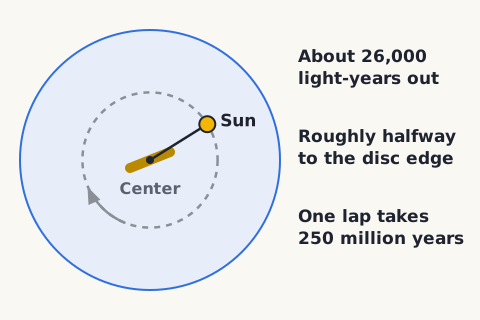
Halfway Out, Still Turning
The Sun is not at the center and not on the rim. It sits about 26,000 light-years from the galactic middle — published values run from 25,000 to 27,000 — roughly halfway out to the edge of the disc. And it is not parked there. One lap around the galactic center takes about 250 million years, longer than the entire history of the dinosaurs. Stars are not fixed while only planets move: the whole disc turns, and we turn with it.
Nobody Has Counted Them
The Milky Way holds on the order of one hundred billion stars — and reputable sources stretch that to a few hundred billion. The range is not caution for its own sake. Nobody has counted them: the total is inferred from the galaxy's mass and its light, which is why careful sources disagree with each other by a factor of a few and none of them can do better.
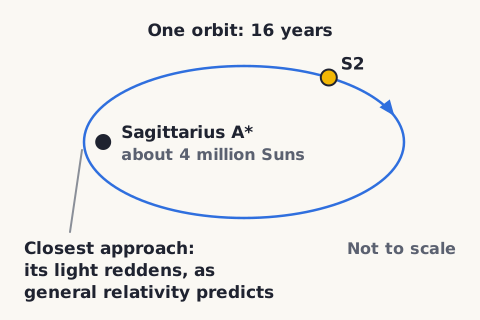
Four Million Suns
At the center sits Sagittarius A*, a supermassive black hole of about four million solar masses. That mass was measured the way a planet's is — from the orbits of things around it. The star S2 goes round every 16 years, and at closest approach its light is stretched to longer wavelengths by exactly the amount general relativity predicts. Four million Suns is still a small share of a galaxy of a hundred billion stars, and the Sun orbits it as calmly as Earth orbits the Sun.
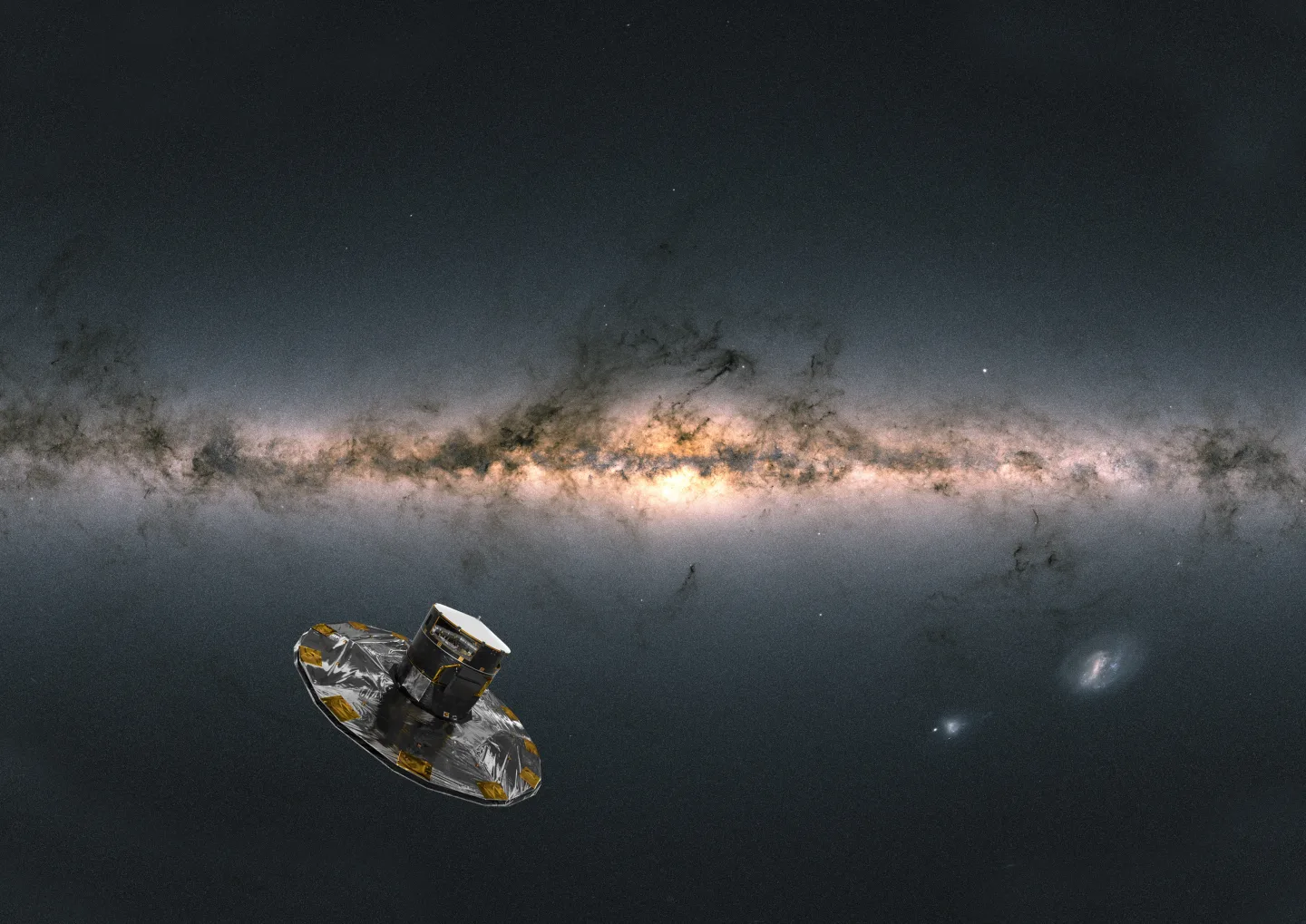
Three Rungs, One Ladder
No single method reaches every distance, so the cosmic distance ladder stacks them. Parallax is the bottom rung and the only purely geometric one: as Earth swings to the far side of its orbit, a nearby star shifts against the background, and trigonometry does the rest. Cepheid variables pulse at a rate tied to their true brightness. Type Ia supernovae all peak near the same brightness and reach roughly 1,000 times farther than Cepheids. Each rung is calibrated by the one below it, so an error low down travels all the way up.
The Galaxy Coming Toward Us
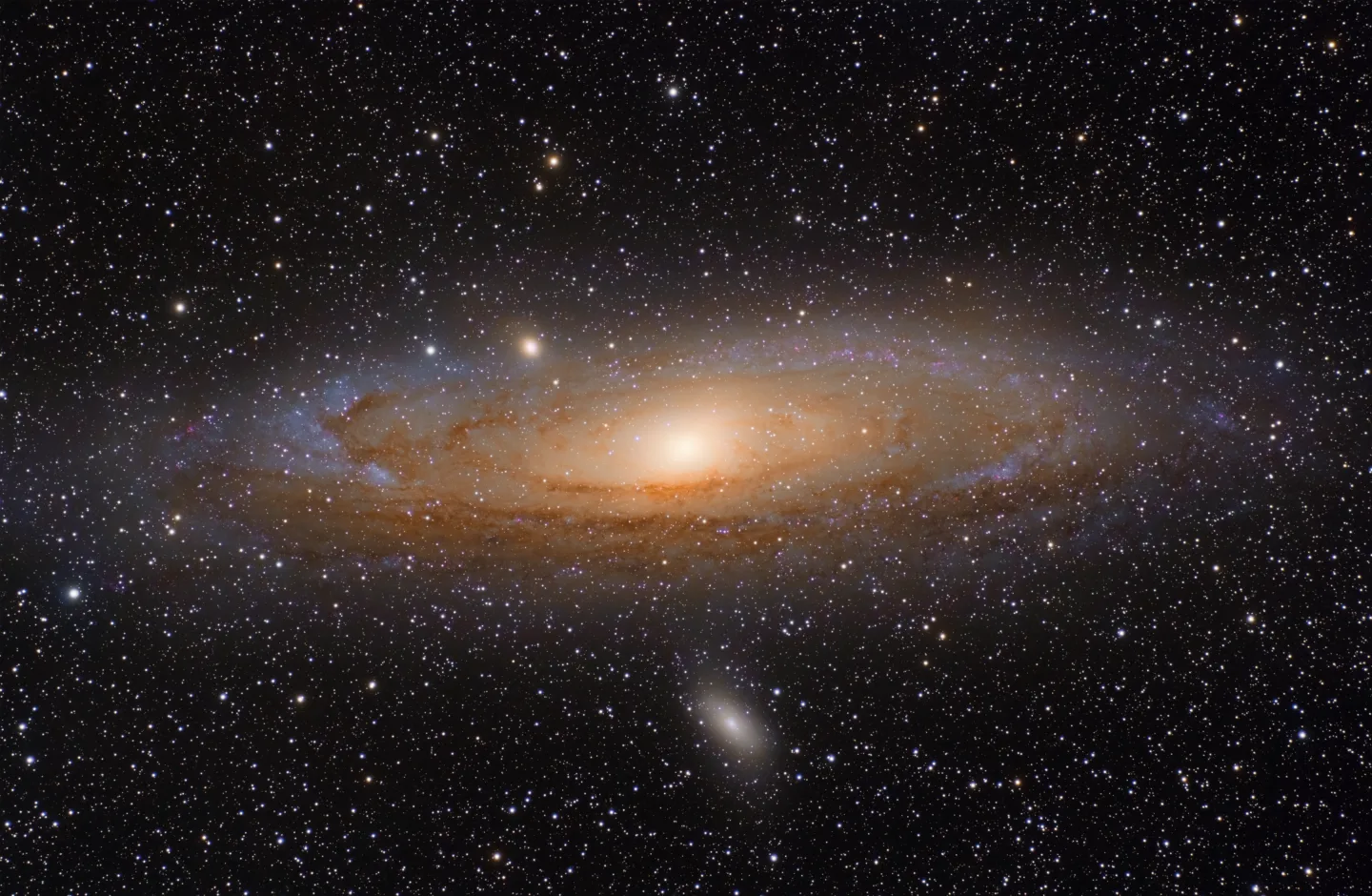
Almost every galaxy is receding. Andromeda is not. It lies about 2.5 million light-years away and is closing at roughly 250,000 miles per hour, so its spectral lines sit at shorter wavelengths — blueshifted, which is unusual among galaxies. Both belong to the Local Group, a gravitationally bound crowd of more than 30 galaxies spread across some 10 million light-years, and inside a bound group local gravity beats cosmic expansion.
The Collision Is Not Settled
The Milky Way–Andromeda collision is usually quoted as a fact with a date. It is not one. Hubble measurements in 2012 predicted a collision in about 4 billion years and a single merged galaxy by about 6 billion. A 2025 analysis in Nature Astronomy, using Gaia and Hubble data, found close to a 50 percent chance of no merger at all within the next 10 billion years. Better data made the answer less certain, not more.
Straight Lines Through Bent Space
General relativity does away with gravity as a force. Mass and energy curve spacetime, and everything — including light, which has no mass — simply follows the curvature. Earth is not held on an invisible rope by the Sun; it is traveling as straight as it can through a region that is bent. That is also why a photon is deflected near a massive object: nothing tugs on it, because there is nothing to tug on. The geometry it crosses is what is bent.
Relativity in Your Pocket
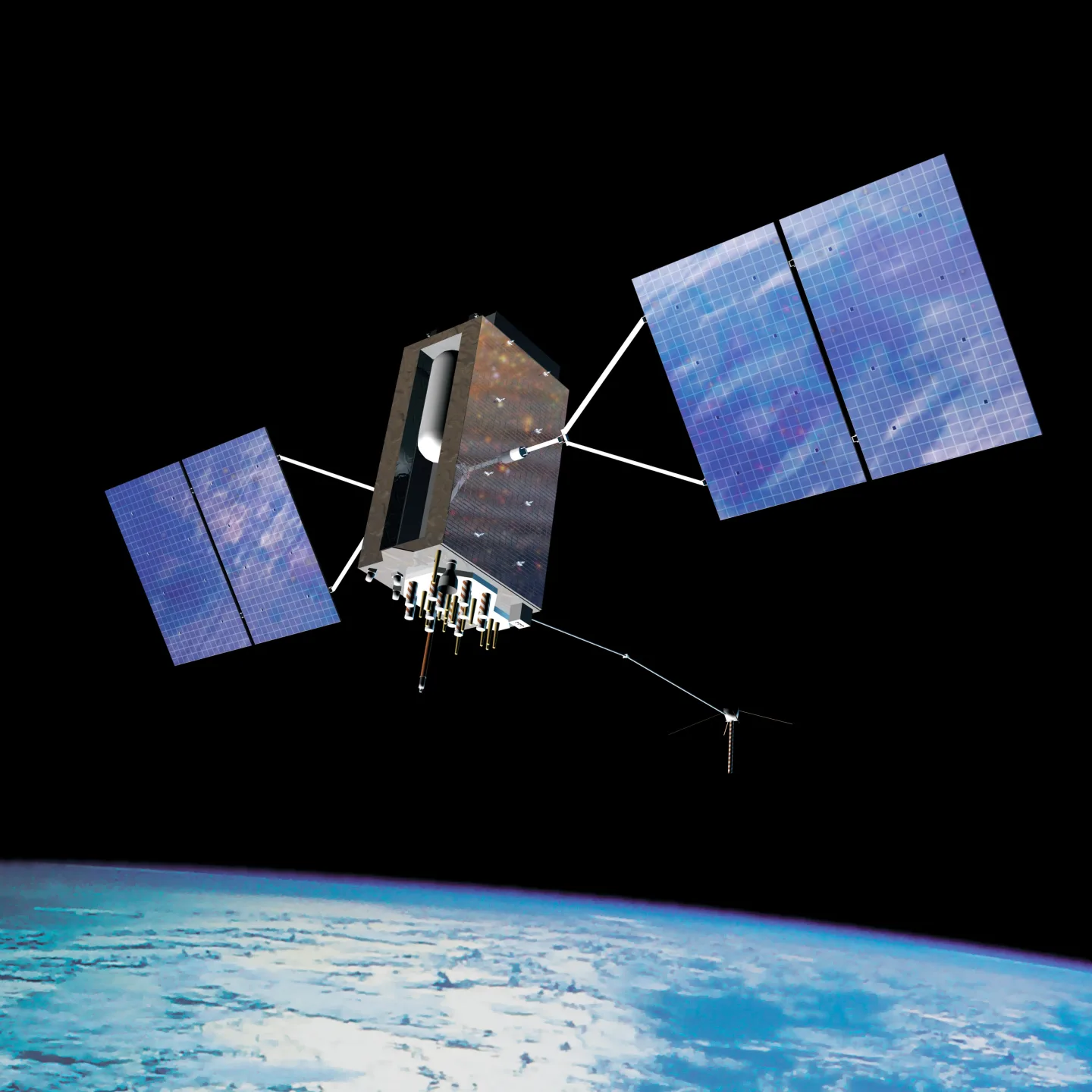
A GPS satellite clock runs about 45 microseconds a day fast because it sits in weaker gravity, and about 7 microseconds a day slow because of its orbital speed — a net gain near 38 microseconds a day. The two effects pull in opposite directions and the system corrects for both. Left uncorrected, positions would drift by roughly 10 kilometers a day. Relativity is not confined to black holes; it is a working engineering correction in hardware you carry around.
The Rate Nobody Agrees On
Everyone agrees the universe expands. Nobody agrees how fast. Distance-ladder measurements give an expansion rate of about 70–76 km/s per megaparsec; measurements of the cosmic microwave background give about 67.4. Both camps have checked their work — Webb observations have ruled out simple measurement error — and the two ranges still do not overlap. This is the Hubble tension: either one method hides an unknown systematic, or the standard cosmological model is missing something.
By the numbers
- One parsec, expressed in light-years
- 3.26 light-year
- Height of the Milky Way's thin disc
- 700 light-year
- The Sun's distance from the galactic center
- 26000 light-year
- Width of the Milky Way's disc
- 100000 light-year
- Distance to the Andromeda galaxy
- 2500000 light-year
- Width of the Local Group of galaxies
- 10000000 light-year
Matched pairs
Each item on the left goes with the one on the right.
- Lenticular galaxy (S0)
- A bulge and disc, but no spiral arms
- Elliptical galaxy
- A round-to-oval swarm built by mergers of spirals
- Parallax
- The shift of a nearby star as Earth changes side
- Cosmological redshift
- Light stretched by space expanding in transit
- Einstein ring
- A background galaxy smeared into a full circle
Self-test
Answer each question from memory, then check your work against the answer key.
1. What does the 2022 image of the Milky Way's center actually show?
- AAn artist's impression of it
- BA shadow ringed by glowing gas
- CA computer simulation of it
- DA photograph of the hole itself
2. What do the labels on Hubble's tuning fork actually record?
- AA galaxy's age
- BA stage of galaxy evolution
- CA galaxy's distance
- DShape, as seen from Earth
3. How is a parsec defined?
- AA one-arcsecond parallax shift
- BThe width of Earth's orbit
- CA year of travel at light speed
- DOne trillion kilometers exactly
4. If the Milky Way and Andromeda merge, what happens to their stars?
- AThey merge into larger stars
- BThey are torn apart by gravity
- CAlmost all of them sail past
- DMost of them smash together
5. Why is a beam of light deflected as it passes a massive object?
- AThe light slows down and turns
- BThe space it crosses is bent
- CGravity tugs on the photons
- DThe photons have a tiny mass
6. Why does light from a distant galaxy arrive stretched to longer wavelengths?
- AAn explosion flung it outward
- BThe galaxy races away from us
- CWe sit at the center of it
- DSpace expanded in transit
Go deeper
- Watch250 Million Years The Sun takes about 250 million years to circle the Milky Way once. The Solar System has gone around perhaps 18 times.
- WatchAndromeda Will Andromeda collide with the Milky Way? The popular answer is out of date.
- WatchRelativity in Your Pocket General relativity is in your pocket. A GPS satellite clock runs about 45 microseconds a day fast, because it sits in weaker gravity.
- StudyAstronomy & Space in the FlashFeed app
Answer key
- 1. B A shadow ringed by glowing gasA black hole emits no light, so it cannot be photographed. The Event Horizon Telescope assembled real 2017 data from eight radio observatories linked into one Earth-sized instrument — neither an impression nor a simulation. The dark center is a silhouette.
- 2. D Shape, as seen from EarthE0 to E7 encodes roundness, Sa to Sc encodes how tightly the arms wind, and a B marks a bar — appearance and nothing else. Age and distance are nowhere on the diagram, and galaxies do not march along it: 'early' and 'late' are a surviving misnomer.
- 3. A A one-arcsecond parallax shiftA parsec is the distance at which a star's parallax would be exactly one arcsecond — about 3.26 light-years, or roughly 31 trillion kilometers, not one. Earth's orbit is the baseline that produces the shift, not the unit, and a year of light travel is a light-year.
- 4. C Almost all of them sail pastA galaxy is mostly empty space: stars are separated by distances vastly greater than their own size, which rules out the smashing, the merging and the tearing alike. What a galactic encounter rearranges is orbits, over hundreds of millions of years.
- 5. B The space it crosses is bentPhotons have no mass, so nothing tugs on them and there is no tiny mass to weigh; nor does light slow and steer itself. Mass and energy curve spacetime, and light simply follows the curvature — which is the only reason a massless particle can be deflected.
- 6. D Space expanded in transitAstronomical redshifts are expansion redshifts: the space the light crossed grew while the light was crossing it. Galaxies are not debris racing outward from an explosion, and an observer on any galaxy sees the same thing — there is no center and nothing to expand into.
Sources
- NASA Imagine the Universe — Milky Way Galaxy — imagine.gsfc.nasa.gov/science/objects/milkyway1.html
- ESO — Astronomers reveal first image of the black hole at the heart of our galaxy (eso2208) — www.eso.org/public/news/eso2208-eht-mw/
- NASA Science — Galaxy Types — science.nasa.gov/universe/galaxies/types/
- ESA/Hubble — The Hubble tuning fork: classification of galaxies — sci.esa.int/web/hubble/-/52791-the-hubble-tuning-fork-classification-of-galaxies
- NASA Science — What is a light-year? — science.nasa.gov/exoplanets/what-is-a-light-year/
- NASA Science — Three Steps to the Hubble Constant — science.nasa.gov/asset/hubble/three-steps-to-the-hubble-constant/
- NASA — Hubble Shows Milky Way is Destined for Head-On Collision — science.nasa.gov/missions/hubble/nasas-hubble-shows-milky-way-is-destined-for-head-on-collision/
- NASA Science — Crash of the Titans: Andromeda Galaxy and the Milky Way Collision — science.nasa.gov/asset/hubble/crash-of-the-titans-andromeda-galaxy-and-the-milky-way-collision/
- ESA/Gaia — Parallax — www.esa.int/Science_Exploration/Space_Science/Gaia/Parallax
- ESA/Hubble — Cosmic distance ladder — sci.esa.int/web/hubble/-/57875-cosmic-distance-ladder
- ESA/Gaia — Cosmic distances — www.esa.int/Science_Exploration/Space_Science/Gaia/Cosmic_distances
- ESA/Gaia — Anatomy of the Milky Way — sci.esa.int/web/gaia/-/58206-anatomy-of-the-milky-way
- NASA Imagine the Universe — Local Group galaxies — imagine.gsfc.nasa.gov/features/cosmic/local_group_info.html
- NASA Imagine the Universe — Ask an Astrophysicist: relativity — imagine.gsfc.nasa.gov/ask_astro/relativity.html
- ESA/Hubble Wordbank — Gravitational lensing — esahubble.org/wordbank/gravitational-lensing/
- Ohio State University Astronomy 162 — Real-World Relativity: The GPS Navigation System — www.astronomy.ohio-state.edu/pogge.1/Ast162/Unit5/gps.html
- NASA Science — Hubble Constant and Tension — science.nasa.gov/mission/hubble/science/science-behind-the-discoveries/hubble-constant-and-tension/
- ESA — What is 'red shift'? — www.esa.int/Science_Exploration/Space_Science/What_is_red_shift
Image credits
- A Hundred Times Wider: FlashFeed original diagram · CC-BY-4.0
- Halfway Out, Still Turning: FlashFeed original diagram · CC-BY-4.0
- Four Million Suns: FlashFeed original diagram · CC-BY-4.0
- Three Rungs, One Ladder: Wikimedia Commons · Spacecraft: ESA/ATG medialab; Milky Way: ESA/Gaia/DPAC. Acknowledgement: A. Moitinho · CC BY-SA 3.0 igo — commons.wikimedia.org/wiki/File:Gaia_observes_the_Milky_Way_ESA24305955.jpeg
- The Galaxy Coming Toward Us: Wikimedia Commons · Brody Wesner · CC0 — commons.wikimedia.org/wiki/File:Andromeda_Galaxy_2025.png
- Straight Lines Through Bent Space: FlashFeed original diagram · CC-BY-4.0
- Relativity in Your Pocket: Wikimedia Commons · U.S. Air Force · Public domain — commons.wikimedia.org/wiki/File:GPS_Block_IIIA.jpg
- The Rate Nobody Agrees On: FlashFeed original diagram · CC-BY-4.0


