
Christianity: A Complete History study guide · Lesson 8 of 15
Core Theology & Doctrine
Trinity and Incarnation · Sin, Grace and Salvation · The Sacraments
This is the lesson's study guide from the FlashFeed app, plus its key facts and a self-test.
What you'll be able to do
- Define the Trinity and distinguish it from the heresies of Tritheism and Modalism.
- Explain the Incarnation and Chalcedon's definition of Christ's two natures.
- Define the human problem and its cure — Original Sin, salvation, and redemption.
- Compare how the Catholic, Lutheran/Calvinist, Arminian, and Pentecostal traditions understand salvation and grace.
- Explain the sacraments and the range of Eucharistic views from transubstantiation to memorial.
Trinity and Incarnation
The two most technically demanding doctrines in Christian theology — the Trinity and the Incarnation — were hammered out over four centuries of council debates, not handed down complete from the apostles.
One God, Three Persons
The Trinity holds that the one God exists as three co-equal, co-eternal persons: Father, Son, and Holy Spirit. Two heresies bracket orthodoxy: Tritheism treats the three as separate gods, while Modalism collapses the distinction and says the one God merely appears in three successive masks. The councils rejected both. The Greek word homoousios ("same substance") was the crux at Nicaea (325 CE) — the Son is not a lesser being created by the Father but fully shares the divine nature. The Nicene Creed (381 CE), finalizing Trinitarian language, remains the shared confession of Catholic, Orthodox, and most Protestant churches.
The Word Became Flesh
Christians believe Jesus was fully God and fully human — not partly each, and not alternating between the two. The Gospel of John frames it memorably: "the Word became flesh and dwelt among us" (John 1:14). Getting the formula precise took more debate. The Council of Chalcedon (451 CE) defined Christ as having two natures, divine and human, united in one person, without confusion, mixture, separation, or division. This "Chalcedonian Definition" remains binding for Catholics, Orthodox, and most Protestants; non-Chalcedonian churches (Oriental Orthodox, including the Coptic and Armenian churches) hold a subtly different position called Miaphysitism. The Incarnation matters practically as well as doctrinally: because God took on flesh, bodily existence and the material world carry theological dignity in mainstream Christianity.
Sin, Grace and Salvation
If the Trinity defines what God is, the doctrines of sin and salvation define the human problem and God's answer to it — and no area of Christian theology generates more internal disagreement.
The Fall and Original Sin
Augustine of Hippo (354–430 CE) gave Western Christianity its dominant account of human wrongness. Drawing on Genesis 3, he argued that Adam and Eve's disobedience in the Garden was not merely a bad example but a catastrophic rupture: it introduced death and suffering into creation and left all subsequent humanity in a state of Original Sin — a corrupted nature, inclined away from God, that no individual willpower can fully repair. Eastern Orthodoxy agrees on the fall's seriousness but traditionally emphasizes inherited mortality more than inherited guilt; the Western Catholic/Protestant debate largely works within Augustine's framework. The doctrine serves a structural role: it explains why humanity needs a savior rather than just better instruction.
How Is One Saved?
Salvation is the restoration of a right relationship with God — the cure for sin applied to the individual. Redemption names the mechanism: Christ's atoning work on the cross "buys back" humanity from bondage to sin and death. Where traditions sharply diverge is on how that redemption is received.
Catholics teach that salvation involves baptism, ongoing faith, cooperation with grace, and the sacraments; it can be lost through unrepented mortal sin. Lutherans and Calvinists insist on Sola Gratia (grace alone) and Sola Fide (faith alone) — good works are the fruit of salvation, not its cause or contribution. Arminians and Wesleyans hold that God's grace is genuinely universal but can be freely resisted, preserving human choice. Pentecostals typically affirm one of the above Protestant frameworks but add a distinct "second blessing" — a post-conversion baptism of the Holy Spirit, often evidenced by speaking in tongues.
The Sacraments
How does divine grace reach ordinary human beings? For most of Christian history, the answer has run through physical rituals — water, bread, wine, oil — that the tradition calls sacraments.
What Is a Sacrament?
A sacrament is a physical rite believed to convey spiritual grace. The Catholic and Orthodox churches recognize seven: Baptism, Eucharist, Confirmation, Confession (Reconciliation), Anointing of the Sick, Marriage, and Holy Orders. Most Protestant churches recognize only two — Baptism and Communion — because only those two are explicitly commanded by Christ with a physical element attached. Many Protestants prefer the term ordinances: acts of obedience that symbolically recall Christ's work rather than channels of grace in themselves, so they are not identical to the Catholic view.
The sharpest internal debate concerns the Eucharist — the sacrament of bread and wine recalling Christ's Last Supper, also called Communion, the Lord's Supper, or the Mass. Catholics teach transubstantiation: the bread and wine become the actual body and blood of Christ, though appearances remain unchanged. Lutherans hold that Christ is present "in, with, and under" the elements — real presence without the Thomistic metaphysics. Reformed (Calvinist) churches teach a spiritual presence received in faith. Baptists and many evangelicals hold a purely memorial view: the rite is a remembrance, nothing more. These differences are not minor: they drove some of the bitterest sixteenth-century splits, and full eucharistic fellowship between Catholic and Protestant denominations remains officially prohibited to this day.
Key terms
- Trinity
- The doctrine that the one God exists as three co-equal, co-eternal persons: Father, Son, and Holy Spirit.
- Tritheism
- The error of treating Father, Son, and Spirit as three separate gods — rejected by Trinitarian orthodoxy.
- Modalism
- The error that the one God merely appears in three successive modes or masks, rather than existing as three distinct persons.
- The Incarnation
- The belief that God took on human flesh in Jesus, who is fully God and fully human — two natures in one person.
- Original Sin
- The doctrine that Adam's first disobedience corrupted human nature, passing a fallen condition to all of humanity.
- Salvation
- The restoration of a right relationship with God — the cure for sin, applied to the individual.
- Redemption
- Christ's atoning work on the cross — "buying back" humanity from bondage to sin and death. Salvation applies it to the individual.
- Sacrament
- A physical rite believed to convey spiritual grace, such as Baptism or the Eucharist.
- Eucharist
- The sacrament of bread and wine recalling Christ's Last Supper; also called Communion, the Lord's Supper, or the Mass.
Key concepts
Tritheism
- One of two errors that bracket orthodox teaching on the one God in three persons.
- The church councils rejected it as a misreading of the Trinity.
- It wrongly treats Father, Son, and Holy Spirit as three separate gods.
Modalism
- One of two heresies that bracket orthodox Trinitarian doctrine.
- It collapses the distinction between the three persons of God.
- It claims the one God merely appears in three successive masks, not three real persons.
Miaphysitism
- A minority position on how the divine and human relate in Christ.
- It differs subtly from the mainstream Chalcedonian definition of two natures in one person.
- It is held by non-Chalcedonian churches such as the Coptic and Armenian Orthodox.
Original Sin
- A doctrine that explains why humanity needs a savior rather than just better instruction.
- Augustine of Hippo gave the West its dominant account of it, drawing on Genesis 3.
- It holds that Adam and Eve's disobedience left every human with a corrupted nature turned away from God.
Transubstantiation
- The Roman Catholic teaching about what happens in the Eucharist.
- It was reaffirmed at the Council of Trent against Protestant views.
- It holds the bread and wine become the actual body and blood of Christ, though their appearance is unchanged.
Key facts
One God, Three Persons
The most distinctive Christian doctrine is the Trinity: the belief that the one God exists in three co-equal, co-eternal persons — Father, Son, and Holy Spirit. It was defined progressively across the first four ecumenical councils, culminating in the Nicene Creed (381 CE). The Trinity is not three gods, but it is also not one God appearing in three temporary modes — it is held as a mysterious unity-in-diversity.
The Word Became Flesh
Christians believe Jesus was fully God and fully human — two natures united in one person. The Gospel of John puts it: "the Word became flesh and dwelt among us" (John 1:14). The precise formula — two natures, divine and human, in one person, without confusion or division — was defined at the Council of Chalcedon (451 CE). This Incarnation underwrites Christianity's high view of the body and the physical world.
The Tritheism Heresy
Tritheism is the heresy of treating the Father, Son, and Holy Spirit as three separate gods.
The Modalism Heresy
Modalism claims the one God doesn't exist as three distinct persons, but merely appears in three successive modes, or masks.
Homoousios at Nicaea
The Greek term homoousios ('same substance'), central at the Council of Nicaea in 325 CE, affirmed that the Son fully shares the divine nature rather than being a lesser being created by the Father.
The Fall and Original Sin
Following Augustine of Hippo, mainstream Christianity teaches that humanity fell from original goodness through Adam and Eve's disobedience in the Garden of Eden — the doctrine of Original Sin. This "fall" is held to have introduced death, suffering, and a fundamental alienation from God into human experience, a condition no human effort can fully repair on its own.
How Is One Saved?
How salvation works is the most contested question in Christian theology. Catholics hold it involves baptism, faith, cooperation with grace, and the sacraments — and can be lost through mortal sin. Lutherans and Calvinists hold salvation is entirely by grace (Sola Gratia) through faith alone (Sola Fide), with good works the fruit, not the cause. Arminians and Wesleyans hold grace is universal but resistible. Pentecostals often add a "second blessing" of Spirit baptism.
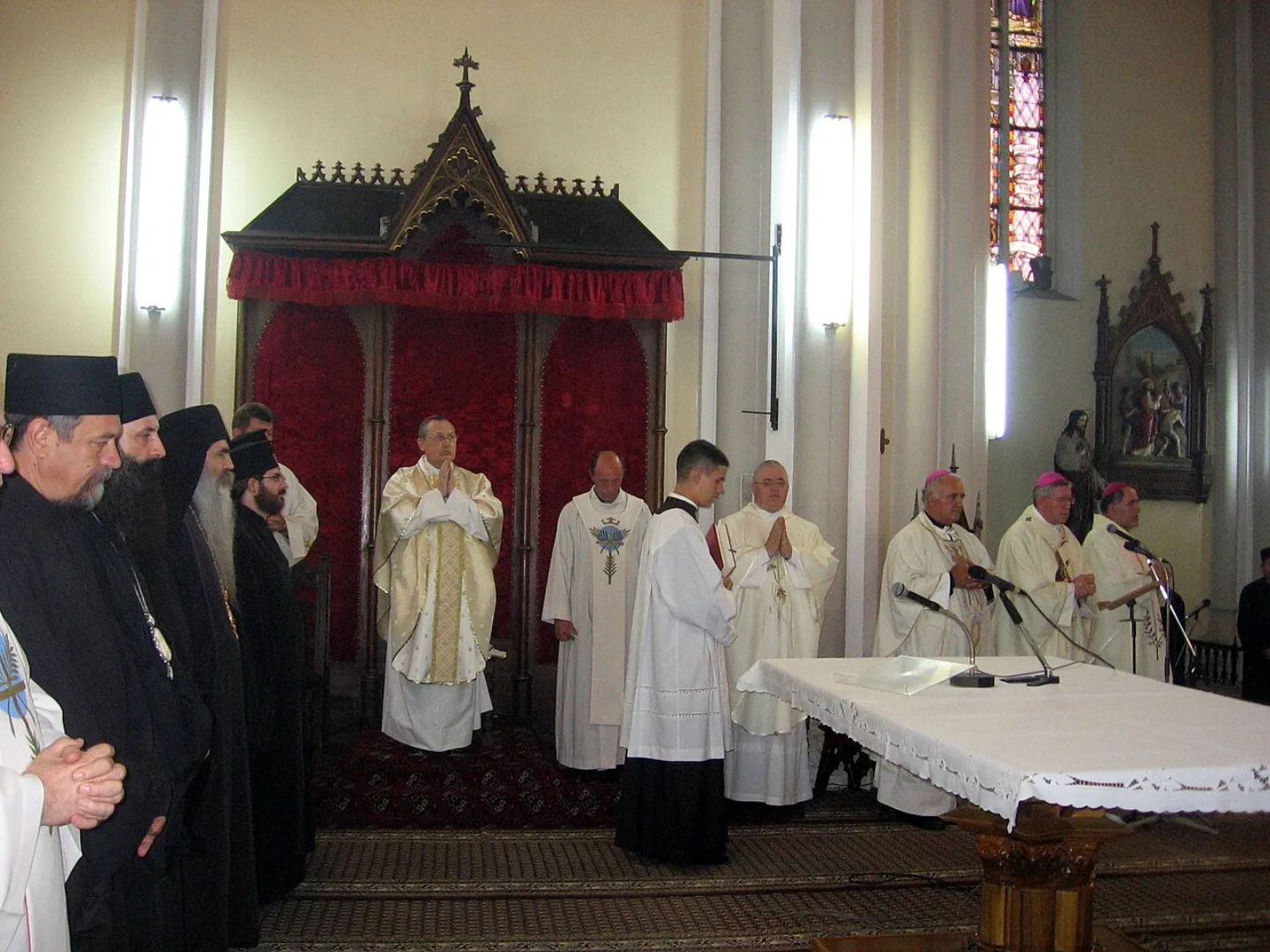
Orthodoxy: Mortality Over Guilt
Eastern Orthodoxy agrees the fall was serious, but its traditional view emphasizes inherited mortality more than inherited guilt, unlike Augustine's Western framework.
Catholic Salvation: Not Guaranteed
Catholic teaching ties salvation to baptism, ongoing faith, cooperation with grace, and the sacraments, and holds that it can be lost through unrepented mortal sin.
Grace You Can Refuse
The Arminian and Wesleyan view holds that God's grace is offered universally to everyone, but it can be freely resisted rather than being irresistible.
What Is a Sacrament?
A sacrament is a physical rite that Christians believe conveys spiritual grace. The Catholic and Orthodox churches recognize seven: Baptism, Eucharist, Confirmation, Confession, Anointing of the Sick, Marriage, and Holy Orders. Most Protestant churches recognize only two — Baptism and Communion — and tend to call them ordinances: acts of obedience that symbolically recall Christ's work rather than channels of grace in themselves.
Why Protestants Keep Two
Most Protestant churches recognize only Baptism and Communion as sacraments, since Christ explicitly commanded both and attached a physical sign to each: water, and bread and wine.
The Catholic Seven
The Catholic and Orthodox churches recognize seven sacraments: Baptism, Eucharist, Confirmation, Confession, Anointing of the Sick, Marriage, and Holy Orders.
The Miracle of Transubstantiation
Catholic transubstantiation teaches that in the Eucharist, the bread and wine become the actual body and blood of Christ, even though their appearances stay exactly the same.
Only a Remembrance
Baptists and many evangelicals hold that the Eucharist is purely a memorial — a remembrance of Christ with no real presence.
By the numbers
- Number of sacraments recognized by the Catholic and Orthodox churches
- 7 sacraments
- Number of sacraments most Protestant churches recognize
- 2 sacraments
Matched pairs
Each item on the left goes with the one on the right.
- Catholic view of salvation
- Faith plus cooperation with grace and the sacraments; losable by mortal sin
- Lutheran / Calvinist view of salvation
- By grace alone through faith alone; works are the fruit, not the cause
- Arminian / Wesleyan view of grace
- Grace is offered universally but can be resisted; humans must freely cooperate
- Pentecostal emphasis
- A "second blessing" of Spirit baptism, often evidenced by speaking in tongues
- Transubstantiation
- Catholic view: bread and wine truly become Christ's body and blood
- Christ present "in, with, and under" the elements
- Lutheran view: Christ truly present alongside the bread and wine
- Spiritual presence, received in faith
- Calvinist view: Christ is spiritually present to those who receive in faith
- Purely memorial
- Zwinglian view: a symbolic re-enactment, with no real presence
Self-test
Answer each question from memory, then check your work against the answer key.
1. What does the doctrine of the Trinity hold about God?
- AThree separate gods sharing a common purpose
- BOne God appearing in three successive modes over time
- COne supreme God with two lesser created spirits
- DOne God existing as three co-equal, co-eternal persons
2. Which term names the heresy that treats Father, Son, and Spirit as three separate gods?
- AMiaphysitism
- BHomoousios
- CTritheism
- DModalism
3. What does Modalism claim about the one God?
- AThe Son is a created being lesser than the Father
- BHe merely appears in three successive modes or masks
- CHe blends a divine and a human nature in Christ
- DHe is three genuinely separate divine beings
4. Which statement is NOT part of Trinitarian orthodoxy?
- AThe three persons are three separate gods
- BThe three persons are co-equal
- CThe one God is Father, Son, and Holy Spirit
- DThe three persons are co-eternal
5. The Greek word homoousios ("same substance"), central at Nicaea in 325 CE, affirmed what about the Son?
- AHe was adopted as God's Son at his baptism
- BHe fully shares the divine nature, not a lesser created being
- CHe is a separate god standing alongside the Father
- DHe appears as one of God's temporary successive modes
6. What did the Council of Chalcedon (451 CE) define about Jesus?
- ATwo natures, divine and human, in one person
- BThat he had one nature, blending divine and human
- CThat he was a created being, not eternal
- DThat he was human only, adopted as God's Son
7. What does the doctrine of the Incarnation claim about Jesus?
- AJesus was fully human and later adopted as God's Son
- BJesus was fully divine and only appeared to be human
- CGod took on human flesh; Jesus is fully God and fully human
- DJesus was part God and part human, a blend of the two
8. What does the Chalcedonian Definition explicitly reject about Christ's two natures?
- AThat Christ has a fully divine nature
- BThat Christ has a fully human nature
- CThat Christ is one person
- DBlending them into a single mixed nature
9. Which phrase from the Gospel of John frames the Incarnation?
- A"the Word was with God"
- B"God so loved the world"
- C"the Word became flesh and dwelt among us"
- D"In the beginning was the Word"
10. Non-Chalcedonian churches such as the Coptic and Armenian Orthodox hold which position on Christ's nature?
- AMiaphysitism
- BTransubstantiation
- CModalism
- DTritheism
11. Which theologian gave Western Christianity its dominant account of Original Sin — that Adam's disobedience corrupted all human nature?
- AMartin Luther
- BThomas Aquinas
- CJohn Calvin
- DAugustine of Hippo
12. What does the doctrine of Original Sin teach?
- AA grave sin so serious it can never be forgiven
- BAdam's first disobedience corrupted human nature, passed to all humanity
- CThe temptation of Christ in the wilderness
- DThe first sin each individual personally commits in life
13. How do Redemption and Salvation differ?
- ARedemption is an Orthodox term and salvation a Catholic one
- BSalvation is Christ's work on the cross; redemption applies it to the individual
- CBoth refer only to the forgiveness of an individual's personal sins
- DRedemption is Christ's work on the cross; salvation applies it to the individual
14. In Christian theology, Redemption names what?
- AThe individual's restored right relationship with God
- BThe corrupted nature inherited from Adam
- CChrist's atoning work "buying back" humanity from bondage to sin and death
- DA physical rite that conveys spiritual grace
15. How does Eastern Orthodoxy's traditional view of the fall differ from Augustine's?
- AIt denies that the fall of Adam and Eve happened at all
- BIt emphasizes inherited mortality more than inherited guilt
- CIt teaches humans can fully repair their nature by willpower
- DIt rejects the idea that humanity needs a savior
16. In the Christian account of the human problem's cure, what does 'salvation' specifically mean?
- AThe restoration of a right relationship with God
- BChrist's atoning work of buying humanity back from sin
- CA post-conversion baptism of the Holy Spirit
- DThe corrupted nature inherited from Adam's disobedience
17. How does the lesson distinguish salvation from redemption in curing the human problem?
- ABoth terms describe only the doctrine of Original Sin
- BRedemption is the mechanism, salvation the personal result
- CSalvation is the mechanism, redemption the personal result
- DRedemption means guilt inherited from Adam's fall
18. Which tradition teaches salvation involves baptism, faith, cooperation with grace, and the sacraments, and can be lost through unrepented mortal sin?
- APentecostal
- BCalvinist
- CLutheran
- DCatholic
19. Which belief about salvation would a Catholic affirm but a Lutheran or Calvinist reject?
- AThat cooperation with grace and the sacraments contribute to salvation
- BThat Christ's death on the cross redeems humanity
- CThat humanity is fallen and needs a savior
- DThat salvation ultimately rests on God's grace
20. The Arminian and Wesleyan view of grace holds what?
- AGrace reaches people only through the seven sacraments
- BGrace is irresistible and cannot be refused once given
- CGrace is offered universally but can be freely resisted
- DGrace is unnecessary because good works alone save
21. What distinctive teaching do Pentecostals typically add to a Protestant framework?
- AThat only two sacraments should ever be recognized
- BA "second blessing" of Spirit baptism, often shown by speaking in tongues
- CThat bread and wine become Christ's literal body and blood
- DThat salvation is earned by good works alone
22. Which tradition insists that good works are the fruit of salvation, not its cause or contribution?
- ACatholics
- BEastern Orthodox
- CArminians and Wesleyans
- DLutherans and Calvinists
23. Why do most Protestant churches recognize only two sacraments, Baptism and Communion?
- AOnly those two were explicitly commanded by Christ with a physical element attached
- BOnly those two are mentioned anywhere in the New Testament
- CThe other five require an ordained priesthood that Protestants abolished
- DThe other five were invented by the medieval papacy
24. What is a sacrament?
- AA creed recited by the congregation in worship
- BA symbolic story that recalls a Bible event
- CA physical rite believed to convey spiritual grace
- DAn ordained office held within the church
25. How many sacraments do the Catholic and Orthodox churches recognize?
- ASeven
- BTwelve
- CTwo
- DThree
26. Catholic transubstantiation teaches what about the Eucharist?
- AChrist is present alongside the unchanged bread and wine
- BThe bread and wine are a purely symbolic remembrance
- CBread and wine become Christ's actual body and blood, though appearances stay the same
- DChrist is spiritually present only to those who receive in faith
27. Which view holds the Eucharist is purely memorial — a remembrance and nothing more?
- AReformed churches
- BLutherans
- CRoman Catholics
- DBaptists and many evangelicals
Go deeper
Answer key
- 1. D One God existing as three co-equal, co-eternal personsThe Trinity holds that the one God exists as three co-equal, co-eternal persons: Father, Son, and Holy Spirit. Three separate gods is Tritheism; successive modes is Modalism.
- 2. C TritheismTritheism is the error of treating the three persons as three separate gods. Modalism collapses them into masks; homoousios is the orthodox term for shared substance.
- 3. B He merely appears in three successive modes or masksModalism collapses the distinction of persons, saying God only appears in successive modes rather than existing as three distinct persons. Three separate beings is Tritheism.
- 4. A The three persons are three separate godsTreating the persons as separate gods is the heresy of Tritheism, which the councils rejected. Co-equal, co-eternal, and one God in three persons are all orthodox.
- 5. B He fully shares the divine nature, not a lesser created beingHomoousios means the Son is of the same substance as the Father, fully sharing the divine nature rather than being a lesser being created by the Father.
- 6. A Two natures, divine and human, in one personChalcedon settled the question by holding the two natures together, without confusion or division, in one person.
- 7. C God took on human flesh; Jesus is fully God and fully humanThe Incarnation holds God took on flesh in Jesus, who is fully God and fully human — not partly each, and not alternating between the two.
- 8. D Blending them into a single mixed natureChalcedon held the two natures together without confusion, mixture, separation, or division — so blending them into one mixed nature is rejected, while one person with both full natures is affirmed.
- 9. C "the Word became flesh and dwelt among us"John 1:14 frames the Incarnation: the Word became flesh and dwelt among us. The other phrases are from John 1:1 and John 3:16 and do not describe the Word taking on flesh.
- 10. A MiaphysitismThe Oriental Orthodox (Coptic, Armenian) hold Miaphysitism, a subtly different position from Chalcedon. Modalism and Tritheism are Trinitarian heresies; transubstantiation is a Eucharistic view.
- 11. D Augustine of HippoAugustine of Hippo (354–430 CE), drawing on Genesis 3, taught that Adam and Eve's disobedience left all humanity in a corrupted state of Original Sin. The later Catholic and Protestant debate largely works within his framework.
- 12. B Adam's first disobedience corrupted human nature, passed to all humanityFollowing Augustine, Original Sin holds that Adam's disobedience corrupted human nature and passed a fallen condition to all subsequent humanity — not a personal first sin or an unforgivable act.
- 13. D Redemption is Christ's work on the cross; salvation applies it to the individualRedemption names Christ's atoning work on the cross that buys back humanity; salvation is that work applied to the individual as a restored relationship with God.
- 14. C Christ's atoning work "buying back" humanity from bondage to sin and deathRedemption is the mechanism — Christ's cross buying humanity back from sin and death. The restored relationship is salvation; the inherited corruption is Original Sin.
- 15. B It emphasizes inherited mortality more than inherited guiltEastern Orthodoxy agrees the fall was serious but traditionally stresses inherited mortality over inherited guilt, unlike Augustine's Western framework.
- 16. A The restoration of a right relationship with GodSalvation is the restoration of a right relationship with God — the cure for sin applied to the individual — distinct from redemption's atoning mechanism.
- 17. B Redemption is the mechanism, salvation the personal resultRedemption names the mechanism — Christ's atoning work 'buying back' humanity — while salvation is that cure for sin applied to the individual.
- 18. D CatholicThe Catholic view ties salvation to baptism, ongoing faith, cooperation with grace, and the sacraments, and holds it can be lost by mortal sin. Lutherans and Calvinists insist on grace and faith alone.
- 19. A That cooperation with grace and the sacraments contribute to salvationCatholics hold cooperation with grace and the sacraments contribute to salvation; Lutherans and Calvinists reject any human contribution (Sola Gratia, Sola Fide). The other three are shared Christian beliefs.
- 20. C Grace is offered universally but can be freely resistedArminians and Wesleyans hold that God's grace is genuinely universal but can be freely resisted, preserving human choice.
- 21. B A "second blessing" of Spirit baptism, often shown by speaking in tonguesPentecostals affirm a Protestant framework but add a post-conversion "second blessing" — a baptism of the Holy Spirit, often evidenced by speaking in tongues.
- 22. D Lutherans and CalvinistsLutherans and Calvinists hold Sola Gratia and Sola Fide, so works are the fruit of salvation. Catholics see cooperation with grace as contributing; Arminians stress resistible grace.
- 23. A Only those two were explicitly commanded by Christ with a physical element attachedProtestants keep Baptism and Communion because Christ explicitly commanded both with a physical sign (water; bread and wine). Many even prefer 'ordinances' — symbolic acts of obedience rather than channels of grace, unlike the Catholic and Orthodox seven.
- 24. C A physical rite believed to convey spiritual graceA sacrament is a physical rite — water, bread, wine, oil — believed to convey spiritual grace, such as Baptism or the Eucharist.
- 25. A SevenCatholic and Orthodox churches recognize seven sacraments: Baptism, Eucharist, Confirmation, Confession, Anointing of the Sick, Marriage, and Holy Orders. Most Protestants keep only two.
- 26. C Bread and wine become Christ's actual body and blood, though appearances stay the sameTransubstantiation holds the bread and wine become the actual body and blood of Christ while their appearances remain unchanged. Spiritual presence is Calvinist; memorial is Zwinglian; presence alongside is Lutheran.
- 27. D Baptists and many evangelicalsBaptists and many evangelicals hold the purely memorial (Zwinglian) view: the rite is a remembrance, with no real presence. The other three teach some form of Christ's presence.
Sources
- The Nicene Creed — Reformed Church in America — www.rca.org/about/theology/creeds-and-confessions/the-nicene-creed/
- Second Vatican Council — Britannica — www.britannica.com/event/Second-Vatican-Council
Image credits
- Orthodoxy: Mortality Over Guilt: Wikimedia Commons · Stebunik · CC BY 4.0 — commons.wikimedia.org/wiki/File:NS_0405_kr%C5%A1%C4%8Danski-%C5%A1kofje.jpg
