
Christianity: A Complete History study guide · Lesson 14 of 15
Visual Reference & Challenges
At a Glance · Right or Wrong · Sequence It · Council Dates · Lightning Round · Term Drill
This is the lesson's study guide from the FlashFeed app, plus its key facts and a self-test.
What you'll be able to do
- Read the pack's summary diagrams — the arc of Jesus's life and the seven ecumenical councils.
- Identify which view won at the councils and the sequence of Christianity's rise to imperial power.
- Recall the year of each of the seven ecumenical councils.
- Recognize the ecumenical councils by the doctrine each settled.
- Rapidly recall pack essentials — Jewish factions, parables, pentarchy cities, and core terms.
Two thousand years is a lot to hold in your head. This lesson compresses the essentials into a few diagrams, then tests whether they've stuck — sorting orthodoxy from heresy, putting the great turning points in order, and dating the councils that fixed the faith.
At a Glance
Three diagrams do most of the organizing. The life of Jesus runs in a clean line from birth at Bethlehem through baptism, ministry, crucifixion, resurrection, and ascension — the spine of the Gospels. The seven ecumenical councils lay out four and a half centuries of doctrine-defining gatherings, each tagged with its central fight: Nicaea (325) over Arianism, Constantinople (381) completing the Trinity, Ephesus (431) over Mary's title, Chalcedon (451) over the two natures, and on to Nicaea II (787) over icons. And the branches diagram maps the family tree — the one faith splitting into Roman Catholic, Eastern Orthodox, and the sprawling Protestant family of Lutheran, Reformed, Anglican, Baptist, Methodist, and Pentecostal. Keep these three pictures in mind and the rest of the pack has somewhere to hang.
Right or Wrong
The early councils were called precisely because the wrong answers were plausible and popular. Knowing the faith means knowing which view won — and why. Four of the great decisions: against Arianism, the Church affirmed at Nicaea that the Son is homoousios, of one substance with the Father, not a creature. Against Monophysitism, Chalcedon defined Christ as one Person in two natures, fully divine and fully human. Against Nestorianism, Ephesus upheld Mary as Theotokos, the God-bearer, because the one Person she bore is both God and man. And against modalism, orthodoxy holds the three Persons to be distinct and co-eternal — not one God cycling through three masks. In each pairing, the heresy is the tidy oversimplification; orthodoxy is the harder, stranger middle.
Sequence It
Finally, order and dates. The turning points of the story have a logic that only appears in sequence: how a persecuted sect became the imperial religion in under four centuries (persecution → the Edict of Milan in 313 → Nicaea in 325 → Theodosius in 380); how Saul the persecutor became Paul the apostle (the Damascus road → baptism → the first missionary journey → the Council of Jerusalem → the later missionary journeys); how Luther's local protest became a continental rupture (the Ninety-Five Theses in 1517 → the printing press → excommunication → the Diet of Worms → the German Bible). Pair that with the council dates — 325, 381, 431, 451, and on — and the abstractions of doctrine acquire a timeline you can actually walk.
Key terms
- Messiah
- A divinely anointed leader expected to deliver Israel; a hope shared across the rival Jewish groups.
- Pax Romana
- The "Roman Peace" — a long span of relative stability across the Mediterranean that eased travel and communication.
- TaNaK
- The Jewish name for the Hebrew Bible, which Christians call the Old Testament.
- Covenant
- A binding relationship God enters into with his people; the central thread linking the Hebrew Bible to Christian interpretation.
- John the Baptist
- An apocalyptic preacher who baptized Jesus in the Jordan and called Israel to repentance ahead of the coming Kingdom.
- The Kingdom of God
- The new social and spiritual reality Jesus proclaimed as breaking into the world — the central theme of his preaching.
- The Beatitudes
- A set of blessings opening the Sermon on the Mount that invert social hierarchy — blessing the poor in spirit, the meek, the merciful, and the peacemakers.
- Golgotha
- "The place of the skull" — the site outside Jerusalem where Jesus was crucified; also called Calvary.
- Pentecost
- The Jewish feast, fifty days after Passover, when the disciples reported the outpouring of the Holy Spirit; traditionally the birth of the Church.
- Pentarchy
- The five patriarchal centers of early Christianity: Jerusalem, Antioch, Alexandria, Rome, and Constantinople.
- Justification by faith
- Paul's teaching that people are made right with God by grace through faith, not by earning it: "By grace you have been saved through faith."
- The Body of Christ
- Paul's image of the church as a single living organism whose members have diverse but interdependent roles.
Key concepts
The Council of Constantinople
- The second of the seven ecumenical councils, meeting a little over half a century after the very first.
- Convened in 381, it built on the earlier gathering that had condemned Arianism.
- Its central achievement was completing the doctrine of the Trinity — the three distinct, co-eternal Persons.
The Council of Ephesus
- A fifth-century ecumenical council called to settle a dispute over Mary's proper title.
- Meeting in 431, it rejected Nestorianism, the view that split Christ into two.
- It upheld Mary as Theotokos, the God-bearer, because the one Person she bore is both God and man.
The Council of Chalcedon
- An ecumenical council of the mid-fifth century, called to define exactly who Christ is.
- Meeting in 451, it rejected Monophysitism, the claim that Christ had only one nature.
- It defined Christ as one Person in two natures, fully divine and fully human.
The Second Council of Nicaea
- The last of the seven ecumenical councils, held in the same city as the very first.
- Meeting in 787, more than four centuries after the council that had condemned Arianism.
- Its defining fight was over icons — religious images and their place in worship.
Key facts
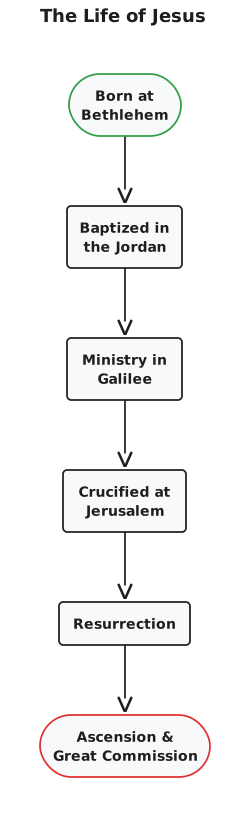
The Life of Jesus at a Glance
From Bethlehem to the Ascension — the arc the Gospels trace.
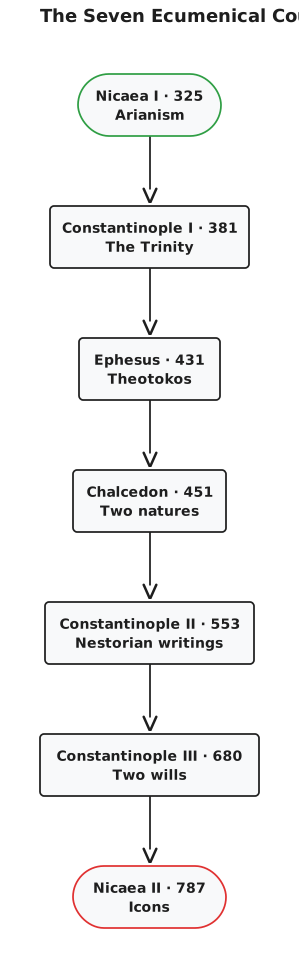
The Seven Ecumenical Councils
Four centuries of doctrine-defining councils, from Nicaea (325) to Nicaea II (787).
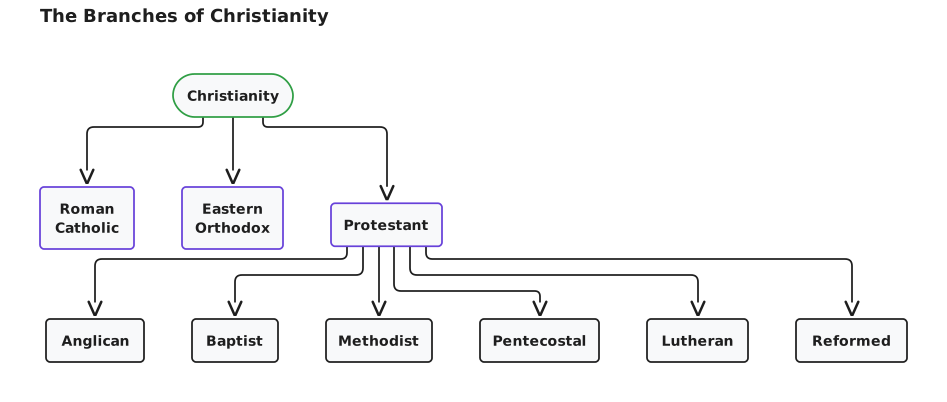
The Branches of Christianity
Catholic, Orthodox, and the Protestant family — one faith, many trees.
Where the Councils Began
The pack's councils diagram opens with the First Council of Nicaea in 325, called over Arianism, and closes with Nicaea II in 787, with Constantinople (381) and Chalcedon (451) falling in between.
By the numbers
- Number of Ecumenical Councils shown in the diagram
- 7 councils
- Year of the First Council of Nicaea
- 325 year
- Year of Nicaea II, the last of the seven councils
- 787 year
- Year (CE) of the First Council of Nicaea
- 325 CE
- Year (CE) of the First Council of Constantinople
- 381 CE
- Year (CE) of the Council of Ephesus
- 431 CE
- Year (CE) of the Council of Chalcedon
- 451 CE
- Year (CE) of the Second Council of Constantinople
- 553 CE
- Year (CE) of the Third Council of Constantinople
- 680 CE
- Year (CE) of the Second Council of Nicaea
- 787 CE
Matched pairs
Each item on the left goes with the one on the right.
- Pharisees
- Rigorous keepers of the Torah and its oral tradition
- Sadducees
- Temple-centered aristocrats
- Essenes
- Ascetic desert communalists who produced the Dead Sea Scrolls
- Zealots
- Nationalist revolutionaries who sought to overthrow Rome by force
- The Good Samaritan
- Neighborly love transcends ethnic and religious divisions
- The Prodigal Son
- God's radical forgiveness and welcome of the repentant
- The Sower and the Soils
- Four types of reception to God's word
- The Lost Sheep
- God's pursuit of every single individual
- The Mustard Seed
- The Kingdom begins small but grows to encompass all
- The Pharisee and the Tax Collector
- Humility before God is greater than religious pride
- The Rich Man and Lazarus
- The moral danger of wealth and indifference to the poor
- Jerusalem
- The original "Mother Church"; destroyed by Rome in 70 CE
- Antioch
- Where followers were first called "Christians"; hub for the Gentile mission
- Alexandria
- Traditionally founded by Mark; center of Christian philosophy and learning in Egypt
Step by step
The arc of Jesus of Nazareth's life
- Born in Bethlehem
- Baptized by John in the Jordan
- Public ministry in Galilee
- Crucified at Jerusalem under Pilate
- Resurrection on the third day
- Ascension and the Great Commission
From persecutor to apostle: the path of Paul
- Persecutes the early Christians
- Has a vision on the road to Damascus
- Is baptized and begins to preach
- The Council of Jerusalem opens the faith to Gentiles
- Undertakes the missionary journeys
From persecuted sect to state religion
- Waves of Roman persecution
- Edict of Milan grants toleration (313)
- Council of Nicaea settles doctrine (325)
- Theodosius makes Nicene Christianity the state religion (380)
Under three centuries from persecution to empire.
Luther's break with Rome
- Posts the Ninety-Five Theses (1517)
- The printing press spreads them across Europe
- Refuses to recant; is excommunicated (1521)
- Defies the Emperor at the Diet of Worms
- Translates the New Testament into German
The first four ecumenical councils, in order
- Nicaea I (325)
- Constantinople I (381)
- Ephesus (431)
- Chalcedon (451)
Self-test
Answer each question from memory, then check your work against the answer key.
1. From **___** to the **Ascension** — the arc the Gospels trace.
- ACanterbury
- BGeneva
- CBethlehem
- DRome
2. Four and a half centuries of doctrine-defining councils, from Nicaea (325) to ___ (787).
- ANicaea II
- BConstantinople II
- CConstantinople III
- DChalcedon
3. The pack's 'life of Jesus' diagram runs in a clean line. Which event does it place last, after the resurrection?
- AThe baptism in the Jordan
- BThe Ascension
- CThe birth at Bethlehem
- DThe Crucifixion
4. How many ecumenical councils does the pack's councils diagram lay out?
- ATwelve
- BThree
- CFive
- DSeven
5. The councils diagram spans the years 325 to 787. Which gathering opens the sequence, in 325?
- AThe Council of Chalcedon
- BThe Second Council of Nicaea
- CThe First Council of Nicaea
- DThe First Council of Constantinople
6. The Council of Ephesus (431) upheld Mary as Theotokos, the 'God-bearer.' Which heresy was it rejecting in doing so?
- AArianism
- BNestorianism
- CMonophysitism
- DModalism
7. In Christianity's rise from persecuted sect to imperial faith, which step made Nicene Christianity the Roman Empire's official state religion?
- AThe Edict of Milan (313)
- BThe First Council of Nicaea (325)
- CThe First Council of Constantinople (381)
- DTheodosius's decree (380)
8. At Nicaea (325) the Church rejected Arianism, declaring the Son co-equal with the Father rather than a creature. Which term did it adopt?
- AHomoousios
- BTheotokos
- CPentarchy
- DLogos
9. Rejecting Monophysitism, the Council of Chalcedon (451) defined the person of Christ how?
- AOne Person with a single, merged divine nature
- BOne Person in two natures, fully divine and fully human
- CTwo separate persons, one divine and one human
- DA created being subordinate to the Father
10. In Christianity's rise from persecuted sect to imperial faith, what did the Edict of Milan (313) accomplish?
- AIt condemned Arianism as heresy
- BIt fixed the books of the biblical canon
- CIt granted Christians toleration and freedom to worship
- DIt made Christianity the empire's official religion
11. Of the seven ecumenical councils, which met last — in 787, to settle the dispute over icons?
- AThe Third Council of Constantinople
- BThe First Council of Nicaea
- CThe Council of Chalcedon
- DThe Second Council of Nicaea
12. In what year (CE) did the First Council of Nicaea meet?
- A325
- B381
- C431
- D313
13. In what year (CE) was the Council of Ephesus held?
- A381
- B431
- C325
- D451
14. In what year (CE) did the Council of Chalcedon convene?
- A431
- B553
- C451
- D381
15. In what year (CE) did the First Council of Constantinople meet?
- A381
- B431
- C451
- D553
16. Which ecumenical council first declared the Son to be of one substance with the Father, condemning Arianism?
- AThe Council of Chalcedon
- BThe Council of Ephesus
- CThe First Council of Constantinople
- DThe First Council of Nicaea
17. Which council defined Christ as one Person in two natures, rejecting Monophysitism?
- AThe Second Council of Nicaea
- BThe First Council of Nicaea
- CThe Council of Chalcedon
- DThe Council of Ephesus
18. Which council, meeting in 381, completed the doctrine of the Trinity?
- AThe Council of Chalcedon
- BThe Council of Ephesus
- CThe First Council of Nicaea
- DThe First Council of Constantinople
19. Which council ended the iconoclast controversy by affirming the veneration of icons?
- AThe First Council of Nicaea
- BThe Second Council of Nicaea
- CThe Council of Ephesus
- DThe Council of Chalcedon
20. Which Jewish group of Jesus's era were ascetic desert communalists, traditionally credited with producing the Dead Sea Scrolls?
- AThe Essenes
- BThe Zealots
- CThe Pharisees
- DThe Sadducees
21. In early Christianity, the term 'Pentarchy' refers to what?
- AThe first five ecumenical councils
- BThe five books of Moses
- CThe five solas of the Reformation
- DThe five great patriarchal centers of the Church
22. The parable of the Prodigal Son most directly illustrates which theme?
- AHumility before God over outward religious pride
- BGod's radical forgiveness and welcome of the repentant
- CThe moral danger of wealth and indifference to the poor
- DNeighborly love that crosses ethnic divisions
23. What does the parable of the Mustard Seed teach about the Kingdom of God?
- AIt is reserved for the wealthy and powerful
- BIt arrives only at the very end of time
- CIt begins small but grows to encompass all
- DIt belongs to the ritually pure alone
24. In the pack's terms, what is Pentecost?
- AThe feast fifty days after Passover marking the Spirit's outpouring and the Church's birth
- BThe five patriarchal centers of the early Church
- CThe 'Roman Peace' that eased travel across the Mediterranean
- DThe Jewish name for the Hebrew Bible
Go deeper
Answer key
- 1. C BethlehemCompare: Canterbury — A cathedral city in southeast England. Rome — The capital of Italy, traditionally built on seven hills.
- 2. A Nicaea II
- 3. B The AscensionThe diagram traces birth, baptism, ministry, crucifixion, resurrection, and finally the Ascension — the last event in the arc. The crucifixion, baptism, and birth all come earlier in the line.
- 4. D SevenThe diagram lays out the seven ecumenical councils, spanning four centuries from Nicaea (325) to Nicaea II (787).
- 5. C The First Council of NicaeaThe sequence opens with the First Council of Nicaea in 325 (over Arianism) and closes with Nicaea II in 787. Constantinople (381) and Chalcedon (451) fall in between.
- 6. B NestorianismCouncils answered heresies: Ephesus rejected Nestorianism — which split Christ into two persons — and affirmed Mary as Theotokos, since the one Person she bore is both God and man.
- 7. D Theodosius's decree (380)The Edict of Milan (313) only granted toleration and Nicaea (325) settled doctrine; it was Emperor Theodosius who, in 380, made Nicene Christianity the empire's official religion — under three centuries after the persecutions.
- 8. A HomoousiosHomoousios — 'of one substance' — was Nicaea's answer to Arianism, affirming the Son shares the Father's being. Theotokos was Ephesus's term for Mary; the others are unrelated.
- 9. B One Person in two natures, fully divine and fully humanChalcedon defined Christ as one Person in two natures, fully divine and fully human. The single merged nature was the Monophysite error; two persons was Nestorianism; a creature was Arianism.
- 10. C It granted Christians toleration and freedom to worshipThe Edict of Milan (313) only granted toleration. Making Christianity the official religion came later, under Theodosius in 380; condemning Arianism was Nicaea's work (325).
- 11. D The Second Council of NicaeaThe councils run from Nicaea I (325) to the Second Council of Nicaea in 787, the seventh and last, which ended the iconoclast controversy by affirming the veneration of icons.
- 12. A 325The First Council of Nicaea met in 325 to condemn Arianism. 313 is the Edict of Milan; 381 is First Constantinople; 431 is Ephesus.
- 13. B 431Ephesus met in 431 and upheld Mary as Theotokos. 451 is Chalcedon, 381 is First Constantinople, and 325 is First Nicaea.
- 14. C 451Chalcedon convened in 451 and defined Christ's two natures. 431 is Ephesus, 553 is Second Constantinople, and 381 is First Constantinople.
- 15. A 381First Constantinople met in 381 and completed the doctrine of the Trinity. 431 is Ephesus, 451 is Chalcedon, and 553 is Second Constantinople.
- 16. D The First Council of NicaeaThe First Council of Nicaea (325) settled the Arian dispute by affirming homoousios. Ephesus addressed Nestorianism, Chalcedon the two natures, and Constantinople completed the Trinity.
- 17. C The Council of ChalcedonChalcedon (451) defined the two natures against Monophysitism. Ephesus handled Nestorianism, First Nicaea handled Arianism, and Nicaea II handled icons.
- 18. D The First Council of ConstantinopleThe First Council of Constantinople (381) completed the Trinitarian doctrine begun at Nicaea. Ephesus and Chalcedon dealt with Christ's person and natures.
- 19. B The Second Council of NicaeaThe Second Council of Nicaea (787), the seventh and last, resolved the dispute over icons. First Nicaea, Chalcedon, and Ephesus each settled entirely different doctrinal questions.
- 20. A The EssenesThe Essenes withdrew into ascetic desert communities and are the group most scholars credit with the Dead Sea Scrolls. The Pharisees (Torah and oral tradition), Sadducees (Temple aristocrats), and Zealots (anti-Roman revolutionaries) were the other major groups.
- 21. D The five great patriarchal centers of the ChurchThe Pentarchy names the five patriarchal sees of the early Church — Jerusalem, Antioch, Alexandria, Rome, and Constantinople. Don't confuse it with the Pentateuch (five books of Moses) or the Reformation's five solas.
- 22. B God's radical forgiveness and welcome of the repentantThe Prodigal Son dramatizes God's radical forgiveness of the repentant. The other themes belong to the Good Samaritan, the Rich Man and Lazarus, and the Pharisee and the Tax Collector.
- 23. C It begins small but grows to encompass allThe Mustard Seed teaches that the Kingdom begins tiny yet grows to encompass all — growth from small beginnings, not exclusivity or delay.
- 24. A The feast fifty days after Passover marking the Spirit's outpouring and the Church's birthPentecost is the feast fifty days after Passover when the disciples reported the Holy Spirit's outpouring — traditionally the birth of the Church. The distractors define Pax Romana, TaNaK, and the Pentarchy.
Image credits
- The Life of Jesus at a Glance: FlashFeed original diagram · CC-BY-4.0
- The Seven Ecumenical Councils: FlashFeed original diagram · CC-BY-4.0
- The Branches of Christianity: FlashFeed original diagram · CC-BY-4.0