
The Infinity Machine (book) study guide · Lesson 1 of 12
The Sweetness — Why this book matters
Opening the book · The book's argument
Unofficial study guide for The Infinity Machine: Demis Hassabis, DeepMind, and the Quest for Superintelligence by Sebastian Mallaby. FlashFeed is not affiliated with the author or publisher.
This is the lesson's study guide from the FlashFeed app, plus its key facts and a self-test.
What you'll be able to do
- Identify the author (Sebastian Mallaby), central subject (Demis Hassabis), and publisher of The Infinity Machine
- Explain 'the sweetness' as Hassabis's name for the instant a hard problem breaks open, and its tie to the AlphaFold Nobel Prize in Chemistry
- Define AGI (artificial general intelligence) and recognise 'the infinity machine' as Mallaby's label for it
- Explain Mallaby's thesis that DeepMind is a research lab pursuing AGI as a primary goal, built by people whose biographies and rivalries determine the outcome
Opening the book
Sebastian Mallaby — previously known for writing about hedge funds and venture capital — opens The Infinity Machine (Penguin Press, 2026) on a single charged moment: Demis Hassabis collecting the Nobel Prize in Chemistry. That scene earns its place as the book's frame because it crystallises what Mallaby is actually chasing.
The Sweetness of discovery
The sweetness is Hassabis's private name for the feeling that arrives at the instant a long-resistant problem finally breaks open. It is not public celebration — it is the moment before the announcement, alone with the solution. Mallaby uses it as his organising metaphor because it explains why anyone pours a decade into a single research problem: not for the prize or the paper, but for that internal signal. The 2024 Nobel in Chemistry, awarded for AlphaFold's prediction of protein structures from amino-acid sequences, is the book's opening proof that the feeling is not romantic — it maps directly onto measurable, world-altering results.
What is the infinity machine?
The infinity machine is Mallaby's label for artificial general intelligence: a system capable, in principle, of solving any problem a human mind can frame — not one narrow task, but the full cognitive range. The phrase is deliberately grandiose, because Mallaby argues the ambition behind DeepMind has always been grandiose in exactly that way. The book's premise is that DeepMind offers the clearest window into how such a machine is actually being constructed — not through a single dramatic leap but through successive, linked breakthroughs in reinforcement learning, deep learning, and the transformer architectures that followed. The title frames everything that comes after: this is a story about building something that may have no upper bound.
The book's argument
Mallaby is not writing a corporate history or a technical primer. He is making a specific argument about why DeepMind's particular path — its people, its bets, its rivalries — shaped what AGI (artificial general intelligence) looks like in practice. Three interlocking storylines carry that argument.
Three strands of the story
Mallaby braids three threads that cannot be read in isolation. First, Hassabis's personal arc: chess prodigy at thirteen, game designer in his twenties, neuroscience PhD, Nobel laureate at fifty-three. Second, the technical lineage — from the Atari DQN paper through AlphaGo, AlphaFold, and Gemini — tracing how each breakthrough made the next one imaginable. Third, geopolitics: the arms-race dynamic between Google DeepMind, OpenAI, Anthropic, and China's state-backed programmes. Mallaby's skill is showing that each strand reshapes the others; the science only makes sense alongside the biography, and both only make sense against the competitive pressure.
Why games matter to the plot
Hassabis built his early career on games — he designed Theme Park as a teenager and played chess to master-level. His conviction, which became DeepMind's founding wager, is that a closed game environment provides a clean reward signal against which an agent can measure its own intelligence and iterate fast. Winning at Go, StarCraft, and Atari was never the end goal; it was a proving ground for learning algorithms that could then face open-ended biological and physical problems. Every major DeepMind milestone began in a game.
The book's thesis in one line
Mallaby argues that the most consequential technology of the century is being built by people whose biographies and rivalries are not incidental to the outcome — they are determinative. DeepMind, founded out of a London poker game and a pitch at a Singularity Summit, has had influence disproportionate to its size. The lab's defining posture — a research lab pursuing AGI as a primary goal, not a product feature — shaped an entire field's self-understanding. Mallaby is explicit that Hassabis does not believe any single actor can slow the race down; he is a participant, not a brake.
Key terms
- AGI
- Artificial general intelligence — a system that can match or surpass human intelligence across the full range of cognitive tasks, not just one narrow domain. Coined by Shane Legg in 2002 in conversations with Marcus Hutter and adopted as DeepMind's founding mission.
Key concepts
The sweetness
- Hassabis's private name for a particular internal signal, and Mallaby's organising metaphor for the whole book.
- It arrives at the instant a long-resistant problem finally breaks open — the moment before any announcement, alone with the solution.
- Not the prize or the paper but this feeling, Mallaby argues, is why anyone pours a decade into a single research problem.
Nobel Prize in Chemistry
- A top international science award, presented in one of its scientific categories.
- The 2024 honour that Mallaby's book opens on, with Hassabis stepping up to collect it.
- It was awarded for AlphaFold's prediction of protein structures from amino-acid sequences.
The infinity machine
- Mallaby's deliberately grandiose name for the kind of system DeepMind has always aimed to build.
- His label for a mind that could, in principle, solve any problem a human can frame — the full cognitive range, not one narrow task.
- The book's central metaphor: a constructed intelligence the author suggests may have no upper bound.
Key facts
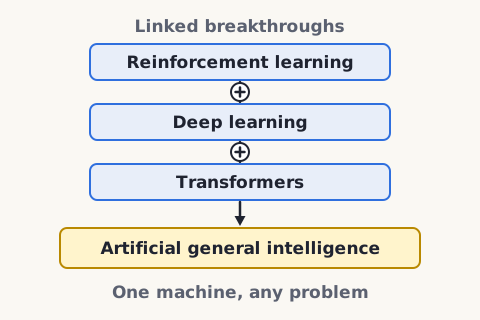
What is the infinity machine?
The title is Mallaby's metaphor for artificial general intelligence: a single machine that could, in principle, solve any problem a human mind can frame. The book argues that DeepMind's history is the clearest case study of how such a machine is actually being built — not by a moonshot, but by linked breakthroughs in reinforcement learning, deep learning, and now transformers.
Written by Sebastian Mallaby
Sebastian Mallaby, previously known for writing about hedge funds and venture capital, is the author of The Infinity Machine.

Hassabis, the book's subject
The Infinity Machine centers on Demis Hassabis — chess prodigy, game designer, neuroscience PhD, and Nobel laureate.
Penguin Press, 2026
The Infinity Machine was published by Penguin Press in 2026.
Three strands of the story
Mallaby braids three storylines: Hassabis's personal arc from chess prodigy to Nobel laureate; the technical lineage from Atari DQN through AlphaGo, AlphaFold and Gemini; and the geopolitics of an arms race between Silicon Valley labs, Google DeepMind, Anthropic, and China. None of the three is intelligible without the other two.
Why games matter to the plot
The book keeps returning to games — chess, Diplomacy, Theme Park, Atari, Go, StarCraft. Hassabis's conviction is that games provide a closed environment in which you can measure intelligence against a clear reward, then transfer the learning to the messy world. Every major DeepMind milestone first proved itself in a game.
The book's thesis in one line
Mallaby's argument: the most consequential technology of the century is being built by a small group of people whose biographies and rivalries matter — and DeepMind, born of a London poker game and a Singularity Summit pitch, has had outsized influence on what gets built and how.
DeepMind's AGI-first mission
Mallaby treats DeepMind's founding mission as a research lab pursuing AGI as a primary goal — a framing built into the company's earliest pitches and incorporation documents from 2010.
Hassabis can't slow the race
Mallaby writes that Hassabis doesn't believe any single actor can slow down the AI race — he sees himself as a participant in it, not someone positioned to act as a brake.
Matched pairs
Each item on the left goes with the one on the right.
- Author of The Infinity Machine
- Sebastian Mallaby
- Central subject of the book
- Demis Hassabis
Self-test
Answer each question from memory, then check your work against the answer key.
1. Which publishing house released The Infinity Machine in 2026?
- AMIT Press
- BRandom House
- CKnopf
- DPenguin Press
2. Who wrote The Infinity Machine?
- ASebastian Mallaby
- BMarcus Hutter
- CShane Legg
- DDemis Hassabis
3. Who is the central subject of The Infinity Machine?
- AShane Legg
- BSam Altman
- CDemis Hassabis
- DSebastian Mallaby
4. Before The Infinity Machine, Sebastian Mallaby was best known for writing about which subjects?
- ANeuroscience and cognitive psychology
- BHedge funds and venture capital
- CChess and competitive gaming
- DNuclear weapons policy
5. Which statement about The Infinity Machine is NOT accurate?
- AIt was published in 2026
- BPenguin Press published it
- CDemis Hassabis is the book's author
- DSebastian Mallaby is the book's author
6. In the book, what does Hassabis mean by 'the sweetness'?
- AThe moment a research grant is finally approved
- BThe instant a long-resistant problem finally breaks open
- CThe satisfaction of publishing ahead of a rival lab
- DThe public ceremony where a discovery is honoured
7. The scene Mallaby opens the book with is Hassabis collecting which award?
- AThe Turing Award
- BThe Nobel Prize in Physiology or Medicine
- CThe Nobel Prize in Physics
- DThe Nobel Prize in Chemistry
8. The Nobel that frames the book's opening was awarded for which achievement?
- APredicting protein structures from amino-acid sequences
- BBuilding the Gemini family of models
- CTraining an agent to play Atari games from raw pixels
- DDefeating a world champion at the board game Go
9. Why does Mallaby make 'the sweetness' his organising metaphor?
- AIt argues that discovery is a purely romantic notion
- BIt explains why researchers pour a decade into one problem
- CIt proves scientific discovery is mostly luck
- DIt shows that prizes are the true motive for research
10. Which moment would Hassabis NOT count as 'the sweetness'?
- ABeing alone with a solution before anyone knows
- BThe private rush the instant an answer appears
- CSeeing a decade-old problem suddenly crack
- DStanding on stage as the prize is announced
11. 'The infinity machine' is Mallaby's label for what?
- AArtificial general intelligence
- BReinforcement learning
- CDeepMind's Gemini model family
- DThe transformer architecture
12. How does the book define AGI?
- AA machine that predicts protein structures at experimental accuracy
- BA system that beats human experts at one narrow, well-defined task
- CA system matching or surpassing humans across the full range of cognitive tasks
- DAny model trained with reinforcement learning on a closed game
13. Which system would Mallaby count as an infinity machine itself, rather than a step toward one?
- AA system that learns to play many arcade games from raw screen pixels
- BA system that masters a single board game well enough to beat the world's champions
- CA system able, in principle, to solve any problem a human mind can frame
- DA system that predicts a protein's three-dimensional structure from its amino-acid sequence
14. According to the book, how is the infinity machine actually being constructed?
- ABy scaling one narrow game-playing agent indefinitely
- BThrough successive, linked breakthroughs rather than one dramatic leap
- CThrough a single moonshot project inside Google
- DBy combining existing narrow systems into a committee
15. Mallaby's 'infinity machine' labels AGI. As the book defines it, such a system is capable in principle of doing what?
- AMastering one narrow task better than any human
- BPredicting protein structures from amino acids
- CWinning closed games like Go and StarCraft
- DSolving any problem a human mind can frame
16. Mallaby treats DeepMind's mission statement as which kind of project?
- AA research lab pursuing AGI as a primary goal
- BA pure software product company
- CA consultancy advising other AI labs
- DA defense contractor for the UK government
17. What is Mallaby's one-line thesis about the century's most consequential technology?
- AThe technology's path is determined by compute budgets alone
- BThe builders' biographies and rivalries are determinative of the outcome
- CThe outcome was fixed once the transformer was invented
- DGovernment regulation will decide what ultimately gets built
18. DeepMind was founded out of a London poker game and a pitch delivered at which event?
- AThe Turing Institute launch
- BThe Royal Society's AI symposium
- CA Google I/O keynote
- DThe Singularity Summit
19. What does Mallaby say about Hassabis's view of slowing the AI race?
- AHassabis has withdrawn from the race on principle
- BHassabis argues regulation has already halted the race
- CHassabis does not believe any single actor can slow it; he is a participant
- DHassabis believes DeepMind alone can pause the race at will
20. Which is NOT part of Mallaby's thesis about DeepMind?
- AIts influence has been proportionate to its modest size
- BIts people's rivalries shaped what got built
- CIt framed AGI as a primary goal, not a product feature
- DIt shaped an entire field's self-understanding
Go deeper
- ReadThe Infinity Machine by Sebastian Mallaby · on Amazon ↗
- StudyThe Infinity Machine (book) in the FlashFeed app
These are affiliate links: if you buy a book through one, FlashFeed may earn a small commission at no extra cost to you. The commission helps pay for FlashFeed's servers.
As an Amazon Associate we earn from qualifying purchases.
Answer key
- 1. D Penguin Press
- 2. A Sebastian MallabySebastian Mallaby is the author, previously known for writing about hedge funds and venture capital. Demis Hassabis is the book's central subject, not its author.
- 3. C Demis HassabisThe book centres on Demis Hassabis — chess prodigy, game designer, neuroscience PhD, Nobel laureate. Mallaby is the author, not the subject.
- 4. B Hedge funds and venture capitalMallaby came to this book from a career writing about hedge funds and venture capital. Neuroscience and chess belong to Hassabis's biography, not Mallaby's.
- 5. C Demis Hassabis is the book's authorHassabis is the central subject, not the author — Mallaby wrote the book. The other three statements are all correct: Penguin Press, 2026.
- 6. B The instant a long-resistant problem finally breaks openThe sweetness is the private rush at the instant a problem cracks — explicitly not the public celebration or the announcement that follows.
- 7. D The Nobel Prize in ChemistryThe book opens on Hassabis collecting the 2024 Nobel Prize in Chemistry, awarded for AlphaFold's protein-structure work.
- 8. A Predicting protein structures from amino-acid sequencesThe 2024 Chemistry Nobel recognised AlphaFold's prediction of protein structures from amino-acid sequences. AlphaGo, the Atari DQN and Gemini are milestones, but not the Nobel work.
- 9. B It explains why researchers pour a decade into one problemThe metaphor explains motivation — the internal signal, not the prize or the paper, is what sustains a decade on one problem. Mallaby uses the Nobel precisely to show the feeling is not merely romantic.
- 10. D Standing on stage as the prize is announcedThe sweetness is the moment before the announcement, alone with the solution — a public stage is exactly what it is not.
- 11. A Artificial general intelligenceThe title is Mallaby's metaphor for artificial general intelligence. Transformers, Gemini and reinforcement learning are components or milestones on the path, not the machine itself.
- 12. C A system matching or surpassing humans across the full range of cognitive tasksAGI spans the full cognitive range, not one narrow domain. Beating experts at a single task — Go, or protein folding — is exactly the narrow capability AGI is contrasted with.
- 13. C A system able, in principle, to solve any problem a human mind can frameThe infinity machine is the full cognitive range — any problem a human can frame. AlphaFold, AlphaGo and the Atari DQN are narrow milestones on the path, however impressive.
- 14. B Through successive, linked breakthroughs rather than one dramatic leapMallaby's premise is that it comes from successive linked breakthroughs — reinforcement learning, deep learning, transformers — not a single dramatic leap or moonshot.
- 15. D Solving any problem a human mind can frameMallaby defines the infinity machine (AGI) as a system capable, in principle, of solving any problem a human mind can frame — the full cognitive range, not one narrow task. The distractors are narrow AI, AlphaFold, and game-playing proving grounds.
- 16. A A research lab pursuing AGI as a primary goalFrom its 2010 founding, DeepMind explicitly framed itself as an AGI-first organisation — the word was in pitches and incorporation documents.
- 17. B The builders' biographies and rivalries are determinative of the outcomeMallaby argues the people's biographies and rivalries are not incidental but determinative. He never claims compute or regulation settles the outcome.
- 18. D The Singularity SummitThe book describes DeepMind as born of a London poker game and a pitch at the Singularity Summit.
- 19. C Hassabis does not believe any single actor can slow it; he is a participantMallaby is explicit: Hassabis doubts any single actor can slow the race down — he is a participant, not a brake.
- 20. A Its influence has been proportionate to its modest sizeMallaby argues DeepMind's influence has been disproportionate to its size — the opposite of proportionate. The other three are core claims of the thesis.
Image credits
- What is the infinity machine?: FlashFeed original diagram · CC-BY-4.0
- Hassabis, the book's subject: Wikimedia Commons · John Sears · CC BY-SA 4.0 — commons.wikimedia.org/wiki/File:Demis_Hassabis,_2024_Nobel_Prize_Laureate_in_Chemistry_7_(cropped).jpg
