
LLM 101 study guide · Lesson 7 of 10
What LLMs Are Good For
Language and writing tasks · Knowledge, search and code · Work and everyday tasks · High-stakes domains and choosing well
This is the lesson's study guide from the FlashFeed app, plus its key facts and a self-test.
What you'll be able to do
- Identify LLM strengths across language tasks — summarization, translation, rewriting, editing, classification, and simplification.
- Explain LLM knowledge/search use cases (research, semantic search, extraction, RAG) and coding assistance (Copilot speedup, explanation, debugging, tests).
- Identify everyday work and personal tasks LLMs assist — support, drafting, meeting notes, data cleaning, tutoring, brainstorming — with their catches.
- Apply the copilot pattern and the cost-of-verification framework to decide how much automation a task warrants.
- Judge good vs poor LLM fit and the human-review guardrails required in healthcare, legal, and finance.
Knowledge, search and code
LLMs earn their keep across four kinds of work: language tasks, knowledge and search, code, and everyday work and personal tasks. All of them rely on the same underlying capability — fluent pattern completion at scale — applied to very different workflows.
Language and writing tasks
Language-in, language-out work is where LLMs are most dependable, because the output can be judged by reading it. Summarization condenses long documents into structured summaries; the catch is that nuance and exact figures can drop, so verify critical details. Translation is often near-professional across major languages, including idioms, but weaker on low-resource languages and on technical or legal text, which need expert review. Rewriting and tone-shifting changes register ('make it formal') while keeping intent. Grammar and copy editing catches errors and awkward phrasing, but can over-formalize or subtly change meaning. Classification and sentiment with few-shot prompting can often match dedicated classifiers on a given label set; the catch is non-determinism, so use low temperature and test on held-out examples. Plain-language simplification rewrites technical, legal, or medical text for low-literacy or non-native readers: high value, low risk, and easy to verify.
Document Q&A over your own files
RAG (Retrieval-Augmented Generation) is a widely used enterprise pattern for grounding an LLM in private knowledge. The approach: chunk your documents, embed each chunk as a vector, store them in a vector database, then at query time retrieve the most relevant passages and inject them into the prompt. The model answers from that retrieved context rather than from weights. This is why RAG is often preferred to fine-tuning for adding private knowledge — it's usually cheaper, the knowledge base is updatable without retraining, and proprietary data never enters the model's weights. Use cases include contract review, internal wiki Q&A, customer support over product manuals, and semantic search — finding passages by meaning rather than keyword. LLMs also excel at structured data extraction: reading unstructured text (an invoice, a clinical note) and outputting structured fields. Related uses include research assistance (synthesizing sources, drafting summaries, explaining dense papers), where the catch is that a model cannot browse live unless it is given a search tool, so citations and what the sources actually say must be verified. Semantic search is weaker on niche jargon unless the embedding model is domain-tuned, and extraction into JSON or CSV errs more often on rare or ambiguous fields, so validate outputs programmatically. The common thread is that the model acts as an intelligent reading layer over your corpus, not as a memory store.
Code generation: the copilot pattern
Code-trained LLMs — models exposed to large volumes of open-source code during pretraining — can suggest lines, complete functions, and generate boilerplate from a comment or docstring. The canonical product is GitHub Copilot, and the best-known evidence on its impact is a single controlled experiment (Peng et al., 2023, arXiv 2302.06590) in which developers implementing an HTTP server in JavaScript completed the task 55.8% faster with Copilot than without. The authors report that less experienced developers benefited most, which fits the idea that the tool narrows the gap between knowing what to write and knowing how to phrase it. Beyond generation, LLMs provide strong code explanation, debugging assistance, and test writing — converting an existing function into a documented, tested unit with a single prompt. Pasting an error and the code often lets an LLM spot root causes and fixes, but novel bugs or performance problems that need profiler data are harder, so treat suggestions as hypotheses to test. Generated tests cover happy paths and common edge cases but not your domain's invariants or business rules, so unique edge cases still need a human. The critical caveat: generated code is a useful starting point, not a finished product. Review still matters; the model can produce plausible-looking code that subtly mishandles edge cases, uses deprecated APIs, or introduces security issues.
Research, debugging and testing in practice
Research assistance means synthesizing sources, drafting summaries, and explaining dense papers. The catch is that an LLM cannot browse live unless it is given a search tool, so always verify citations and that each source says what is claimed. Semantic search uses embeddings to retrieve by meaning ('contract renewals' finds documents that never use the phrase), but is weaker on niche jargon unless the embedding model is domain-tuned. Extraction outputs clean JSON or CSV, but rare or ambiguous fields err more often, so validate outputs programmatically. For debugging, paste the error and the code: LLMs often spot root causes and fixes, though novel bugs or performance issues that need profiler data are harder, so treat suggestions as hypotheses to test. Generated tests cover happy paths and common edge cases, but the model does not know your domain's invariants or business rules, so unique edge cases still need a human.
Work and everyday tasks
In the workplace, customer support chatbots backed by RAG answer tier-1 questions around the clock and escalate ambiguous ones; the catch is that out-of-scope questions get confident wrong answers without good guardrails. Email and report drafting turns bullets or a thread into a polished first draft, though a human edit pass is still needed for tone and accuracy. Meeting notes summarize transcripts into decisions and to-dos, but speaker attribution and acronyms get mangled, so attendees should skim before distribution. Data cleaning normalizes free-text fields ('NY' / 'new york' becomes 'New York, NY'); high-volume pipelines need structured-output modes or fine-tuning for consistency. For personal use, tutoring is patient and always available and can explain a concept many ways, but factual errors are hard for learners to spot, so pair it with a verified curriculum. Brainstorming generates many names, angles, or framings fast while the human selects; ideas cluster around training data, so truly novel domains get generic output.
High-stakes domains and choosing well
The same capabilities that make LLMs useful in low-stakes drafting become potential liabilities when the output drives a consequential decision. Healthcare, law, and finance share a common structure: valuable assistance is available, but unsupervised deployment creates real harm. The unifying principle is the copilot pattern — the model suggests, drafts, or assists, and a human approves before anything takes effect.
Healthcare: assist, don't diagnose
LLMs are productive in clinical settings for summarizing clinical notes, drafting discharge summaries, and surfacing relevant literature — tasks where the bottleneck is reading and writing volume, not clinical judgment. The risk is medical hallucination: a wrong dosage, a misattributed contraindication, an invented drug interaction. Research suggests hallucination may be intrinsic to LLMs rather than a solvable edge case, which means deployment in healthcare cannot rely on the model's self-correction. Every output requires clinician review, and evaluation suites designed for the specific medical domain are a prerequisite, not an option.
Legal: research and drafting, never final
LLMs handle contract summarization, clause extraction, and statute research well. The canonical cautionary case: in 2023, two attorneys were sanctioned after filing a brief in federal court that cited cases ChatGPT had fabricated. The citations looked real; the cases did not exist. The lesson is that LLM legal research is a starting point for human search, not a substitute. All LLM-generated legal content must be cite-verified by a qualified attorney before it carries any weight.
Finance: analysis aid, regulated output
In finance, LLMs assist with earnings call summarization, filing sentiment analysis, and structured data extraction from dense reports. The exposure is regulatory: outputs that drive investment decisions, lending choices, or compliance actions fall under existing rules, and a hallucinated figure in a customer-facing document creates legal as well as financial harm. Best practice is RAG over verified data sources combined with mandatory human review before any output reaches a customer or a decision system.
Human-in-the-loop: when and why
The framework for calibrating autonomy: let the cost of verification set the checkpoint level. If a human can cheaply check the output — reading a draft, running a unit test — more automation is appropriate. If verification is expensive or slow, or an error would be costly and hard to undo — a surgical procedure, a court filing, an executed trade — a human must approve before the consequential action is taken. The copilot pattern names this design: LLM suggests or drafts, human decides. It contrasts with autonomous agents that act without per-step human review. Fully autonomous LLM deployment on high-stakes decisions is the failure mode, not the goal.
Key terms
- copilot pattern
- A design where the LLM suggests, drafts, or assists and a human approves before anything takes effect — accelerating the work without finalizing it. It contrasts with autonomous agents that act without per-step review.
Key concepts
Healthcare
- A high-stakes domain where LLMs help but must never be the final decision-maker.
- Useful for summarizing clinical notes and drafting discharge summaries, where the bottleneck is reading and writing volume.
- Its signature danger is a wrong dosage or invented drug interaction, so every output needs clinician review.
Legal
- A high-stakes domain where an LLM's research is a starting point, never the finished product.
- Strong at contract summarization, clause extraction, and statute research.
- Its cautionary tale: in 2023 two attorneys were sanctioned for filing a brief citing cases ChatGPT had fabricated.
Finance
- A high-stakes domain where LLM outputs fall squarely under existing regulation.
- Useful for earnings-call summarization, filing sentiment analysis, and extracting structured data from dense reports.
- Best practice here is RAG over verified data sources plus mandatory human review before anything reaches a customer.
Key facts
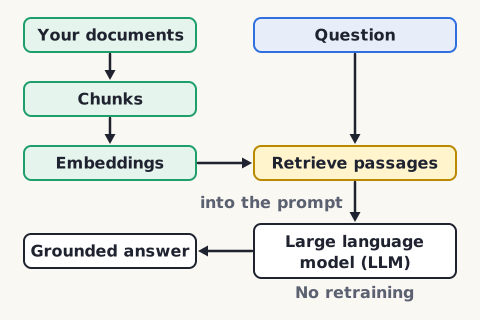
Document Q&A over your own files
Chunk private documents, embed them, and retrieve relevant passages into the prompt (RAG) to get an assistant grounded in your own data — manuals, contracts, wikis — without retraining. It is a widely used enterprise LLM pattern because it is usually cheaper than retraining, the knowledge base is updatable, and proprietary data stays out of model weights.
RAG Is Often Preferred to Fine-Tuning
RAG often grounds an LLM in private company knowledge more cheaply than fine-tuning, lets the knowledge base update without retraining, and keeps proprietary data out of the model's weights.
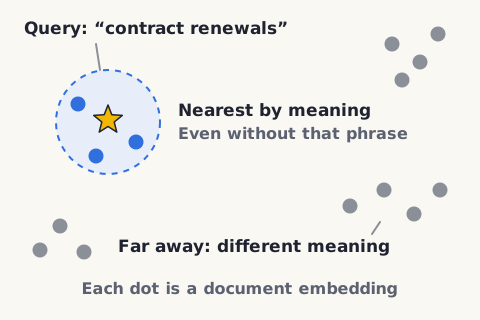
Embeddings Search By Meaning
Semantic search retrieves passages by meaning using embeddings, so a query like "contract renewals" can surface documents that never use that phrase — though it weakens on niche jargon the embedding model doesn't cover.
Where AI Testing Falls Short
LLMs write unit tests that cover happy paths and common edge cases well, but they don't know your domain's invariants or business rules, so the edge cases unique to your system still need a human to catch them.

Human-in-the-loop: when and why
Let the cost of verification set the level of autonomy. If checking the output is fast and cheap — reading a draft, running a test — more automation is fine. If verification is expensive, or an error would be costly and hard to undo — surgery, a legal filing, a trade — keep a human checkpoint before every consequential action.
The Copilot Pattern
In the copilot pattern, the LLM suggests, drafts, or assists, but a human must approve before anything takes effect — it accelerates work without ever finalizing it on its own.
By the numbers
- In Peng et al.'s 2023 controlled experiment on writing a JavaScript HTTP server, how much faster did developers complete the task with GitHub Copilot (%)?
- 55.8 %
Matched pairs
Each item on the left goes with the one on the right.
- Summarization
- Condensing long documents into structured summaries — a top strength. Catch: nuance and exact figures can drop, so verify critical details.
- Translation
- Near-professional quality across major languages. Catch: weaker on low-resource languages and technical or legal text — get expert review.
- Rewriting and tone-shifting
- Reliably shifts register ('make it formal,' 'make it friendlier') while keeping intent — among the most dependable uses, since the output is easy to judge by reading.
- Grammar and copy editing
- Catches errors and awkward phrasing and rewrites inline. Catch: can over-formalize or subtly change meaning without flagging it.
- Classification and sentiment
- Given a label set, few-shot prompting can come close to dedicated classifiers on many tasks. Catch: it's non-deterministic — use low temperature and test on held-out examples.
- Plain-language simplification
- Rewrites technical, legal, or medical text to a plain reading level for low-literacy or non-native readers — high value and easy for a reviewer to compare with the source. Catch: simplification can shift meaning, so legal or medical text still needs expert review before it is relied on.
- Research assistance
- Synthesizes sources, drafts summaries, and explains dense papers. Catch: it can't browse live unless given a search tool — always verify citations and that sources say what's claimed.
- Semantic search
- Embeddings retrieve by meaning, not keywords ('contract renewals' finds docs that never use the word). Catch: weaker on niche jargon unless the embedding model is domain-tuned.
- Structured data extraction
- Parses messy text — invoices, emails, notes — into clean JSON or CSV. Catch: rare or ambiguous fields err more often, so validate outputs programmatically.
- Code explanation and docs
- 'Explain this line by line' or 'write a docstring' — very strong, since explanation is text over a constrained domain. Catch: can be plausibly wrong on optimized or legacy code; test the described behavior.
- Debugging assistance
- Paste an error and the code; LLMs often spot root causes and fixes. Catch: novel bugs or performance issues needing profiler data are harder — treat suggestions as hypotheses to test.
- Test writing
- Generates unit tests covering happy paths and common edge cases. Catch: it won't know your domain's invariants or business rules, so unique edge cases still need a human.
- Customer support chatbots
- RAG-backed bots answer tier-1 questions 24/7 and escalate ambiguous ones. Catch: out-of-scope questions yield confident wrong answers without good guardrails.
- Email and report drafting
- Turns bullets or a thread into a polished first draft in seconds. A human edit pass is still needed for tone and accuracy, but starting from a draft beats a blank page.
- Meeting notes and action items
- Summarizes transcripts into decisions and to-dos. Catch: speaker attribution and acronyms get mangled — have attendees skim before distributing.
- Data cleaning and normalization
- Normalizes free-text fields ('NY' / 'new york' → 'New York, NY'). Catch: high-volume pipelines need structured-output modes or fine-tuning for consistency.
- Tutoring and learning
- Patient, always available, and able to explain a concept ten ways. Catch: factual errors are hard for learners to spot, so it's best paired with a verified curriculum.
- Brainstorming and ideation
- Generates many names, angles, or framings fast; the human evaluates and selects. Catch: ideas cluster around training data, so truly novel domains get generic output.
- Good LLM fit
- Output is easy to judge, errors are cheap to catch, the task is language-in / language-out, and volume justifies the integration — e.g., drafting, summarizing, classification, reviewed code.
- Poor LLM fit
- Correctness can't be cheaply verified, exact arithmetic is required without tools, real-time data is needed without retrieval, or accountability demands auditable logic — e.g., live trading, unsupervised clinical decisions.
Step by step
Choose the right LLM approach for a task
- Identify the task type: language, code, knowledge retrieval, or taking actions.
- Need real-time or proprietary data? Reach for RAG before fine-tuning.
- Need persistent custom style, persona, or domain behavior? Consider fine-tuning.
- Ask how costly a wrong output is; if high, require human review and prefer a copilot over an autonomous agent.
- Prototype with prompting first; add RAG or fine-tuning only when prompting hits a ceiling.
Self-test
Answer each question from memory, then check your work against the answer key.
1. LLM translation reaches near-professional quality across major languages, but the section warns it is weakest on which inputs?
- AShort marketing taglines
- BCasual dialogue between two speakers
- CIdioms and common expressions in major languages
- DLow-resource languages and technical or legal text
2. Summarization is called a top LLM strength. What catch does the section attach to it?
- AThe model refuses documents longer than a few pages
- BNuance and exact figures can drop, so verify critical details
- CIt cannot produce structured summaries, only prose
- DSummaries come out longer than the source text
3. Which of these is NOT listed among the language and writing tasks LLMs handle well?
- ATool-free exact arithmetic
- BRewriting and tone-shifting
- CClassification and sentiment
- DPlain-language simplification
4. Few-shot prompting can come close to dedicated classifiers on a given label set. What caveat does the section add?
- AIt only supports two labels at a time
- BIt needs a full fine-tune before it reaches classifier parity
- CIt is non-deterministic, so use low temperature and test on held-out examples
- DIt cannot return its answer as a structured field
5. A hospital rewrites a dense consent form so low-literacy and non-native readers can follow it. Which listed strength is this?
- AStructured data extraction
- BPlain-language simplification
- CSemantic search
- DClassification and sentiment
6. What LLM strength involves condensing long documents into structured summaries?
- ASummarization
- BClassification
- CTranslation
- DExtraction
7. What is the main catch when an LLM summarizes a document?
- AIt can only summarize text it saw in training
- BStructured summaries are not supported
- CSummaries come out longer than the source
- DNuance and exact figures can drop
8. Rewriting technical, legal, or medical text to a plain reading level is called what?
- AStructured data extraction
- BRewriting and tone-shifting
- CPlain-language simplification
- DClassification
9. Why is plain-language simplification a good LLM use case?
- AIt's high value, low risk, but hard to verify
- BIt's high value, high risk, and hard to verify
- CIt's low value, low risk, and easy to verify
- DIt's high value and easy for a reviewer to check against the source
10. For classification and sentiment tasks, few-shot prompting can come close to the accuracy of what?
- ADedicated classifiers
- BFine-tuned translation models
- CRAG retrieval accuracy
- DHuman expert reviewers
11. RAG (Retrieval-Augmented Generation) is often preferred over fine-tuning for grounding an LLM in private company knowledge. Why?
- AIt lets the model memorize the documents during training, so no storage is needed
- BIt permanently bakes the company's documents into the model's weights for faster recall
- CIt's cheaper, the knowledge base updates without retraining, and proprietary data never enters the model's weights
- DIt guarantees the model can browse the live web at query time
12. In the controlled study cited, how much faster did developers complete a task with GitHub Copilot than without it?
- A72.6% faster
- B55.8% faster
- C41.2% faster
- D27.5% faster
13. In that Copilot study, which group of developers gained the most from the tool?
- ASenior architects
- BDevelopers working in low-level languages
- CDevelopers with prior Copilot experience
- DJunior developers
14. What makes semantic search different from keyword search, and where does it get weaker?
- AIt ranks results by recency; it weakens on older archives
- BEmbeddings retrieve by meaning; it weakens on niche jargon
- CIt requires fine-tuning per corpus; it weakens on short queries
- DIt matches exact keyword strings faster; it weakens on long documents
15. LLMs generate unit tests covering happy paths and common edge cases. What still needs a human?
- ADocstrings for the function under test
- BBasic assertion syntax for the target test framework
- CYour domain's invariants and business rules, so unique edge cases get missed
- DBoilerplate setup code for each test
16. What is the catch with LLM research assistance and citations?
- AIt can't browse live without a search tool
- BIt can't draft summaries of sources
- CIt can't format citations in standard styles
- DIts citations are verified automatically before output
17. What do LLMs do well for research assistance?
- ABrowse the live web without any search tool
- BConfirm whether a paper has been retracted
- CReliably recall the exact page numbers of its citations
- DSynthesize sources and explain dense papers
18. Structured data extraction turns messy text like invoices into what?
- AClean JSON or CSV
- BA fine-tuned classifier
- CA vector database
- DA retrieval index
19. What is the catch with structured data extraction?
- ACommon fields such as dates err most often
- BOutput cannot be validated programmatically
- CRare or ambiguous fields err more often
- DMessy text must be cleaned by hand before parsing
20. Given an error and the code, what can an LLM often spot?
- AOnly the line number of the error
- BRoot causes and fixes
- CBugs only in code it wrote itself
- DSyntax errors only, never logic errors
21. The section praises LLMs for brainstorming and ideation, but what limitation does it note?
- AIdeas cluster around training data, so truly novel domains get generic output
- BIt only generates ideas for creative writing, not business
- CIdeas are more novel in unfamiliar domains than familiar ones
- DIt cannot generate more than a handful of options per prompt
22. LLMs summarize meeting transcripts into decisions and to-dos. What does the section say tends to go wrong?
- ATranscripts over ten minutes cannot be processed
- BSpeaker attribution and acronyms get mangled
- CDecisions are always omitted from the summary
- DAction items are produced only in the speaker's language
23. RAG-backed support chatbots answer tier-1 questions around the clock. What is the risk the section names?
- AThey must be retrained for each new product manual
- BThey only work during business hours in one time zone
- CThey cannot escalate anything to a human agent
- DOut-of-scope questions get confident wrong answers without good guardrails
24. LLMs make patient, always-available tutors. Why does the section still recommend pairing them with a verified curriculum?
- AThey refuse to answer beginner-level questions
- BThey can only explain a concept one way
- CFactual errors are hard for learners to spot
- DThey are unavailable outside scheduled sessions
25. Which of these is NOT one of the everyday work or personal uses the section lists?
- ABrainstorming and ideation
- BExecuting a trade from a portfolio brief
- CEmail and report drafting
- DData cleaning and normalization
26. What do RAG-backed customer support chatbots do well?
- AMake policy exceptions on their own authority
- BAnswer questions outside their knowledge base reliably
- CResolve every refund or legal dispute without escalation
- DAnswer tier-1 questions 24/7 and escalate the rest
27. What is the catch with customer support chatbots?
- ATier-1 questions get slow answers at night
- BManual updates require retraining the model
- COut-of-scope questions get confident wrong answers
- DAmbiguous questions are never escalated
28. LLM meeting-notes tools summarize transcripts into what?
- ADecisions and to-dos
- BFinancial forecasts
- CVerbatim word-for-word transcripts
- DCalendar invites for follow-ups
29. What is the catch with LLM meeting notes?
- ASpeaker attribution and acronyms get mangled
- BTranscripts must be in English first
- CTranscripts must be cleaned by hand before summarizing
- DDecisions are captured but to-dos are dropped
30. What does LLM data cleaning do with a field like 'NY'?
- AReplaces it with a numeric state code
- BRewrites it in lowercase as 'ny'
- CLeaves it as 'NY' and flags it as an error
- DNormalizes it to 'New York, NY'
31. In the section's human-in-the-loop framework, what should determine how much automation is appropriate for a task?
- AThe length of the model's context window
- BThe size of the model being used
- CThe cost of verifying the output
- DThe number of users the system serves
32. How is the copilot pattern defined?
- ATwo models cross-check each other and ship the agreed output
- BThe LLM suggests, drafts, or assists and a human approves before anything takes effect
- CThe LLM acts first and reports its actions to a human afterward
- DA human writes the draft and the LLM grades it for quality
33. The copilot pattern is defined in contrast to what other design?
- AAutonomous agents that act without per-step review
- BRetrieval pipelines that ground answers in documents
- CFine-tuned models trained on proprietary data
- DFew-shot classifiers tuned with a fixed label set
34. Using the cost-of-verification framework, which task best justifies more automation with a lighter human checkpoint?
- AExecuting a trade on a live account
- BApproving a step in a surgical procedure
- CFiling a brief in federal court
- DGenerating a unit test that a CI run immediately checks
35. Which of these is the failure mode rather than the goal?
- AA human reviewing a generated draft before it ships
- BFully autonomous LLM deployment on high-stakes decisions
- CRunning RAG over verified data sources
- DRunning unit tests against generated code
36. Which set of conditions marks a good LLM fit for a task?
- AAccountability requires a fully auditable decision trail
- BThe task needs exact arithmetic and no calculator tool is available
- COutput is easy to judge, errors are cheap to catch, it is language-in / language-out, and volume justifies it
- DCorrectness can only be confirmed by an expensive external audit
37. Which of these is NOT a signal of poor LLM fit?
- AReal-time data is needed but there is no retrieval
- BCorrectness cannot be cheaply verified
- CDrafting a summary a reviewer can skim in a minute
- DExact arithmetic is required and no tools are available
38. What is the canonical 2023 cautionary case for legal use of LLMs?
- AA firm was fined for uploading client contracts to a public model
- BA state bar suspended an attorney for drafting contracts with an LLM
- CAn attorney was disbarred after an LLM mistranslated a statute in a filing
- DTwo attorneys were sanctioned after filing a brief citing cases ChatGPT had fabricated
39. What is required before an LLM output is used in a clinical setting?
- AA larger context window holding the full patient chart
- BClinician review of every output, plus domain-specific evaluation suites
- CA self-correction prompt asking the model to check its own dosages
- DFine-tuning on patient records in place of human review
40. What is best practice for LLM use in regulated finance?
- ARAG over verified data sources plus mandatory human review before customer-facing output
- BFine-tuning on public filings and shipping outputs directly to customers
- CAllowing the model to execute low-value trades autonomously
- DRelying on the model to flag its own hallucinated figures
41. In healthcare, what does every LLM output require before use?
- AA larger context window
- BReal-time internet access
- CA blockchain audit log
- DClinician review
42. What specific risk is central to LLM use in healthcare?
- AMedical hallucination such as a wrong dosage
- BPoor translation quality
- CSlow response latency
- DHigh compute cost
43. What must happen to all LLM-generated legal content before it carries any weight?
- AAutomatic filing with the court
- BPeer review by another LLM
- CCite-verification by a qualified attorney
- DTranslation into plain language
44. What 2023 incident is cited as a warning about unsupervised LLM use in law?
- AA law firm's court filing was leaked in a data breach
- BAttorneys sanctioned for fabricated ChatGPT citations
- CA firm was fined for uploading client files to a chatbot
- DA judge dismissed a case after an LLM mistranslated a contract
45. What is best practice for finance LLM deployments?
- AFully autonomous trading without oversight
- BRAG over verified data plus mandatory human review
- CFine-tuning on customer chat logs only
- DSkipping review for internal-only reports
Go deeper
Answer key
- 1. D Low-resource languages and technical or legal textTranslation handles major languages well, but quality drops on low-resource languages and technical or legal text — get expert review for those.
- 2. B Nuance and exact figures can drop, so verify critical detailsSummarization condenses long documents well, but nuance and precise figures can be lost, so critical details need verifying. Structured summaries are actually a stated strength, not a limit.
- 3. A Tool-free exact arithmeticSimplification, rewriting/tone-shifting, and classification are all listed language strengths. Needing exact arithmetic without tools is named as a marker of poor LLM fit.
- 4. C It is non-deterministic, so use low temperature and test on held-out examplesThe stated catch is non-determinism: lower the temperature and validate on held-out examples. Fine-tuning is not required to get close, which is the point of few-shot prompting.
- 5. B Plain-language simplificationRewriting technical, legal, or medical text to a plain reading level is plain-language simplification: high value and easy for a reviewer to compare with the source, though a consent form still needs expert review before use. Extraction outputs fields, not rewrites.
- 6. A SummarizationSummarization — condensing long documents into structured summaries — is a top LLM strength.
- 7. D Nuance and exact figures can dropThe catch for summarization is that nuance and exact figures can drop, so critical details need verifying.
- 8. C Plain-language simplificationPlain-language simplification rewrites technical, legal, or medical text for low-literacy or non-native readers.
- 9. D It's high value and easy for a reviewer to check against the sourcePlain-language simplification is high value and easy for a reviewer to compare with the source, though legal or medical text still needs expert review.
- 10. A Dedicated classifiersGiven a label set, few-shot prompting can come close to dedicated classifiers on many tasks.
- 11. C It's cheaper, the knowledge base updates without retraining, and proprietary data never enters the model's weightsRAG retrieves relevant chunks at query time and injects them into the prompt, so the model answers from context — cheaper than retraining, updatable without it, and proprietary data stays out of the weights.
- 12. B 55.8% fasterThe controlled study found developers finished the task 55.8% faster with Copilot, roughly a 56% speedup. The other figures do not appear in the evidence cited.
- 13. D Junior developersJunior developers gained most, consistent with the idea that the tool compresses the gap between knowing what to write and knowing how to phrase it. Seniors already have that phrasing fluency.
- 14. B Embeddings retrieve by meaning; it weakens on niche jargonEmbeddings retrieve passages by meaning, so 'contract renewals' can find docs that never use the phrase. The catch is niche jargon unless the embedding model covers it. No per-corpus fine-tune is needed.
- 15. C Your domain's invariants and business rules, so unique edge cases get missedTest generation covers happy paths and common edge cases, but the model does not know your domain's invariants or business rules, so unique edge cases still need a human. Docstrings are a stated strength.
- 16. A It can't browse live without a search toolResearch assistance can't browse live unless given a search tool, so citations and sources must always be verified.
- 17. D Synthesize sources and explain dense papersFor research assistance, LLMs do well at synthesizing sources, drafting summaries, and explaining dense papers.
- 18. A Clean JSON or CSVStructured data extraction parses messy text into clean JSON or CSV fields.
- 19. C Rare or ambiguous fields err more oftenRare or ambiguous fields err more often in extraction, so outputs should be validated programmatically.
- 20. B Root causes and fixesPasting an error and the code often lets an LLM spot root causes and fixes.
- 21. A Ideas cluster around training data, so truly novel domains get generic outputLLMs generate many names, angles, and framings fast for a human to select — but because output reflects patterns in the training data, genuinely novel domains tend to get generic ideas.
- 22. B Speaker attribution and acronyms get mangledThe catch is mangled speaker attribution and acronyms, which is why attendees should skim notes before they are distributed. Extracting decisions and to-dos is the strength, not the failure.
- 23. D Out-of-scope questions get confident wrong answers without good guardrailsGood bots escalate ambiguous questions; the danger is out-of-scope questions answered confidently and wrongly when guardrails are weak. RAG also means new manuals are indexed, not retrained.
- 24. C Factual errors are hard for learners to spotA learner lacks the background to catch a confident factual error, so a verified curriculum supplies the ground truth. Explaining a concept ten ways and constant availability are the stated strengths.
- 25. B Executing a trade from a portfolio briefData cleaning, drafting, and brainstorming are all listed everyday uses. An executed trade is used as an example of an action too consequential to automate without human approval.
- 26. D Answer tier-1 questions 24/7 and escalate the restRAG-backed support bots answer tier-1 questions 24/7 and escalate ambiguous ones.
- 27. C Out-of-scope questions get confident wrong answersWithout good guardrails, out-of-scope questions can yield confident wrong answers.
- 28. A Decisions and to-dosMeeting-notes tools summarize transcripts into decisions and to-dos.
- 29. A Speaker attribution and acronyms get mangledSpeaker attribution and acronyms get mangled, so attendees should skim before distributing.
- 30. D Normalizes it to 'New York, NY'Data cleaning normalizes 'NY' / 'new york' into 'New York, NY'.
- 31. C The cost of verifying the outputLet the cost of verification set the checkpoint: cheap-to-check outputs (a draft, a unit test) allow more automation; actions that are expensive to verify or hard to undo if wrong (a trade, a court filing) require human approval first.
- 32. B The LLM suggests, drafts, or assists and a human approves before anything takes effectThe copilot pattern accelerates work without finalizing it: the model suggests or drafts, and a human approves before anything takes effect. Acting first and reporting later is the autonomous design it contrasts with.
- 33. A Autonomous agents that act without per-step reviewThe contrast case is autonomous agents that act without per-step human review. RAG, few-shot classification, and fine-tuning are techniques, not alternatives to the human-approval checkpoint.
- 34. D Generating a unit test that a CI run immediately checksA unit test is cheap and fast to verify, so more automation is appropriate. A filing, a trade, and a surgical step are expensive to verify or costly and hard to undo if wrong, so a human must approve first.
- 35. B Fully autonomous LLM deployment on high-stakes decisionsPlainly that fully autonomous deployment on high-stakes decisions is the failure mode, not the goal. Human review, verified-source RAG, and testing are the recommended guardrails.
- 36. C Output is easy to judge, errors are cheap to catch, it is language-in / language-out, and volume justifies itGood fit means judgeable output, cheap-to-catch errors, a language-in / language-out shape, and enough volume to justify integration. The other three are listed as markers of poor fit.
- 37. C Drafting a summary a reviewer can skim in a minuteTool-less arithmetic, real-time data without retrieval, and un-verifiable correctness are all poor-fit signals. A summary a reviewer skims in a minute is cheap to check, which is the definition of good fit.
- 38. D Two attorneys were sanctioned after filing a brief citing cases ChatGPT had fabricatedTwo attorneys were sanctioned for a federal filing built on fabricated citations that looked real but named cases that did not exist. The lesson: LLM legal research starts human search, never replaces it.
- 39. B Clinician review of every output, plus domain-specific evaluation suitesBecause hallucination may be intrinsic to LLMs, deployment cannot rely on the model's self-correction: every output needs clinician review, and domain-specific evals are a prerequisite, not an option.
- 40. A RAG over verified data sources plus mandatory human review before customer-facing outputOutputs driving investment, lending, or compliance carry regulatory exposure, so best practice is RAG over verified sources plus mandatory human review before anything reaches a customer or decision system.
- 41. D Clinician reviewBecause hallucination may be intrinsic to LLMs, healthcare deployment requires clinician review of every output plus domain-specific evaluation.
- 42. A Medical hallucination such as a wrong dosageMedical hallucination — a wrong dosage or invented drug interaction — is the core healthcare risk requiring review.
- 43. C Cite-verification by a qualified attorneyAll LLM legal content must be cite-verified by a qualified attorney, since fabricated citations can look real.
- 44. B Attorneys sanctioned for fabricated ChatGPT citationsTwo attorneys were sanctioned after filing a brief with case citations ChatGPT had fabricated — the citations looked real but the cases did not exist.
- 45. B RAG over verified data plus mandatory human reviewBest practice in finance is RAG over verified data sources combined with mandatory human review before output reaches a customer or decision system.
Sources
- Peng et al. 2023, The Impact of AI on Developer Productivity: Evidence from GitHub Copilot — arxiv.org/abs/2302.06590
Image credits
- Document Q&A over your own files: FlashFeed original diagram · CC-BY-4.0
- Embeddings Search By Meaning: FlashFeed original diagram · CC-BY-4.0
- Human-in-the-loop: when and why: AI-generated (gpt-image-1.5)