
AI for Everyone study guide · Lesson 11 of 14
A Map of AI
Narrow Systems, AGI, and Superintelligence · Training and Inference · Six Milestones in AI
This is the lesson's study guide from the FlashFeed app, plus its key facts and a self-test.
What you'll be able to do
- Distinguish present AI systems, hypothetical intelligence categories, and the training and inference phases.
Narrow Systems, AGI, and Superintelligence
“Artificial intelligence” is an umbrella, not one machine or method. It includes systems that rank search results, detect fraud, recognize speech, recommend products, generate images, predict protein structures, and converse in natural language. These systems can be remarkably capable without sharing a single architecture or level of autonomy.
The safest starting point is to separate observed systems from hypothetical categories:
- A present-day AI system has a particular design, training process, interface, and deployment boundary. People often call such systems narrow AI, even when a modern model can perform many tasks.
- Artificial general intelligence (AGI) usually means flexible, dependable performance across a very wide range of intellectual work. There is no universally accepted test, so claims that a system “is AGI” depend heavily on the speaker’s definition.
- Artificial superintelligence (ASI) means capability far beyond the best human performance across most important cognitive domains. It is a speculative category, not a product category that has been demonstrated.
This vocabulary is imperfect. A general-purpose language model may summarize, code, translate, tutor, and analyze images, so “narrow” can sound too restrictive. Yet breadth in a chat window does not by itself establish robust transfer, real-world autonomy, self-awareness, or reliability. Treat AGI as a disputed threshold, not as a synonym for “impressive chatbot.”
The practical habit is simple: ask what a system can do under what conditions, how often it fails, and what evidence supports the claim. Labels come after the test.
Training and Inference
Modern machine learning is easier to understand when split into two phases.
During training, an optimization process changes a model’s internal parameters. The system produces outputs, receives a learning signal, and adjusts its weights over many examples. Training can include pretraining on large datasets, supervised examples, preference feedback, fine-tuning, and safety or domain-specific stages. It is usually the expensive phase, although the exact cost varies enormously by system.
During inference, a trained model receives a new input and produces an output. Asking for a summary, generating an image, or classifying a support ticket are inference. The prompt and conversation history can change what the model attends to in that interaction, but they do not ordinarily rewrite the base model’s weights.
That distinction prevents a common misunderstanding: a conversation may become part of the current context, and a provider may separately retain data for later improvement under its policies, but neither fact means each message instantly retrains the deployed model.
The analogy “training is studying; inference is taking the test” is useful but incomplete. A model does not study like a person, and a prompt can supply temporary context the model never saw during training. For the machinery—tokens, embeddings, attention, transformers, fine-tuning, retrieval, and alignment—continue in LLM 101.
Six Milestones in AI
The field name dates to the 1956 Dartmouth Summer Research Project on Artificial Intelligence. Six milestones provide a useful—not exhaustive—timeline:
- 1956: the Dartmouth project helped establish artificial intelligence as a field name.
- 1997: IBM Deep Blue defeated world chess champion Garry Kasparov.
- 2012: AlexNet's ImageNet result became a landmark for deep learning in computer vision.
- 2016: AlphaGo defeated Lee Sedol in a five-game match.
- 2017: “Attention Is All You Need” introduced the Transformer architecture.
- 2022: ChatGPT brought a conversational interface for generative AI to a mass audience.
Progress was not smooth. Periods when expectations outran results and funding fell are often called AI winters. The current generative wave is historically important, but it is not the beginning of AI.
Humanlike language also creates a projection trap: anthropomorphism, or attributing human traits and inner experience to a nonhuman system. Saying a model “knows” or “wants” something can be convenient shorthand for describing behavior. It is not evidence by itself that the model has human understanding, motives, or consciousness.
You do not need to settle philosophical questions before using AI well. Keep three layers separate:
- what the system outputs;
- what mechanism can explain that behavior;
- what, if anything, the behavior implies about inner experience.
The first layer is observable. The next two require additional evidence and remain active areas of research and debate.
Sources
- Dartmouth — Artificial Intelligence coined at Dartmouth
- NIST — AI Risk Management Framework
- FlashFeed, LLM 101 pack and study guides
Key terms
- AGI
- A proposed threshold for broad, flexible performance across many intellectual tasks; no universal test exists.
- Inference
- Using a trained model's learned values to produce an output for a request.
Key facts
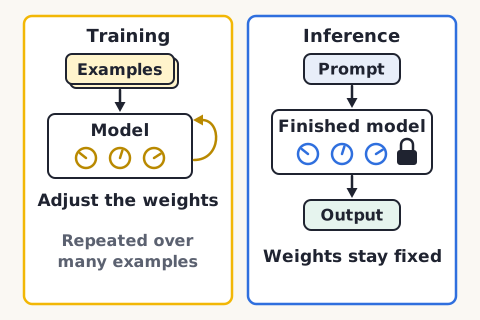
Training Changes the Model
During training, an optimization process repeatedly compares model outputs with a learning signal and adjusts internal weights. Training may use labeled examples, self-supervised objectives, feedback, or several stages.
Inference Uses the Model
Inference is a trained model producing an output from a new input. A prompt can change what the model considers in that interaction without automatically rewriting its underlying weights.
By the numbers
- Dartmouth Summer Research Project that named the AI field
- 1956 year
- IBM Deep Blue defeated chess champion Garry Kasparov
- 1997 year
- AlexNet's landmark ImageNet competition victory
- 2012 year
- AlphaGo defeated Lee Sedol in a five-game match
- 2016 year
- Publication of “Attention Is All You Need”
- 2017 year
- Public launch of ChatGPT
- 2022 year
Matched pairs
Each item on the left goes with the one on the right.
- Broad fluency
- Evidence of capability, not proof of an agreed AGI threshold
- Inference
- Using learned weights to answer without retraining them
- AI winter
- A period of reduced AI funding and enthusiasm
Step by step
Classify an AI activity as training or inference
- Ask whether the model's learned weights are being changed
- If examples or feedback change weights, classify the activity as training
- If fixed weights process a new request, classify the activity as inference
- Separate retrieval or tool calls from changes to the model itself
- State the evidence for the classification and any uncertainty
A deployed system may retrieve data or call tools during inference without retraining its underlying model.
Self-test
Answer each question from memory, then check your work against the answer key.
1. Why is a superhuman Go program still a bounded system?
- AIt can defeat experts within the game
- BIt uses neural networks to evaluate positions
- CIt searches many possible move sequences
- DIts skill does not transfer freely
2. Which status best fits superintelligence today?
- AA regulatory category for high-risk software
- BA speculative future category
- CA product term for general-purpose assistants
- DA benchmark label for any model that beats one expert
3. In the basic two-phase model, when are learned weights adjusted?
- ADuring training
- BDuring tokenization before inference
- CDuring decoding after each generated token
- DDuring inference for each prompt
4. A user asks a deployed model to summarize a memo. What phase is this?
- AFine-tuning
- BPretraining
- CInference
- DEvaluation
5. What does an “AI winter” describe?
- AA temporary decline in deployed-model accuracy
- BA pause while new training data is collected
- CReduced funding and enthusiasm
- DA period of slower chip production
Go deeper
- WatchAsking Is Not Training Ask an artificial intelligence model for a summary. Does that prompt instantly retrain the model?
- StudyAI for Everyone in the FlashFeed app
Answer key
- 1. D Its skill does not transfer freelyExceptional performance in one domain does not imply flexible competence across unrelated domains.
- 2. B A speculative future categorySuperintelligence is a hypothetical category used in forecasting and risk debates.
- 3. A During trainingOptimization during training changes weights; ordinary inference reads and applies them.
- 4. C InferenceGenerating an answer from a new request is inference.
- 5. C Reduced funding and enthusiasmThe phrase refers to downturns after expectations outran results.
Sources
- Dartmouth — Artificial Intelligence coined at Dartmouth — home.dartmouth.edu/about/artificial-intelligence-ai-coined-dartmouth
- NIST — AI Risk Management Framework — www.nist.gov/itl/ai-risk-management-framework
- IBM — Deep Blue — www.ibm.com/history/deep-blue
- Krizhevsky, Sutskever, and Hinton — ImageNet Classification — proceedings.neurips.cc/paper/4824-imagenet-classification-with-deep-convolutional-neural-networks
- Google DeepMind — AlphaGo — deepmind.google/research/breakthroughs/alphago/
- Vaswani et al. — Attention Is All You Need — arxiv.org/abs/1706.03762
- OpenAI — Introducing ChatGPT — openai.com/index/chatgpt/
Image credits
- Training Changes the Model: FlashFeed original diagram · CC-BY-4.0