
AI for Everyone study guide · Lesson 12 of 14
Words You'll See Everywhere
Models, Data, and Parameters · Hallucination, Bias, and Grounding · Six Key AI Concepts
This is the lesson's study guide from the FlashFeed app, plus its key facts and a self-test.
What you'll be able to do
- Use collection-wide AI vocabulary to distinguish components, failure modes, interfaces, and agents.
Models, Data, and Parameters
A machine-learning model is a mathematical system whose behavior is shaped from examples. Instead of a programmer writing a separate rule for every possible input, training adjusts internal values so the system learns a mapping from inputs to outputs.
A dataset is a collection of examples used for training, evaluation, or both. A dataset is never a neutral window onto the whole world. Decisions about what to collect, how to label it, what to exclude, and how to measure quality all influence the result.
Parameters—often called weights—are the adjustable numerical values inside a model. Training data supplies a learning signal; optimization changes the parameters. The finished model is therefore related to its training data without being identical to a searchable archive of every source.
Parameter count is easy to headline and easy to misuse. More parameters can increase capacity, but the number alone does not tell you whether a model has better data, was trained efficiently, follows instructions, cites facts accurately, or fits your task. Architecture, data quality, training objective, evaluation, tools, and deployment controls also matter.
LLM 101 takes these ideas into technical depth. For this guide, remember the relationship:
Data supplies examples. Training adjusts parameters. The model uses the learned result.
Hallucination, Bias, and Grounding
A hallucination is generated content that is unsupported or false while appearing plausible. A model may invent a study, combine details from different events, supply a nonexistent citation, or answer a question whose premise is wrong. The fluent surface can hide the missing foundation.
Hallucination is not the same as bias. Bias is a systematic pattern of distorted or unequal outcomes. It can enter through historical data, underrepresentation, labels, measurement choices, product objectives, or the setting in which a system is deployed. A fabricated citation may be a one-off hallucination; a hiring model that repeatedly disadvantages one demographic group presents a bias and fairness problem.
Grounding gives the model relevant evidence for a response. A system might retrieve documents, receive a database result, or be given approved source material in its context. Grounding can make answers more current and traceable. It does not eliminate error: the system may retrieve the wrong passage, misread a source, omit a caveat, or invent a link between facts.
Use a risk-matched verification habit:
- For brainstorming or reversible drafts, a quick human review may be enough.
- For factual claims, open the source and confirm it supports the sentence.
- For calculations, run an independent calculation or test.
- For medical, legal, financial, employment, or safety decisions, use qualified review and the governing process—not a chatbot as the final authority.
“Reduced” is the right promise for hallucination mitigation. “Eliminated” is not.
Six Key AI Concepts
Six concepts form a useful recognition set: model, chatbot, AI agent, hallucination, grounding, and anthropomorphism. The first three separate the learned system from the interface and the action loop. The last three help you reason about reliability and human projection.
An LLM is a model that generates and transforms language. It may power many products, but it is not the complete product.
A chatbot is an interface for a conversation. Behind the chat window, the product may combine an LLM with system instructions, safety filters, retrieval, web search, memory, account data, file tools, or other services. Two products using the same base model can behave differently because the surrounding system differs.
An agent adds goal-directed behavior over multiple steps. A typical loop is:
- observe the current state;
- plan or select a next action;
- use an approved tool;
- inspect the result;
- continue, ask for help, or stop.
Agency is a spectrum. A system that drafts one reply and waits is less agentic than one that searches a database, updates a ticket, checks the change, and escalates an exception. “Agent” does not mean infallible or fully independent. More autonomy can multiply usefulness, but it can also multiply an error across several actions.
When evaluating an agent, ask what tools it can use, what data it can access, what limits constrain it, what actions require approval, how it handles failure, and who remains accountable.
Sources
Key terms
- Parameters
- Learned internal numerical values adjusted during training to shape model behavior.
- Hallucination
- A plausible-seeming model output that is unsupported, incorrect, or invented.
- AI agent
- A system that pursues a goal through multiple steps, often using tools or taking actions.
Key concepts
Model
- A mathematical system whose behavior is shaped from examples.
- Its internal parameters are adjusted during training.
- At inference time, it maps a new input to an output.
Chatbot
- A product interface organized around a conversation.
- It may combine a language system with retrieval, memory, and safety filters.
- It usually waits for the user's next message rather than acting through a long goal loop.
AI agent
- A goal-directed system that can operate across several steps.
- It may keep state, select tools, inspect results, and change its next action.
- Its loop commonly follows observe, plan, act, check, and stop or continue.
Hallucination
- A reliability failure whose surface can look polished and plausible.
- It occurs when generated content is unsupported or false.
- An invented study or nonexistent citation is a classic example.
Grounding
- A reliability technique that gives generation an evidence base.
- The evidence may come from supplied documents, retrieval, or a trusted database.
- It reduces unsupported answers but still requires checking.
Anthropomorphism
- A reasoning trap that can be triggered by a humanlike interface.
- It treats convenient behavioral language as evidence of an inner experience.
- It means attributing human traits or motives to a nonhuman system.
Key facts
A Model Is Learned Behavior
A machine-learning model is a mathematical system whose behavior is shaped from data. It maps inputs to outputs using learned values rather than a programmer writing every possible answer.
Data and Parameters Play Different Roles
A dataset contains examples used for learning or evaluation. Parameters are adjustable internal values. Training data influences those values, but the finished model is not simply a searchable copy of its dataset.
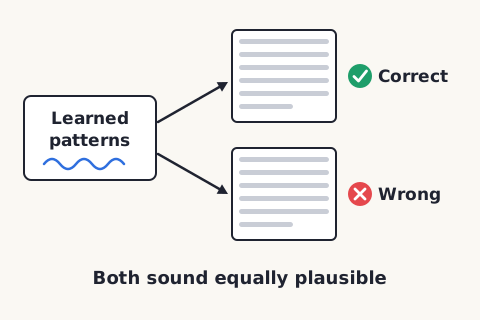
Fluent Can Still Be False
A hallucination is generated content that is unsupported or false while sounding plausible. Examples include an invented citation, a fabricated quote, or an incorrect detail supplied without a reliable basis.
Bias Is Often Systematic
AI bias is a pattern of unequal or distorted outcomes tied to data, design, measurement, or deployment. Unlike a one-off fabrication, bias can repeatedly disadvantage the same group or viewpoint.
Matched pairs
Each item on the left goes with the one on the right.
- Parameter count
- A capacity measure, not a count of verified facts
- Grounding
- Relevant evidence that reduces, but cannot eliminate, hallucinations
- AI agent
- A system pursuing a goal across steps, tools, or actions
Self-test
Answer each question from memory, then check your work against the answer key.
1. What is the main role of a training dataset?
- AChoose the model architecture
- BProvide learning examples
- CStore every future answer verbatim
- DSet deployment permissions
2. Which description best fits model parameters?
- ALearned internal values
- BExternal rules attached after training
- CRaw training examples stored verbatim
- DInstructions typed by a user at inference time
3. A model supplies a plausible citation that does not exist. What happened?
- APrompt injection
- BData leakage
- CHallucination
- DBias
4. What practice gives a model relevant evidence for a response?
- ACalibration
- BDistillation
- CQuantization
- DGrounding
5. Which feature most clearly moves a chatbot toward an agent?
- AMore response-formatting templates
- BA more conversational tone
- CA longer context window
- DMulti-step tool use
Go deeper
- WatchThe Missing Foundation An artificial intelligence model can write a fluent answer that cites a study. The study may not exist.
- StudyAI for Everyone in the FlashFeed app
Answer key
- 1. B Provide learning examplesExamples provide the signal from which the training process shapes model behavior.
- 2. A Learned internal valuesParameters are numerical values adjusted during training.
- 3. C HallucinationThe system generated unsupported information in a credible form.
- 4. D GroundingGrounding connects generation to supplied or retrieved evidence.
- 5. D Multi-step tool usePlanning and executing actions through tools is a central agentic capability.
Sources
- Google Cloud — What are AI hallucinations? — cloud.google.com/discover/what-are-ai-hallucinations
- NIST — AI Risk Management Framework — www.nist.gov/itl/ai-risk-management-framework
- Wang et al. — Survey of LLM-based agents — arxiv.org/abs/2309.07864
Image credits
- Fluent Can Still Be False: FlashFeed original diagram · CC-BY-4.0