
AI for Small Business study guide · Lesson 1 of 8
AI Foundations for an Owner
What AI Can and Cannot Do · Start with a Workflow, Not a Tool
This is the lesson's study guide from the FlashFeed app, plus its key facts and a self-test.
What you'll be able to do
- Distinguish productive AI assistance from fluent but unsupported output, and verify material claims before acting.
- Choose a frequent, low-risk workflow for a first AI pilot instead of beginning with a tool or high-stakes decision.
Capabilities
Generative AI is best understood as a highly capable pattern machine. It can draft, summarize, classify, compare, brainstorm, translate, and reorganize information at unusual speed. That makes it useful, but it does not make it an oracle. A polished answer can still be incomplete, stale, or wrong.
For a small-business owner, the most useful distinction is between generation and analysis. Generation creates a new draft: a customer reply, job description, checklist, promotion, or meeting agenda. Analysis looks for patterns or implications in material you provide: a set of reviews, a sales export, a contract, or a collection of support tickets. Both require review. The model may misunderstand a column, invent a fact, or smooth over uncertainty — confidently producing invented, unsupported, or incorrect information despite fluent-sounding wording. This failure mode is called a hallucination, and it is why every material claim needs verification no matter how polished the answer sounds.
AI becomes more useful when you supply the local truth: your actual offer, customer, policy, price, examples, and constraints. No general model knows your business as well as the people operating it. Treat your expertise as the source and AI as a fast collaborator.
The adoption statistics are a useful lesson in evidence. The U.S. Census Bureau reported overall business AI use around 17–20% from late 2025 through spring 2026 under its survey wording. A U.S. Chamber small-business survey reported 58% generative-AI use in 2025. Those figures are not interchangeable: they involve different populations, definitions, and methods. Before repeating a headline number, ask who was surveyed and what counted as use.
Workflow First
The best place to begin is not a product comparison. It is a workflow: a repeatable sequence of inputs, decisions, actions, and outputs. List recurring work and look for a task that is frequent, structured, easy to review, and low consequence when the first draft is wrong.
Good early candidates include drafting routine replies, turning notes into a checklist, creating variations from approved marketing copy, summarizing internal meetings, or organizing customer feedback. Poor first candidates include final hiring decisions, unsupervised payments, legal commitments, or anything where one error can materially harm a person or the business.
Start by augmenting the existing process. Run the AI-assisted version beside the current method and compare time, quality, and correction effort. This parallel period teaches you the exceptions that a generic demonstration never shows. Only after the workflow is understood should you consider additional automation.
The owner remains responsible for defining good work. If a process is inconsistent or undocumented, AI will reproduce the inconsistency faster. Clean up the process, define what acceptable output looks like, and then test assistance.
A practical owner exercise
Choose three tasks from yesterday. For each, write down the input, the judgment required, the output, and the consequence of an error. A routine follow-up email probably has a clear input and a reversible output. Deciding whether to fire an employee has ambiguous inputs, legal consequences, and a decision that should never be delegated to a general AI tool. The exercise trains you to see task characteristics rather than product features.
Then test one safe task twice. In the first attempt, provide only a short request. In the second, include the business context, a real example, and a definition of good output. Compare the results. This usually demonstrates an important principle: model capability matters, but the surrounding information and process often matter just as much.
Warning signs in AI advice
Be cautious when an answer presents precise savings, adoption rates, or revenue gains without a traceable source and definition. Be cautious when a product recommendation ignores your existing software, staff skills, data sensitivity, or workflow. Be especially cautious when anyone promises effortless passive income, fully autonomous operations, or guaranteed outcomes.
Useful AI advice makes tradeoffs visible. It identifies what the owner must supply, what needs checking, what could go wrong, and how to test value with limited exposure. That standard applies to this pack too: product names are examples, while the durable lesson is how to evaluate work.
Key terms
- Hallucination
- A confident-sounding AI output that contains invented, unsupported, or incorrect information.
- Workflow
- A repeatable sequence of inputs, decisions, actions, and outputs used to complete a business task.
Key facts
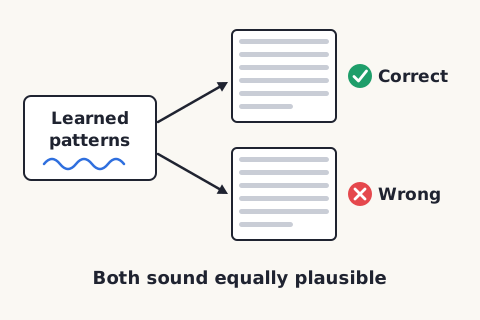
A Pattern Machine, Not an Oracle
A language model generates plausible responses from learned patterns. It can be remarkably capable, but fluent wording is not proof that a claim is true.
Useful Does Not Mean Deterministic
The same request can produce different answers. Use each AI output as a draft or recommendation whose reliability depends on the task, context, and review process.
You Supply the Local Truth
AI usually does not know your current prices, policies, customers, inventory, or judgment. Your business context is what turns a generic answer into useful work.
Workflow First
Start with a recurring business problem, then evaluate tools. Buying an AI subscription before naming the job often creates cost without adoption.
The Best First Task
A strong first task is frequent, structured, easy to check, and low consequence if the first draft is wrong.
Augment Before You Automate
Use AI alongside the existing process before allowing it to act alone. A parallel run exposes errors, exceptions, and missing instructions.
Matched pairs
Each item on the left goes with the one on the right.
- Generation
- Creating a new draft from instructions and context
- Analysis
- Finding patterns or implications in information you provide
- High-fit first workflow
- Frequent, structured, reviewable, and low risk
- Low-fit first workflow
- Rare, ambiguous, irreversible, or high stakes
Step by step
Run a safe first AI experiment
- Choose a low-risk task you already understand
- Define what a good result looks like
- Give the AI context and a clear desired output
- Compare the result with work you trust
- Record what required correction
Early experiments should teach you where AI helps and where review is still essential.
Build an AI opportunity list
- List tasks repeated at least weekly
- Estimate time spent on each task
- Mark tasks that follow a recognizable pattern
- Rate the cost of an error
- Choose one frequent, low-risk task to test
A task inventory keeps adoption grounded in work rather than novelty.
Self-test
Answer each question from memory, then check your work against the answer key.
1. A polished AI answer includes three statistics but no sources. What should you do first?
- APublish it because the prose is confident
- BReplace the numbers with larger estimates
- CVerify each statistic against reliable sources
- DAsk the AI whether it is certain
2. In AI terms, what is a 'hallucination'?
- AA slowdown caused by too many simultaneous requests
- BA confident-sounding output that contains invented or unsupported information
- CA setting that shortens the length of a response
- DA deliberate refusal to answer a sensitive question
3. Which task is an example of AI analysis rather than generation?
- AFinding patterns in a batch of customer reviews you upload
- BWriting a customer reply from your notes
- CBrainstorming names for a new promotion
- DDrafting a job description from a short brief
4. Which statement about a polished AI answer is NOT correct?
- AA polished answer can still be incomplete or stale
- BMaterial claims should be verified before acting
- CThe same request can produce different answers
- DFluent, confident wording confirms the claim is accurate
5. Why can't the Census Bureau's roughly 17 to 20 percent figure and the Chamber's 58 percent figure be treated as interchangeable?
- AThey measured entirely different decades
- BThey used different populations, definitions, and methods
- COne counted only failed AI projects
- DBoth figures were later retracted as errors
6. Two surveys report very different AI-adoption rates for small businesses. What should you check before citing either number?
- AThe population surveyed and how 'use' was defined
- BWhich of the two figures more news articles repeat
- CWhether the outlet is well known
- DWhether a chatbot confirms the same figure when asked
7. An AI-generated report states a precise revenue increase with no traceable source. What should you do before acting on it?
- ATrust it because the number is precise
- BAsk a colleague if it sounds plausible
- CVerify it against an independent source first
- DRound the number down slightly
8. Which is the strongest first AI workflow for a neighborhood service business?
- AAuto-send AI replies to every customer complaint
- BDraft a once-a-year strategic plan
- CCompare AI tools before listing any tasks
- DDraft weekly social posts from approved offers
9. How is a 'workflow' defined?
- AA ranked list of AI vendors to compare
- BA one-time decision about which software to buy
- CThe total monthly cost of an AI subscription
- DA repeatable sequence of inputs, decisions, actions, and outputs
10. Which task is the WORST candidate for a first AI pilot?
- ATurning meeting notes into a checklist
- BDeciding whether to fire an employee
- CSummarizing an internal meeting
- DDrafting routine customer replies
11. What is the main benefit of running AI alongside your existing process before automating it?
- AIt exposes errors, exceptions, and missing instructions
- BIt lets you skip writing instructions
- CIt speeds up the work immediately, before any testing
- DIt removes the need to define good output
12. A strong first AI task should be:
- AComplex and requiring expert judgment
- BRare, ambiguous, and legally binding
- CFrequent, easy to check, and low consequence if wrong
- DIrreversible but high in value
Go deeper
Answer key
- 1. C Verify each statistic against reliable sourcesFluency is not evidence. Verify material claims using reliable sources before using them.
- 2. B A confident-sounding output that contains invented or unsupported informationA hallucination is a confident-sounding AI output containing invented, unsupported, or incorrect information. The other options describe unrelated behaviors, not fabricated content.
- 3. A Finding patterns in a batch of customer reviews you uploadAnalysis finds patterns or implications in material you provide, like uploaded reviews. Drafting, writing, and brainstorming all create new drafts, which is generation.
- 4. D Fluent, confident wording confirms the claim is accurateFluency is not evidence of accuracy, so that statement is false. A polished answer can be wrong or stale, outputs vary, and claims should be verified.
- 5. B They used different populations, definitions, and methodsThe figures differ because they surveyed different populations with different definitions and methods. Always ask who was surveyed and what counted as use before repeating a headline.
- 6. A The population surveyed and how 'use' was definedAdoption figures vary by population and definition, so check who was surveyed and what counted as use before repeating a number. Repetition, reputation, or a chatbot's agreement does not settle what was measured.
- 7. C Verify it against an independent source firstA precise-sounding figure without a traceable source is a warning sign; material claims must be independently verified before use.
- 8. D Draft weekly social posts from approved offersDrafting posts from approved offers is frequent, easy to review, and reversible. Auto-sent complaint replies skip review, a yearly plan is infrequent, and a tool comparison is not a workflow.
- 9. D A repeatable sequence of inputs, decisions, actions, and outputsA workflow is a repeatable sequence of inputs, decisions, actions, and outputs used to complete a business task. The other options describe purchases or costs, not the process itself.
- 10. B Deciding whether to fire an employeeFiring an employee has ambiguous inputs, legal consequences, and an irreversible decision, making it a poor first pilot. The others are frequent, reviewable, and low consequence.
- 11. A It exposes errors, exceptions, and missing instructionsA parallel run reveals errors, exceptions, and missing instructions that a generic demo never shows. It means comparing time, quality, and correction effort, and the owner still defines what good output looks like.
- 12. C Frequent, easy to check, and low consequence if wrongA good first task is frequent, structured, easy to review, and low consequence when the first draft is wrong. The other traits describe high-risk, poor-fit candidates.
Sources
- U.S. Small Business Administration — AI for small business — www.sba.gov/business-guide/manage-your-business/ai-small-business
- U.S. Census Bureau — AI use by U.S. businesses (May 2026) — www.census.gov/library/stories/2026/05/ai-use-businesses.html
- U.S. Chamber of Commerce — 2025 Empowering Small Business report — www.uschamber.com/technology/artificial-intelligence/u-s-chambers-latest-empowering-small-business-report-shows-majority-of-businesses-in-all-50-states-are-embracing-ai
- Ethan Mollick — Using AI Right Now: A Quick Guide — www.oneusefulthing.org/p/using-ai-right-now-a-quick-guide
Image credits
- A Pattern Machine, Not an Oracle: FlashFeed original diagram · CC-BY-4.0