
Atomic Habits study guide · Lesson 6 of 6
Advanced Tactics and Mastery
Genetics, Personality, and the Goldilocks Rule · Deliberate Practice and Overcoming Complacency
Unofficial study guide for Atomic Habits: An Easy & Proven Way to Build Good Habits & Break Bad Ones by James Clear. FlashFeed is not affiliated with the author or publisher.
This is the lesson's study guide from the FlashFeed app, plus its key facts and a self-test.
What you'll be able to do
- Pick habits that suit your personality and natural strengths, and hold difficulty just past the edge of comfort.
- Pair automatic habits with deliberate practice, and recognize what Clear's yearly review covers.
Genetics, Personality, and the Goldilocks Rule
The closing section of Atomic Habits turns from building habits to choosing the right ones, and it opens with the uncomfortable half of the truth about talent: genes matter. Michael Phelps and Hicham El Guerrouj were both Olympic champions in Athens in 2004, but no training program could have swapped them. Phelps carries a long torso and comparatively short legs — a body shaped for the water. El Guerrouj, far shorter, has long legs and a short torso, the build of a middle-distance runner. Each dominated the arena that suited his frame. Clear's conclusion is not fatalism but direction: genes do not determine your destiny, they determine your areas of opportunity. They predispose without predetermining, and they never remove the need for hard work — they clarify where the work will pay.
The same logic runs through personality, which behavioral scientists most describe with the Big Five. Openness to experience runs from curious and inventive to cautious and consistent. Conscientiousness runs from organized and disciplined to easygoing and spontaneous. Extroversion runs from outgoing and stimulation-seeking to reserved and solitary. Agreeableness runs from warm and cooperative to challenging and detached. Neuroticism runs from anxious and reactive to calm and even-keeled. These traits are not attitudes; they have biological roots. One long-standing theory, from psychologist Hans Eysenck, holds that extroverts have lower baseline cortical arousal and so need more external stimulation to feel alert — which is why a crowded gym class energizes one person and drains another.
The practical instruction is to build habits that suit your temperament rather than habits that sound admirable. An outgoing person sticks with a running club; a reserved one sticks with a solitary morning route. Neither is better in the abstract. Pick the habit that fits and progress feels frictionless; pick the one that fights you and every session becomes a negotiation. Clear's summary is to play a game where the odds are in your favor — and if no such game exists, to create one through specialization. When you cannot win by being better, win by being different: combine two or three skills you are merely good at until the intersection has almost no competition.
Finding that game takes evidence, not introspection alone, which is where the explore/exploit trade-off comes in. Early on, explore widely and sample many possibilities, accepting that most will not fit. Once something works, shift toward exploiting it — narrow, repeat and compound — while still spending a slice of your time exploring, so a changing world cannot leave you optimized for a game nobody plays. Useful questions while exploring: what feels like fun to me but work to others, what makes me lose track of time, and where do I get greater returns than average.
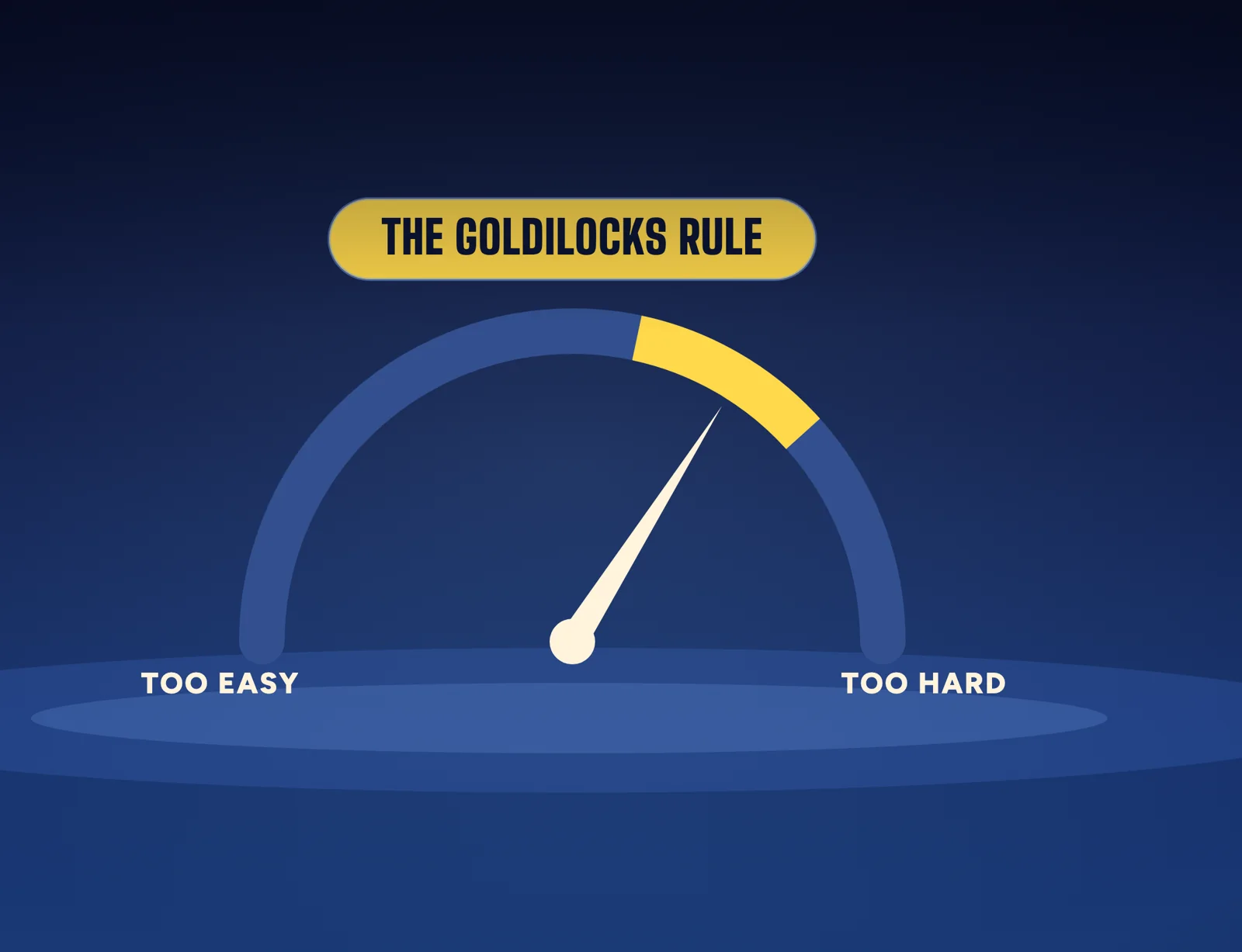
Choosing the right game solves selection. Staying motivated inside it is a separate problem, and Clear's answer is the Goldilocks Rule: peak motivation arrives at the edge of your abilities. Play tennis against a four-year-old and you are bored within minutes; play against Serena Williams and you are demoralized just as fast. Play someone at your level and you lose track of the afternoon. The zone is not fixed — as skill rises, difficulty must rise with it, or yesterday's stretch becomes today's tedium. A well-designed habit needs re-tuning, not permanent settings.
Which leads to the section's hardest claim: the greatest threat to success is not failure but boredom. Clear asked an elite coach what separated the best athletes from everyone else. The coach named the factors you might expect, talent among them, then added that at some point it comes down to who can handle the boredom of training every day, the same lifts over and over. Anyone can work hard while the work is novel. Professionals stick to the schedule; amateurs let life get in the way. Elite performers are not immune to boredom; they do not treat it as a reason to stop.
Deliberate Practice and Overcoming Complacency
Every advantage a habit gives you is purchased with attention you no longer pay, and that is also its hidden cost. Automaticity is what makes a behavior sustainable — you stop deliberating and simply act — but the same unconsciousness that removes friction also removes error detection. Once a skill runs on autopilot you stop noticing the small mistakes, and small mistakes left uncorrected become the ceiling of your performance. This is why long experience and high skill are not the same thing: a driver of twenty years is not twenty years better than a driver of five. Repetition alone locks in whatever you happened to be doing when the behavior went automatic.
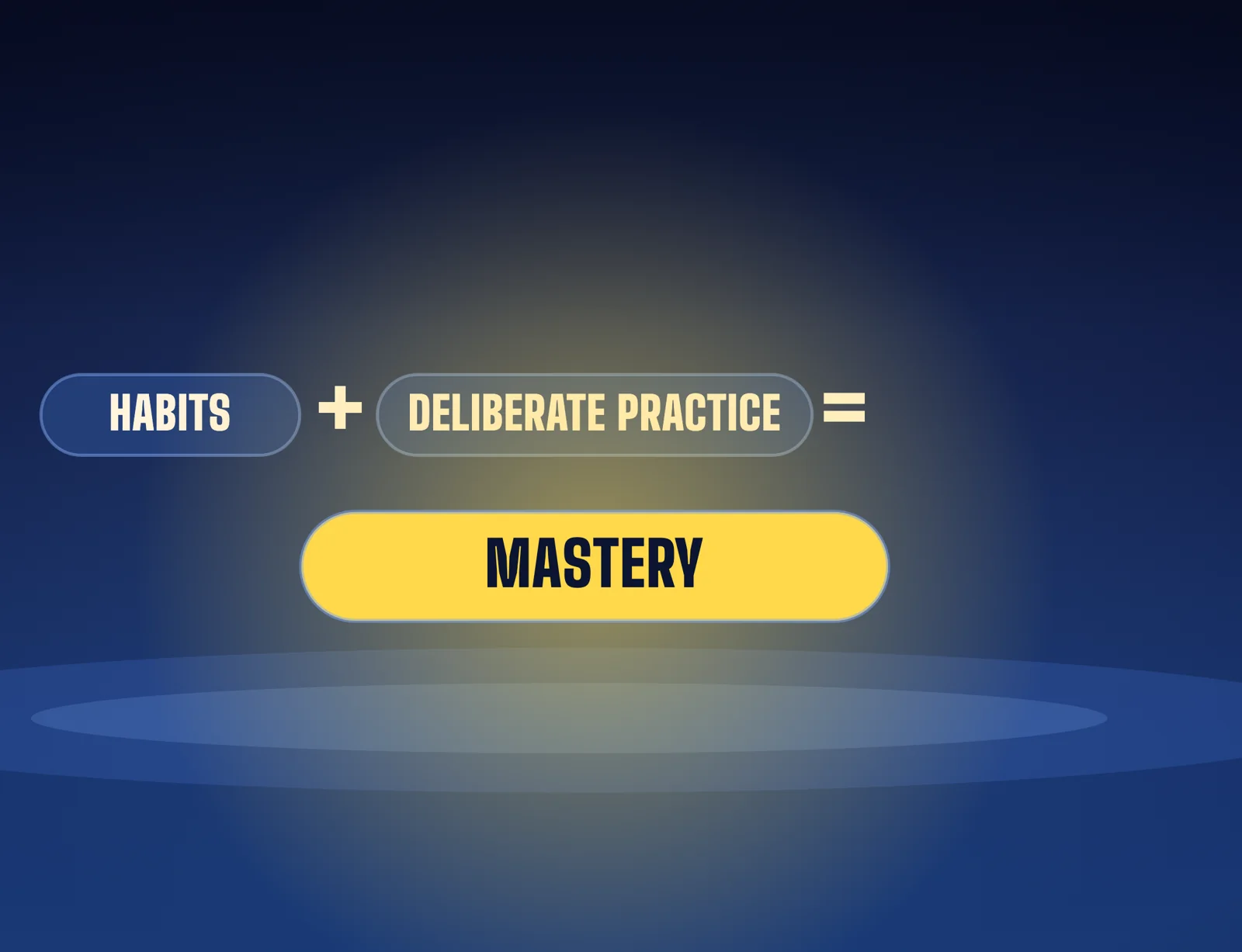
Clear's correction is an equation: Habits + Deliberate Practice = Mastery. Habits do the job no amount of willpower can, which is holding the foundation in place at zero cognitive cost. Deliberate practice is the opposite mode — focused, effortful attention aimed at a specific component of performance that is currently below standard. Neither works alone. Pure deliberate practice with no habitual base burns out, because everything requires conscious effort. Pure habit with no deliberate practice plateaus, comfortably and permanently.
Mastery therefore looks like a ladder rather than a single push. You narrow onto one element, practice it deliberately until it becomes automatic, then use that automated element as the platform for attacking the next one. A basketball player drills dribbling until the ball takes no attention, which frees the attention that shooting under pressure demands. The pattern repeats indefinitely: each habit mastered is not a finish line but the floor you stand on to reach the next problem.
Keeping this honest requires a deliberate system of reflection and review, because the whole difficulty is that unconscious behavior cannot audit itself. Clear runs two such reviews a year. In December he conducts an Annual Review, tallying the habits he actually kept and answering three questions: What went well this year? What didn't go so well? And what did I learn? Around the middle of the year he writes an Integrity Report, which examines conduct rather than output, asking what core values drive his life and work, how he is living and working with integrity right now, and how he can set a higher standard in the future. The Annual Review measures performance; the Integrity Report checks whether the performance is pointed at anything worth reaching. Neither is elaborate — the value is in the scheduled interruption of automatic behavior, not in the format.
Reflection also protects against a subtler failure mode: identity that hardens. Habits are excellent at building an identity, and Clear argues that is exactly why they can trap you. The tighter you cling to a single identity, the harder it becomes to grow beyond it — an athlete who defines herself entirely as an athlete is destroyed by an injury, a founder who is only a CEO has nothing left after an acquisition. The fix is to hold identity at a broader level than any one role. "I am the person who stays fit" survives a torn ligament in a way that "I am a marathon runner" does not; "I build things" survives the end of a company. Life is constantly changing, so periodically check whether the beliefs and routines that once served you still do.
The underlying stance is that improvement never terminates. Success is not a finish line to cross but a system to refine, and the same 1% gains that compound at the start compound at every level after it. The point of habits was never to arrive at a fixed self; it is to make continuous, small, honest refinement cheap enough that you can afford to do it forever.
Key terms
- Big Five
- The standard model of stable personality, spanning openness, conscientiousness, extroversion, agreeableness and neuroticism.
- Specialization
- Narrowing until the intersection of your skills faces almost no competition — winning by being different rather than better.
- Deliberate practice
- Focused, effortful attention aimed at a specific weak component of performance, rather than repetition of what already works.
- Automaticity
- The state in which a behavior runs without conscious attention — cheap to sustain, but blind to the small errors it repeats.
Key concepts
Openness to Experience
- The Big Five dimension that separates the person who reorders the whole kitchen from the one who leaves it exactly as it was.
- High scorers chase novelty, abstraction and variety; low scorers prefer the routine that already works.
- It predicts who will happily swap a proven workout for an unfamiliar class every month.
Conscientiousness
- The Big Five dimension running from organized and disciplined to easygoing and spontaneous.
- High scorers are organized and disciplined; low scorers are spontaneous and improvisational.
- Habit systems built on schedules, checklists and fixed times come easiest to people high in this trait.
Extroversion
- The Big Five dimension running from stimulation-seeking and outgoing to reserved and solitary.
- One long-standing theory, from psychologist Hans Eysenck, links it to a lower baseline of cortical arousal, so high scorers need more input to feel alert.
- It explains why a loud group fitness class energizes one person and flattens the person beside them.
Agreeableness
- The Big Five dimension running from warm and cooperative to challenging and detached.
- High scorers are trusting and quick to help; low scorers are skeptical and quick to push back.
- Like the other Big Five traits it has biological roots, so it shapes which habits feel natural rather than forced.
Neuroticism
- The Big Five dimension running from anxious and reactive to calm and even-keeled.
- Like the other four Big Five traits, it is not an attitude but has biological roots.
- One of the five traits Clear uses to argue you should build habits that suit your temperament rather than ones that sound admirable.
The Goldilocks Rule
- The principle that motivation peaks on work sitting just past what you can comfortably already do.
- Too easy and you are bored; too hard and you are demoralized — the useful band is narrow and it moves.
- It is why playing tennis against a four-year-old and against Serena Williams both fail, for opposite reasons.
Explore/Exploit Trade-off
- The strategic choice between sampling new options and doubling down on the one already working.
- Clear advises a wide sampling phase early, then a narrowing phase that compounds the winner.
- Keeping a slice of effort on sampling is what stops you being perfectly optimized for a game nobody plays.
Key facts
Two Champions, Two Different Skeletons
Michael Phelps and Hicham El Guerrouj were both Olympic champions in Athens in 2004, and no training program could have swapped them. Phelps carries a long torso and comparatively short legs — a frame shaped for the water. El Guerrouj, far shorter overall, has long legs and a short torso, the build of a middle-distance runner. Each dominated the arena that suited his body. Clear's conclusion is not fatalism but direction: genes do not determine your destiny, they determine your areas of opportunity.
Play the Game Where the Odds Favor You
Because temperament is real, the habit that fits you beats the habit that sounds admirable. An outgoing person sticks with a running club; a reserved one sticks with a solitary morning route — neither is better in the abstract. Clear's strategy is to play a game where the odds are in your favor, and if no such game exists, to create one through specialization. When you cannot win by being better, win by being different: combine two or three skills you are merely good at until the intersection has almost no competition.
Boredom, Not Failure, Ends Most Habits
Clear asked an elite coach what separated the best athletes from everyone else. The coach named the factors you might expect, talent among them, then added that at some point it comes down to who can handle the boredom of training every day, the same lifts over and over. Anyone can work hard while the work is still novel and motivation is high. Professionals stick to the schedule; amateurs let life get in the way. Elite performers are not immune to boredom: they simply refuse to treat it as a reason to stop.
The Hidden Cost of Doing It Without Thinking
Every advantage a habit gives you is purchased with attention you no longer pay — and that is also its hidden cost. Automaticity is what makes a behavior sustainable, but the same unconsciousness that removes friction also removes error detection. Once a skill runs on autopilot you stop noticing small mistakes, and uncorrected mistakes become the ceiling on your performance. It is why long experience and high skill are not the same thing: a driver of twenty years is not twenty years better than a driver of five.
Habits Plus Deliberate Practice Equals Mastery
Clear's correction to the plateau is an equation: Habits + Deliberate Practice = Mastery. Habits hold the foundation in place at zero cognitive cost, which no amount of willpower can do. Deliberate practice is the opposite mode — focused, effortful attention aimed at one component of performance that is currently below standard. Neither works alone. Practice with no habitual base burns out because everything demands conscious effort; habit with no practice plateaus, comfortably and permanently.
December's Reckoning, Summer's Audit
Unconscious behavior cannot audit itself, so Clear schedules two reviews a year. In December he writes an Annual Review, tallying the habits he actually kept and answering three questions: what went well, what didn't go well, and what he learned. Around mid-year he writes an Integrity Report, which examines conduct rather than output — what core values drive his life and work, how he is living up to them now, and how he can set a higher standard. The first measures performance; the second checks it is aimed at something worth reaching.
An Identity Too Tight to Grow Out Of
Habits are excellent at building an identity, and Clear argues that is exactly why they can trap you. The tighter you cling to a single identity, the harder it becomes to grow beyond it: an athlete who is only an athlete is undone by an injury, a founder who is only a CEO has nothing left after the sale. The repair is to hold identity one level broader than any role. I am someone who stays fit survives a torn ligament in a way I am a marathon runner does not.
By the numbers
- How many questions does the Annual Review ask each December?
- 3 questions
Matched pairs
Each item on the left goes with the one on the right.
- Michael Phelps
- Long torso, short legs — a frame built for the water.
- Hicham El Guerrouj
- Long legs, short torso — the build of a middle-distance runner.
- Annual Review
- Clear's December tally of the year's habits and lessons.
- Integrity Report
- Clear's mid-year audit of the values behind his conduct.
Step by step
Run a year-end review that actually changes next year's habits
- Tally the habits you actually kept this year, not the ones you meant to keep.
- Answer what went well, and name the systems that produced those wins.
- Answer what did not go well, being honest about which habits you let slide.
- Write down what you learned, and let it be blunt rather than elaborate — the value is the scheduled interruption, not the format.
Pair it with a mid-year values check so performance and direction are both audited, not just output.
Climb the mastery ladder one element at a time
- Narrow onto one element of performance that is currently below standard.
- Practice that element deliberately until it runs automatically.
- Use the attention it frees up to attack the next weak element.
Each mastered habit is the floor you stand on to reach the next problem, not a finish line.
Self-test
Answer each question from memory, then check your work against the answer key.
1. What role do genes play in habit success?
- AThey point to where your effort will pay best
- BThey can be overridden with enough repetition
- CThey matter only for athletic ability
- DThey set a hard ceiling on any habit you attempt
2. You have run the same beginner routine for a year and are bored stiff. What does the Goldilocks Rule prescribe?
- ACut the sessions in half until motivation returns
- BRaise the difficulty until it sits just past comfortable
- CSwitch to a completely different sport
- DWait for motivation to come back on its own
3. Per the Goldilocks Rule, when does motivation peak during a habit?
- AWhen the challenge exactly matches a beginner's ability
- BWhen the challenge is far above your ability
- CWhen the challenge is far below your ability
- DWhen the challenge sits just past the edge of your ability
4. When you can't win by being better than everyone else, the advice is to win by being different — through what?
- ADeliberate practice
- BExplore-exploit trade-off
- CSpecialization
- DThe Goldilocks Rule
5. In the explore-exploit trade-off, what should you do once something proves it works?
- ARepeat it forever and stop exploring
- BReturn to exploring widely before deciding
- CAbandon it and explore something new
- DShift toward exploiting it while still exploring a little
6. Why can a habit that has become fully automatic stall your improvement?
- AIt stops you noticing the small errors you repeat
- BIt removes the reward at the end of the loop
- CIt uses up willpower you need elsewhere
- DIt makes the original cue harder to notice
7. Which best describes deliberate practice?
- AReviewing your habits once a year
- BRepetition of what already works until automatic
- CFocused attention on a specific weak skill
- DRaising difficulty until a habit feels uncomfortable
8. In the equation for mastery, what combines with habits to produce it?
- AExplore-exploit trade-off
- BDeliberate practice
- CThe Goldilocks Rule
- DAutomaticity
9. Which three questions does the December Annual Review ask?
- AWhat went well, what didn't go well, what did I learn
- BWhat habits did I build, which did I break, what's next
- CWhat are my values, how do I act, how do I improve
- DWhat went well, what surprised me, what will I automate
10. How does the Integrity Report differ from the Annual Review?
- AIt only tracks numeric habit completion rates
- BIt happens in December instead of mid-year
- CIt replaces the need for an Annual Review
- DIt examines values and conduct rather than tallying habits
Go deeper
- ListenLesson 6 episode
- WatchThe Goldilocks Rule Play tennis against a 4-year-old, and you're bored in minutes. Play Serena Williams, and you're crushed just as fast.
- WatchHabits Plus Practice Habits have a hidden cost. On autopilot, you stop noticing small mistakes.
- ReadAtomic Habits by James Clear · on Amazon ↗
- StudyAtomic Habits in the FlashFeed app
These are affiliate links: if you buy a book through one, FlashFeed may earn a small commission at no extra cost to you. The commission helps pay for FlashFeed's servers.
As an Amazon Associate we earn from qualifying purchases.
Answer key
- 1. A They point to where your effort will pay bestGenes predispose without predetermining. They never remove the need for hard work — they clarify which work is worth doing.
- 2. B Raise the difficulty until it sits just past comfortableThe motivating zone moves upward as skill rises, so the fix for tedium is to re-tune the challenge rather than abandon the habit.
- 3. D When the challenge sits just past the edge of your abilityPeak motivation arrives at the edge of your abilities — too easy and you're bored like against a four-year-old, too hard and you're demoralized like against Serena Williams.
- 4. C SpecializationSpecialization combines two or three skills you are merely good at until the intersection has almost no competition.
- 5. D Shift toward exploiting it while still exploring a littleOnce a pursuit works, narrow and repeat to compound gains, but keep exploring a little so you don't stay optimized for a game nobody plays.
- 6. A It stops you noticing the small errors you repeatAutomatic behavior is cheap precisely because it needs no attention — and attention is exactly what finding and fixing a flaw requires.
- 7. C Focused attention on a specific weak skillDeliberate practice targets a specific component of performance that is below standard, unlike habit repetition which runs on autopilot.
- 8. B Deliberate practiceHabits hold the foundation at zero cognitive cost; deliberate practice supplies the focused attention that pushes a weak component forward.
- 9. A What went well, what didn't go well, what did I learnThe Annual Review tallies the year's habits with exactly these three questions; the values-focused questions belong to the Integrity Report.
- 10. D It examines values and conduct rather than tallying habitsThe Annual Review measures performance; the mid-year Integrity Report checks whether that performance is pointed at anything worth reaching.
Sources
- Atomic Habits — James Clear
Image credits
- The Goldilocks Rule: FlashFeed original diagram
- Habits Plus Practice: FlashFeed original diagram