
Atomic Habits study guide · Lesson 5 of 6
The 4th Law: Make It Satisfying
Immediate Rewards and Habit Tracking · Accountability Contracts and Inverting the 4th Law
Unofficial study guide for Atomic Habits: An Easy & Proven Way to Build Good Habits & Break Bad Ones by James Clear. FlashFeed is not affiliated with the author or publisher.
This is the lesson's study guide from the FlashFeed app, plus its key facts and a self-test.
What you'll be able to do
- Attach an immediate, identity-consistent reward to a habit, and track it without letting the measure become the goal.
- Make a lapse immediately costly with accountability partners and habit contracts, and invert the laws to break a habit.
Immediate Rewards and Habit Tracking
The 4th Law of Behavior Change governs the reward phase of the habit loop, and James Clear compresses it into the Cardinal Rule of Behavior Change: what is immediately rewarded is repeated, and what is immediately punished is avoided. The distinction matters because the first three laws — make it obvious, attractive, easy — only raise the odds that a behavior happens this time. The 4th Law decides whether it happens next time. Reinforcement closes the loop so the brain files the action under "do that again."
The obstacle is that human brains were tuned for an immediate-return environment, where consequences arrived in minutes: find water and thirst ends. Modern life is a delayed-return environment — you work all month to be paid later, save for a retirement decades away, train today for a body you get next year. The nervous system handling this was built for the older world, so it overvalues the present, a bias called time inconsistency.
That produces a brutal asymmetry. With bad habits the immediate outcome feels good and the ultimate outcome feels bad: the cigarette soothes now and costs later. With good habits the immediate effort feels hard and the ultimate outcome feels great. The costs of your good habits are in the present; the costs of your bad habits are in the future. The whole practical program of the 4th Law follows — move some of the payoff forward in time.
So attach a small immediate reward to a habit whose real benefit is delayed. One reader Clear describes wanted to eat out less, so each time the family skipped a restaurant meal they moved money into an account earmarked for a trip they wanted; the sacrifice became a visible deposit. But the reward must not contradict the identity you are building: celebrating a workout with ice cream cancels the behavior it was meant to reinforce, while a long bath or money toward new running shoes reinforces it. Rewards are a bridge, not a structure — incentives start a habit, identity sustains one.
Habit tracking is one of the best ways to manufacture that immediate reward. A habit tracker is any simple measure of whether you did the habit: an X on a calendar, a checked box, a logged rep. Benjamin Franklin carried a small booklet and, at the end of each day, recorded his progress on thirteen personal virtues. The modern version, "don't break the chain," is popularly attributed to Jerry Seinfeld — mark each productive day on a wall calendar, then protect the streak.
Tracking works because it satisfies three laws at once. The chart is a visible cue, so the habit stays obvious. The growing streak makes progress attractive, and progress is among the most durable motivators there is. And recording feels good in itself, so the habit becomes satisfying exactly when it needs to be. Two rules keep it from collapsing: log immediately after the habit, not at day's end, and stack the logging onto the habit so it is part of the routine. Automate the measurement where a device can, and do not track everything — a burdensome tracker gets abandoned.
Every streak eventually breaks, which is why the maintenance rule is: never miss twice. Missing once is an accident; missing twice is the start of a new habit. The first mistake rarely ruins you — the spiral of repeated mistakes does. If a full session is impossible, do a scaled-down version: the gap between zero and something dwarfs the gap between something and perfect.

The final caution concerns measurement itself. What you can measure is not always what matters most. Goodhart's Law warns that when a measure becomes a target, it stops being a good measure: chase the scale and you may starve instead of train; chase word count and you will write filler. Numbers are a guide, not the goal.
Accountability Contracts and Inverting the 4th Law
If the 4th Law says make it satisfying, its inversion says make it unsatisfying. We repeat what feels good and abandon what feels bad, so the way to dissolve an unwanted routine is to attach a cost to it — and, crucially, a cost that arrives now. Pain is an effective teacher, but only when it is prompt. The more immediate and the more costly a mistake feels, the faster the behavior changes. Lung damage twenty years from now will not stop a smoker's hand; a penalty owed this afternoon might.
Society runs on the same mechanism. Speeding tickets, late fees and license suspensions convert a distant, diffuse consequence into a sharp and immediate one. Clear's point is that you can install the same machinery in your own life, at a far smaller scale.
The simplest version is an accountability partner: a friend, colleague, coach or spouse who knows what you committed to and checks whether you did it. It works because human beings are relentlessly attentive to social standing. We will tolerate a private failure that we would be mortified to have witnessed, so being observed converts a delayed consequence into an immediate one — the flicker of embarrassment when you report a missed day. The same effect explains why you are far less likely to skip a workout when someone is standing outside the gym waiting for you. The cost of not showing up stops being an abstract loss of fitness and becomes a person you let down in the next fifteen minutes.
The formal version is a habit contract: a written or verbal agreement stating the habit you commit to and the punishment that follows if you fail. You then have one or two accountability partners sign it with you, which turns a private intention into a public obligation with named enforcers. Clear describes an entrepreneur, Bryan Harris, who wrote a habit contract with his wife and his personal trainer covering his target weight and the daily behaviors that would get him there, with set penalties for skipping them; after he hit his first-quarter targets, he raised both the goals and the penalties. The contract works on two channels at once: the financial or logistical penalty, and the reputational sting of having two people you respect watch you break your word.
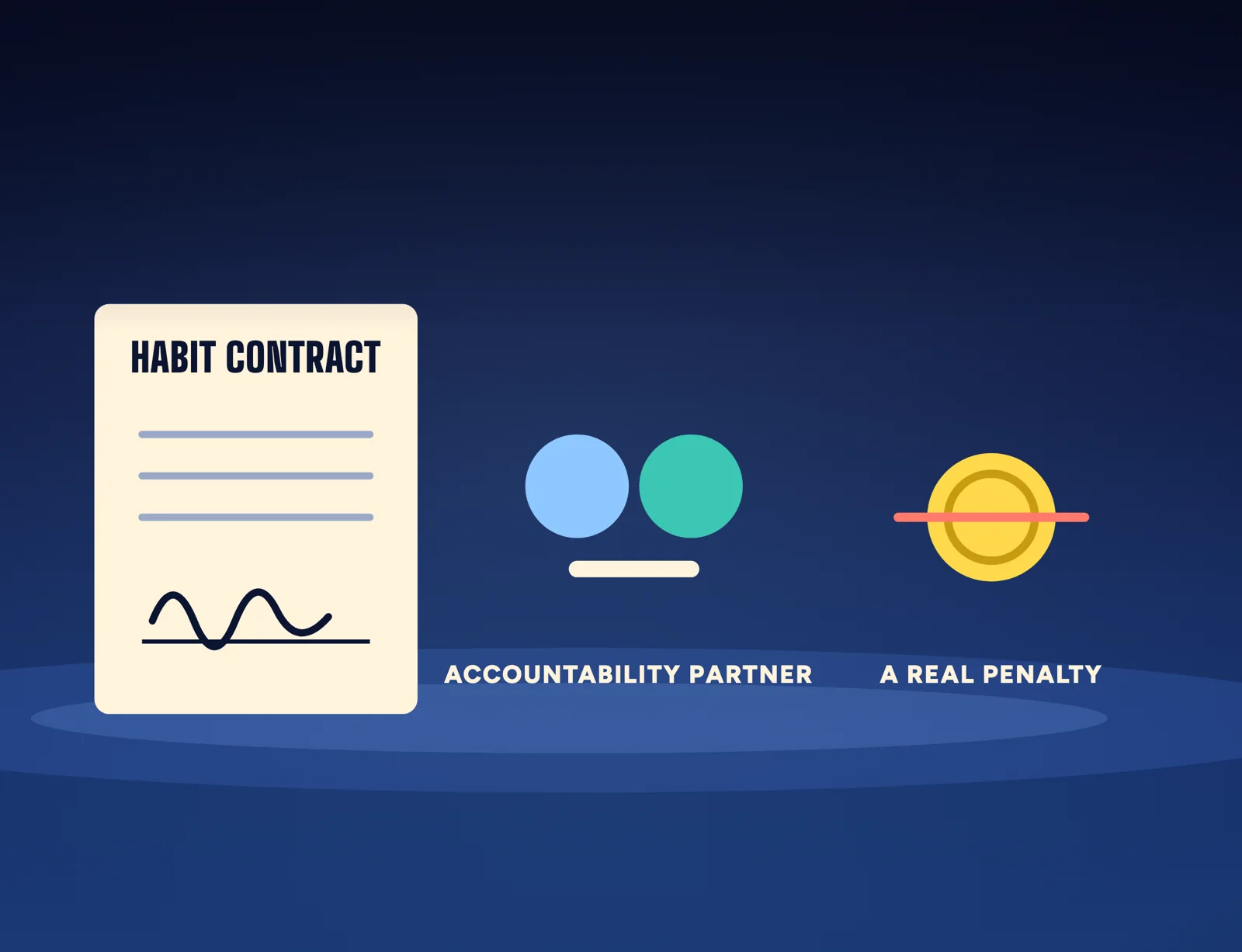
A good contract is specific. Name the behavior rather than the outcome, because you control whether you go to the gym but not what the scale reads. Set a penalty that is genuinely unpleasant but survivable, so the contract keeps its teeth without becoming something you quietly abandon. And enforce it every time, promptly: behavior shifts only when the punishment is painful enough and reliably enforced, and an unpaid penalty is no penalty at all.
Automation makes the same idea more reliable, because a rule you cannot argue with beats a rule you can. Clear cites Thomas Frank, who wants to wake early and has a tweet pre-scheduled offering a small cash payment to each of the first few people who reply — if he is up on time he deletes it, and if he sleeps in it publishes at his expense. The general pattern is to arrange, in advance and in a calm moment, a consequence your future self cannot negotiate away.
Two limits are worth keeping in mind. A habit contract makes a bad habit unsatisfying, but if the underlying behavior is still obvious, attractive and easy, you are fighting an unfair fight — the inversion of the 4th Law works best stacked on the inversions of the first three: make it invisible, unattractive and difficult, then make it unsatisfying. And the arrangement should feel like support rather than surveillance. The purpose of the partner is not humiliation; it is to make sure the vote you cast today is counted by someone other than yourself, until the behavior can stand on its own identity.
Key terms
- Cardinal Rule
- The claim at the heart of the 4th Law: an action that ends in satisfaction gets run again, and one that ends in pain gets dropped.
- Habit tracker
- Any simple measure of whether you performed the behavior today — an X on a calendar, a checked box, a logged rep.
- Goodhart's Law
- The warning that once a measurement becomes the target you chase, it stops indicating what you actually care about.
- Social cost
- The sting of being seen falling short by someone whose opinion you care about — a price that lands the same week.
- Inversion
- Running a law of behavior change backwards to break a habit — for the 4th Law, making the unwanted routine end badly right away.
Key facts
What Is Rewarded Now Is What Gets Repeated
The 4th Law — make it satisfying — rests on what Clear calls the Cardinal Rule of Behavior Change: what is immediately rewarded is repeated, and what is immediately punished is avoided. The distinction from the first three laws is sharp. Making a habit obvious, attractive and easy raises the odds the behavior happens this time. Only a satisfying ending raises the odds it happens next time. Reinforcement is simply the act of closing the loop so the brain files the behavior under do that again.
Built for a World That Paid You Instantly
Human brains were tuned for an immediate-return environment, where the consequence of an action landed within minutes: find water and the thirst ends. Modern life is a delayed-return environment — you work all month to be paid later, save for a retirement decades away, train today for a body you get next year. Running old hardware in the new setting produces time inconsistency: the present is felt vividly, the future is an abstraction. That mismatch, not weak character, is why good habits feel like a losing trade.
The Costs of Good Habits Are in the Present
Clear's summary of the asymmetry is a single sentence worth memorizing: the costs of your good habits are in the present, and the costs of your bad habits are in the future. With a bad habit the immediate outcome feels good and the ultimate outcome feels bad. With a good habit the immediate effort feels hard and the ultimate outcome feels great. The whole practical program of the 4th Law follows from that — move part of the payoff forward in time, so the behavior ends in something the brain can actually feel.
Franklin's Booklet and the Unbroken Chain
A habit tracker is any simple measure of whether you did the thing: an X on a calendar, a checked box, a logged rep. Benjamin Franklin carried a pocket booklet in which he charted his thirteen personal virtues nightly. The modern version — don't break the chain — is popularly attributed to Jerry Seinfeld: mark each productive day on a wall calendar and your only job becomes protecting the streak. Tracking works on three laws at once. The chart is a visible cue, the streak makes progress attractive, and recording feels good the moment the work ends.
Missing Once Is an Accident
Every streak eventually breaks, which is why Clear's maintenance rule is never miss twice. Missing once is an accident; missing twice is the start of a new habit. The first mistake is rarely what ruins you — the spiral of repeated mistakes that follows is. When a full session is impossible, do a scaled-down version instead of nothing, because the gap between zero and something is far larger than the gap between something and a perfect performance. Showing up badly still casts a vote for the identity you are building.
Pain Only Teaches When It Arrives on Time
The inversion of the 4th Law is make it unsatisfying. We abandon what feels bad, so the way to dissolve an unwanted routine is to attach a cost to it — and the cost has to land now. Clear's rule is that the more immediate and the more costly a mistake feels, the faster the behavior changes. A consequence twenty years out will not stop a hand reaching for the packet; a penalty owed this afternoon might.
Society Already Runs This Machinery
Speeding tickets, late fees and license suspensions all do the same job: they take a distant, diffuse consequence and convert it into a sharp, immediate one. Clear's point is that you do not have to wait for an institution to install this machinery on your behalf. A habit contract is the private, small-scale version of the same idea.
Someone Is Waiting, So You Show Up
An accountability partner is a friend, colleague, coach or spouse who knows what you committed to and checks whether you did it. It works because human beings are relentlessly attentive to social standing: we tolerate private failures that would mortify us if witnessed. Being observed converts a delayed consequence into an immediate one — the flicker of embarrassment when you report a missed day. It is why skipping a run is far harder when someone is standing at the track waiting for you.
The Contract Two Other People Sign
A habit contract is a written or verbal agreement stating the habit you commit to and the punishment that follows if you fail. One or two accountability partners sign it, which turns a private intention into a public obligation with named enforcers. Clear describes entrepreneur Bryan Harris, whose contract with his wife and his personal trainer set penalties for skipping his daily behaviors, then raised both goals and penalties after he hit his first-quarter targets. The contract bites on two channels: the penalty itself, and the sting of two people you respect watching you break your word.
By the numbers
- How many personal virtues did Benjamin Franklin chart in his pocket booklet?
- 13 virtues
- How many Laws of Behavior Change get inverted when you set out to break a bad habit?
- 4 laws
Matched pairs
Each item on the left goes with the one on the right.
- Immediate-return environment
- The ancestral world where an action paid off within minutes.
- Delayed-return environment
- Modern life, where today's effort pays off years later.
- Accountability partner
- Someone who knows your commitment and checks that you kept it.
- Habit contract
- A signed agreement naming your promise and the cost of a miss.
Step by step
Set up a habit tracker that survives past the first month
- Pick one or two habits worth tracking — a tracker that covers everything becomes a chore and gets abandoned.
- Choose the smallest possible record: an X on a wall calendar, a checked box, a tally in a notebook.
- Stack the logging onto the habit itself, so the record is made the moment the work ends.
- Automate the measurement wherever a device, receipt or app can capture it for you.
- Apply never-miss-twice: after any lapse, get the very next rep in, even a scaled-down one.
Recording later in the day is the most common failure — by then the satisfaction no longer attaches to the behavior.
Write a habit contract that will still be holding in three months
- State the exact behavior and how often, not the outcome you hope it will produce.
- Name a penalty that is painful enough to matter but survivable, one you would genuinely pay, and who receives it.
- Have one or two accountability partners sign the contract alongside you.
- Enforce the penalty every time, promptly, so a miss is never free.
Behavior shifts only when the punishment is painful enough and reliably enforced.
Self-test
Answer each question from memory, then check your work against the answer key.
1. Why does the 4th Law matter more than the first three for long-term change?
- AIt makes the cue impossible to miss
- BIt lowers the effort the behavior takes
- CIt decides whether the behavior gets repeated
- DIt removes the craving that starts the loop
2. A runner celebrates every finished workout with a slice of cake. What is wrong with that reward?
- AIt contradicts the identity the habit is building
- BIt is too small to reinforce anything
- CIt arrives too long after the workout ends
- DIt cannot be marked on a calendar
3. Which principle warns that once a measurement becomes a target, it stops reflecting what actually matters?
- AThe Plateau of Latent Potential
- BGoodhart's Law
- CThe Law of Least Effort
- DThe Diderot Effect
4. An X on a calendar, a checked box, and Franklin's virtue booklet are all examples of which behavior-change mechanism?
- AA habit contract
- BA pre-committed automation
- CAn accountability partner
- DA habit tracker
5. A family skipped a restaurant meal and moved that money into a trip fund each time. What does this illustrate?
- AAn accountability partner enforcing a promise
- BAn immediate reward for a delayed benefit
- CAn automated, pre-committed consequence
- DA habit contract with a penalty clause
6. Why does an accountability partner change behavior so reliably?
- AIt makes the eventual reward larger
- BIt removes the effort the habit takes
- CIt turns a distant consequence into an immediate social cost
- DIt replaces the habit's cue with a better one
7. What makes the penalty in a habit contract actually work?
- AIt is settled up at the end of the year
- BIt stays private between you and yourself
- CIt is severe enough to frighten you
- DIt is unpleasant, survivable and paid at once
8. A good habit contract names the behavior you'll do rather than an outcome like a target weight. Why?
- AYou control the behavior, not the outcome
- BThe penalty must stay survivable either way
- COnly behaviors can trigger immediate payment
- DThe behavior review only happens weekly
9. Inverting only the 4th Law to break a bad habit is an unfair fight unless you also make the behavior what?
- ASocial, automatic and cheap
- BVisible, rewarding and immediate
- CObvious, attractive and easy
- DInvisible, unattractive and difficult
10. Thomas Frank pre-schedules a tweet offering a small cash payment to each of the first few people who reply, deleting it only if he wakes on time. What does this show?
- AAn accountability partner checking on him
- BA reward for waking up on time
- CAn automated, pre-committed consequence
- DA calendar tracking his wake-up time
Go deeper
- ListenLesson 5 episode
- WatchNever Miss Twice Your brain repeats what pays off right away. That's hard on good habits, because their rewards come later.
- WatchA Penalty You Can't Dodge Pain teaches well, but only when it's fast. Lung damage in 20 years won't stop a smoker's hand today.
- ReadAtomic Habits by James Clear · on Amazon ↗
- StudyAtomic Habits in the FlashFeed app
These are affiliate links: if you buy a book through one, FlashFeed may earn a small commission at no extra cost to you. The commission helps pay for FlashFeed's servers.
As an Amazon Associate we earn from qualifying purchases.
Answer key
- 1. C It decides whether the behavior gets repeatedThe first three laws raise the odds a behavior happens this time. A satisfying ending is what makes the brain run it again next time.
- 2. A It contradicts the identity the habit is buildingAn immediate reward has to reinforce the identity you are voting for. A treat that cancels the workout's purpose teaches the wrong lesson.
- 3. B Goodhart's LawGoodhart's Law says a measure you chase stops being a good measure — chasing the scale can mean starving instead of training.
- 4. D A habit trackerEach is just a simple record of whether you did the habit — the definition of a habit tracker, distinct from a contract, a partner, or an automated consequence.
- 5. B An immediate reward for a delayed benefitSkipping the meal is the habit; moving money to the fund is the visible, immediate reward that reinforces the delayed benefit of saving.
- 6. C It turns a distant consequence into an immediate social costWe care intensely about how we are seen, so being observed converts a far-off consequence into an embarrassment you feel this week.
- 7. D It is unpleasant, survivable and paid at onceA postponed or unpaid penalty is no penalty, and one so harsh you quietly abandon the contract is no penalty either.
- 8. A You control the behavior, not the outcomeName the behavior, not the outcome — you can guarantee you go to the gym, but not what the scale reads.
- 9. D Invisible, unattractive and difficultInverting the 4th law alone is unfair unless the first three are inverted too: make it invisible, unattractive and difficult.
- 10. C An automated, pre-committed consequenceThis is called automation — arranging, in advance and in a calm moment, a consequence his future self can't negotiate away.
Sources
- Atomic Habits — James Clear
Image credits
- Never Miss Twice: FlashFeed original diagram
- A Penalty You Can't Dodge: FlashFeed original diagram