
Atomic Habits study guide · Lesson 4 of 6
The 3rd Law: Make It Easy
Law of Least Effort and Friction · The Two-Minute Rule and Commitment Devices
Unofficial study guide for Atomic Habits: An Easy & Proven Way to Build Good Habits & Break Bad Ones by James Clear. FlashFeed is not affiliated with the author or publisher.
This is the lesson's study guide from the FlashFeed app, plus its key facts and a self-test.
What you'll be able to do
- Apply the Law of Least Effort — cut friction for good habits, add it for bad — and tell motion apart from action.
- Scale a habit down to a two-minute entry point, shape it upward, and lock in behavior with commitment devices.
Law of Least Effort and Friction
The 3rd Law of Behavior Change — make it easy — governs the response stage of the habit loop, the moment where intention finally becomes behavior. Its foundation is the Law of Least Effort: given several ways to spend an hour, we drift toward the option that demands the least work. This is not laziness, it is economics. Energy is a finite resource and the brain is built to conserve it, so out of everything you could do, the action that actually happens is the one delivering the most value for the least effort. Motivation is not the deciding variable most of the time. Difficulty is.
The first trap this exposes is the difference between motion and action. Motion is planning, researching, strategizing, outlining, comparing apps, buying the gear. Action is the behavior that produces the outcome. Motion feels productive, which is exactly what makes it dangerous: it lets you feel like you are making progress while protecting you from the possibility of failing at the real thing. Ten workout plans is motion; one set of squats is action. If you are stuck, the honest question is usually not "what should I do?" but "am I in motion or in action?"
The reason action matters so much is that habits form through repetition, not through time spent thinking about them. What automates a behavior is the number of times you have performed it, not the number of days since you decided to. Repetition itself is what reshapes the pathway: the more often you perform a behavior, the more readily it runs, until it needs no conscious thought at all. Practice is not a metaphor for building a habit. It is the mechanism. Neuroscientists call this strengthening of the connections between neurons with each repetition long-term potentiation.
What you are building toward is automaticity: performing a behavior without deliberating over each step. Plot automaticity against repetitions and you get a curve that rises steeply, then flattens as the behavior crosses into the automatic. Repetitions are what you are optimizing for, and every unit of friction removed buys you more of them.
Friction is simply the energy a behavior costs — physical steps, decisions, setup, delay. Reduce it and you get more repetitions almost for free. Prime the environment for its future use: lay out your workout clothes the night before, load the coffee machine before bed, keep the guitar on a stand instead of in a case, wash and chop the vegetables when you unpack the groceries. Redesign spaces so the good behavior is the path of least resistance rather than a detour. Notice how often the deciding factor is embarrassingly small — the gym on your commute is used, the better gym twenty minutes off it is not.
The same principle in reverse gives you addition by subtraction. Rather than adding willpower, remove steps, and rather than doing more, delete what stands in the way. Reset the room after you use it so the next occasion starts from zero friction. A kitchen cleaned tonight makes tomorrow's cooking a two-step decision instead of a ten-step one.
Inverting the 3rd Law breaks bad habits: make them difficult. Add steps, delay and distance between yourself and the behavior. Leave the phone in another room while you work, unplug the television and stow the remote, delete the app so re-installing is a required toll, keep the snacks unbought rather than merely out of sight. None of this makes the behavior impossible, and it does not need to. It simply inserts a pause where an impulse used to run unopposed — long enough for a decision to happen instead of a reflex.
The Two-Minute Rule and Commitment Devices
Making a habit easy is not only about removing friction from the environment. It is also about shrinking the habit itself until starting is no longer a decision. That is the job of the Two-Minute Rule: when you begin a new habit, it should take less than two minutes to do. "Read before bed each night" becomes "read one page." "Do thirty minutes of yoga" becomes "take out my yoga mat." "Run three miles" becomes "put on my running shoes." The rule sounds like it is asking too little, and that is the point.
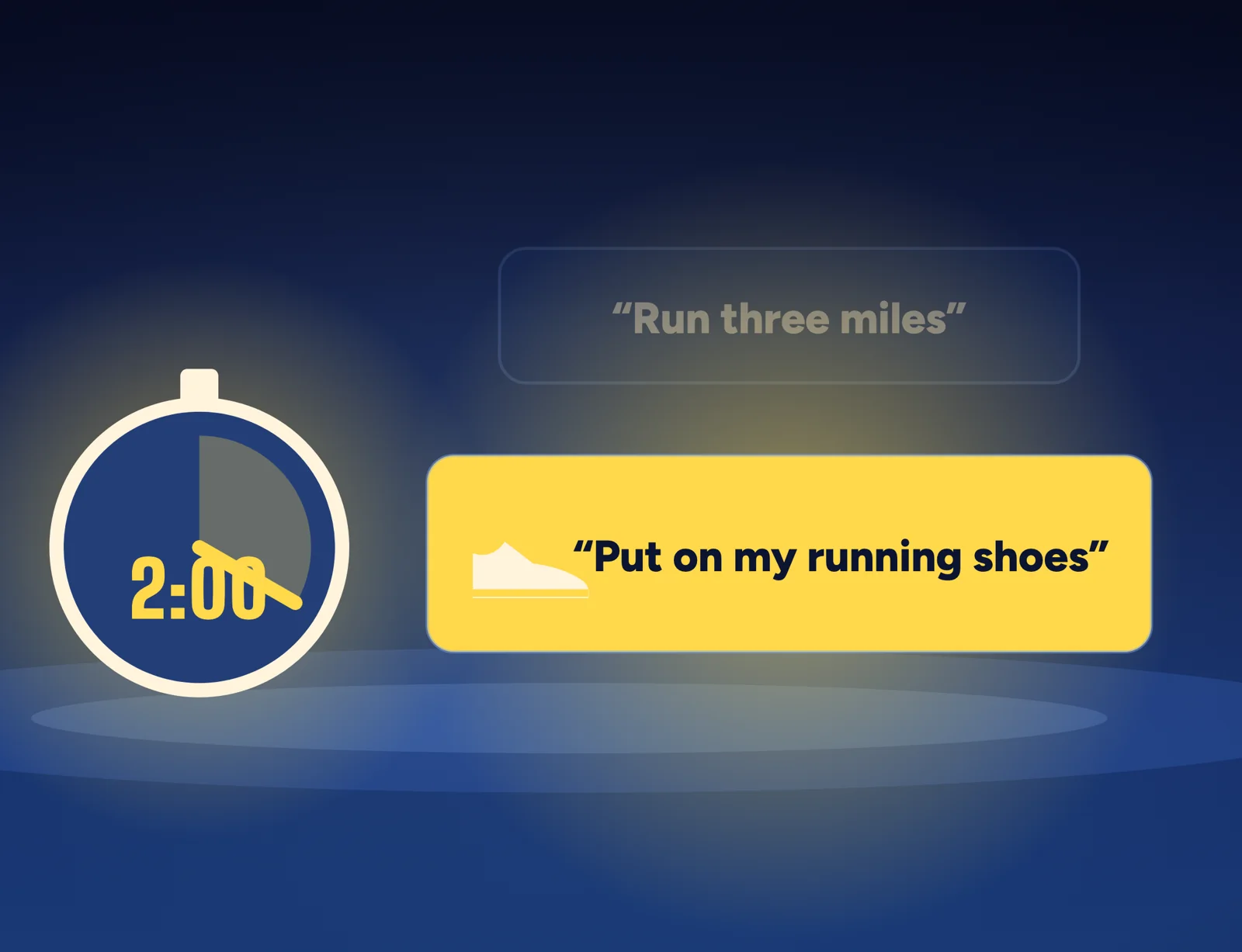
Two ideas justify it. The first is that almost any habit can be scaled down to a gateway habit — a two-minute version that sits at the entrance to a larger routine. Shoes on leads naturally toward a run in a way that scrolling on the couch never does, so the gateway is not merely smaller, it points down the productive path. The second is the ordering rule: a habit must be established before it can be improved. Standardize before you optimize. If you cannot reliably show up, there is nothing yet to make better, and elaborate plans built on an unbuilt foundation collapse the first busy week.
So you master the art of showing up first. In practice the Two-Minute Rule works as a ritual — you perform the opening move regardless of how the rest goes, because that move casts the vote for the identity you are building. Someone who unrolls the mat daily is becoming a person who does yoga, even on the days the session lasts two minutes. A common failure is treating the rule as a trick to bait yourself into a long session, then judging the short days as failures. Two minutes done is the habit working as designed.
Once the entry point is dependable, you extend it through habit shaping: master a small phase, then advance to the next. Phase one is putting on the workout clothes. Phase two is stepping out the door. Phase three is a five-minute walk. Each phase is trivially reachable from the one before, and each is held until it is automatic rather than abandoned the moment enthusiasm arrives. Progress this way is slower on paper and dramatically faster in practice, because nothing ever collapses back to zero.
The rule earns its leverage because it lands on decisive moments — the small forks that shape everything after them. The minute you get home from work, the moment you pass the gym exit, what you order first at a restaurant. Each takes seconds and each redirects hours. Your day is not a thousand deliberate decisions; it is a handful of habitual choices and the automatic stretches that follow them. Aim your two-minute habits at those forks.
For the behaviors you want guaranteed rather than merely likely, use a commitment device: a choice made now that locks in better behavior later. It works by binding your future self while your present self is still thinking clearly, so the decision is not re-litigated in the moment temptation is strongest. Victor Hugo, badly behind on a manuscript, kept his clothes locked away so leaving the house was not an option, and finished the book. Modern equivalents are quieter — single-portion packages, leaving the credit card at home, a website blocker, a table away from the buffet.
The strongest version is the one-time action: an effort spent once that keeps paying without further willpower. Automatic transfers to savings, unsubscribing from the tempting mailing list, buying blackout curtains, deleting an app, using smaller plates. Technology is the great automator here, and it cuts both ways — the same devices that automate a saving habit will happily automate a scrolling one. Use one-time actions deliberately, and you spend willpower once instead of daily.
Key terms
- 3rd Law
- Make it easy: cut the energy a behavior costs so repetition happens without negotiation.
- Habit shaping
- Mastering one small phase of a routine before advancing to the next, slightly larger one.
- Decisive moment
- A brief fork in the day whose outcome quietly determines the hours that follow.
Key concepts
Law of Least Effort
- A principle about energy budgets that explains why the closer gym gets used and the better one across town does not.
- It treats the brain as a conservation machine, so the behavior that wins is the cheapest route to a worthwhile payoff.
- Clear makes it the foundation of the 3rd Law, which is why removing obstacles buys you more repetitions.
Motion
- The busy, preparatory half of a pair Clear uses to explain why people stall for months with nothing to show.
- Planning, researching, outlining and buying gear all count, and none of them produce the outcome you want.
- It feels productive precisely because it shields you from ever risking failure at the real thing.
Long-term potentiation
- A neural mechanism that explains why habit formation tracks repetitions rather than elapsed time.
- It is the cellular version of the rule that neurons which fire together wire together.
- Neuroscientists use it for the tightening of cell-to-cell signaling that comes with each repetition.
Friction
- In Clear's model this is what a behavior costs you: steps, decisions, setup and delay.
- Lower it and repetitions get cheaper; raise it and an impulse has to pause before it can run.
- Unplugging a television or leaving a phone in another room are both deliberate adjustments to it.
Environment priming
- A tactic that front-loads a habit's setup so the next occasion starts from zero resistance.
- Laying out workout clothes at night or loading the coffee machine before bed are textbook cases.
- It targets the cost of beginning a behavior rather than your enthusiasm for performing it.
Automaticity
- The end state the 3rd Law aims at, and the reason repetitions matter more than good intentions.
- Plotted against repetitions, it rises steeply, then flattens as the behavior stops costing attention.
- Reaching it means you no longer deliberate over the steps — the sequence simply runs on its own.
Key facts
Effort Is the Hidden Variable in Every Choice
The Law of Least Effort holds that among competing options, the behavior that actually happens is the one delivering the most value for the least work. This is economics, not laziness: energy is finite and the brain is built to conserve it. Most of the time the deciding variable is not how motivated you are but how hard the thing is — which is why the closer gym gets used and the better one does not.
Motion Feels Like Progress and Isn't
Motion is planning, researching, outlining, comparing apps and buying gear. Action is the behavior that produces the outcome. Motion is seductive because it feels productive while protecting you from ever risking failure at the real thing. Ten workout plans is motion; one set of squats is action. When you are stuck, the useful question is rarely what to do — it is which of the two you are currently doing.
Repetitions Build Habits, Not Calendar Days
What automates a behavior is the number of times you have performed it, not how long ago you decided to. Each repetition strengthens the neural pathway behind the habit, so the more you have practiced it, the more readily it runs — until the behavior needs no thought at all.
Shrink It Until Starting Isn't a Decision
The Two-Minute Rule says a new habit should take less than two minutes to do. "Read before bed" becomes "read one page." "Thirty minutes of yoga" becomes "take out the mat." "Run three miles" becomes "put on my running shoes." The rule feels like it asks too little, and that is exactly the design: you are not training the routine yet, you are training the act of showing up.
A Gateway Habit Points Down the Right Path
A gateway habit is the two-minute version that sits at the entrance to a larger routine, and crucially it faces the right direction. Shoes on leads naturally toward a run in a way that sitting down with your phone never will. That is what separates a real gateway from an arbitrary small task: it is not merely easy, it is the opening move of the thing you actually want to be doing.
Establish Before You Improve
A habit must be established before it can be improved: standardize, then optimize. If you cannot reliably show up, there is nothing yet to make better, and an elaborate plan built on that missing foundation collapses in the first busy week. Habit shaping follows from this — master one small phase until it runs itself, then advance to the next slightly larger one.
A Handful of Forks Decide the Whole Day
Decisive moments are the small forks that shape everything after them: the minute you walk in from work, the moment you pass the gym exit, what you order first at a restaurant. Each takes seconds and each redirects hours. A day is not a thousand deliberate decisions — it is a few habitual choices and the long automatic stretches that follow them. Aim your two-minute habits at those forks.
By the numbers
- The suggested cap on how long a brand-new habit should take
- 2 minutes
Matched pairs
Each item on the left goes with the one on the right.
- Action
- The behavior that actually delivers the outcome you want.
- Inverting the 3rd Law
- Making a bad habit hard by adding steps, delay and distance.
- Gateway habit
- A two-minute entry point that leads into a bigger routine.
- Commitment device
- A choice made now that locks in better behavior later.
- One-time action
- A single effort that keeps paying off without more willpower.
Step by step
Grow a two-minute habit into a full routine by shaping it
- Scale the habit down until starting takes under two minutes.
- Repeat that entry point daily until it needs no decision.
- Add the next slightly larger phase and hold it there.
- Keep each phase until it runs itself before advancing.
Standardize before you optimize — the habit is the entry point, not the end point.
Self-test
Answer each question from memory, then check your work against the answer key.
1. Which of these is action rather than motion?
- ADrafting a training plan
- BComparing five running apps
- CReading about running form
- DRunning one slow mile
2. What does the 3rd Law tell you to do with friction?
- AAdd friction to habits you want to repeat
- BCut it for good habits and add it for bad
- CKeep friction identical across all habits
- DIgnore it and rely on motivation instead
3. Which action cuts friction for a good habit, rather than adding friction to a bad one?
- AKeeping the guitar on a stand
- BUnplugging the TV and remote
- CLeaving the phone in another room
- DDeleting the tempting app
4. A writer spends the evening comparing seven notebook brands instead of writing. This is called—
- AEnvironment priming
- BLong-term potentiation
- CMotion
- DAutomaticity
5. To break a habit like mindless scrolling, the 3rd Law inverted says to—
- AAdd steps and distance
- BRely on willpower alone
- CReward resisting it
- DRemove all friction
6. What actually separates motion from action?
- AMotion always happens after action is complete
- BMotion requires more physical effort than action
- CMotion is any habit repeated fewer than two minutes
- DMotion prepares for a task; action produces the outcome
7. When you feel stuck, what question should you honestly ask?
- AHow motivated do I feel right now?
- BHow many days have I kept this up?
- CAm I in motion or in action?
- DWhat should I do next?
8. Why scale a new habit down to under two minutes?
- ATo keep the habit permanently tiny forever
- BTo make showing up easy enough to repeat
- CTo measure progress with a stopwatch instead
- DTo finish an entire routine in record time
9. Which of these is a one-time action?
- AReminding yourself nightly to save
- BDeciding each month how much to save
- CSetting up an automatic transfer
- DTracking purchases in a spreadsheet
10. Victor Hugo kept his clothes locked away until his manuscript was done. Which idea does this illustrate?
- AA commitment device
- BHabit shaping
- CA gateway habit
- DA decisive moment
11. A new runner scales 'run three miles' down to just 'put on my running shoes' to get started. The term for this two-minute entry point is—
- ACommitment device
- BDecisive moment
- COne-time action
- DGateway habit
12. What ordering rule underlies habit shaping?
- ASkip straight to hardest phase
- BMaster each phase first
- CAdd every phase at once
- DJudge days by session length
Go deeper
- ListenLesson 4 episode
- WatchMotion Is Not Action 10 workout plans is motion. 1 set of squats is action. Motion feels productive. Only action produces the result.
- WatchThe Two-Minute Rule When you start a new habit, make it take less than 2 minutes.
- ReadAtomic Habits by James Clear · on Amazon ↗
- StudyAtomic Habits in the FlashFeed app
These are affiliate links: if you buy a book through one, FlashFeed may earn a small commission at no extra cost to you. The commission helps pay for FlashFeed's servers.
As an Amazon Associate we earn from qualifying purchases.
Answer key
- 1. D Running one slow mileMotion is preparation and action is the behavior that produces the outcome. Only the mile changes anything about your fitness.
- 2. B Cut it for good habits and add it for badReducing the cost of a good habit buys repetitions; raising the cost of a bad one inserts a pause where an impulse used to run unopposed.
- 3. A Keeping the guitar on a standThe guitar stays easy to grab, cutting friction for a good habit. The other three add friction to make a bad habit harder—the opposite move.
- 4. C MotionMotion is preparation that feels productive but changes nothing; only writing itself would count as action.
- 5. A Add steps and distanceInverting the 3rd Law makes bad habits hard by adding steps and distance, pausing impulse before it becomes action.
- 6. D Motion prepares for a task; action produces the outcomeMotion is planning, researching, or outlining; action is the behavior that actually produces the outcome.
- 7. C Am I in motion or in action?Being stuck is reframed as a motion-versus-action question, since motion can feel productive while never risking the real thing.
- 8. B To make showing up easy enough to repeatThe rule buys repetitions. Two minutes is an entry point rather than a ceiling, and the days that stop there still count as the habit working.
- 9. C Setting up an automatic transferA one-time action is set up once and keeps producing the behavior afterwards. The other three demand fresh willpower on every cycle.
- 10. A A commitment deviceIt bound Hugo's future behavior while he could still decide clearly, instead of resisting temptation in the moment.
- 11. D Gateway habitThe gateway habit is the two-minute entry point that points toward the bigger routine—shoes on leads to a run. It names the single step, not the multi-phase shaping process.
- 12. B Master each phase firstHabit shaping masters one small phase until it's automatic before advancing—standardize first, then optimize.
Sources
- Atomic Habits — James Clear
Image credits
- The Two-Minute Rule: FlashFeed original diagram