
Atomic Habits study guide · Lesson 2 of 6
The 1st Law: Make It Obvious
The Habit Loop and Cue Awareness · Habit Stacking and Environment Design
Unofficial study guide for Atomic Habits: An Easy & Proven Way to Build Good Habits & Break Bad Ones by James Clear. FlashFeed is not affiliated with the author or publisher.
This is the lesson's study guide from the FlashFeed app, plus its key facts and a self-test.
What you'll be able to do
- Trace the four stages of the habit loop and map each of the Four Laws of Behavior Change onto its stage.
- Make a cue obvious using implementation intentions, habit stacking, and deliberate environment design.
The Habit Loop and Cue Awareness
James Clear breaks the psychological mechanics of habit into four distinct, interconnected stages: cue, craving, response, and reward. Building on Charles Duhigg's three-part cue-routine-reward loop from The Power of Habit, he splits the middle stage into craving and response and explains that this four-step loop is the automatic cognitive feedback cycle underlying every routine you perform, from tying your shoes to reaching for your phone.
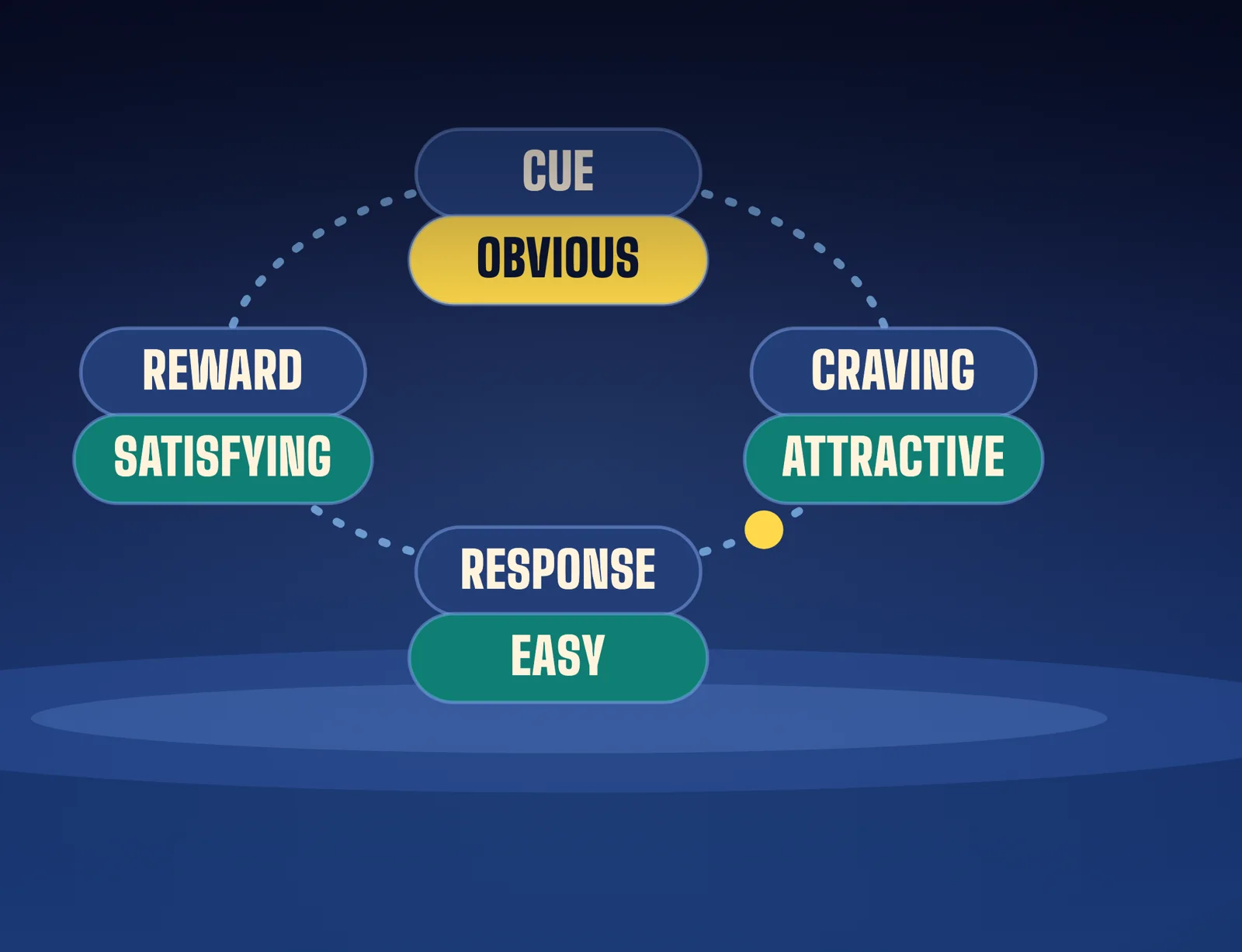
The first step is the cue. The cue triggers your brain to initiate a behavior because it predicts a reward. Our prehistoric ancestors constantly scanned the environment for cues signaling primary rewards like food, water, sex, and shelter. Today we spend most of our time learning cues that predict secondary rewards like money, status, praise, friendship, or a sense of personal satisfaction. Because the cue is the first signal that a reward is near, it leads directly to the second step.
The craving is the motivational force behind every habit. Without some level of desire, we have no reason to act. Crucially, you do not crave the habit itself; you crave the change in internal state it delivers. A person does not crave a cigarette; they crave the relaxation and stress relief it promises. A person does not crave turning on the television; they crave being entertained and distracted from boredom. A person does not crave brushing their teeth; they crave the clean, fresh feeling in their mouth. Cravings are tied to our desire to alter how we feel.
The third step is the response — the actual habit you perform, whether physical, mental, or emotional. Whether the response occurs depends on how motivated you are, how much friction or physical resistance stands in the way, and whether you possess the ability to perform the action at all. If something requires more effort than you are willing to expend, you simply will not do it.
The loop concludes with the reward. Rewards are the end goal of every habit. The cue is about noticing the reward, the craving is about wanting it, and the response is about obtaining it. Rewards serve two purposes: they satisfy your craving, and they teach your brain which actions are worth remembering and repeating. Pleasure and relief act as a neural feedback signal that the preceding behavior worked and should be stored in memory for next time.
Together the four steps form a continuous loop. The cue triggers a craving, which motivates a response, which delivers a reward, which satisfies the craving and becomes associated with the cue. This model is the foundation of the Four Laws of Behavior Change, Clear's practical framework for creating good habits and breaking bad ones:
- The 1st Law (Cue): Make it obvious.
- The 2nd Law (Craving): Make it attractive.
- The 3rd Law (Response): Make it easy.
- The 4th Law (Reward): Make it satisfying.
Building any new routine starts with the 1st Law: make the cue obvious. But because so many daily habits have become automatic and subconscious over years of repetition, you must first become consciously aware of the behaviors you already have. To build that awareness, Clear recommends a practical tool called the Habits Scorecard. You sit down and list all your daily habits in chronological order, from the moment you wake up to the moment you go to sleep. Next to each behavior you score it as positive (+), negative (-), or neutral (=), depending on whether it serves your long-term identity. Verbalizing and writing your routines down brings nonconscious behavior into conscious awareness.
Habit Stacking and Environment Design
Once the Habits Scorecard has made your daily routines conscious, you can begin designing specific, obvious cues for new habits. The two most common cues that trigger human behavior are time and location. Many people believe they lack motivation to start a new habit when in reality they lack clarity. They say "I am going to eat healthier" or "I am going to write more," but such vague intentions leave it to chance whether the habit ever happens.
To remove that ambiguity, Clear recommends a technique backed by a large body of psychological research: the implementation intention, a concrete plan made in advance about when and where you will perform a specific behavior. The formula is simple and explicit: "I will [BEHAVIOR] at [TIME] in [LOCATION]." For example, "I will meditate for one minute at 7:00 AM in my kitchen," or "I will study Spanish for twenty minutes at 6:00 PM in my home office." Naming the exact time and place anchors the habit in physical reality and makes follow-through far easier.
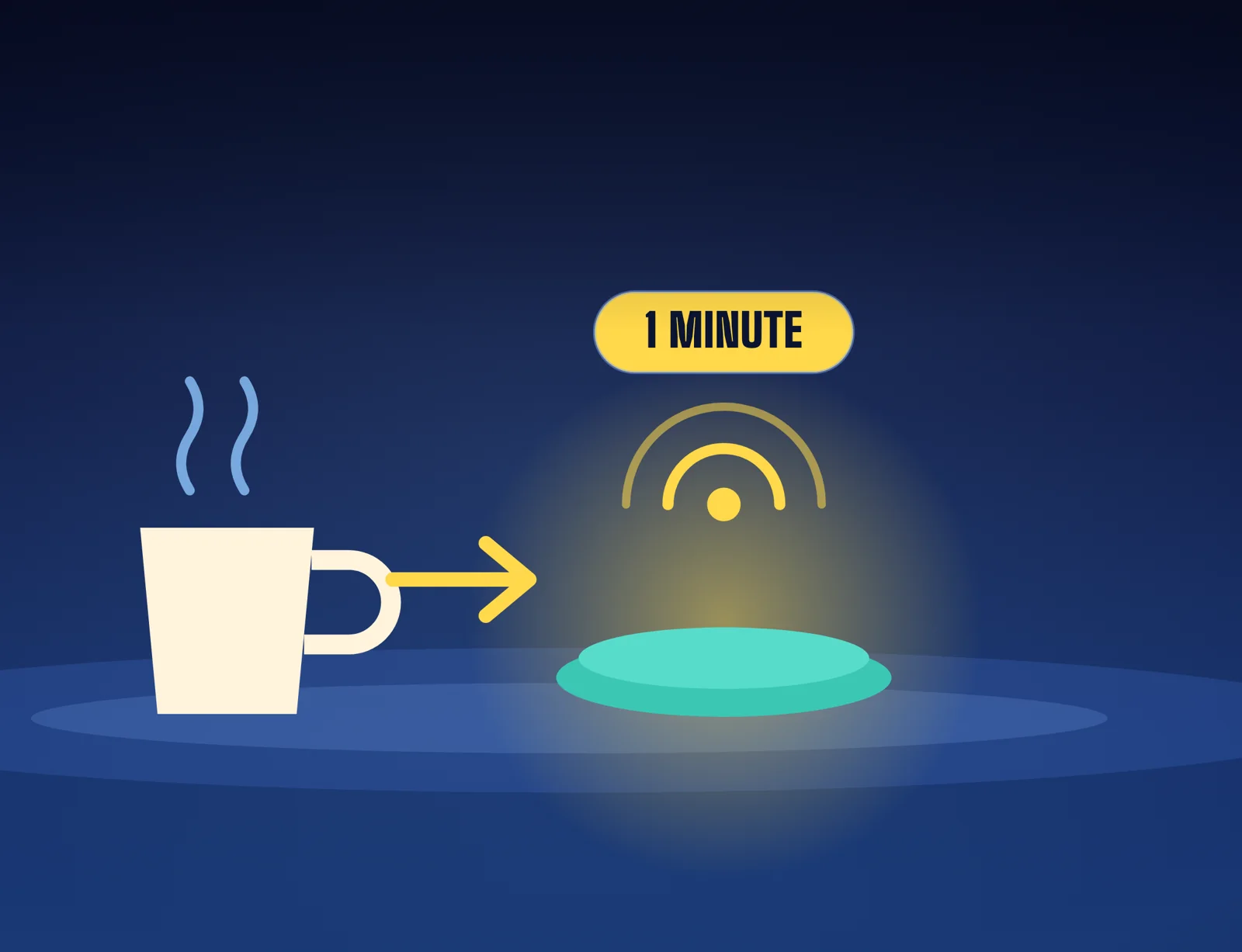
A special form of implementation intention is habit stacking. Developed by professor BJ Fogg, habit stacking pairs a new habit you want to build with an existing habit you already perform automatically every day. Instead of pairing the new behavior with a specific time and location, you pair it with the momentum of an established routine. The formula is: "After [CURRENT HABIT], I will [NEW HABIT]."
For instance: "After I pour my morning cup of coffee, I will meditate for one minute." Or: "After I take off my work shoes, I will change into my workout clothes." Or: "After I sit down to eat dinner, I will say one thing I am grateful for." Habit stacking works because your current habits are already wired into your brain; tying a new behavior to an established neural pathway piggybacks on existing momentum and makes it more likely that you will stick with the new behavior.
Beyond time and location, your physical environment plays a colossal role in your daily choices. Clear calls environment the invisible hand that shapes human behavior. We like to believe we are in total conscious control of our choices, but we are heavily influenced by the visual cues immediately around us. We often choose products on a supermarket shelf not because of what they are but because of where they sit at eye level. We often pick up our smartphones not because we consciously decided to check messages but because the device was lying face-up on the desk.
To make good habits easier to adopt, design your environment so the cues for the behaviors you want are obvious, visible, and front-and-center. If you want to drink more water, fill bottles and place them in prominent spots around the house and desk. If you want to read more books, put a book on your pillow each morning after making the bed. If you want to practice guitar, stand the guitar in the middle of the living room rather than hiding it in a closet.
The inversion of the 1st Law, for breaking a bad habit, is to make the cue invisible. The people with the highest self-control are typically the ones who structure their lives so they need willpower least; self-control is a short-term strategy, not a long-term one. To stop checking social media while working, put the phone in another room or turn off notifications. To stop eating junk food, remove it from the pantry so the visual cue is eliminated entirely. Master environment design and you make good habit cues obvious and bad habit cues invisible.
Key terms
- Habit
- A routine performed so many times that it now runs automatically — the unit Clear treats as the building block of long-term change.
- Four Laws
- Clear's practical framework — make it obvious, make it attractive, make it easy, make it satisfying — one rule for each stage of the loop.
- Habit Stacking
- Anchoring a new behavior to one you already perform automatically, using the formula: After [CURRENT], I will [NEW].
- Environment Design
- Arranging the space around you so the cues for behaviors you want are in plain sight, and the cues for behaviors you don't are gone.
Key concepts
The Habit Loop
- The four-stage feedback cycle Clear builds by splitting Charles Duhigg's three-part cue-routine-reward loop from The Power of Habit into four stages.
- Its stages always run in the same order, each one setting up the next, and the last one feeds straight back into the first.
- Clear maps the Four Laws of Behavior Change onto it, one law per stage.
Cue
- The first of the four stages, and the one that fires before you have consciously decided anything.
- Prehistoric humans scanned the landscape for these signals of food, water and shelter; we scan for signs of money, status and praise.
- The 1st Law of Behavior Change says to make this stage obvious.
Craving
- The motivational force behind every habit — without it there is no reason to act at all.
- You never actually want the cigarette or the television; you want the change in internal state each one promises.
- The 2nd Law of Behavior Change addresses this stage by telling you to make it attractive.
Response
- The stage where intention turns into action — the behavior you actually perform, physical, mental or emotional.
- Whether it happens at all comes down to your motivation, the friction in the way, and whether you are able to do it.
- The 3rd Law of Behavior Change addresses this stage by telling you to make it easy.
Reward
- The end point of every habit, and the reason the loop closes instead of trailing off.
- It does two jobs at once: it settles the craving, and it teaches the brain which actions are worth repeating.
- The 4th Law of Behavior Change addresses this stage by telling you to make it satisfying.
Habits Scorecard
- Clear's first practical exercise, aimed at behavior that has gone automatic and invisible after years of repetition.
- You write out every daily behavior in chronological order, from the moment you wake to the moment you sleep.
- Beside each line you mark a plus, a minus or an equals sign, depending on whether it serves your long-term identity.
Key facts
Four Steps Behind Every Automatic Behavior
Clear splits every habit into four stages: cue, craving, response, reward. The cue is noticing the reward is near, the craving is wanting it, the response is the behavior that obtains it, and the reward closes the circuit. Then the reward attaches itself back onto the cue, and the loop is ready to run again. The model builds on Charles Duhigg's three-part cue-routine-reward loop from The Power of Habit, with Clear splitting the middle stage into craving and response.
Nobody Actually Craves a Cigarette
What a smoker wants is the relaxation the cigarette promises. Nobody craves turning on the television either — they crave being entertained and pulled out of boredom. Nobody craves brushing their teeth; they crave the clean feeling afterward. You never crave the behavior itself, only the change in internal state it delivers. Which is why swapping the behavior is possible: the wanted state stays the same.
Score Your Day Before You Try to Change It
Most daily habits have run on autopilot for so long that you no longer notice them. The Habits Scorecard drags them back into view: write out every behavior of your day in chronological order, waking to sleeping, then mark each one positive, negative or neutral. The scoring standard is not health or productivity in the abstract — it is whether the behavior serves the identity you are trying to build.
Not a Motivation Problem — a Clarity Problem
"I am going to eat healthier." "I am going to write more." These sound like commitments, but they name no moment and no place, so whether they happen is left to chance. An implementation intention fixes that by writing the plan out in advance: I will [BEHAVIOR] at [TIME] in [LOCATION]. Time and location are the two most common cues for behavior, and the technique is backed by a large body of research.
Bolt the New Habit onto One You Already Have
Habit stacking, developed by professor BJ Fogg, skips the calendar entirely. Instead of pairing a new behavior with a time and place, you pair it with a routine already running on autopilot: After I pour my morning coffee, I will meditate for one minute. After I take off my work shoes, I will change into workout clothes. The anchor habit is already wired in, which makes you more likely to stick with the new one.
Environment Is the Invisible Hand
We often choose the product on the supermarket shelf not for what it is but for where it sits, at eye level. We often pick up the phone not because we decided to check anything but because it was lying face-up on the desk. Clear's conclusion is structural: stop arguing with your surroundings and rearrange them. Water bottles in plain sight. A book on the pillow. The guitar on a stand in the living room instead of in a closet.
Matched pairs
Each item on the left goes with the one on the right.
- BJ Fogg
- The professor who developed habit stacking.
- Inversion of the 1st Law
- Make the cue invisible to break a bad habit.
Step by step
Write an implementation intention you will actually keep
- Pick one specific behavior — 'walk twenty minutes', not 'exercise more'.
- Choose the exact time of day you will do it, down to the clock.
- Choose the exact location, somewhere you will physically be at that hour.
- Write the whole sentence out: I will [BEHAVIOR] at [TIME] in [LOCATION].
Vagueness is the failure mode. An unspecified plan leaves the habit to chance, and chance rarely delivers.
Stack a new habit onto a routine you already run
- List the behaviors you already perform automatically every day, in the order they happen.
- Find the one that reliably occurs right before the moment you want the new habit to live.
- Write it in the formula: After [CURRENT HABIT], I will [NEW HABIT].
- Keep the new habit small enough that the old one can carry it without resistance.
The anchor must be genuinely automatic. Stacking onto a habit you also struggle with just moves the problem.
Self-test
Answer each question from memory, then check your work against the answer key.
1. Which stage of the habit loop supplies the motivation to act?
- AResponse
- BCue
- CCraving
- DReward
2. Which stage of the habit loop is the actual behavior performed?
- AReward
- BResponse
- CCue
- DCraving
3. Which of the Four Laws pairs with the reward stage?
- AMake it satisfying
- BMake it attractive
- CMake it obvious
- DMake it easy
4. Which of these is NOT one of the four stages of the habit loop?
- ACue
- BCraving
- CReward
- DMotivation
5. Besides satisfying a craving, what else does a reward do?
- ATeaches the brain to repeat it
- BEliminates future cravings
- CErases the memory of the cue
- DReplaces the need to respond
6. Which fill-in sentence is the formula for writing an implementation intention?
- AI will try to [BEHAVIOR] when I can
- BI will [BEHAVIOR] more often to reach [GOAL]
- CI will [BEHAVIOR] because of [REASON]
- DI will [BEHAVIOR] at [TIME] in [LOCATION]
7. What do people with the highest self-control tend to have in common?
- AThey set far more ambitious goals than others
- BThey practice resisting temptation daily
- CThey arrange life so willpower is rarely needed
- DThey rely on strict punishment for slips
8. Why does habit stacking help a new habit stick?
- AIt replaces the old routine entirely
- BThe anchor routine is already automatic
- CNew routines are easier in the morning
- DIt removes the need for any reward
9. What is the formula for habit stacking?
- AI will try to [BEHAVIOR] more often
- BI will [BEHAVIOR] whenever I feel like it
- CAfter [CURRENT HABIT], I will [NEW HABIT]
- DI will [BEHAVIOR] at [TIME] in [LOCATION]
10. Which of these changes is an example of environment design?
- AScore as plus, minus, or neutral
- BMeditate at 7 AM in the kitchen
- CMeditate after morning coffee
- DPut water bottles in plain view
Go deeper
- ListenLesson 2 episode
- WatchThe Four-Step Habit Loop Every habit runs on a loop of 4 steps: cue, craving, response, reward.
- WatchStack It on Your Coffee Many people don't lack motivation. They lack clarity. Saying “I'll eat healthier” leaves it to chance.
- ReadAtomic Habits by James Clear · on Amazon ↗
- StudyAtomic Habits in the FlashFeed app
These are affiliate links: if you buy a book through one, FlashFeed may earn a small commission at no extra cost to you. The commission helps pay for FlashFeed's servers.
As an Amazon Associate we earn from qualifying purchases.
Answer key
- 1. C CravingWithout desire there is no reason to act. The craving is what turns a noticed trigger into an actual behavior.
- 2. B ResponseThe response is the behavior itself — what you actually do to obtain the reward, distinct from noticing (cue) or wanting (craving) it.
- 3. A Make it satisfyingReward is the 4th stage, paired with the 4th Law: make it satisfying. Obvious, attractive, and easy pair with cue, craving, and response.
- 4. D MotivationThe four stages are cue, craving, response, and reward. Motivation is the general drive behind cravings, not a named stage of the loop.
- 5. A Teaches the brain to repeat itRewards serve two purposes: satisfying the craving and teaching the brain which actions are worth remembering and repeating next time.
- 6. D I will [BEHAVIOR] at [TIME] in [LOCATION]Clear's template pins down the two most common cues, time and place: I will [BEHAVIOR] at [TIME] in [LOCATION]. The other sentences name no moment or place, so they leave follow-through to chance.
- 7. C They arrange life so willpower is rarely neededClear calls self-control a short-term strategy. The durable move is structural: remove the cue and there is nothing left to resist.
- 8. B The anchor routine is already automaticYou piggyback on a neural pathway that already fires every day, which makes you more likely to stick with the new behavior.
- 9. C After [CURRENT HABIT], I will [NEW HABIT]Habit stacking pairs a new habit with an existing automatic one using After-then. The time-and-location formula is implementation intentions; the others are the vague intentions Clear warns leave follow-through to chance.
- 10. D Put water bottles in plain viewPlacing bottles where you'll see them reshapes the physical space itself. The others are an implementation intention, habit stacking, and the Habits Scorecard.
Sources
- Atomic Habits — James Clear
Image credits
- The Four-Step Habit Loop: FlashFeed original diagram
- Stack It on Your Coffee: FlashFeed original diagram