
Broken Money: Why Our Financial System Is Failing Us & How We Can Make It Better study guide · Lesson 7 of 7
Lesson 7: Layered Scaling, CBDCs, and the Monetary Horizon
7.1 Layered Architecture and Lightning · 7.2 CBDCs, Autonomy, and Long-Term Cycles
Unofficial study guide for Broken Money: Why Our Financial System is Failing Us and How We Can Make it Better by Lyn Alden. FlashFeed is not affiliated with the author or publisher.
This is the lesson's study guide from the FlashFeed app, plus its key facts and a self-test.
What you'll be able to do
- Explain how the Lightning Network's Layer 2 design, HTLCs, and onion routing enable fast, private, non-custodial payments.
- Explain how programmable CBDCs threaten privacy and autonomy, and how Ray Dalio's Long-Term Debt Cycle ends in currency devaluation and monetary reset.
Monograph Section: Lesson 7 of Broken Money: Why Our Financial System Is Failing Us and How We Can Make It Better by Lyn Alden.
Executive Overview
Explores the Blockchain Trilemma and why base-layer blockchains scale via layered architectures rather than oversized blocks. Deep-dives into the Lightning Network's peer-to-peer payment channels, comparative analysis between open decentralized protocols and centralized surveillance Central Bank Digital Currencies (CBDCs), real-world grassroots financial inclusion in high-inflation economies (Lebanon, Argentina, Nigeria), and the macroeconomic endgame of long-term sovereign debt cycles.
Layered Architecture and Lightning
Conceptual Foundations: The Blockchain Trilemma, Layered Money Architecture, Base Layer (L1) Settlement, Lightning Network (L2) Protocols
Core Insight: The Blockchain Trilemma, articulated by Vitalik Buterin, posits that a blockchain can maximize at most two of three properties simultaneously: decentralization, security, and scalability.
If a blockchain increases block sizes to process 50,000 transactions per second (like Visa), the ledger expands by hundreds of gigabytes per day. Only giant corporate data centers can afford to run nodes, destroying decentralization and creating a centralized system identical to traditional banking.
Core Insight: Just as the internet scaled through layered protocols (TCP/IP at the base layer, HTTP and SSL at higher application layers), monetary networks scale through layered architectures.
The base TCP/IP protocol does not stream video; it routes data packets reliably. Similarly, Bitcoin Layer 1 functions as the high-assurance global settlement layer (like Fedwire or sovereign gold transfers), while Layer 2 handles retail transactions.
Core Insight: The Lightning Network is an open-source Layer 2 protocol built on top of Bitcoin that enables instant, high-volume microtransactions with near-zero fees without cluttering the base blockchain.
Lightning transactions do not require mining new blocks. Counterparties open a channel on-chain, transact millions of times instantly off-chain, and record only the opening and closing net balances on the base Bitcoin blockchain.
Core Insight: A Lightning payment channel is established by locking funds into a 2-of-2 multisignature address on the Bitcoin base blockchain, creating an off-chain ledger between two parties.
Think of a Lightning channel like a bar tab: you open the tab with a credit card (on-chain lock), order dozens of drinks throughout the night with instant balance updates (off-chain), and close the tab with a single final settlement at the end of the evening.
Core Insight: Hash Time-Locked Contracts (HTLCs) enable payments to be securely routed across multiple intermediary nodes across the Lightning Network without trusting any intermediary.
If Alice wants to pay Carol but only has a channel with Bob (who has a channel with Carol), Alice routes the payment through Bob. Bob cannot steal the funds because he can only claim Alice's payment by revealing the cryptographic secret provided by Carol.
Core Insight: Lightning Network routing uses onion encryption (similar to the Tor network), ensuring that intermediate routing nodes only know the immediately preceding and succeeding hops, protecting user privacy.
When Bob routes a payment between Alice and Carol, Bob only knows he received satoshis from Alice to forward to Carol. He does not know if Alice is the original sender or if Carol is the ultimate recipient, providing superior transaction privacy compared to Visa or bank wires.
Core Insight: The Lightning Network achieves settlement finality within milliseconds, whereas traditional credit card rails (Visa, Mastercard) require 30 to 90 days for full chargeback and dispute settlement.
When a customer swipes a credit card, the merchant receives a provisional promise of payment. The actual funds take days to deposit and remain subject to chargebacks and reversal for months. Lightning settlement is instantaneous, final, and non-reversible.
Core Insight: Channel capacity in the Lightning Network refers to the total amount of Bitcoin locked in a payment channel, which constrains the maximum payment size that can be routed through that specific path.
If a channel has 1,000,000 sats capacity, it cannot route a 2,000,000 sat payment. Advanced protocols (like multi-path payments) solve this by splitting large payments into multiple small shards routed across different channels and reassembled at the destination.
Core Insight: Chaumian eCash mints (such as Cashu and Fedimint) provide a secondary Layer 3 scaling model that combines community custody with complete cryptographic transaction privacy.
Based on cryptographer David Chaum's 1982 invention, eCash mints allow small communities (churches, villages, clubs) to pool custody while using blinded cryptographic tokens where even the mint operator cannot see who is paying whom or what balances they hold.
Core Insight: The Lightning Network enables machine-to-machine microtransactions, allowing automated AI agents and IoT devices to pay fractions of a cent per API call or per second of streaming data.
Traditional banking cannot process transactions under $0.50 because fixed card fees (30 cents + 3%) make micro-payments impossible. Lightning can route 0.001 cents efficiently, creating new business models for streaming media, spam prevention, and AI services.
Core Insight: Watchtowers are specialized third-party services on the Lightning Network that monitor the base blockchain to protect offline users against fraudulent channel closures by cheating counterparties.
If Alice goes on vacation without internet and Bob tries to broadcast an old channel balance from last week, Alice's watchtower automatically catches the invalid state and penalizes Bob by seizing his entire channel balance, making cheating economically fatal.
Core Insight: Unlike centralized Layer 2 solutions (like traditional fintech apps), the Lightning Network is completely non-custodial and open-source, allowing anyone to run a routing node without corporate permission.
Unlike PayPal or Venmo—where a central corporation can freeze your funds, limit transactions, or deny service—Lightning nodes operate independently, forming an uncensorable global mesh network.
Core Insight: The integration of the Lightning Network into global payment platforms (like Strike, Cash App, and Bitso) enables frictionless real-time international remittances that bypass traditional 7% Western Union fees.
A worker in the US sends dollars; the app converts dollars to Bitcoin, routes it across the Lightning Network in 500 milliseconds for a fraction of a cent, and converts it instantly into local currency in the recipient's bank account, saving migrant workers billions in predatory wire fees.
Core Insight: Statechains and spacechains represent alternative non-custodial Layer 2 scaling architectures that allow the off-chain transfer of UTXO ownership without broadcast to the base blockchain.
These advanced second-layer architectures complement Lightning by allowing users to onboard and offboard liquidity with fewer on-chain footprints, addressing base-layer block space constraints.
Core Insight: Layered scaling proves that Bitcoin does not need to compromise its base-layer decentralization and unforgeable hardness in order to serve as a high-velocity transactional currency for billions of global users.
Bitcoin avoids the catastrophic centralization that doomed previous fiat experiments. By keeping Layer 1 rock-solid and immutable, all higher layers inherit the unforgeable scarcity and security of the base thermodynamic ledger.
CBDCs, Autonomy, and Long-Term Cycles
Conceptual Foundations: Central Bank Digital Currencies (CBDCs), Programmable Money and Surveillance, Expiry Dates and Negative Interest Rates, Financial Deplatforming
Core Insight: A Central Bank Digital Currency (CBDC) is a digital liability of a central bank that allows the state to directly observe, track, program, and restrict individual citizen transactions on a centralized sovereign ledger.
Unlike physical cash (which is anonymous and peer-to-peer) or commercial bank deposits (which are intermediated by private banks), a CBDC gives central planners a real-time panopticon over every coffee bought, book read, and donation made across the nation.
Core Insight: CBDCs introduce programmable money capabilities, allowing governments to program geographic spending boundaries, category restrictions, expiration dates on savings, and automatic tax deductions into currency units.
In a programmable CBDC regime, money is no longer a neutral property right; it is a conditional government voucher that can be configured to expire in 90 days, deactivated outside a specific postal code, or banned from purchasing certain fuels or foods.
Core Insight: CBDCs eliminate the physical cash lower bound, empowering central banks to impose deeply negative nominal interest rates (-3% to -5%) directly on citizens' savings to force consumption during recessions.
With physical cash, if a bank charges -3% interest, depositors simply withdraw physical cash bills and store them in a home safe. A cashless CBDC traps all capital inside the central bank's ledger, allowing the state to drain private wealth at will.
Core Insight: Agustin Carstens, General Manager of the Bank for International Settlements (BIS), said in October 2020 that with a CBDC the central bank would have absolute control over the rules and regulations determining its use, and the technology to enforce them.
Carstens highlighted the profound difference between cash and CBDCs: with cash, central banks do not know who holds the $100 bill or how it is spent. With a CBDC, he said, the central bank would set the rules governing its use and have the technology to enforce them.
Core Insight: Financial deplatforming and account freezes against peaceful political protestors (such as the Canadian Freedom Convoy in February 2022 under the Emergencies Act) demonstrate that traditional fiat banking lacks civil liberty protections.
Under the Emergencies Act the Canadian government ordered banks and payment processors to freeze more than 200 accounts linked to the protest and its donors. Some Canadians responded by turning to cash and self-custodial Bitcoin.
Core Insight: About 1.3 billion adults worldwide (World Bank Global Findex 2025, down from 1.4 billion in 2021) remain unbanked, excluded from the traditional financial system due to poverty, lack of official identity documentation, and lack of bank branch infrastructure.
Traditional banks require identity papers, minimum balance fees, and physical branch visits that exclude rural and impoverished populations. Open-source monetary networks require only an inexpensive Android smartphone and an open-source app.
Core Insight: In high-inflation economies like Nigeria, Argentina, and Lebanon, grassroots adoption of Bitcoin and dollar stablecoins functions as a critical survival tool to protect family wealth from currency collapse.
When the Lebanese pound lost 98% of its value and local banks froze customer deposits, citizens turned to Bitcoin and USDT on the Lightning Network to receive remittances from family abroad, buy groceries, and store value outside the bankrupt state banking system.
Core Insight: El Salvador made history on September 7, 2021, by becoming the first sovereign nation on Earth to adopt Bitcoin as legal tender alongside the US dollar under the leadership of President Nayib Bukele.
With over 70% of Salvadorans unbanked and relying heavily on expensive remittances from abroad, El Salvador adopted Bitcoin to eliminate remittance friction, attract foreign investment, and establish monetary sovereignty outside the US banking system.
Core Insight: Ray Dalio's Long-Term Debt Cycle model demonstrates that human financial systems experience multi-decade (often cited as roughly 50-to-100-year) macroeconomic super-cycles that culminate in massive debt restructurings, currency debasement, and monetary resets.
Short-term debt cycles (5-8 years) end in regular recessions managed by cutting interest rates. When interest rates hit zero and debt keeps climbing, the long-term debt cycle culminates in sovereign currency devaluation and systemic monetary transformation. In the United States, public debt rose from roughly 40% of GDP in 1936 to about 112% of GDP at the end of World War II in 1945.
Core Insight: The four historical methods for resolving an unsustainable sovereign debt burden are: austerity (fiscal cuts), hard sovereign default (bankruptcy), debt restructuring (negotiated haircuts), and currency debasement (monetization).
Austerity triggers political revolution, while outright default destroys the domestic banking system. Politicians and central bankers consistently choose inflation because it devalues debt quietly, spreading the pain across all currency holders.
Core Insight: Fiscal dominance occurs when the scale of government deficits and national debt becomes so enormous that the central bank can no longer prioritize inflation targets, forced instead to suppress interest rates to keep the government solvent.
When national debt reaches $35+ trillion, every 1% increase in interest rates adds hundreds of billions in annual federal debt service. The central bank is forced to print money and purchase bonds to cap yields, guaranteeing persistent structural inflation.
Core Insight: Financial repression is a policy toolkit used by heavily indebted governments to force domestic institutions and pension funds to hold government bonds that yield below the real rate of inflation, quietly liquidating national debt.
Between 1945 and 1975, the US government successfully reduced its World War II debt-to-GDP ratio from about 112% to about 35% with the help of financial repression—running inflation higher than bond yields for much of those decades, quietly eroding purchasing power from bondholders.
Core Insight: The clash between centralized surveillance CBDCs and open-source decentralized protocols represents the defining civil liberties battle of the 21st century.
Money is the foundational medium of human cooperation. If money becomes a programmable CBDC, freedom of speech, assembly, and political opposition can be extinguished with a single keystroke. Open protocols like Bitcoin preserve human freedom in the digital age.
Core Insight: Gresham's Law and Thiers' Law interact in monetary evolution: bad money drives out good money during mild inflation (as good money is hoarded), but during extreme hyperinflation, good money drives out bad money as society abandons the worthless currency.
When inflation reaches crisis levels, citizens stop accepting local fiat entirely, demanding payment in gold, US dollars, or Bitcoin. The market spontaneously demonetizes the broken fiat ledger and adopts the superior hard asset.
Core Insight: Lyn Alden concludes Broken Money with the profound insight that fixing the world's money is the single highest-leverage endeavor for fixing global human flourishing, peace, and economic justice.
Corrupt and broken money fuels endless deficit-financed wars, concentrates wealth in political oligarchies, and impoverishes working families worldwide. Establishing honest, decentralized, hard money is the essential foundation for a free and thriving human future.
Key terms
- The Blockchain Trilemma
- The engineering principle stating that a blockchain cannot simultaneously maximize all three properties of decentralization, security, and scalability on a single layer.
- HTLC (Hash Time-Locked Contract)
- Cryptographic payment script enabling trustless multi-hop routing across intermediary nodes, guaranteeing payments either settle completely or fail safely without loss.
- Chaumian eCash (Fedimint/Cashu)
- Layer 3 blinded cryptographic mint protocols allowing community federations to issue instant, private digital tokens backed by pooled on-chain Bitcoin reserves.
- Central Bank Digital Currency (CBDC)
- A direct digital liability of a central bank establishing real-time operational surveillance, tracking, and programmable spending restrictions over individual citizens.
- Ray Dalio's Long-Term Debt Cycle
- An 80-to-100-year macroeconomic super-cycle where accumulating debt exhausts central bank rate cuts, culminating in massive sovereign debt monetization and monetary resets.
- Fiscal Dominance
- The terminal phase of a fiat regime where government debt is so immense that central bank policy is subjugated to monetizing runaway Treasury deficits at suppressed rates.
Key facts
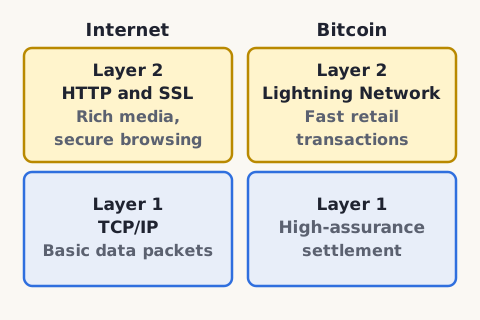
Compare the internet's scaling architecture with Bitcoin's layered architecture
TCP/IP (Layer 1) routes basic data packets, while HTTP and SSL (Layer 2) handle rich media and secure browsing. Bitcoin Layer 1 optimizes for high-assurance settlement, like a digital Fedwire, while the Lightning Network (Layer 2) handles fast, high-volume retail transactions.
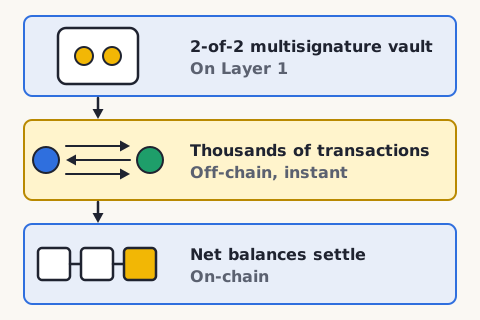
Lightning Payment Channels
Bidirectional 2-of-2 multisignature vaults on Layer 1 that allow counterparties to exchange thousands of off-chain transactions instantly, settling net balances on-chain.
Compare Lightning Network settlement finality with traditional payment networks
Credit card networks (Visa/Mastercard) give merchants only a provisional promise of payment, which stays open to chargebacks and disputes for 30 to 90 days. Lightning Network payments settle with irrevocable cryptographic finality within milliseconds.
Lightning Channel Capacity
The total liquidity locked in a payment channel path, determining the maximum payment size that can be routed and requiring multi-path sharding for larger transfers.
Statechains and Ark Protocols
Alternative second-layer scaling architectures that enable the non-custodial transfer of individual UTXO ownership off-chain without on-chain blockchain footprint.
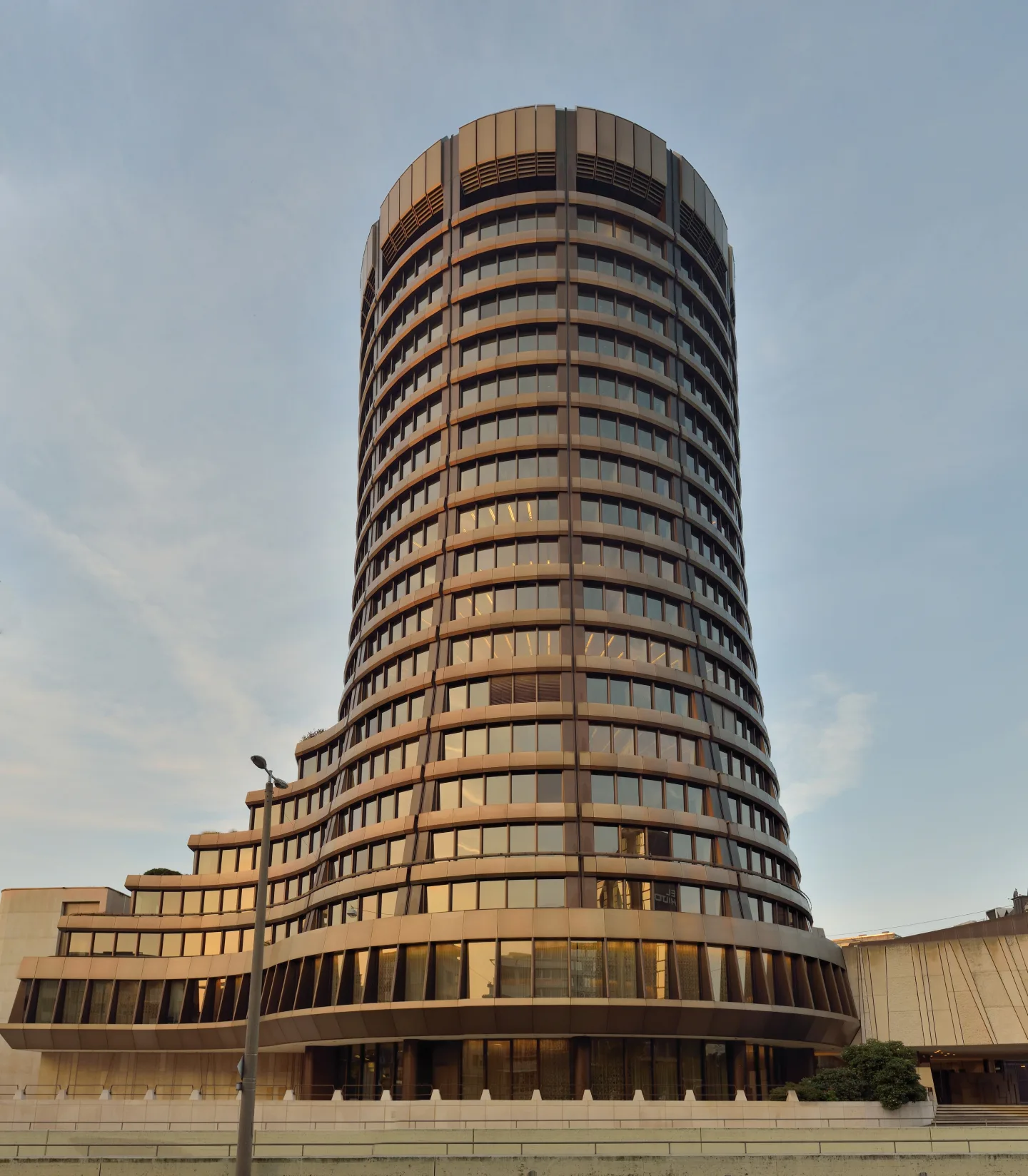
Agustín Carstens' BIS Statement (2020)
BIS General Manager's declaration that CBDCs grant central banks absolute technological control and direct enforcement over who can use currency.
Contrast Western speculative crypto trading with grassroots asset adoption
In the West, tokens are often treated as volatile speculative bets. In countries like Lebanon, Nigeria, and Argentina, citizens facing currency collapse adopt Bitcoin and dollar stablecoins as a survival lifeline to protect savings and receive remittances.
El Salvador Bitcoin Law (Sept 7, 2021)
Historic legislation making Bitcoin legal tender alongside the US dollar, deploying the Chivo wallet and Lightning payment terminals nationwide to bank the unbanked.
Financial Repression
Stealth policy capping interest rates below the rate of inflation while forcing institutions to hold sovereign bonds, quietly liquidating national debt at the expense of savers.
Contrast the two divergent monetary futures confronting human civilization
Centralized CBDCs risk building a financial panopticon of programmable government control over money. Open, decentralized protocols like Bitcoin preserve individual property rights, privacy, and economic freedom.
Matched pairs
Each item on the left goes with the one on the right.
- Watchtowers
- Automated services monitoring the blockchain to punish cheating counterparties when users are offline.
- Layered Scaling Synthesis
- Preserves absolute decentralization at L1 while scaling transaction velocity at L2.
- Thiers' Law
- During severe currency collapses, good money drives out bad money as merchants reject paper.
- Fixing the Money
- Restoring sound, neutral, unforgeable money is the foundational endeavor for global human flourishing.
Step by step
Trace the step-by-step cross-border remittance flow using Lightning Network rails (e.g. Strike).
- A migrant worker in New York deposits US dollars from their local checking account.
- The remittance platform automatically converts dollars into Bitcoin satoshis.
- The payment routes across the global Lightning Network in under 500 milliseconds for sub-cent fees.
- The receiving app converts satoshis into Mexican pesos and deposits them into family bank accounts.
Self-test
Answer each question from memory, then check your work against the answer key.
1. The Blockchain Trilemma says a blockchain can maximize at most two of which three properties?
- ADecentralization, security, scalability
- BLiquidity, security, cost
- CDivisibility, fungibility, saleability
- DSpeed, privacy, custody
2. Who articulated the Blockchain Trilemma?
- ASatoshi Nakamoto
- BVitalik Buterin
- CNick Szabo
- DHal Finney
3. What do Hash Time-Locked Contracts (HTLCs) enable on the Lightning Network?
- A2-of-2 multisig channel funding
- BMulti-path payment sharding
- COnion-encrypted routing privacy
- DTrustless multi-hop routing
4. Lightning's routing privacy uses onion encryption modeled after which system?
- AHTTPS/SSL
- BIPsec protocol
- CTor network
- DVPN tunneling
5. Unlike PayPal or Venmo, what makes the Lightning Network non-custodial?
- AAnyone can run a routing node freely
- BGovernment controls network access
- CA company holds all user funds
- DKYC verification required to transact
6. What distinguishes a Central Bank Digital Currency (CBDC) from a commercial bank deposit?
- ADecentralized, permissionless protocol
- BPrivately issued stablecoin
- CDirect liability of the central bank
- DDirect liability of commercial banks
7. By eliminating physical cash, a cashless CBDC regime lets central banks impose what directly on savings?
- APositive real interest rates
- BNegative nominal interest rates
- CFixed currency exchange pegs
- DMandatory capital gains taxes
8. About how many adults worldwide remain completely unbanked, per World Bank data?
- A800 million
- B2.8 billion
- C500 million
- D1.4 billion
9. According to BIS General Manager Agustin Carstens' 2020 statement, what do CBDCs grant central banks?
- AControl over the rules governing its use, but no technology to enforce them
- BVisibility of aggregate spending only, with no control over how it is used
- CAbsolute control over the rules governing its use, and the technology to enforce them
- DControl limited to interbank settlement, with none over retail use
10. Which term describes the terminal fiat-regime phase where central bank policy is subjugated to monetizing government deficits?
- ACurrency Debasement
- BQuantitative Easing
- CFinancial Repression
- DFiscal Dominance
11. Ray Dalio's Long-Term Debt Cycle describes a debt super-cycle lasting roughly how many years before a monetary reset?
- A80 to 100 years
- B10 to 20 years
- C40 to 60 years
- D150 to 200 years
12. In Ray Dalio's Long-Term Debt Cycle, what ultimately happens once accumulating debt exhausts central bank rate cuts?
- AA prolonged period of austerity and permanent spending cuts
- BMassive sovereign debt monetization and a monetary reset
- CGovernments repay the debt from budget surpluses within a few years
- DRapid economic growth outpaces the debt, so no restructuring or devaluation is needed
13. What term names the terminal phase where government debt is so immense that central bank policy must monetize deficits at suppressed rates?
- ACurrency Debasement
- BFinancial Repression
- CQuantitative Easing
- DFiscal Dominance
14. Which stealth policy caps interest rates below inflation while forcing institutions to hold sovereign bonds?
- AThiers' Law
- BFinancial Repression
- CProgrammable Money
- DFiscal Dominance
Go deeper
- ReadBroken Money by Lyn Alden · on Amazon ↗
- StudyBroken Money: Why Our Financial System Is Failing Us & How We Can Make It Better in the FlashFeed app
These are affiliate links: if you buy a book through one, FlashFeed may earn a small commission at no extra cost to you. The commission helps pay for FlashFeed's servers.
As an Amazon Associate we earn from qualifying purchases.
Answer key
- 1. A Decentralization, security, scalabilityVitalik Buterin's Trilemma names decentralization, security, and scalability. Divisibility/fungibility/saleability are properties of money itself, not the blockchain engineering tradeoff.
- 2. B Vitalik ButerinThe lesson credits Vitalik Buterin with articulating the Trilemma. Satoshi, Szabo, and Finney are other foundational crypto figures but not the source of this framing.
- 3. D Trustless multi-hop routingHTLCs let payments route safely across intermediary nodes without trusting them. Onion encryption, multisig funding, and payment sharding are separate Lightning mechanisms.
- 4. C Tor networkLightning uses onion encryption similar to Tor, so intermediate nodes only know the previous and next hop. VPNs, SSL, and IPsec are unrelated encryption schemes here.
- 5. A Anyone can run a routing node freelyLightning is open-source and permissionless, so anyone can run a node without corporate approval. The other options describe custodial or restricted fintech-style control, the opposite of Lightning.
- 6. C Direct liability of the central bankA CBDC is a direct digital liability of the central bank itself, not a commercial bank. It is also centralized, unlike a decentralized protocol or a privately issued stablecoin.
- 7. B Negative nominal interest ratesWithout cash as an escape valve, central banks can push deeply negative nominal interest rates on savings to force consumption. Exchange pegs and tax policy are separate tools.
- 8. D 1.4 billionThe lesson cites World Bank data showing over 1.4 billion adults are completely unbanked, excluded from the traditional financial system.
- 9. C Absolute control over the rules governing its use, and the technology to enforce themIn an October 2020 IMF panel, Carstens said that with a CBDC the central bank would have absolute control over the rules and regulations determining its use, plus the technology to enforce them. He did not limit that control to aggregate data or interbank settlement, nor say it lacked enforcement.
- 10. D Fiscal DominanceFiscal Dominance is the terminal phase where debt monetization overrides central bank independence. Financial Repression is a related but distinct policy of capping rates below inflation.
- 11. A 80 to 100 yearsDalio's model spans roughly 80 to 100 years, ending in sovereign debt monetization and a monetary reset.
- 12. B Massive sovereign debt monetization and a monetary resetThe cycle culminates in monetizing runaway debt and resetting the monetary system once rate cuts are exhausted.
- 13. D Fiscal DominanceFiscal Dominance is the terminal phase where debt subjugates central bank policy to monetizing runaway deficits.
- 14. B Financial RepressionFinancial Repression quietly liquidates national debt at savers' expense by capping rates below inflation.
Sources
- Broken Money: Why Our Financial System Is Failing Us & How We Can Make It Better — Lyn Alden
- History of the United States public debt — Wikipedia — en.wikipedia.org/wiki/History_of_the_United_States_public_debt
Image credits
- Compare the internet's scaling architecture with Bitcoin's layered architecture: FlashFeed original diagram · CC-BY-4.0
- Lightning Payment Channels: FlashFeed original diagram · CC-BY-4.0
- Agustín Carstens' BIS Statement (2020): Wikimedia Commons · Taxiarchos228 · FAL — commons.wikimedia.org/wiki/File:Basel_-_Bank_f%C3%BCr_internationalen_Zahlungsausgleich1.jpg
