
Broken Money: Why Our Financial System Is Failing Us & How We Can Make It Better study guide · Lesson 6 of 7
Lesson 6: Digital Scarcity and the Bitcoin Architecture
6.1 Proof-of-Work and Thermodynamic Truth · 6.2 Consensus, Scarcity, and Node Sovereignty
Unofficial study guide for Broken Money: Why Our Financial System is Failing Us and How We Can Make it Better by Lyn Alden. FlashFeed is not affiliated with the author or publisher.
This is the lesson's study guide from the FlashFeed app, plus its key facts and a self-test.
What you'll be able to do
- Explain how Bitcoin's proof-of-work secures a fixed, unconfiscatable digital scarcity by anchoring the ledger to energy cost.
- Explain Bitcoin's 21 million cap, satoshi divisibility and UTXO model, why full nodes won the Blocksize War, and how the network effect locks in its lead.
Monograph Section: Lesson 6 of Broken Money: Why Our Financial System Is Failing Us and How We Can Make It Better by Lyn Alden.
Executive Overview
Analyzes how Bitcoin resolves the historical 180-year 'speed gap' by combining the hardness and unforgeable costliness of a physical bearer asset with the near-instantaneous velocity of telecommunications. Explores Satoshi Nakamoto's breakthrough in solving the double-spend problem, Proof-of-Work as a thermodynamic anchor to physical reality, the algorithmic difficulty adjustment, the 21 million absolute scarcity limit, Proof-of-Work versus Proof-of-Stake oligarchy, and decentralized full node sovereignty.
Proof-of-Work and Thermodynamic Truth
Conceptual Foundations: Digital Bearer Asset, Resolving the Speed Gap, Double-Spend Problem, Proof-of-Work (PoW)
Core Insight: Bitcoin fundamentally resolves the historical 180-year 'speed gap' by combining the absolute scarcity and bearer settlement of gold with the speed-of-light velocity of the internet.
Throughout history, humanity had to choose between slow physical gold (high hardness, zero speed) or centralized bank ledger credit (high speed, zero hardness). Bitcoin provides both: hard, unforgeable money that travels digitally across continents in minutes.
Core Insight: Satoshi Nakamoto's revolutionary innovation in the 2008 Bitcoin whitepaper was solving the computer science 'double-spend problem' without requiring a trusted central server.
If a digital token could be spent twice, it could not function as money. Previous digital cash attempts (DigiCash, E-Gold) relied on a central company to verify transactions, making them vulnerable to single points of failure, government shutdown, and internal corruption.
Core Insight: Proof-of-Work (PoW) anchors the digital ledger to the physical laws of thermodynamics by requiring miners to expend massive computational electricity to validate and timestamp transactions.
In a digital world where code can be edited freely, Proof-of-Work requires irreversible real-world energy expenditure to generate blocks. Rewriting transaction history requires re-expending that exact immense physical energy, securing the ledger against fraud.
Core Insight: The Difficulty Adjustment algorithm, executing automatically every 2,016 blocks (approximately every two weeks), dynamically calibrates mining difficulty to maintain a steady 10-minute average block creation interval regardless of total network computational power.
With physical gold, higher prices incentivize more mining, increasing supply flow. With Bitcoin, if millions of new supercomputers begin mining, the difficulty automatically ratchets upward, ensuring that new supply issuance remains perfectly inelastic and fixed to the mathematical schedule.
Core Insight: The SHA-256 cryptographic hash function is a one-way mathematical operation that compresses arbitrary digital data into a unique 256-bit hexadecimal string that is computationally irreversible.
While finding a valid hash requires massive energetic brute force, verifying that a discovered hash is valid takes a fraction of a millisecond for any consumer laptop, creating an asymmetrical architecture where validation is nearly free while block creation is energetically costly.
Core Insight: Proof-of-Work mining utilizes stranded, curtailed, and non-rival energy sources—such as flared methane gas, remote hydro, geothermal, and solar curtailment—monetizing wasted electrons that cannot reach urban power grids.
Unlike factories or aluminum smelters that require roads and urban labor, Bitcoin miners can be installed in shipping containers directly at remote wellheads or dams, transforming stranded physical energy into globally liquid financial value.
Core Insight: Proof-of-Stake (PoS) consensus replaces physical energy expenditure with financial capital staking, structurally recreating the Cantillon Effect and oligarchic governance of the traditional fiat banking system.
In PoS, the wealthiest holders validate blocks without incurring real-world operating expenses, allowing them to perpetually compound their ownership share and exercise voting control over the network rules without physical market competition.
Core Insight: In Proof-of-Work, a miner who stops investing in electricity and upgrading hardware immediately loses their hash rate share and influence over the network.
Unlike PoS or fiat banking (where capital earns passive risk-free returns without work), PoW forces miners into intense, continuous physical competition with rising energy efficiency, preventing permanent entrenched monopolies.
Core Insight: The Blocksize War (2015-2017) demonstrated that economic full nodes run by ordinary users, rather than miners or corporate giants, maintain sovereign control over the consensus rules of the Bitcoin protocol.
Corporate mining monopolies and venture capital firms signed the New York Agreement (SegWit2x) to expand block sizes, which would have increased hardware requirements and centralized node operation. Ordinary users running $50 Raspberry Pi nodes refused to validate the corporate blocks, preserving decentralization.
Core Insight: A full node is a computer running open-source software that independently downloads, verifies, and validates every single block and transaction since the genesis block against the protocol's consensus rules without trusting any third party.
Unlike light mobile wallets that query centralized servers, an independent full node enforces the 21 million supply limit, verifies digital signatures, and rejects invalid blocks, ensuring that miners cannot secretly debase the currency or censor valid transactions.
Core Insight: Hal Finney, a legendary cryptographic pioneer and the recipient of the first Bitcoin transaction from Satoshi Nakamoto in January 2009, envisioned Bitcoin operating as a high-powered reserve currency for layered banks.
Finney recognized early that a decentralized base blockchain cannot process billions of daily retail coffee transactions without compromising node decentralization, anticipating the layered scaling architecture of the Lightning Network.
Core Insight: A 51% attack on Bitcoin becomes exponentially more expensive over time as total global hash rate and energy consumption expand across international borders.
Even if an attacker momentarily amassed 51% of hash rate, they could not create coins out of thin air or steal private keys—they could only attempt to double-spend their own recent transactions. The network's full nodes would instantly reject any invalid block that violated consensus rules.
Core Insight: Bitcoin's Genesis Block was mined by Satoshi Nakamoto on January 3, 2009, embedding the famous text: 'The Times 03/Jan/2009 Chancellor on brink of second bailout for banks'.
By embedding this headline, Nakamoto established the historical context of Bitcoin's creation during the Great Financial Crisis, demonstrating that Bitcoin was engineered specifically to replace corruptible fiat bank ledgers with algorithmic scarcity.
Core Insight: The energy expenditure of Bitcoin mining is not waste, but the indispensable cost of manufacturing trust, absolute scarcity, and censorship resistance in a digital medium.
Traditional fiat currencies require military forces, central bank headquarters, courts, and regulatory bureaucracies to enforce their ledgers. Bitcoin replaces these institutional apparatuses with pure thermodynamic energy and cryptographic mathematics.
Core Insight: By anchoring a digital ledger to thermodynamic reality, Bitcoin created the first completely non-sovereign, unconfiscatable, mathematically fixed bearer asset in human history.
Anyone who controls their own cryptographic private keys can transport billions of dollars in wealth anywhere in the world in their memory via a 12-word seed phrase, completely immune to physical seizure, border controls, or sovereign debasement.
Consensus, Scarcity, and Node Sovereignty
Conceptual Foundations: 21 Million Hard Supply Cap, Halving Epochs Schedule, UTXO Transaction Model, Public-Key Asymmetric Cryptography
Core Insight: Bitcoin possesses an absolute mathematical supply limit of 21,000,000 bitcoins, coded into its open-source protocol and enforced by thousands of independent validating full nodes worldwide.
Because every full node independently rejects any block containing more block reward subsidies than permitted by code, no mining pool, government, or billionaire can increase the 21 million cap without being rejected by the network.
Core Insight: The programmatic halving occurs every 210,000 blocks (roughly every four years), cutting the new block issuance subsidy in half until terminal issuance ceases around the year 2140.
With each halving, Bitcoin's annual supply inflation rate drops in half. Following the 2024 halving, Bitcoin's annual inflation rate fell to ~0.8%, making it mathematically the hardest monetary asset ever created, with a stock-to-flow ratio surpassing gold.
Core Insight: Bitcoin operates on the Unspent Transaction Output (UTXO) accounting model, where transactions consume discrete cryptographic outputs from previous transactions rather than adjusting account balances.
The UTXO model resembles physical cash transactions: if you have a 20 bill and buy an 8 book, you surrender the entire 20 bill (input) and receive an 8 payment to the bookstore and a $12 change output back to yourself.
Core Insight: Asymmetric public-key cryptography (specifically the ECDSA secp256k1 elliptic curve) allows users to generate public receiving addresses from private keys without ever exposing the private spending key.
You can publish your public address freely to receive funds from anyone. However, without your private cryptographic key, it is mathematically impossible for an attacker or sovereign government to reverse-engineer the private key or move your funds.
Core Insight: BIP-39 (Bitcoin Improvement Proposal 39), established in 2013, introduced 12-to-24-word human-readable mnemonic seed phrases to backup and restore cryptographic private master keys.
A user does not need to store files or USB drives; memorizing 12 words allows a refugee fleeing war or authoritarian persecution to cross borders with their entire life savings intact in their mind, recovering their funds on any computer worldwide.
Core Insight: The fundamental maxim of sovereign digital self-custody is 'Not your keys, not your coins,' highlighting the critical distinction between holding bearer assets and holding claims on a centralized exchange.
When an investor leaves Bitcoin on an exchange (like FTX, Celsius, or Mt. Gox), they do not hold Bitcoin; they hold an unsecured account balance on a private company's internal database, exposing them to the exact custodial failures of the traditional banking system.
Core Insight: Censorship resistance is the architectural guarantee that any transaction accompanied by a valid cryptographic signature and sufficient transaction fee will be processed by the network regardless of the sender, recipient, or purpose.
In traditional banking, governments can instruct SWIFT, Visa, or banks to freeze political dissidents' accounts (as seen in the Canadian truckers' protest in 2022). Bitcoin treats all valid transactions equally, preventing state censorship.
Core Insight: Bitcoin is divisible down to eight decimal places, with the smallest unit called a 'Satoshi' (sat), representing 0.00000001 BTC, providing 2.1 quadrillion total transactional units.
Divisibility ensures that supply scarcity does not create unit friction. As purchasing power appreciates, prices of goods in satoshis naturally decline, facilitating retail commerce without altering the base supply cap.
Core Insight: Multisignature (multisig) architectures require M-of-N distinct cryptographic private keys to authorize a single transaction, eliminating single points of failure for corporate treasuries and institutional custody.
A company can hold one key in New York, one in London, and one with a third-party security partner. To spend funds, any two keys must sign, ensuring that the theft or loss of a single key cannot compromise corporate assets.
Core Insight: Hardware wallets (cold storage devices) isolate cryptographic private keys on secure offline microcontrollers, signing transactions locally without ever exposing keys to internet-connected computers.
Even if your laptop or phone is infected with malicious spyware, connecting a hardware wallet (like Coldcard, Trezor, or Ledger) is safe because the device only outputs the signed transaction data, never the raw private key.
Core Insight: Bitcoin's backward-compatible upgrades are implemented via 'soft forks', which tighten existing protocol rules without fracturing the network or forcing old nodes to upgrade immediately.
Major upgrades like Segregated Witness (SegWit in 2017) and Taproot (in 2021) were deployed as soft forks. Nodes running 2013 software continue to recognize valid blocks, protecting the network against contentious chain splits.
Core Insight: The mempool (memory pool) is the decentralized holding area where unconfirmed transactions reside on individual full nodes while awaiting selection and inclusion into a block by miners.
Unlike fiat payment rails where fees are set administratively by credit card networks, Bitcoin block space fees fluctuate dynamically based on market supply and demand for urgent global settlement.
Core Insight: Bitcoin's fixed supply schedule represents the complete inversion of fiat central banking: whereas fiat supplies expand infinitely under discretionary human committees, Bitcoin's supply is determined by unalterable mathematics.
For the first time in history, market participants do not need to guess what the Federal Reserve will do next month or analyze central bank speeches. The future supply curve of Bitcoin is known with absolute certainty for the next 100+ years.
Core Insight: In open-source software, network effects create immense structural inertia around the dominant monetary protocol, making it nearly impossible for newer copycat cryptocurrencies to replace Bitcoin as the premier monetary base.
Just as the internet converged on TCP/IP and HTTP as base communication standards, the global financial system converges on a single Schelling point for hard digital money. Forks and altcoins lack the unforgeable hash rate security and decentralized node distribution.
Core Insight: Bitcoin provides an unalterable, globally neutral monetary baseline that restores individual property rights and financial privacy in an increasingly surveillance-oriented global economy.
Regardless of race, religion, nationality, or political affiliation, any person with a basic smartphone can participate in global commerce, save value across time, and protect their family's wealth from state confiscation.
Key terms
- Double-Spend Problem
- The computer science challenge of ensuring a digital asset cannot be duplicated and spent more than once without relying on a trusted central authority.
- Bitcoin Full Node
- A computer running open-source software that independently downloads, validates, and enforces every consensus rule across all blocks and transactions since the genesis block.
- UTXO (Unspent Transaction Output)
- Bitcoin's accounting model where transactions consume discrete cryptographic outputs from previous transactions as inputs and produce new unspent outputs.
- Censorship Resistance
- The protocol guarantee that any transaction accompanied by a valid cryptographic signature and sufficient fee is processed regardless of identity or purpose.
- The Mempool (Memory Pool)
- The dynamic, decentralized holding area where unconfirmed transactions reside on validating nodes while awaiting block inclusion based on fee priority.
Key facts
Thermodynamic Ledger Bridge
Proof-of-Work consensus mechanism requiring miners to burn real-world electricity to validate blocks, anchoring digital ledger history to physical physical energy laws.
Stranded Energy Monetization
The economic deployment of location-agnostic Bitcoin mining rigs to monetize flared oilfield methane, remote hydro, and curtailed renewable power that cannot reach urban grids.
Compare the governance and incentives of Proof-of-Work versus Proof-of-Stake.
Proof-of-Work forces miners to keep spending real-world energy and hardware to keep validating blocks — stop mining and your influence drops to zero. Proof-of-Stake instead grants validation power and yield based on existing coin holdings, letting the largest holders compound their share without physical competition, which critics say recreates the entrenched, oligarchic dynamics of fiat banking.
Genesis Block Timestamp (Jan 3, 2009)
The headline 'Chancellor on brink of second bailout for banks' embedded into Bitcoin's first block, establishing it as an explicit technological alternative to fiat banking.
BIP-39 Mnemonic Seed Phrases (2013)
Standard encoding complex 256-bit cryptographic keys into 12-to-24 common English words, allowing individuals to carry fortunes in human memory across borders.
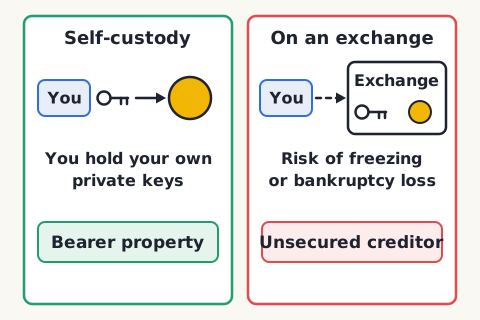
Contrast sovereign self-custody with holding Bitcoin on a centralized exchange.
Holding your own private keys makes bitcoin your outright bearer property. Leaving it on a custodial exchange (like FTX or Celsius) instead makes you an unsecured creditor of that company, exposed to freezing, rehypothecation, and loss if it goes bankrupt.
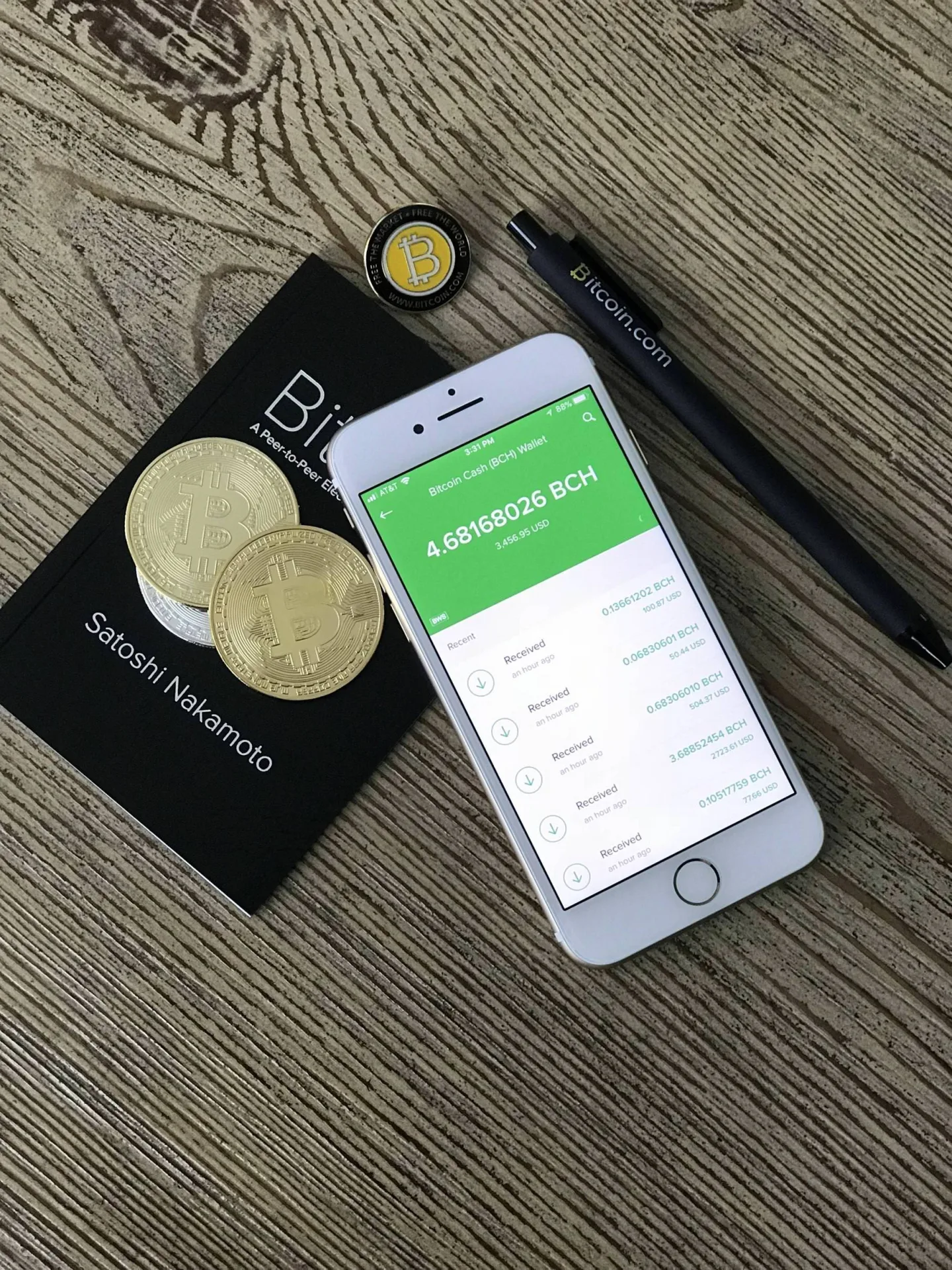
Hardware Wallet Air-Gap Security
Dedicated microcontroller devices that store private keys completely offline, signing transactions internally to protect against malware and remote hacking.
Matched pairs
Each item on the left goes with the one on the right.
- Proof-of-Work Miner
- Must continuously burn power; turning off machines immediately reduces network influence to zero.
- Bitcoin Security Cost
- Thermodynamic energy expenditure securing a $1+ trillion property rights network without armies.
- Soft Fork (SegWit/Taproot)
- Tightens rules backward-compatibly, allowing older validating nodes to recognize valid blocks.
- Neutral Monetary Baseline
- Restores individual property rights, financial privacy, and economic freedom in a digital world.
Step by step
Trace the programmatic Bitcoin halving progression across its first five four-year epochs.
- Genesis Epoch (2009): Block reward subsidy is set at 50.0 BTC per block.
- First Halving (2012 at block 210,000): Reward drops to 25.0 BTC per block.
- Second & Third Halvings (2016 & 2020): Reward drops to 12.5 BTC and then 6.25 BTC.
- Fourth Halving (2024 at block 840,000): Reward drops to 3.125 BTC, pushing stock-to-flow above gold.
Self-test
Answer each question from memory, then check your work against the answer key.
1. Bitcoin closes the historical 'speed gap' by combining gold's hardness with what?
- AInternet speed
- BBank-wire speed
- CTelegraph speed
- DCourier speed
2. What is the 'double-spend problem' that Satoshi's whitepaper solved without a central server?
- ALeaking a private key twice
- BSpending a digital asset twice
- CReusing a wallet address twice
- DMining a block twice
3. How often does Bitcoin's Difficulty Adjustment algorithm recalibrate mining difficulty?
- A6,000 blocks
- B144 blocks
- C2,016 blocks
- D500 blocks
4. Who received the first Bitcoin transaction from Satoshi Nakamoto?
- AWei Dai
- BDavid Chaum
- CNick Szabo
- DHal Finney
5. Which of these is NOT required to maintain influence under Proof-of-Work?
- AHardware upgrades
- BContinuous electricity spending
- CCompetitive mining effort
- DExisting coin holdings
6. What is Bitcoin's absolute mathematical supply limit?
- A100 million
- B42 million
- C21 million
- D84 million
7. What does Bitcoin's UTXO accounting model track?
- ASmart contract states
- BUnspent transaction outputs
- CValidator stake weights
- DTotal account balances
8. What is the name for Bitcoin's smallest sub-unit, worth 1/100,000,000 of a coin?
- ASatoshi
- BWei
- CBit
- DEther
9. During the 2015-2017 Blocksize War, who preserved Bitcoin's decentralization by rejecting larger blocks?
- AVenture capital firms
- BUsers running full nodes
- CCorporate mining pools
- DCentral bank regulators
10. What term describes Bitcoin's liquidity, brand recognition, and hash rate compounding into an unmatched advantage?
- AFirst-mover advantage
- BCantillon Effect
- CGresham's Law
- DNetwork effect
Go deeper
- ReadBroken Money by Lyn Alden · on Amazon ↗
- StudyBroken Money: Why Our Financial System Is Failing Us & How We Can Make It Better in the FlashFeed app
These are affiliate links: if you buy a book through one, FlashFeed may earn a small commission at no extra cost to you. The commission helps pay for FlashFeed's servers.
As an Amazon Associate we earn from qualifying purchases.
Answer key
- 1. A Internet speedBitcoin merges gold's unforgeable scarcity with telecommunications-speed transfer, closing the 180-year gap between hard money and fast money.
- 2. B Spending a digital asset twiceThe double-spend problem is a digital token being copied and spent more than once; Bitcoin solves it via decentralized consensus instead of a trusted company.
- 3. C 2,016 blocksThe Difficulty Adjustment runs every 2,016 blocks (about two weeks) to keep the average block time near 10 minutes regardless of total mining power.
- 4. D Hal FinneyCryptographic pioneer Hal Finney received the first Bitcoin transaction and, in 2010, predicted Bitcoin would scale as a layered reserve asset.
- 5. D Existing coin holdingsPoW influence depends on ongoing energy and hardware competition, not on existing coin holdings -- that basis belongs to Proof-of-Stake instead.
- 6. C 21 millionBitcoin's protocol caps total issuance at 21 million coins, enforced by independent validating full nodes worldwide.
- 7. B Unspent transaction outputsUTXO stands for Unspent Transaction Output -- Bitcoin consumes prior outputs as inputs and creates new unspent outputs, unlike an account-balance model.
- 8. A SatoshiEach bitcoin divides into 100,000,000 satoshis (sats), letting the network price micro-purchases regardless of the aggregate coin value.
- 9. B Users running full nodesOrdinary users running inexpensive full nodes refused to validate the corporate-backed SegWit2x blocks, keeping consensus power decentralized.
- 10. D Network effectThis compounding advantage is called the network effect, which establishes Bitcoin as the global Schelling point for digital money.
Sources
- Broken Money: Why Our Financial System Is Failing Us & How We Can Make It Better — Lyn Alden
Image credits
- Contrast sovereign self-custody with holding Bitcoin on a centralized exchange.: FlashFeed original diagram · CC-BY-4.0
- Hardware Wallet Air-Gap Security: Wikimedia Commons · BitcoinXio · CC0 — commons.wikimedia.org/wiki/File:Bitcoin_Cash_wallet_and_whitepaper_3.jpg
