
Buddhism: A Deep Study study guide · Lesson 6 of 13
Sacred Texts
The Canon and Key Texts · What Is It? — Sacred Texts
This is the lesson's study guide from the FlashFeed app, plus its key facts and a self-test.
What you'll be able to do
- Identify the three baskets of the Tripitaka (Vinaya, Sutta, Abhidhamma) and their contents.
- Recognize the role of oral transmission and Ananda in preserving the Buddha's discourses.
- Recognize the Heart, Diamond, and Lotus Sutras as Mahayana texts outside the Tripitaka, linked to Nichiren and Huineng.
- Recognize the Dhammapada and the Platform Sutra and their significance.
The Canon and Key Texts
The study of sacred texts in Buddhism reveals the foundational principles and teachings that guide practitioners. Understanding the Tripitaka and key texts enhances comprehension of Theravada Buddhism and its practices.
The Tripitaka — Three Baskets
The Tripitaka, or "Three Baskets," is crucial for Theravada Buddhism, serving as its primary scripture. The Vinaya Pitaka outlines the monastic discipline essential for maintaining community order and ethical conduct among monks and nuns. The Sutta Pitaka comprises the Buddha's discourses, which provide insights into his teachings and philosophy, organized into five Nikayas. The Abhidhamma Pitaka delves into the intricacies of Buddhist psychology and metaphysics, offering a systematic analysis of the mind and phenomena. Together, these texts form the bedrock of Buddhist thought and practice.
"Thus Have I Heard"
The phrase "Evam me sutam" or "Thus have I heard" emphasizes the importance of oral transmission in preserving the teachings of the Buddha. This tradition highlights the role of Ananda, who not only served as the Buddha's attendant but also played a pivotal role in the First Council, where the teachings were compiled. According to tradition, his memory and dedication ensured the accuracy and continuity of the Buddha's discourses, which remain central to the practice and understanding of Buddhism today.
The Dhammapada
The Dhammapada stands out as a key text in Theravada Buddhism, celebrated for its profound ethical teachings. With 423 verses across 26 chapters, it distills the essence of the Buddha's wisdom into accessible aphorisms. Its famous opening underscores the significance of the mind in shaping actions and experiences, asserting that a serene mind leads to happiness. This text serves as a practical guide for ethical living and spiritual development, resonating deeply with practitioners and scholars alike, and it is often quoted and referenced in Buddhist literature and teachings.
In addition to these texts, the quizzes may also touch on significant Mahayana texts such as the Heart Sutra, Diamond Sutra, and Lotus Sutra, which, while not part of the Pali Tripitaka (the Theravada canon), offer important insights into different Buddhist philosophies and practices.
Key terms
- Vinaya Pitaka
- The 'Basket of Discipline' — the rules governing monastic life (over 200 for monks), with accounts of how each rule arose.
- Sutta Pitaka
- The 'Basket of Discourses' — the Buddha's teachings, organized into five Nikayas; includes the Dhammapada and the Fire Sermon.
- Abhidhamma Pitaka
- The 'Basket of Higher Teaching' — systematic psychology and philosophy cataloging mental states and the structure of experience.
Key concepts
The Tripitaka
- The foundational scripture collection of Theravada Buddhism, preserved in the Pali language.
- Its name means 'Three Baskets.'
- It comprises the Vinaya (monastic rules), the Suttas (discourses), and the Abhidhamma (systematic psychology).
The Dhammapada
- A beloved Theravada text of 423 short verses in 26 chapters.
- It covers ethics, the mind, the path, and liberation in memorable lines.
- Its famous opening declares that the mind is the forerunner of all actions.
The Platform Sutra
- A Chan Buddhist text recording the life and teachings of the Sixth Patriarch.
- It champions sudden enlightenment over gradual practice.
- It is the only Chinese composition traditionally honored with the title 'sutra.'
Key facts
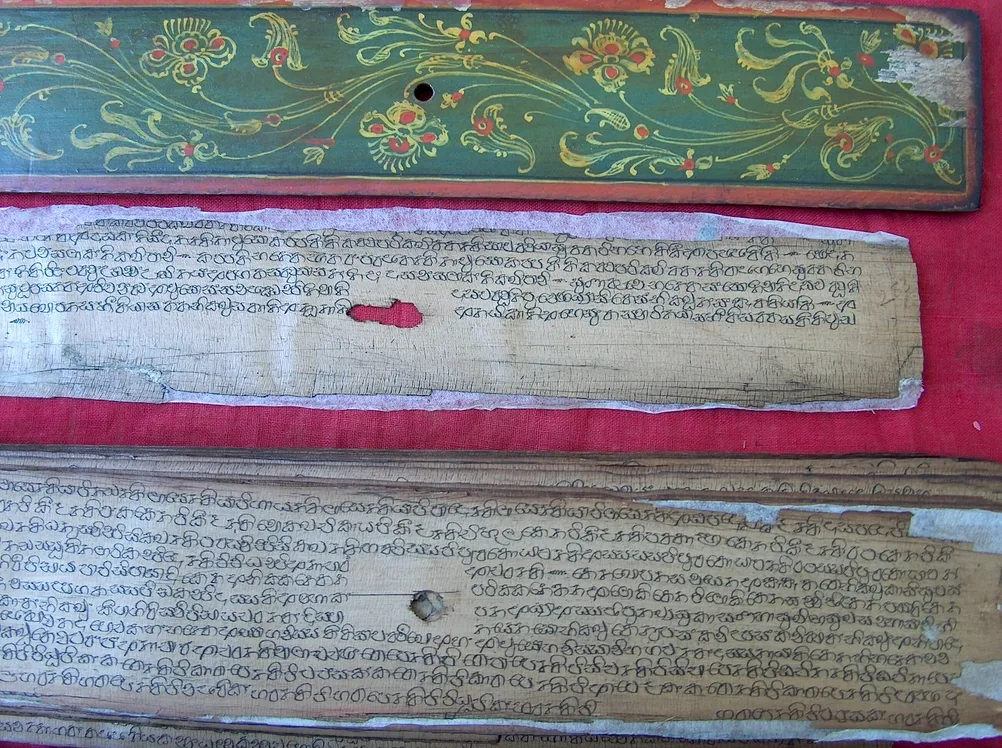
The Tripitaka — Three Baskets
The foundational canon of Theravada Buddhism, preserved in Pali and written down in Sri Lanka around 80 BCE after centuries of oral transmission. Its name means "Three Baskets": the Vinaya Pitaka (monastic rules), the Sutta Pitaka (the Buddha's discourses, in five Nikayas), and the Abhidhamma Pitaka (systematic Buddhist psychology).
"Thus Have I Heard"
Each discourse traditionally opens with "Evam me sutam" — "Thus have I heard" — signaling oral transmission from Ananda, the Buddha's attendant who was present for most of the teachings and recited them from memory at the First Council.
The Dhammapada
Arguably the most beloved Theravada text: 423 verses in 26 chapters on ethics, the mind, the path, and liberation. Its famous opening: "Mind is the forerunner of all actions. All deeds are led by mind, created by mind. If one speaks or acts with a serene mind, happiness follows, as a shadow that never departs."
The Vinaya Pitaka
The Vinaya Pitaka, the "Basket of Discipline," is one of the Tripitaka's three baskets. It sets out the rules governing monastic life, including over 200 rules for monks.
The Abhidhamma Pitaka
The Abhidhamma Pitaka, the "Basket of Higher Teaching," offers a systematic analysis of the mind, cataloging mental states and the structure of experience.
Self-test
Answer each question from memory, then check your work against the answer key.
1. Which basket of the Tripitaka contains the rules governing monastic life, with over 200 rules for monks?
- AAbhidhamma Pitaka
- BSutta Pitaka
- CVinaya Pitaka
- DDhammapada
2. The Sutta Pitaka organizes the Buddha's discourses into five collections known as what?
- ANikayas
- BPitakas
- CVinayas
- DCouncils
3. Which basket provides a systematic analysis of the mind, cataloging mental states and the structure of experience?
- AHeart Sutra
- BSutta Pitaka
- CVinaya Pitaka
- DAbhidhamma Pitaka
4. The name 'Tripitaka' translates literally to which phrase?
- AThree Jewels
- BThree Baskets
- CThree Vehicles
- DThree Marks
5. Which of the following is NOT one of the three baskets of the Tripitaka?
- AAbhidhamma Pitaka
- BSutta Pitaka
- CVinaya Pitaka
- DDhammapada Pitaka
6. The phrase 'Thus have I heard' (Evam me sutam) that opens each discourse points to which disciple, who recited the Buddha's teachings from memory at the First Council?
- AAnanda
- BUpali
- CSubhuti
- DMahakassapa
7. The Pali phrase 'Evam me sutam' that opens each discourse translates to which English phrase?
- AHomage to the Buddha
- BThus have I heard
- CGo forth for the welfare of all
- DForm is emptiness
8. The opening formula 'Thus have I heard' chiefly emphasizes which method of preserving the Buddha's teachings?
- AWritten commentary
- BSilent meditation
- COral transmission
- DRoyal decree
9. What was Ananda's relationship to the Buddha, enabling him to preserve the discourses?
- AA rival teacher he debated
- BA king who sponsored the canon
- CThe Sixth Patriarch of Chan
- DHis attendant, present for most of the teachings
10. According to tradition, which achievement is credited to Ananda?
- AKeeping the discourses intact
- BSpreading the Dharma by edicts
- CFounding the Madhyamaka school
- DBringing Chan Buddhism to China
11. Which kind of texts are the Heart, Diamond, and Lotus Sutras?
- AAbhidhamma Pitaka texts on Buddhist psychology
- BVinaya Pitaka texts governing monastic discipline
- CSignificant Mahayana texts outside the Pali Tripitaka
- DSutta Pitaka discourses among the five Nikayas
12. Which teacher, covered earlier, elevated the Lotus Sutra as the ultimate truth in Japanese Buddhism?
- AHuineng
- BNichiren
- CNagarjuna
- DBodhidharma
13. Hearing a line recited from which sutra reportedly awakened Huineng, the Sixth Patriarch of Chan?
- AHeart Sutra
- BDiamond Sutra
- CPlatform Sutra
- DLotus Sutra
14. Which of the following is NOT one of the three major Mahayana sutras?
- AHeart Sutra
- BDiamond Sutra
- CLotus Sutra
- DDhammapada
15. The Heart, Diamond, and Lotus Sutras belong to which of the three vehicles introduced earlier?
- AMahayana
- BVajrayana
- CTheravada
- DZen
16. Which text is the only Chinese composition traditionally honored with the title 'sutra,' recording the life and teachings of the Sixth Patriarch of Chan?
- AThe Diamond Sutra
- BThe Lankavatara Sutra
- CThe Platform Sutra
- DThe Lotus Sutra
17. How many verses does the Dhammapada contain?
- A84,000
- B250
- C108
- D423
18. The verses of the Dhammapada are arranged into how many chapters?
- A40
- B26
- C12
- D5
19. The famous opening of the Dhammapada names what as the 'forerunner of all actions'?
- ADesire
- BThe body
- CThe mind
- DKarma
20. The Dhammapada, prized for its ethical aphorisms, is a central scripture of which branch of Buddhism?
- ATheravada
- BVajrayana
- CNichiren
- DPure Land
Go deeper
Answer key
- 1. C Vinaya PitakaThe Vinaya Pitaka is the 'Basket of Discipline' — the monastic rules. The Sutta Pitaka holds discourses and the Abhidhamma Pitaka holds systematic philosophy; the Dhammapada is a text within the Sutta basket.
- 2. A NikayasThe Sutta Pitaka is arranged into five Nikayas. 'Pitaka' means basket (the three divisions of the whole canon), not the subdivisions of the discourses.
- 3. D Abhidhamma PitakaThe Abhidhamma Pitaka is the 'Basket of Higher Teaching' — Buddhist psychology and metaphysics. The Vinaya covers discipline and the Sutta covers discourses.
- 4. B Three Baskets'Tripitaka' means 'Three Baskets' — Vinaya, Sutta, and Abhidhamma. The Three Jewels (Buddha, Dharma, Sangha) and Three Marks of existence are separate concepts.
- 5. D Dhammapada PitakaThere is no 'Dhammapada Pitaka' — the Dhammapada is a text contained within the Sutta Pitaka. The three baskets are Vinaya, Sutta, and Abhidhamma.
- 6. A AnandaAnanda was the Buddha's attendant, present for most of the teachings. His memorized recitation at the First Council preserved the discourses, and the opening 'Thus have I heard' marks that oral transmission.
- 7. B Thus have I heard'Evam me sutam' means 'Thus have I heard,' signaling that the discourse was received and recited from memory rather than written by the Buddha himself.
- 8. C Oral transmissionThe phrase highlights oral transmission — teachings memorized and recited before being written down. It marks the teaching as heard and remembered, not authored.
- 9. D His attendant, present for most of the teachingsAnanda was the Buddha's personal attendant, present for most teachings, and recited them from memory. The Sixth Patriarch (Huineng) belongs to later Chan Buddhism.
- 10. A Keeping the discourses intactTradition credits Ananda's memory and dedication with keeping the Buddha's discourses accurate and continuous. The others belong to other figures: Nagarjuna founded Madhyamaka, Bodhidharma is traditionally credited with bringing Chan to China, and Ashoka spread the Dharma by edicts.
- 11. C Significant Mahayana texts outside the Pali TripitakaThe Heart, Diamond, and Lotus Sutras are significant Mahayana texts that, while not part of the Pali Tripitaka (the Theravada canon), offer insight into Buddhist philosophy and practice.
- 12. B NichirenAn earlier lesson explains that Nichiren revolutionized Japanese Buddhism by elevating the Lotus Sutra as the ultimate truth, chanting 'Nam Myoho Renge Kyo.'
- 13. B Diamond SutraAn earlier lesson recounts that Huineng's awakening came upon hearing a line recited from the Diamond Sutra, a pivotal moment in early Chan history.
- 14. D DhammapadaThe Dhammapada is a Theravada text within the Sutta Pitaka, not a Mahayana sutra. The Heart, Diamond, and Lotus Sutras are the three major Mahayana texts here.
- 15. A MahayanaTheravada, Mahayana, and Vajrayana are the three vehicles; the Heart, Diamond, and Lotus Sutras are Mahayana texts.
- 16. C The Platform SutraThe Platform Sutra recounts Huineng, the Sixth Patriarch of Chan, and champions sudden enlightenment. Though not spoken by the Buddha and Chinese-authored, it uniquely earned the honorific 'sutra.'
- 17. D 423The Dhammapada has 423 verses across 26 chapters. 108 and 84,000 are symbolic numbers in Buddhism but not the Dhammapada's verse count.
- 18. B 26The Dhammapada's verses are grouped into 26 chapters on ethics, the mind, the path, and liberation. Five is the number of Nikayas in the Sutta Pitaka, not chapters here.
- 19. C The mindThe Dhammapada opens: 'Mind is the forerunner of all actions.' It teaches that acting with a serene mind brings happiness — the mind, not desire or the body, leads all deeds.
- 20. A TheravadaThe Dhammapada is a beloved Theravada text within the Sutta Pitaka. Nichiren, Pure Land, and Vajrayana are later Mahayana/tantric traditions that do not treat it as a central scripture.
Sources
- Buddhist texts — Wikipedia — en.wikipedia.org/wiki/Buddhist_texts
Image credits
- The Tripitaka — Three Baskets: Wikimedia Commons · Bhikkhu Nyanatusita · Public domain — commons.wikimedia.org/wiki/File:The_Cullavagga_manuscript_of_the_Colombo_National_Museum.jpg
