
Buddhism: A Deep Study study guide · Lesson 11 of 13
Secular Buddhism & Modern Science
Evolution and the Mind · Meditation, the Brain, and MBSR · What Secular Buddhism Brackets
This is the lesson's study guide from the FlashFeed app, plus its key facts and a self-test.
What you'll be able to do
- Explain Wright's argument that feelings evolved as motivators and that craving (tanha) and no-self (anatta) align with evolutionary psychology.
- Identify the brain regions in meditation research — prefrontal cortex, insula, amygdala, default mode network — and how strong the evidence is.
- Explain MBSR: its founder Jon Kabat-Zinn, its 1979 start (named MBSR in the early 1990s), and its standard 8-week format.
- Explain what secular Buddhism brackets and Batchelor's agnostic, experimental approach.
Evolution and the Mind
This section explores the intersection of Buddhism and evolutionary psychology through Robert Wright's insights in Why Buddhism Is True. It reveals how ancient teachings align with modern understandings of the mind, highlighting the implications for well-being and self-awareness.
Why Buddhism Is True
In Why Buddhism Is True, Robert Wright presents a compelling argument that Buddhism's insights into the human mind resonate with contemporary findings in evolutionary psychology. By focusing on psychological aspects rather than metaphysical beliefs, Wright emphasizes that Buddhism's understanding of the mind's workings is remarkably aligned with scientific observations. This connection suggests that ancient practices can inform modern mental health strategies, making Buddhism relevant in today’s psychological discourse.
Evolution Doesn't Care If You're Happy
Wright asserts that natural selection prioritizes the propagation of genes over individual happiness. This perspective reveals that the human brain evolved to create feelings of craving and anxiety as survival mechanisms, not as pathways to contentment. The ancestral environment shaped our minds to seek out resources and reproduce, indicating that the pursuit of happiness is a byproduct rather than a primary goal of evolution. Understanding this can shift how we approach personal fulfillment and mental well-being.
Feelings Are Motivators, Not Truth-Tellers
The notion that feelings serve as motivational signals rather than accurate reflections of reality is crucial. Wright calls feelings the levers natural selection uses to get us to do its bidding (The Real News, 2017). If eating brought permanent gratification, he says in a 2017 NPR Fresh Air interview, we would feel blissed out and never eat again, so natural selection seems to have built animals to be recurringly dissatisfied. His example is the powdered-sugar donut: the first brings bliss, but later you feel intense desire and anticipate the pleasure, may barely notice the donut while eating it, and find the pleasure lasts less long, until you want another. He ties this to a monkey study he cites, in which dopamine, first released when fruit juice touched the tongue, came increasingly when a light signalled the juice and less with the juice itself. He says it is hard to tell what is going on in those monkeys' brains, that the result is consistent with ordinary experience, and that dopamine's exact role is still disputed. Psychologists call the pattern the hedonic treadmill. Buddhism's concept of tanha (craving) highlights this gap, emphasizing the importance of recognizing and managing cravings to foster a healthier relationship with desires and expectations.
The Mind Has No CEO
Wright's exploration of the mind as a collection of partially independent modules challenges the notion of a singular, controlling self. This aligns with the Buddhist teaching of anatta (no-self), which posits that the self is an illusion constructed by the brain. Understanding this can lead to greater mindfulness and self-awareness, as individuals learn to observe their thoughts and feelings without identifying with them. This shift creates a valuable space between one’s feelings and reactions, fostering emotional regulation and clarity. In interviews Wright describes how he gets that space: sitting with a feeling such as anxiety or pain instead of running from it, which he says can give "a kind of critical distance" from it (NPR's Fresh Air, 2017). In a Lion's Roar interview he recalls watching a feeling of stress and discomfort, without fearing or indulging it, and gaining a certain critical distance, after which it was no longer a problem.
Meditation, the Brain, and MBSR
Brain research is one of the places where secular Buddhism and modern science meet. This part sets out what that research reports about meditation, how strong the evidence is and where it is still thin, and then follows mindfulness into the clinic as Mindfulness-Based Stress Reduction (MBSR).
Does Meditation Reshape the Brain?
Some studies find thicker cortex in experienced meditators than in people who do not meditate. In a 2005 study of 20 experienced insight meditators, regions linked to attention and to sensing the body from the inside were thicker than in matched non-meditators. They included the prefrontal cortex, which is associated with higher-order functions such as attention and executive control, and the right front part of the insula, which plays a key role in body awareness and empathy. A 2014 review of 21 studies of meditators' brain structure found eight regions that differed consistently, including the insula, but its authors called publication bias and methodological limits strong concerns.
These comparisons look at people at one point in time, so they cannot show that meditation caused the difference; people who take up long practice may already differ. A better test scans people before and after training. The largest such test to date combined two randomized trials of 218 adults who were new to meditation (Kral and colleagues, 2022). It found no evidence that the eight-week MBSR course produced structural brain change compared with either a waiting list or a matched active-control program, and the authors described this as a failure to replicate earlier findings. Earlier before-and-after studies of the same course had lacked active controls and randomization and had small samples. The trial tested short-term training, not years of practice. So the careful reading is that brain differences have been reported in experienced meditators, while structural change caused by meditation is not established.
The Alarm and the Narrator: What Scans Show
Two more findings are often cited, and both are narrower than the headlines.
The alarm. The amygdala is the brain's center for processing threats and fear. In a 2018 study (Kral and colleagues), meditation training went with less amygdala reactivity to positive pictures than in controls, but there was no group difference for negative pictures. Among 30 long-term meditators, more hours spent on retreat went with lower reactivity to negative pictures, but in the eight-week MBSR group practice time showed no such link. The authors suggested that calming the response to negative pictures may take more practice, or more concentrated practice; the study did not show that.
The narrator. The Default Mode Network is a set of brain areas that are more active during quiet rest and mind-wandering than during demanding tasks, and that are linked to self-referential thought. In a 2011 study (Brewer and colleagues), its main hubs were relatively less active in 12 experienced meditators than in matched non-meditators while they did three kinds of meditation, a pattern the authors called consistent with less mind-wandering. They named the moderately small sample as the main limit, one that raises the chance of inflated findings, and wrote that the results warrant replication before definitive conclusions. A later randomized trial found that MBSR strengthened one connection between a hub of this network and a region involved in cognitive control more than the control programs did, but the difference had not lasted at the follow-up about five and a half months later. Group comparisons like these do not show that meditation switches the network off. Linking the pattern to anatta (non-self) is an interpretation, not something the scans measure.
The Monk in the Scanner
Matthieu Ricard, a monk and former molecular biologist, became a celebrated research subject, taking part in fMRI studies at the University of Wisconsin under neuroscientist Richard Davidson. Headlines dubbed him "the world's happiest man," though Ricard himself waved the label off as a media invention. His involvement underscores the scientific community's growing interest in the effects of meditation on well-being.
Mindfulness Goes to the Clinic
In 1979, Jon Kabat-Zinn began a program for hospital patients at the University of Massachusetts Medical School. By his own account it started in September of that year as the Stress Reduction and Relaxation Program and, within a few years, was renamed the Stress Reduction Clinic. The name Mindfulness-Based Stress Reduction (MBSR) came into formal use only in the early 1990s, so 1979 marks the start of the program rather than of the name. His initiative aimed to adapt traditional Buddhist mindfulness practices for secular clinical applications, making them accessible to a broader audience. Kabat-Zinn described mindfulness as a form of moment-to-moment, nonjudgmental attention, a framing that has become foundational in therapeutic settings. This recontextualization has allowed mindfulness to be integrated into various health disciplines.
What the Program Treats
The standardized eight-week MBSR program has been studied for a variety of conditions, including anxiety and depression, chronic pain, and stress-related disorders. A large 2014 review of randomized trials of meditation programs (Goyal and colleagues; 47 trials) rated the evidence that mindfulness programs ease anxiety, depression and pain as moderate, and the evidence for stress and for mental health-related quality of life as low. It found no evidence that the programs beat active treatments such as drugs or exercise, and it described the benefits as small to moderate. The program's popularity has contributed to the global "mindfulness movement," which has spread into healthcare, educational systems, corporate environments, and even military training.
What Secular Buddhism Brackets
Secular Buddhism reinterprets traditional Buddhist concepts by emphasizing practical applications and psychological insights while setting aside elements considered non-essential. This approach allows practitioners to engage with Buddhism in a way that aligns with contemporary understandings of psychology and ethics.
What Secular Buddhism Keeps
Secular Buddhism, championed by figures like Stephen Batchelor (whose 1997 book Buddhism Without Beliefs argues for an "agnostic," experimental approach rather than a fixed doctrine), prioritizes concepts that can be empirically examined and applied to daily life. Mindfulness and meditation are viewed as effective psychological tools for enhancing well-being and reducing stress. The Four Noble Truths serve as a framework for diagnosing human suffering and outlining paths toward alleviation. Key tenets such as anatta (non-self), impermanence, and dependent origination challenge traditional notions of a permanent self and encourage a deep understanding of interconnectedness. The ethical guidelines focus on compassion and rationality, steering clear of theistic influences and instead fostering a secular moral compass.
What Secular Buddhism Brackets
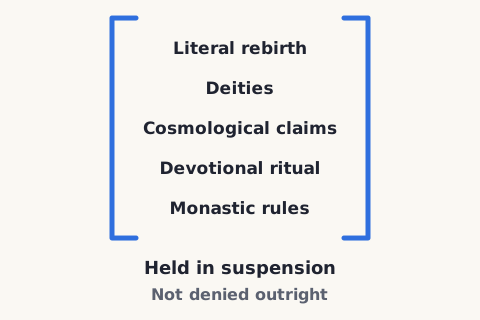
Secular Buddhism intentionally sets aside various supernatural elements that are traditionally associated with Buddhist practice. This includes the concept of literal rebirth and the idea of karmic continuity, which posits that actions in this life affect future existences. Additionally, it brackets deities and divine Buddhas, as well as cosmological claims about heavens, hells, and various realms of existence. The practice of devotional rituals and adherence to specific monastic rules are also viewed as non-essential to the secular approach. The term "bracket" signifies that these elements are not outright rejected but are instead held in suspension, allowing practitioners to focus on the practical and testable aspects of the teachings.
Key terms
- Tanha
- Pali for "craving" or "thirst" — the restless wanting that, in Buddhism, drives suffering. Wright maps it onto evolved motivational drives.
- Anatta (no-self)
- The teaching that there is no permanent, unified, independent self — only a bundle of changing processes. Wright reads it as consistent with the modular-mind model.
- MBSR
- Mindfulness-Based Stress Reduction — Kabat-Zinn's standardized 8-week secular program teaching mindfulness for health, stripped of religious content.
- Secular Buddhism
- A modern approach that adopts Buddhist practice and ethics while bracketing supernatural claims, treating the tradition as a psychology rather than a religion.
- Buddhism Without Beliefs
- Stephen Batchelor's 1997 book arguing for an "agnostic," secular Buddhism — practice without commitment to metaphysical doctrines like rebirth.
Key concepts
The Prefrontal Cortex
- A region at the front of the brain's cortex that handles higher-order functions such as attention and executive control.
- In a 2005 study, this region's cortex was thicker in 20 experienced insight meditators than in matched non-meditators.
- That compared groups at one point in time, so it cannot show that meditation caused the difference.
The Insula
- A fold of cortex deep in the brain that is central to body awareness and to empathy.
- A 2005 study found its right front part thicker in 20 experienced insight meditators than in matched non-meditators.
- A 2014 review of 21 studies found it among eight regions that differed in meditators, but flagged publication bias as a strong concern.
The Amygdala
- The almond-shaped structure the brain uses to process threat and fear.
- In a 2018 study, meditation training went with less reactivity here to positive pictures, but no group difference for negative ones.
- In long-term meditators, more hours of retreat went with lower reactivity to negative pictures; practice time in an 8-week MBSR course did not.
The Default Mode Network
- A network of brain areas active in mind-wandering and self-referential thought, and more active at quiet rest than during demanding tasks.
- In a 2011 study, its main hubs were relatively less active in 12 experienced meditators than in matched non-meditators while they meditated.
- The authors called the small sample a limit and said the result needs replication; linking it to anatta is an interpretation.
Key facts

Why Buddhism Is True
Robert Wright's Why Buddhism Is True (2017) argues that Buddhism's psychological claims hold up — not because of faith, but because Buddhism was describing the same human mind that evolutionary psychology now studies. Wright brackets the metaphysics (rebirth, gods) and keeps the diagnosis of the mind, which he thinks the tradition got remarkably right.
Evolution Doesn't Care If You're Happy
Wright's first move: natural selection optimizes for gene propagation, not well-being. The brain was built to generate cravings, anxieties, and flattering distortions because those motivated survival and reproduction on the ancestral savanna — not because they make you content. Lasting satisfaction was never the design goal.
Feelings Are Motivators, Not Truth-Tellers
Wright describes feelings as the levers natural selection uses to steer us, not as accurate reports. His example, from a 2017 NPR interview, is the powdered-sugar donut: the first brings bliss, but later you feel intense desire and anticipate the pleasure, may barely notice eating it, and the pleasure lasts less long. Feelings evolved to move you, not to inform you. Buddhism named this restless wanting tanha (craving) some 2,500 years earlier.

The Mind Has No CEO
Modern psychology increasingly describes the mind as a set of partially independent modules competing for control — with the felt sense of a single, unified "self in charge" being a post-hoc story the brain tells after the fact. There is no inner CEO. Wright notes this lines up with the Buddhist teaching of anatta (no-self).

Mindfulness Can Give Critical Distance
In interviews, Wright describes mindfulness as observing a feeling such as anxiety or pain instead of running from it. He says this can give "a kind of critical distance" from the feeling, almost a kind of detachment.
The Alarm and the Narrator: What Scans Show
Two more findings are often cited, and both are narrower than the headlines. In a 2018 study, meditation training went with less reactivity in the amygdala, the brain's threat alarm, to positive pictures but not to negative ones. In a 2011 study of 12 experienced meditators, the Default Mode Network, active in mind-wandering and self-referential thought, was relatively less active than in non-meditators while they meditated; the authors called the sample moderately small and said the results warrant replication. Linking the network to anatta is an interpretation, not a finding.
The Monk in the Scanner
The French-born monk Matthieu Ricard, a former molecular biologist, became a celebrated research subject — taking part in fMRI studies at the University of Wisconsin under neuroscientist Richard Davidson. Headlines dubbed him "the world's happiest man," though Ricard himself waved the label off as a media invention.
Mindfulness Goes to the Clinic
In 1979, Jon Kabat-Zinn began a program at the University of Massachusetts Medical School, first called the Stress Reduction and Relaxation Program. It became known as Mindfulness-Based Stress Reduction (MBSR) in the early 1990s. His move was to lift Buddhist mindfulness practice out of its religious frame and repackage it for secular clinical use — defining mindfulness as "moment-to-moment, nonjudgmental attention."
What the Program Treats
The standardized eight-week MBSR program has been studied for anxiety and depression, chronic pain and stress-related disorders. A 2014 review of 47 trials of meditation programs rated the evidence for mindfulness programs as moderate for anxiety, depression and pain and low for stress, with no evidence that they beat active treatments. Its popularity helped spread the global "mindfulness movement" into healthcare, schools, corporations, and even military training.
What Secular Buddhism Keeps
Secular Buddhism — associated with teachers like Stephen Batchelor and thinkers like Wright — foregrounds what it treats as testable and practical: mindfulness and meditation as psychological tools, the Four Noble Truths as a diagnosis-and-treatment framework, anatta, impermanence, and dependent origination as empirically checkable claims, and ethics that are rational and compassion-based rather than theistic.
What Secular Buddhism Brackets
What it sets aside as non-essential is the supernatural scaffolding: literal rebirth and karmic continuity across lives, deities and divine Buddhas, cosmological claims (heavens, hells, realms), devotional ritual, and the specific monastic rules. "Bracket" is the key word — not denied outright, just held in suspension.

Buddhism As Psychology
Secular Buddhism treats the Buddhist tradition primarily as a psychology rather than a religion, keeping the practice and ethics while setting aside supernatural claims.
Buddhism Without Beliefs
Stephen Batchelor's 1997 book Buddhism Without Beliefs argues for an agnostic, secular approach to practice that doesn't commit to metaphysical doctrines like rebirth.

The Meaning Of Bracket
In secular Buddhism, to "bracket" a claim like rebirth means holding it in suspension — neither affirmed nor rejected — so practitioners can focus on testable, practical teachings.
By the numbers
- Year Kabat-Zinn began the UMass program that became MBSR
- 1979 CE
- Length of the standard MBSR course
- 8 weeks
Self-test
Answer each question from memory, then check your work against the answer key.
1. What does Wright say observing a feeling, rather than running from it, can give you?
- AStronger, more intense cravings
- B"Critical distance" — a detachment from the feeling
- CA permanent, fixed sense of self
- DTotal elimination of all emotion
2. According to Wright, what did feelings primarily evolve to do?
- AGive an accurate forecast of future outcomes
- BPermanently eliminate craving and anxiety
- CMove you toward behaviors that aided survival and reproduction
- DReport objective truth about the world
3. In Buddhism, the term tanha refers to which of the following?
- ACraving or thirst — the restless wanting that drives suffering
- BMoment-to-moment nonjudgmental attention
- CThe teaching that there is no permanent self
- DThe impermanence of all things
4. Wright reads the Buddhist teaching of anatta (no-self) as consistent with which modern view of the mind?
- AA blank slate shaped only by culture
- BA single unified self firmly in control
- CA permanent soul that survives across lives
- DA set of partially independent modules vying for control
5. In a 2017 NPR interview, Wright used the powdered-sugar donut to show that feelings are:
- AIrrelevant to human behavior
- BEvidence of a permanent, unified self
- CMotivational signals, which overstate future satisfaction
- DPerfectly reliable predictors of future reward
6. In a 2011 study of 12 experienced meditators, which circuit, active in mind-wandering and self-referential thought, was relatively less active than in non-meditators during meditation?
- AThe prefrontal cortex
- BThe amygdala
- CThe insula
- DThe Default Mode Network
7. In studies that found thicker cortex in experienced meditators, which functions is the prefrontal cortex associated with?
- ABody awareness and empathy
- BAttention and executive control
- CMind-wandering and self-narrative
- DThreat detection and fear
8. Which brain region, found thicker in some studies of experienced meditators, is tied to body awareness and empathy?
- AThe insula
- BThe prefrontal cortex
- CThe Default Mode Network
- DThe amygdala
9. In a 2018 study, meditation training went with less reactivity to positive pictures but no group difference for negative ones in which region, the brain's threat alarm?
- AThe Default Mode Network
- BThe insula
- CThe prefrontal cortex
- DThe amygdala
10. Kral and colleagues (2022) tested the 8-week MBSR course in 218 adults new to meditation. What did they find about brain structure?
- AA larger hippocampus than either control group
- BNo structural change compared with either control group
- CThicker prefrontal cortex than either control group
- DA smaller amygdala than either control group
11. Who founded Mindfulness-Based Stress Reduction (MBSR)?
- ARobert Wright
- BMatthieu Ricard
- CJon Kabat-Zinn
- DStephen Batchelor
12. In what year did Kabat-Zinn begin the University of Massachusetts Medical School program that became MBSR?
- A1979
- B1997
- C1959
- D1990
13. How long is the standardized MBSR course?
- A4 weeks
- B8 weeks
- C12 weeks
- D6 weeks
14. How did Kabat-Zinn define mindfulness?
- A"Craving for future pleasure"
- B"Devotion to a divine Buddha"
- C"Total elimination of all thought"
- D"Moment-to-moment, nonjudgmental attention"
15. What was Kabat-Zinn's key move in creating MBSR?
- ALifting mindfulness out of its religious frame for secular clinical use
- BAdding devotional rituals to meditation
- CBasing the program on literal rebirth
- DRequiring monastic ordination for participants
16. Which of these does secular Buddhism typically BRACKET as non-essential?
- AMindfulness as a psychological tool
- BThe Four Noble Truths as a framework
- CLiteral rebirth across lifetimes
- DAnatta as a testable claim
17. Which of these does secular Buddhism bracket as supernatural scaffolding?
- AMindfulness as a psychological tool
- BCompassion-based ethics
- CThe Four Noble Truths as a framework
- DDeities and divine Buddhas
18. Secular Buddhism treats the Buddhist tradition primarily as which of the following?
- AA psychology rather than a religion
- BA theistic faith centered on worship
- CA monastic discipline requiring ordination
- DA cosmology of heavens and hells
19. Which teacher is a champion of secular Buddhism's practical approach?
- AJon Kabat-Zinn
- BMatthieu Ricard
- CStephen Batchelor
- DRobert Wright
20. When secular Buddhism 'brackets' rebirth, what does that mean?
- AIt requires belief in rebirth to practice
- BIt holds rebirth in suspension as an open question
- CIt replaces rebirth with belief in deities
- DIt proves rebirth is scientifically false
Go deeper
Answer key
- 1. B "Critical distance" — a detachment from the feelingIn a 2017 NPR interview Wright said that observing a feeling such as anxiety or pain, rather than running from it, can give "a kind of critical distance" from it. In another interview he said the feeling does not go away, but it has less of a grip on you.
- 2. C Move you toward behaviors that aided survival and reproductionWright argues feelings are motivational signals calibrated to push behavior in the ancestral environment, not accurate truth-tellers about reality.
- 3. A Craving or thirst — the restless wanting that drives sufferingTanha is Pali for 'craving' or 'thirst.' Wright maps it onto evolved motivational drives. No-self is anatta, not tanha.
- 4. D A set of partially independent modules vying for controlModern psychology describes the mind as competing modules with the unified 'self in charge' being a post-hoc story — which Wright links to anatta.
- 5. C Motivational signals, which overstate future satisfactionWright's point is that natural selection built feelings to keep us seeking, not to leave us lastingly satisfied: anticipated pleasure runs ahead of the enjoyment, which fades.
- 6. D The Default Mode NetworkThe Default Mode Network is active in mind-wandering and self-referential thought. Its main hubs were relatively less active in 12 experienced meditators while they meditated, but the authors called the sample moderately small and said the results warrant replication.
- 7. B Attention and executive controlThe prefrontal cortex handles attention and executive control. Body awareness and empathy go with the insula, threat with the amygdala, and mind-wandering with the Default Mode Network.
- 8. A The insulaThe insula is tied to body awareness and empathy. The prefrontal cortex handles attention and executive control, the amygdala threat, and the Default Mode Network mind-wandering.
- 9. D The amygdalaThe amygdala is the brain's threat and fear alarm. In that study, meditation training went with less amygdala reactivity to positive pictures but not to negative ones, so "calms the alarm" is a narrower finding than it sounds.
- 10. B No structural change compared with either control groupAcross two randomized trials, 8-week MBSR produced no structural brain change compared with a waiting list or a matched active control. The authors said this failed to replicate earlier findings.
- 11. C Jon Kabat-ZinnJon Kabat-Zinn founded MBSR at UMass. Ricard is the monk in fMRI studies, Batchelor a secular-Buddhism teacher, Wright the author of Why Buddhism Is True.
- 12. A 1979Kabat-Zinn began the program in 1979, as the Stress Reduction and Relaxation Program; the name MBSR came into formal use only in the early 1990s. 1997 is the year of Batchelor's Buddhism Without Beliefs.
- 13. B 8 weeksThe standard MBSR program runs eight weeks.
- 14. D "Moment-to-moment, nonjudgmental attention"Kabat-Zinn defined mindfulness as 'moment-to-moment, nonjudgmental attention,' a foundation for secular clinical use.
- 15. A Lifting mindfulness out of its religious frame for secular clinical useKabat-Zinn repackaged Buddhist mindfulness for secular clinical use, stripped of religious content, so it could be studied and applied broadly.
- 16. C Literal rebirth across lifetimesSecular Buddhism keeps the practical, testable elements (mindfulness, the Four Noble Truths, anatta) and brackets the metaphysical ones — most prominently literal rebirth.
- 17. D Deities and divine BuddhasSecular Buddhism brackets supernatural elements like deities and divine Buddhas, while keeping mindfulness, the Four Noble Truths, and secular ethics.
- 18. A A psychology rather than a religionSecular Buddhism adopts Buddhist practice and ethics while bracketing supernatural claims, treating the tradition as a psychology rather than a religion.
- 19. C Stephen BatchelorStephen Batchelor is a champion of secular Buddhism, which prioritizes concepts that can be empirically examined and applied to daily life.
- 20. B It holds rebirth in suspension as an open question'Bracket' is the key word: supernatural claims like rebirth are held in suspension, not denied, so practitioners focus on testable, practical teachings.
Sources
- Wikipedia — Why Buddhism Is True — en.wikipedia.org/wiki/Why_Buddhism_Is_True
- Lion's Roar — Why Jon Kabat-Zinn brought mindfulness to the mainstream — www.lionsroar.com/why-jon-kabat-zinn-brought-mindfulness-to-the-mainstream/
- Kral et al. 2022 — Absence of structural brain changes from MBSR: two combined randomized controlled trials (Science Advances) — pmc.ncbi.nlm.nih.gov/articles/PMC9122316/
- Kral et al. 2018 — Impact of short- and long-term mindfulness meditation training on amygdala reactivity (NeuroImage) — pmc.ncbi.nlm.nih.gov/articles/PMC6671286/
- Kral et al. 2019 — MBSR-related changes in posterior cingulate resting brain connectivity (SCAN) — pmc.ncbi.nlm.nih.gov/articles/PMC6778831/
- Brewer et al. 2011 — Meditation experience is associated with differences in default mode network activity (PNAS) — pmc.ncbi.nlm.nih.gov/articles/PMC3250176/
- Lazar et al. 2005 — Meditation experience is associated with increased cortical thickness (NeuroReport) — pmc.ncbi.nlm.nih.gov/articles/PMC1361002/
- Fox et al. 2014 — Is meditation associated with altered brain structure? A meta-analysis — pubmed.ncbi.nlm.nih.gov/24705269/
- Goyal et al. 2014 — Meditation programs for psychological stress and well-being (JAMA Internal Medicine) — pmc.ncbi.nlm.nih.gov/articles/PMC4142584/
- Kabat-Zinn 2011 — Some reflections on the origins of MBSR, skillful means, and the trouble with maps — doi.org/10.1080/14639947.2011.564844
- NPR Fresh Air — Robert Wright interview, 7 August 2017 (transcript) — www.npr.org/transcripts/541610511
- Lion's Roar — Why Buddhism Is True (interview with Robert Wright) — www.lionsroar.com/why-buddhism-is-true/
- The Real News — Robert Wright on Mindfulness, Buddhism, and Overcoming Delusions — therealnews.com/rwright1129buddhism
Image credits
- Why Buddhism Is True: AI-generated (gpt-image-1.5)
- The Mind Has No CEO: AI-generated (gpt-image-1.5)
- Mindfulness Can Give Critical Distance: AI-generated (gpt-image-1.5)
- What Secular Buddhism Brackets: FlashFeed original diagram · CC-BY-4.0
- Buddhism As Psychology: AI-generated (gpt-image-1.5)
- The Meaning Of Bracket: AI-generated (gpt-image-1.5)