
Buddhism: A Deep Study study guide · Lesson 12 of 13
Vocabulary & Numbers
Essential Vocabulary · The Immeasurables and Meditation · Numbers to Know
This is the lesson's study guide from the FlashFeed app, plus its key facts and a self-test.
What you'll be able to do
- Match core Buddhist terms (Dharma, Sangha, Three Jewels, Bodhi, Skandha, Upaya, Maya) to their meanings.
- Identify the Four Immeasurables (metta, karuna, mudita, upekkha) collectively known as the Brahmaviharas.
- Distinguish key meditation terms — metta, samadhi, vipassana, samatha, and jhana.
- Recall the canonical Buddhist numbers (3 marks, 4 truths, 5 precepts, 5 aggregates, 8-fold path, 10 paramitas, 12 nidanas, 84,000 teachings).
- Explain the Five Precepts (Pancasila) as training commitments for lay Buddhists.
The Immeasurables and Meditation
The Four Immeasurables, or Brahmaviharas, are essential qualities in Buddhist practice that foster emotional well-being and ethical conduct. Cultivating these attitudes not only enhances personal peace but also promotes harmonious relationships with others, making them a cornerstone of Buddhist ethics.
The Four Immeasurables
The Four Immeasurables—metta, karuna, mudita, and upekkha—serve as a framework for developing a compassionate mindset. Metta, or loving-kindness, encourages unconditional love towards all beings, while karuna emphasizes empathy and the desire to alleviate suffering. Mudita is the practice of taking joy in the happiness and success of others, countering feelings of jealousy. Lastly, upekkha represents equanimity, fostering a balanced state of mind in the face of life's ups and downs. Together, these qualities cultivate a profound sense of connection and peace.
Metta
Metta, or loving-kindness, is the practice of wishing well for oneself and others. This attitude is foundational in meditation, where practitioners often begin by generating feelings of love and goodwill. Some studies on loving-kindness meditation associate cultivating metta with increased well-being and reduced anxiety, though effect sizes vary across studies. In the context of meditation, it is often paired with visualization techniques, where one imagines sending love to friends, family, and even adversaries, thereby expanding one's emotional boundaries.
Karuna
Karuna, or compassion, is the heartfelt response to the suffering of others. In meditation, practitioners focus on recognizing and embracing the pain of others, fostering a desire to help alleviate that suffering. This practice not only enhances emotional intelligence but also deepens one's understanding of interconnectedness. In Buddhist teachings, karuna is seen as essential for personal growth and contributes to a more compassionate society.
Mudita
Mudita, or sympathetic joy, is the ability to rejoice in the happiness and success of others. This quality counters the common tendency toward envy and competition. In meditation, practitioners cultivate mudita by reflecting on the joy of others, which can lead to a profound sense of community and interconnectedness. By celebrating others' achievements, individuals can enhance their own emotional resilience and foster a more positive outlook on life.
Upekkha
Upekkha, or equanimity, is the mental state of being undisturbed by the dualities of pleasure and pain. In meditation, practitioners seek to cultivate a balanced mind that remains steady amidst the fluctuations of life. Upekkha encourages acceptance and non-attachment, allowing individuals to respond to situations with clarity and calmness. This quality is crucial for maintaining peace in both personal and communal contexts, making it a vital aspect of Buddhist practice.
Understanding these four immeasurable qualities deepens one's meditation practice, enhancing both personal well-being and the ability to connect compassionately with others.
Meditation Terms
Buddhist meditation is often grouped into two complementary modes. Samatha (calm-abiding) is concentration practice that settles and stabilizes the mind, while vipassana (insight) is the direct, investigative observation of experience. Deep states of concentration reached through sustained practice are called jhana (Sanskrit dhyana); the Sanskrit form is the linguistic root of the East Asian terms "Chan" and "Zen." The general capacity for one-pointed, unified attention is samadhi, meditative concentration that forms one of the three trainings alongside ethical conduct (sila) and wisdom (prajna).
Essential Vocabulary
A handful of Pali and Sanskrit terms recur throughout Buddhist teaching. Most appeared in earlier lessons; two ideas are new here: the wider sense of Dharma and the notion of skillful means.
Dharma
Dharma (Pali Dhamma) most often means the body of teachings the Buddha set out, the second of the Three Jewels. The word also carries a wider sense. In Buddhist philosophy dharma is treated as a cosmic law, a tenet of nature as fundamental as gravity: the natural order that governs reality, and what the Buddha discovered to be true about it. On this reading the teachings describe that order rather than invent it.
Sangha and the Three Jewels
The Sangha is the community of practitioners. Traditionally the word meant the order of ordained monks and nuns; today it is often used for all Buddhists, lay and ordained. With the Buddha, the teacher and exemplar, and the Dharma, his teaching, the Sangha makes up the Three Jewels. Taking refuge in these three, by reciting "I take refuge in the Buddha," "in the Dharma," and "in the Sangha" three times, is one of the oldest ways of expressing Buddhist faith and formalizes a commitment to the Buddha's path.
Upaya: Skillful Means
Upaya, usually translated skillful means or "expedient means," is the adapting of the teaching to the capacity of the listener. The scholar Edward Conze described it as bringing out people's spiritual potential through statements or actions adjusted to their needs and their capacity to understand. The idea is especially prominent in the Lotus Sutra, the Mahayana text Nichiren placed above all others, where the Buddha is said to give different teachings to different audiences rather than reveal the ultimate truth to those not ready for it.
Terms from Earlier Lessons
Bodhi means awakening or enlightenment; the Bodhi tree at Bodh Gaya, a sacred fig, is the "tree of awakening" under which Siddhartha became the Buddha. A skandha is an aggregate, one of the five (form, sensation, perception, mental formations, consciousness) that together make up what we call the self. Maya means illusion: the misperceived world, in which things are not what they seem, and the illusion that obscures our understanding. The same word is also the name of the Buddha's mother. A koan is a question or statement used in Zen to carry the student beyond logical reasoning toward direct insight.
Numbers to Know
The following study guide explores essential concepts in Buddhism, focusing on ethical practices and mindfulness. Understanding these principles is crucial for anyone studying Buddhist philosophy and practice.
The Five Precepts
The Five Precepts (Pancasila) form the ethical foundation for lay Buddhists, guiding their actions and intentions. These precepts are not strict commandments but rather training commitments aimed at cultivating moral behavior and reducing suffering. By refraining from taking life, individuals foster compassion; avoiding theft promotes respect for others' property; and steering clear of sexual misconduct encourages healthy relationships. The precept against false speech emphasizes the importance of honesty, while abstaining from intoxicants supports mental clarity and awareness. Together, they serve as a practical framework for ethical living.
The Four Foundations of Mindfulness
The Four Foundations of Mindfulness (Satipatthana) represent key areas for cultivating awareness and insight in Buddhist practice. Mindfulness of the body (kaya) encourages practitioners to observe physical sensations and movements, fostering a deeper connection with their physical existence. Mindfulness of feelings/sensations (vedana) involves recognizing the nature of feelings as pleasant, unpleasant, or neutral, allowing individuals to experience emotions without attachment. Mindfulness of the mind (citta) focuses on understanding one's thoughts and mental states, promoting clarity and emotional regulation. Finally, mindfulness of principles (dhamma) is worked through, in the Satipatthana Sutta (MN 10), as five named sets taken in turn: the five hindrances, the five aggregates, the six sense fields, the seven awakening factors, and the four noble truths. Translators render dhamma here differently, as principles, phenomena, or mental qualities. Together, these foundations cultivate a profound sense of awareness and presence.
Key terms
- Metta
- Metta is loving-kindness, the heartfelt wish that all beings be happy and free from harm. Cultivating metta is the first of the four immeasurable states.
- Samadhi
- Samadhi is meditative concentration, a calm and unified state of mind. Samadhi forms one of the three trainings, alongside ethical conduct and wisdom.
Key concepts
Metta
- One of the Four Immeasurables, generated as the foundation of many meditation sessions.
- Usually translated 'loving-kindness,' it is the practice of wishing well for oneself and all beings.
- Practitioners visualize sending unconditional goodwill outward — to friends, family, and even adversaries.
Karuna
- One of the Four Immeasurables, a heartfelt response to what others are going through.
- Usually translated 'compassion,' it is the wish to recognize and relieve the suffering of others.
- In meditation one embraces others' pain, deepening empathy and a felt sense of interconnectedness.
Mudita
- One of the Four Immeasurables, cultivated as an antidote to envy and competition.
- Translated 'sympathetic joy,' it is the ability to rejoice in the happiness and success of others.
- Practitioners nurture it by reflecting on others' good fortune, celebrating their wins rather than resenting them.
Upekkha
- One of the Four Immeasurables, prized for keeping the mind steady.
- Translated 'equanimity,' it is a balanced state undisturbed by the pull of pleasure and pain.
- It fosters acceptance and non-attachment, letting one meet life's ups and downs with calm clarity.
Key facts

The Four Immeasurables
Also called the Brahmaviharas ("divine abodes"), these four boundless attitudes are cultivated in meditation: metta (loving-kindness), karuna (compassion), mudita (sympathetic joy), and upekkha (equanimity). Together they are the emotional core of Buddhist ethics.
Karuna: Buddhist Compassion
Karuna, one of the Four Immeasurables (Brahmaviharas) in Buddhism, is compassion — the heartfelt wish that all beings be free from suffering.
Mudita: Sympathetic Joy
Mudita, one of the Brahmaviharas, is sympathetic joy — taking delight in the happiness and good fortune of others, and a direct counter to envy.
Jhana: Root Of Zen
Jhana (Sanskrit: dhyana) is the Buddhist term for deep meditative absorption. Its Sanskrit form is the linguistic root of the words "Chan" and "Zen."
Samadhi: One Of Three Trainings
Samadhi — meditative concentration, a calm and unified state of mind — is one of Buddhism's three trainings, alongside ethical conduct and wisdom.
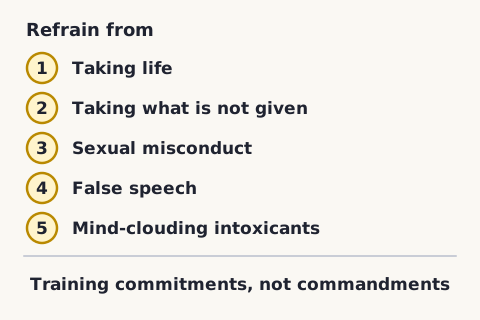
The Five Precepts
The foundational ethics of lay Buddhists (Pancasila): refrain from (1) taking life, (2) taking what is not given, (3) sexual misconduct, (4) false speech, and (5) intoxicants that cloud the mind. They are training commitments, not commandments.

The Four Foundations of Mindfulness
The Satipatthana — the four foundations of mindfulness: the body (kaya), feelings (vedana), the mind (citta) and principles (dhamma, also rendered phenomena). In the Satipatthana Sutta (MN 10) the fourth is worked through five named sets: the hindrances, the aggregates, the sense fields, the awakening factors and the noble truths.
84,000 Teachings
Buddhist tradition counts a symbolic total of 84,000 teachings given by the Buddha, traditionally said to be one antidote for each of the 84,000 mental defilements.
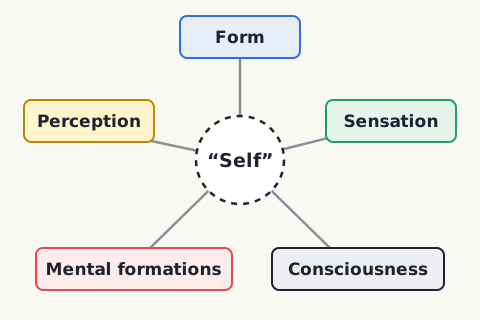
The Five Aggregates
The Buddhist "self" is analyzed into five aggregates, or skandhas: form, sensation, perception, mental formations, and consciousness.
No False Speech
Refraining from false speech is the fourth of the Five Precepts (Pancasila), the ethical guidelines lay Buddhists voluntarily undertake to follow.
By the numbers
- Number of the Marks of Existence (impermanence, suffering, non-self)
- 3 count
- Number of the Noble Truths
- 4 count
- Number of Precepts in the lay Buddhist code (Pancasila)
- 5 count
- Number of Aggregates (skandhas) that make up the 'self'
- 5 count
- Number of factors in the Noble Eightfold Path
- 8 count
- Number of Perfections (paramitas) in the Theravada list
- 10 count
- Number of links (nidanas) in dependent origination
- 12 count
- Traditional number of the Buddha's teachings (one per mental defilement)
- 84000 count
Matched pairs
Each item on the left goes with the one on the right.
- Dharma / Dhamma
- The Buddha's teachings; also 'cosmic law' or the natural order
- Sangha
- The community of practitioners — traditionally ordained monks and nuns, now often laypeople too
- The Three Jewels
- Buddha, Dharma, Sangha — taking refuge in these three is the formal Buddhist commitment
- Bodhi
- Awakening; enlightenment — the realization the Buddha attained under the fig tree
- Skandha
- Aggregate — one of the five processes (form, sensation, perception, formations, consciousness) that make up experience
- Upaya
- Skillful means — adapting the teaching to the capacity of the student
- Maya
- Illusion; the misperceived world — also the name of the Buddha's mother
- Koan
- A paradoxical Zen question or statement used to short-circuit discursive thinking
- Metta
- Loving-kindness; unconditional goodwill toward all beings
- Karuna
- Compassion; the wish for beings to be free from suffering
- Mudita
- Sympathetic joy; delight in the happiness and good fortune of others
- Upekkha
- Equanimity; a stable, balanced mind regardless of circumstance
- Vipassana
- Insight meditation — direct, investigative observation of experience
- Samatha
- Calm-abiding; concentration meditation that settles and stabilizes the mind
- Jhana / Dhyana
- Deep meditative absorption; the Sanskrit dhyana is the root of the words Chan and Zen
Self-test
Answer each question from memory, then check your work against the answer key.
1. In Buddhist vocabulary, what does the term upaya mean?
- AAwakening, or enlightenment
- BSkillful means — adapting the teaching to the capacity of the student
- CIllusion, or the misperceived world
- DThe community of practitioners
2. In Buddhist vocabulary, the term Dharma (Dhamma) refers to what?
- ASkillful means of adapting the teaching
- BThe community of practitioners
- CAwakening, or enlightenment
- DThe Buddha's teachings; also 'cosmic law' or the natural order
3. The Three Jewels, in which Buddhists take refuge, are which three?
- AMetta, Karuna, Mudita
- BForm, Sensation, Consciousness
- CBuddha, Dharma, Sangha
- DBody, Feelings, Mind
4. What does the term skandha (aggregate) denote?
- AOne of five processes—form, sensation, perception, formations, consciousness—that make up experience
- BThe community of practitioners
- CThe misperceived, illusory world
- DAwakening that ends rebirth
5. Which pairing of a Buddhist term with its meaning is INCORRECT?
- ASangha — the community of practitioners
- BBodhi — awakening or enlightenment
- CMaya — awakening or enlightenment
- DUpaya — skillful means
6. The Four Immeasurables — metta, karuna, mudita, and upekkha — are known collectively by what name?
- ASatipatthana
- BBrahmaviharas
- CParamitas
- DSkandhas
7. Which of the Four Immeasurables is loving-kindness—unconditional goodwill toward all beings?
- AUpekkha
- BMudita
- CKaruna
- DMetta
8. Which immeasurable is sympathetic joy—delight in the happiness and good fortune of others?
- AMudita
- BKaruna
- CUpekkha
- DMetta
9. In the Brahmaviharas, karuna is best described as which quality?
- ACompassion; the wish for beings to be free from suffering
- BEquanimity; a balanced mind regardless of circumstance
- CLoving-kindness toward all beings
- DSympathetic joy in others' success
10. Which of the following is NOT one of the Four Immeasurables (Brahmaviharas)?
- AUpekkha
- BKaruna
- CMetta
- DSamadhi
11. Which meditation term refers to insight—direct, investigative observation of experience?
- AJhana
- BVipassana
- CMetta
- DSamatha
12. Samatha meditation is best described as what?
- AInsight; investigative observation of experience
- BLoving-kindness toward all beings
- CCalm-abiding; concentration that settles and stabilizes the mind
- DDeep meditative absorption states
13. The term jhana (Sanskrit dhyana), the root of the words Chan and Zen, refers to what?
- ACalm-abiding that stabilizes the mind
- BSympathetic joy in others' happiness
- CDeep meditative absorption
- DInsight; investigative observation of experience
14. Samadhi, one of the three trainings alongside ethical conduct and wisdom, is what?
- AMeditative concentration; a calm, unified state of mind
- BLoving-kindness toward all beings
- CEquanimity amid pleasure and pain
- DInsight meditation into impermanence
15. Among these meditation-related terms, which one specifically means loving-kindness?
- AVipassana
- BSamatha
- CSamadhi
- DMetta
16. How many Noble Truths are there in Buddhism?
- A8
- B4
- C3
- D5
17. How many factors make up the Path taught as the fourth Noble Truth?
- A10
- B4
- C12
- D8
18. The traditional number of the Buddha's teachings—one per mental defilement—is which?
- A108
- B12
- C84,000
- D8,000
19. How many aggregates (skandhas) make up the 'self'?
- A5
- B3
- C8
- D4
20. Which number is correctly matched to its Buddhist set?
- A4 — Marks of Existence
- B12 — links (nidanas) in dependent origination
- C3 — Precepts (Pancasila)
- D8 — Aggregates (skandhas)
21. The Five Precepts (Pancasila) are best understood as what?
- AVows binding only on fully ordained monks and nuns
- BRitual chants recited to purify past misdeeds
- CVoluntary training commitments to cultivate moral conduct
- DStrict divine commandments that must never be broken
22. How many precepts make up the Pancasila, the lay Buddhist ethical code?
- A5
- B8
- C3
- D10
23. Which of the following is one of the Five Precepts?
- ARefrain from eating after noon
- BRefrain from false speech
- CRecite the refuge formula
- DPractice daily prostrations
24. Which of these is NOT one of the Five Precepts?
- ARefrain from taking life
- BRefrain from intoxicants that cloud the mind
- CRefrain from taking what is not given
- DAbstain from wealth and personal property
25. Why does the fifth precept counsel abstaining from intoxicants?
- ATo fulfill a divine command
- BTo imitate the monastic Vinaya
- CTo earn merit toward a better rebirth
- DTo support mental clarity and awareness
Go deeper
Answer key
- 1. B Skillful means — adapting the teaching to the capacity of the studentUpaya means 'skillful means' — adapting the teaching to the student's capacity. (Bodhi is awakening, Sangha is the community, and Maya is illusion.)
- 2. D The Buddha's teachings; also 'cosmic law' or the natural orderDharma is the Buddha's teachings and also means cosmic law or the natural order. Awakening is Bodhi, the community is the Sangha, and skillful means is Upaya.
- 3. C Buddha, Dharma, SanghaThe Three Jewels are Buddha, Dharma, and Sangha; taking refuge in them is the formal Buddhist commitment. The others are the immeasurables, foundations of mindfulness, and some of the aggregates.
- 4. A One of five processes—form, sensation, perception, formations, consciousness—that make up experienceA skandha is an aggregate—one of the five processes making up experience. Awakening is Bodhi, the community is the Sangha, and illusion is Maya.
- 5. C Maya — awakening or enlightenmentMaya means illusion or the misperceived world, not awakening—so this pairing is wrong. Awakening is Bodhi. The other three pairings are all correct.
- 6. B BrahmaviharasThe Four Immeasurables are the Brahmaviharas: metta, karuna, mudita, and upekkha. The skandhas are the aggregates, paramitas the perfections, and satipatthana the foundations of mindfulness — other numbered sets, but not these four qualities.
- 7. D MettaMetta is loving-kindness. Karuna is compassion, mudita is sympathetic joy, and upekkha is equanimity.
- 8. A MuditaMudita is sympathetic joy, countering envy. Metta is loving-kindness, karuna is compassion, and upekkha is equanimity.
- 9. A Compassion; the wish for beings to be free from sufferingKaruna is compassion—the wish that beings be free from suffering. Equanimity is upekkha, loving-kindness is metta, and sympathetic joy is mudita.
- 10. D SamadhiSamadhi is meditative concentration, not one of the Brahmaviharas. The Four Immeasurables are metta, karuna, mudita, and upekkha.
- 11. B VipassanaVipassana is insight meditation. Samatha is calm-abiding concentration, jhana is deep absorption, and metta is loving-kindness.
- 12. C Calm-abiding; concentration that settles and stabilizes the mindSamatha is calm-abiding, concentration that stabilizes the mind. Investigative observation is vipassana, deep absorption is jhana, and loving-kindness is metta.
- 13. C Deep meditative absorptionJhana/dhyana is deep meditative absorption; its Sanskrit form is the root of Chan and Zen. Investigative observation is vipassana, calm-abiding is samatha, and sympathetic joy is mudita.
- 14. A Meditative concentration; a calm, unified state of mindSamadhi is meditative concentration, a calm and unified state of mind, and one of the three trainings. Insight is vipassana, loving-kindness is metta, and equanimity is upekkha.
- 15. D MettaMetta is loving-kindness. Samadhi is concentration, vipassana is insight, and samatha is calm-abiding—all modes or states of meditation, not the quality of loving-kindness.
- 16. B 4There are 4 Noble Truths. 3 is the Marks of Existence, 5 the Precepts, and 8 the factors of the Path.
- 17. D 8The Noble Eightfold Path has 8 factors. 4 is the Noble Truths, 10 the paramitas, and 12 the nidanas.
- 18. C 84,000Tradition counts 84,000 teachings, one per mental defilement. The other values are not this figure.
- 19. A 5There are 5 aggregates: form, sensation, perception, formations, and consciousness. 3 is the Marks, 4 the Truths, and 8 the Path factors.
- 20. B 12 — links (nidanas) in dependent originationThere are 12 nidanas in dependent origination. The Precepts number 5, the aggregates 5, and the Marks of Existence 3—so the other three pairings are wrong.
- 21. C Voluntary training commitments to cultivate moral conductThe Five Precepts are not strict commandments but rather training commitments — voluntary undertakings for lay Buddhists that cultivate moral behavior and reduce suffering, not enforced laws or monastic-only vows.
- 22. A 5The Pancasila comprises 5 precepts for lay Buddhists. 3 is the Marks of Existence, 8 the Path factors, and 10 the paramitas.
- 23. B Refrain from false speechRefraining from false speech is the fourth precept. Eating after noon, prostrations, and reciting refuge are practices, not part of the Pancasila.
- 24. D Abstain from wealth and personal propertyRenouncing all property is not among the Five Precepts. The precepts cover taking life, taking what is not given, sexual misconduct, false speech, and intoxicants.
- 25. D To support mental clarity and awarenessAbstaining from intoxicants supports mental clarity and awareness. The precepts are training commitments, not divine commands or monastic rules.
Sources
- Tricycle — Dharma — tricycle.org/buddhism-dharma/
- EBSCO Research Starters — Dharma (religious concept) — www.ebsco.com/research-starters/religion-and-philosophy/dharma-religious-concept
- Tricycle — What Are the Three Jewels of Buddhism? — tricycle.org/magazine/three-jewels-of-buddhism/
- Wikipedia — Refuge (Buddhism) — en.wikipedia.org/wiki/Refuge_(Buddhism)
- Wikipedia — Upaya — en.wikipedia.org/wiki/Upaya
- Wikipedia — Maya (religion) — en.wikipedia.org/wiki/Maya_(religion)
- SuttaCentral — Satipatthana Sutta, MN 10 (Sujato translation) — suttacentral.net/mn10/en/sujato
- Access to Insight — Satipatthana Sutta: Frames of Reference, MN 10 (Thanissaro translation) — www.accesstoinsight.org/tipitaka/mn/mn.010.than.html
Image credits
- The Four Immeasurables: AI-generated (gpt-image-1.5)
- The Five Precepts: FlashFeed original diagram · CC-BY-4.0
- The Four Foundations of Mindfulness: AI-generated (gpt-image-1.5)
- The Five Aggregates: FlashFeed original diagram · CC-BY-4.0