
Buddhism: A Deep Study study guide · Lesson 1 of 13
The Life of the Buddha
Prince and the Four Sights · Awakening and Teaching · A Life in Numbers
This is the lesson's study guide from the FlashFeed app, plus its key facts and a self-test.
What you'll be able to do
- Recall Siddhartha's birth in Lumbini into the prominent Shakya clan, the prophecy at his birth, and the early loss of his mother Maya.
- Identify the key members of Siddhartha's family: his mother Maya, father Suddhodana, wife Yasodhara, and son Rahula.
- Recognize the Four Sights (especially the wandering ascetic) and the Great Renunciation that launched Siddhartha's quest.
- Explain the Middle Way and the events leading to awakening: the two meditation teachers and the Bodhi tree at Bodh Gaya.
- Recall the key ages and durations of the Buddha's life, from marriage to death.
Prince and the Four Sights
The early life of Siddhartha Gautama, who would become known as the Buddha, is marked by significant events that shaped his spiritual journey. This section explores his birth, upbringing, family life, and the pivotal moments that led to his quest for enlightenment.
A Prince Is Born
Siddhartha Gautama was born in Lumbini, a site now revered as a pilgrimage destination. His birth into the Shakya clan positioned him within a prominent lineage that would later influence his teachings. The clan also gave him his later title Shakyamuni, "Sage of the Shakyas." His dates are contested: most early twentieth-century historians used 563–483 BCE, while at a 1988 symposium most scholars who presented dated his death to within 20 years of 400 BCE, which with a life of about 80 years puts his birth nearer 480 BCE. The prophecy surrounding his birth foreshadowed a dual potential for greatness, compelling his father to choose a path of luxury and power for him. The early loss of his mother, Maya, may have contributed to Siddhartha's introspective nature and later quest for deeper meaning in life.
Sheltered from Suffering
Siddhartha's father, Suddhodana, aimed to protect him from the harsh realities of life, believing that a life of comfort would lead to a powerful ruler. This 29-year period of isolation highlights the extent of Siddhartha's privilege but also sets the stage for his profound awakening. The deliberate shielding from poverty, sickness, age, and death created a stark contrast to the realities he would eventually confront, emphasizing the Buddhist concept of dukkha, or suffering, as a fundamental aspect of existence.
Yasodhara and Rahula
At the age of sixteen, Siddhartha's marriage to Yasodhara and the birth of their son, Rahula, marked a significant transition in his life. The name Rahula, meaning "fetter," symbolizes Siddhartha's growing internal conflict regarding family obligations versus his spiritual aspirations. Despite the joys of domestic life, Siddhartha felt increasingly constrained, suggesting that attachment can lead to suffering and the desire for liberation, a key theme in Buddhist philosophy.
The Four Sights
The transformative experience of witnessing the Four Sights shattered Siddhartha's illusion of a perfect life. The first three sights—aging, disease, and death—confronted him with the inevitability of suffering. However, it was the sight of the wandering ascetic that ignited a profound realization within him. This figure exemplified a path of renunciation, suggesting that true peace and understanding could be found beyond the confines of material existence, prompting Siddhartha to seek a spiritual path.
The Great Renunciation
The Great Renunciation signifies Siddhartha's radical departure from his life as a prince. At the age of 29, he made a conscious choice to abandon his royal life, symbolized by shaving his head and relinquishing his princely garments. This act of letting go was not merely physical but also spiritual, marking the beginning of his journey toward enlightenment. The crossing of the Anoma River symbolizes a crossing into a new realm of existence, one dedicated to seeking truth and understanding the nature of suffering.
Awakening and Teaching
Siddhartha Gautama's journey to enlightenment is marked by profound experiences and teachings that shaped Buddhism. This section explores key moments leading to his awakening and the foundational principles he established.
Two Meditation Masters
Siddhartha's early training under Alara Kalama and Uddaka Ramaputta reflects the rich tradition of meditation in ancient India. Alara taught the state of "nothingness," a profound meditative experience, while Uddaka introduced the concept of "neither perception nor non-perception." Despite mastering these techniques, Siddhartha realized they did not lead to the ultimate liberation from suffering, highlighting the limits of conventional meditation practices in achieving enlightenment.
Six Years of Extremes
During his six years of extreme asceticism, Siddhartha sought liberation through self-mortification, enduring severe fasting and intense physical challenges. This period illustrates the ascetic (shramana) belief in extreme austerity as a path to spiritual liberation, a renunciant tradition often practiced apart from mainstream Brahmanical religion. However, instead of achieving enlightenment, he approached death, which taught him that neither extreme indulgence nor extreme denial could lead to true understanding or freedom from suffering.
The Middle Way
The pivotal moment came when Siddhartha accepted rice milk from Sujata, symbolizing a crucial shift towards self-care. This act led him to the realization of the Middle Way (majjhima patipada), advocating a balanced approach between indulgence and asceticism. This principle became foundational in Buddhist philosophy, emphasizing moderation as essential for spiritual progress. His decision to embrace this path alienated his five companions, who clung to their ascetic practices.
Under the Bodhi Tree
Siddhartha's determination to meditate under the Bodhi tree at Bodh Gaya signifies his commitment to attaining enlightenment. This tree, revered as the Bodhi tree or "tree of awakening," became a symbol of spiritual realization in Buddhism. His vow to remain until liberation underscores the importance of perseverance in spiritual journeys, setting a powerful example for future practitioners.
The Assault of Mara
During his meditation, Siddhartha faced the demon Mara, representing the internal struggles of desire, fear, and illusion. Mara's three attacks—an army of terrors, temptations embodied by his daughters, and a challenge to his right to enlightenment—illustrate the psychological barriers to awakening. Siddhartha's earth-touching gesture (bhumisparsha mudra) signifies his resolve and connection to the earth, symbolizing the triumph over these distractions.
The Awakening
At 35, Siddhartha achieved full enlightenment and became the Buddha, or "the Awakened One." His time near the Bodhi tree post-awakening reflects the importance of contemplation and integration of insights. The story of the serpent king Muchilinda sheltering him emphasizes the protective nature of wisdom and the sacredness of the moment of enlightenment in Buddhist tradition.
Turning the Wheel
In Sarnath, the Buddha delivered his first sermon, known as Setting the Wheel of Dhamma in Motion, where he introduced the Four Noble Truths and the Noble Eightfold Path. This event marks a significant turning point in Buddhism, symbolizing the dissemination of his teachings. Kondanna's conversion as the first monk underscores the transformative power of the Buddha's message and the beginning of the monastic community.
The Final Words
After 45 years of teaching, the Buddha passed away at around 80 in Kushinagar, following a meal from Cunda. His last words, emphasizing the impermanence of all things, encapsulate the essence of Buddhist thought. They serve as a reminder for practitioners to diligently pursue their own paths to enlightenment, reinforcing the urgency of personal responsibility in spiritual practice.
The Buddha's Life at a Glance
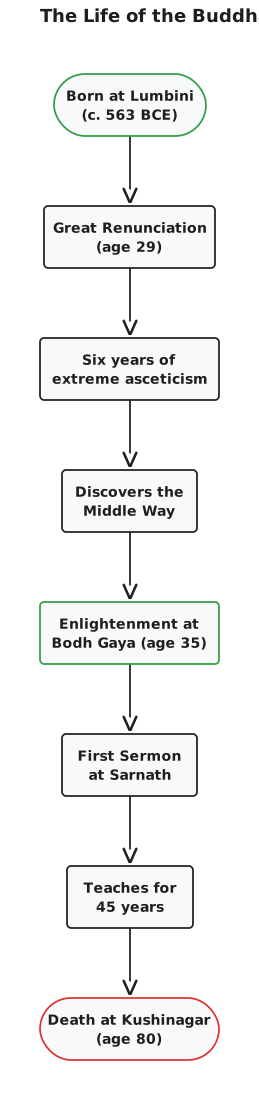
Siddhartha's life journey, from his birth at Lumbini to his awakening at Bodh Gaya and eventual death at Kushinagar, reflects the profound transformation he underwent. This overview encapsulates the key milestones that shaped his teachings and the foundation of Buddhism as a spiritual path.
Key terms
- Shakya
- The clan Siddhartha was born into, which positioned him within a prominent lineage.
- The Middle Way
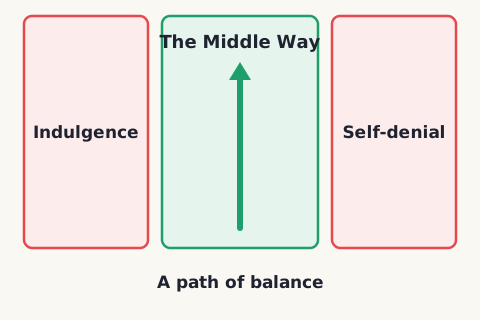
- A path of balance avoiding both extreme self-indulgence and extreme self-denial; the Buddha's first major insight.
Key concepts
Maya
- A member of the royal household whose early death is thought to have deepened the young prince's introspective, searching nature.
- The birth mother of the child born at Lumbini into the Shakya clan.
- Siddhartha's mother, who died soon after giving birth to him.
Suddhodana
- The head of the household who, warned by a prophecy, steered his son toward worldly power instead of a spiritual path.
- The ruler who walled his heir off from poverty, sickness, age, and death for nearly three decades.
- Siddhartha's father, who kept him in palace luxury for 29 years hoping he would become a great king.
Yasodhara
- A person the prince was joined to at sixteen, part of the domestic life he came to feel trapped by.
- The prince's spouse, whose marriage to him produced a single child.
- Siddhartha's wife and the mother of his son Rahula.
Rahula
- A newborn in the palace whose arrival deepened the prince's inner conflict between family duty and spiritual longing.
- The son of Siddhartha and Yasodhara.
- The Buddha's only child, whose name means 'fetter' or chain.
Key facts
A Prince Is Born
Siddhartha Gautama was born around 563 BCE (some modern scholars argue as late as 480 BCE) in Lumbini, in present-day Nepal, into the Shakya clan — the source of his later title Shakyamuni, "Sage of the Shakyas." His mother, Maya, died shortly after his birth. A prophecy said he would become either a great king or a great spiritual teacher.
Sheltered from Suffering
Hoping his son would become a great king rather than renounce the world, Siddhartha's father, the chieftain Suddhodana, raised him in extraordinary luxury — deliberately insulating him from poverty, sickness, age, and death for 29 years behind the palace walls.
Yasodhara and Rahula
At sixteen, Siddhartha married his cousin Yasodhara. They had a son named Rahula — a name meaning "fetter" or "bond," hinting at Siddhartha's growing sense that domestic life was a chain holding him back.
The Great Renunciation
On the night of his 29th birthday, Siddhartha slipped away while his wife and son slept. He crossed the river Anoma, shaved his head, and handed his princely garments to his charioteer Channa. This decisive break with his old life is called the Great Renunciation.
Two Meditation Masters
Siddhartha first studied under two renowned teachers: Alara Kalama, who taught the meditative state of "nothingness," and Uddaka Ramaputta, who taught "neither perception nor non-perception." He mastered both quickly — then realized neither one actually ended suffering.
Six Years of Extremes
For roughly six years Siddhartha joined five fellow ascetics and pushed self-mortification to the brink — fasting nearly to death, holding his breath until he fainted. It brought him no closer to liberation, only closer to dying.
The Middle Way
Near death, Siddhartha accepted a bowl of rice milk from a village girl named Sujata. That act of self-care sparked his insight: the Middle Way (majjhima patipada) — a path of balance between indulgence and self-denial. Disgusted, his five companions abandoned him.
The Awakening
At age 35, Siddhartha attained full enlightenment and became the Buddha — "the Awakened One." He lingered near the tree for weeks; in one story the serpent king Muchilinda spread his hood above the Buddha to shelter him from a storm.
The Final Words
The Buddha taught for 45 years across northeastern India before dying around age 80 at Kushinagar, reportedly after a meal of tainted food offered by a blacksmith named Cunda. His last words: "All conditioned things are impermanent. Work out your salvation with diligence."
The Buddha's Life at a Glance
The whole arc in one view — from birth at Lumbini to awakening at Bodh Gaya to death at Kushinagar.
By the numbers
- Age at which Siddhartha married Yasodhara
- 16 years
- Age at which Siddhartha left the palace (the Great Renunciation)
- 29 years
- Age at which Siddhartha attained enlightenment
- 35 years
- Years Siddhartha spent as a wandering seeker before enlightenment
- 6 years
- Years the Buddha spent teaching after his enlightenment
- 45 years
- Approximate age at which the Buddha died
- 80 years
Self-test
Answer each question from memory, then check your work against the answer key.
1. What did Siddhartha's birth into the Shakya clan position him within?
- AAn itinerant merchant family
- BA minor vassal clan
- CA prominent lineage
- DA foreign royal court
2. Into which clan was Siddhartha Gautama born?
- AShakya
- BMalla
- CKoliya
- DLicchavi
3. What did the prophecy at Siddhartha's birth foreshadow?
- AA destiny to remain unmarried
- BAn early death in infancy
- CA life of poverty
- DA dual potential for greatness
4. Whose early death may have shaped Siddhartha's introspective nature?
- AHis wife, Yasodhara
- BHis mother, Maya
- CHis father, Suddhodana
- DHis son, Rahula
5. Where was Siddhartha Gautama born?
- ABodh Gaya
- BLumbini
- CSarnath
- DKushinagar
6. Who was Siddhartha's mother, who died shortly after his birth?
- APajapati
- BYasodhara
- CMaya
- DSujata
7. Who was Siddhartha's father, the Shakya chieftain who raised him in luxury?
- AKondanna
- BChanna
- CRahula
- DSuddhodana
8. At sixteen, Siddhartha married his cousin. What was her name?
- AYasodhara
- BMaya
- CSujata
- DPajapati
9. What was the name of Siddhartha's son, meaning 'fetter' or 'bond'?
- AKondanna
- BRahula
- CCunda
- DChanna
10. Which of these was NOT a member of Siddhartha's immediate family?
- AMaya
- BRahula
- CSujata
- DYasodhara
11. Which of the Four Sights inspired Siddhartha to seek a spiritual path?
- AA corpse
- BAn old man
- CA sick man
- DA wandering ascetic, serene amid suffering
12. The first three of the Four Sights each revealed an aspect of suffering. Which trio was it?
- AAging, disease, and death
- BPoverty, war, and famine
- CHunger, thirst, and pain
- DBirth, illness, and rebirth
13. What is the name of Siddhartha's decisive break with palace life when he left on his 29th birthday?
- AThe Awakening
- BThe Great Renunciation
- CThe Middle Way
- DThe First Turning
14. Which river did Siddhartha cross during the Great Renunciation?
- AGanges
- BRohini
- CNeranjara
- DAnoma
15. At what age did Siddhartha carry out the Great Renunciation?
- AAge 29
- BAge 16
- CAge 35
- DAge 21
16. At **___** in India, Siddhartha sat beneath a **pipal tree** (*Ficus religiosa*) and vowed not to rise until he was liberated. That tree is remembered as the **Bodhi tree** — the "tree of awakening."
- AKushinagar
- BSarnath
- CBodh Gaya
- DNalanda
17. The Middle Way advocates what kind of approach?
- ADeep meditation on nothingness
- BBalance between indulgence and self-denial
- CExtreme asceticism and fasting
- DTotal renunciation of all desire
18. Which meditative state did the teacher Alara Kalama teach Siddhartha?
- ANeither perception nor non-perception
- BInfinite space
- CNothingness
- DInfinite consciousness
19. Who offered Siddhartha the bowl of rice milk that sparked his insight into the Middle Way?
- ASujata
- BYasodhara
- CKondanna
- DMaya
20. Which meditative state did the teacher Uddaka Ramaputta teach Siddhartha?
- AA state of absolute nothingness in meditation
- BThe Middle Way between indulgence and denial
- CBoundless loving-kindness toward all beings
- DNeither perception nor non-perception
21. According to tradition, which milestone in the Buddha's life took place at age 35?
- AHis marriage to Yasodhara
- BHis enlightenment under the Bodhi tree
- CHis death (parinirvana)
- DThe Great Renunciation — leaving the palace
22. At what age did Siddhartha marry Yasodhara?
- A19
- B29
- C16
- D25
23. How many years did Siddhartha spend as a wandering seeker before his enlightenment?
- A45
- B16
- C29
- D6
24. For how many years did the Buddha teach after his enlightenment?
- A45
- B29
- C35
- D80
25. Around what age did the Buddha die, at Kushinagar?
- A45
- B35
- C100
- D80
Go deeper
- WatchA Father Hid the World In the traditional story, a father hid the world from his son for 29 years. Prince Siddhartha was shielded from poverty, sickness, age and death.
- StudyBuddhism: A Deep Study in the FlashFeed app
Answer key
- 1. C A prominent lineageHis birth into the Shakya clan positioned him within a prominent lineage that would later influence his teachings.
- 2. A ShakyaSiddhartha Gautama was born in Lumbini into the Shakya clan, which positioned him within a prominent lineage that would later influence his teachings.
- 3. D A dual potential for greatnessThe prophecy foreshadowed a dual potential for greatness, prompting his father to choose a life of luxury and power for him.
- 4. B His mother, MayaThe early loss of his mother, Maya, may have contributed to Siddhartha's introspective nature and later quest for meaning.
- 5. B LumbiniSiddhartha Gautama was born in Lumbini, now a pilgrimage site. The other places are tied to later events in his life.
- 6. C MayaHis mother Maya died shortly after his birth. Yasodhara was his wife and Sujata was the village girl who later gave him rice milk.
- 7. D SuddhodanaSuddhodana, the chieftain, shielded him from suffering for 29 years. Channa was his charioteer and Kondanna his first monk.
- 8. A YasodharaHe married his cousin Yasodhara at sixteen. Maya was his mother and Sujata gave him rice milk near Bodh Gaya.
- 9. B RahulaHis son Rahula's name means 'fetter,' hinting at how domestic life felt like a chain. Channa was his charioteer; Cunda offered his final meal.
- 10. C SujataSujata was the village girl who offered rice milk, not family. Maya (mother), Yasodhara (wife), and Rahula (son) were his relatives.
- 11. D A wandering ascetic, serene amid sufferingThe first three sights revealed the universality of suffering; the fourth — a calm ascetic — showed a possible response to it.
- 12. A Aging, disease, and deathThe old man (aging), sick man (disease), and corpse (death) confronted him with universal suffering; the fourth sight, the ascetic, pointed to a response.
- 13. B The Great RenunciationLeaving the palace to seek truth is called the Great Renunciation. The First Turning was his first sermon; the Awakening was his enlightenment at 35.
- 14. D AnomaHe crossed the river Anoma, then shaved his head. The Neranjara flows near Bodh Gaya, a plausible but incorrect choice.
- 15. A Age 29He left the palace at 29. 16 was his marriage age and 35 was when he reached enlightenment.
- 16. C Bodh GayaCompare: Nalanda — An archaeological site in Bihar, India. Kushinagar — A town in Uttar Pradesh, India.
- 17. B Balance between indulgence and self-denialThe Middle Way (majjhima patipada) balances between extreme self-indulgence and extreme self-denial. Extreme asceticism is exactly what it rejects.
- 18. C NothingnessAlara Kalama taught 'nothingness'; Uddaka Ramaputta taught 'neither perception nor non-perception.' Siddhartha mastered both but found neither ended suffering.
- 19. A SujataThe village girl Sujata gave him rice milk near death, prompting the Middle Way insight. Kondanna later became his first monk.
- 20. D Neither perception nor non-perceptionUddaka taught 'neither perception nor non-perception'; Alara Kalama taught the nothingness state. Neither ended Siddhartha's search for liberation from suffering.
- 21. B His enlightenment under the Bodhi treeThe traditional timeline: married at 16, left the palace at 29, awakened at 35 after six years of seeking, then taught for 45 years and died around 80.
- 22. C 16He married his cousin Yasodhara at sixteen. 29 is the age at which he later left the palace, not the age at which he married.
- 23. D 6He sought for six years (between leaving the palace at 29 and awakening at 35). 45 was his teaching period after enlightenment.
- 24. A 45He taught for 45 years after awakening at 35, dying around age 80. 80 was his approximate age at death, not his teaching span.
- 25. D 80He died around age 80 at Kushinagar after 45 years of teaching. 35 was the age of his enlightenment.
Sources
- Met Museum — Life of the Buddha — www.metmuseum.org/essays/life-of-the-buddha
- Wikipedia — Gautama Buddha — en.wikipedia.org/wiki/Gautama_Buddha
Image credits
- The Middle Way: FlashFeed original diagram · CC-BY-4.0
- The Buddha's Life at a Glance: FlashFeed original diagram · CC-BY-4.0