
Buddhism: A Deep Study study guide · Lesson 2 of 13
The Four Noble Truths & the Eightfold Path
The Four Noble Truths · The Noble Eightfold Path
This is the lesson's study guide from the FlashFeed app, plus its key facts and a self-test.
What you'll be able to do
- Identify the Four Noble Truths (dukkha, samudaya, nirodha, magga) as the Buddha's diagnostic sequence for suffering.
- Explain dukkha (suffering) and its cause in craving (tanha) and ignorance (avijja).
- Define the Dharma as the body of teachings the Buddha set out, the second of the Three Jewels.
- Explain the Noble Eightfold Path as eight factors grouped under wisdom, ethical conduct, and mental discipline.
- Match each of the eight path factors (Right View through Right Concentration) to its meaning.
The Four Noble Truths
The Four Noble Truths form the foundation of Buddhist philosophy, providing a framework to understand suffering and its cessation. This guide delves into each truth, offering deeper insights and context to enhance your understanding.
The Physician's Diagnosis
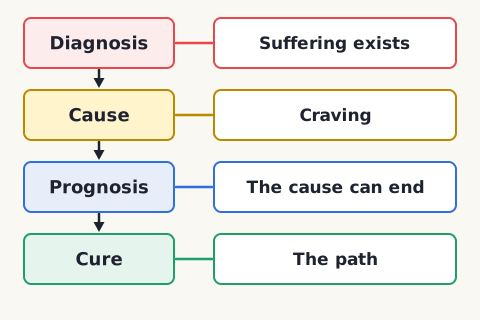
The Four Noble Truths mirror a physician's diagnostic process, emphasizing a methodical approach to understanding human suffering. By identifying suffering (the diagnosis), its cause (craving), the prognosis (the possibility of cessation), and the cure (the path), the Buddha encourages a clinical, realistic perspective on life's challenges. This approach is not about pessimism but about acknowledging reality to effectively address it, much like a doctor must first identify an ailment to treat it successfully.
First Truth: Dukkha
Dukkha, often translated as suffering, encapsulates a broad spectrum of human experience. It highlights not just acute pain but also a pervasive sense of unsatisfactoriness that permeates life, akin to a wheel that doesn't turn smoothly. This truth invites individuals to recognize that even moments of joy can be tinged with anxiety due to their impermanent nature. Understanding dukkha is crucial for practitioners, as it lays the groundwork for the subsequent truths and the pursuit of liberation.
Second Truth: Samudaya
The second truth, Samudaya, identifies tanha—the craving for sensory pleasures, existence, and even non-existence—as the root cause of suffering. This relentless desire leads to a cycle of dissatisfaction and attachment. The Buddha further points to avijja, or ignorance, as the underlying misconception that promotes this craving. Recognizing the interplay between craving and ignorance is essential for understanding how to alleviate suffering and cultivate a more enlightened perspective.
Third Truth: Nirodha
Nirodha conveys the hopeful message that since suffering has a cause, it can also cease. This truth illustrates that the obscurations of the mind, like clouds, are temporary and can clear to reveal the nirvana—a state of liberation and peace. The cessation of craving and ignorance leads to profound freedom from the cycle of samsara (birth and rebirth). Understanding nirodha is vital for practitioners, as it provides motivation and assurance that change is possible.
Fourth Truth: Magga
The last truth, Magga, outlines the path to cessation through the Noble Eightfold Path, which is categorized into three training areas: wisdom, ethical conduct, and mental discipline. This truth serves as a practical guide for individuals seeking to transform their understanding of suffering into actionable steps towards enlightenment. By following this path, practitioners can systematically address the causes of suffering and cultivate a more fulfilling existence, aligning with the overarching goal of the Dharma.
The Three Jewels
The Dharma, the body of teachings the Buddha set out, is the second of the Three Jewels, also called the Triple Gem. The first is the Buddha, the fully awakened teacher; the third is the Sangha, the community that practices and preserves the teaching, traditionally the order of ordained monks and nuns. Buddhists take refuge in these three, traditionally by reciting three times each "I take refuge in the Buddha," "I take refuge in the Dharma," and "I take refuge in the Sangha." Taking refuge is one of the oldest ways of expressing Buddhist faith and formalizes a commitment to the Buddha's path. To follow the Dharma is to live by the truths and practices he described, beginning with the Four Noble Truths.
The Noble Eightfold Path
The Noble Eightfold Path is a fundamental aspect of Buddhist teachings, outlining a practical guide to ethical and mental development with the ultimate goal of achieving nirvana. This path emphasizes the interconnectedness of its components, encouraging a holistic approach to personal growth and enlightenment.
Three Trainings, Eight Factors
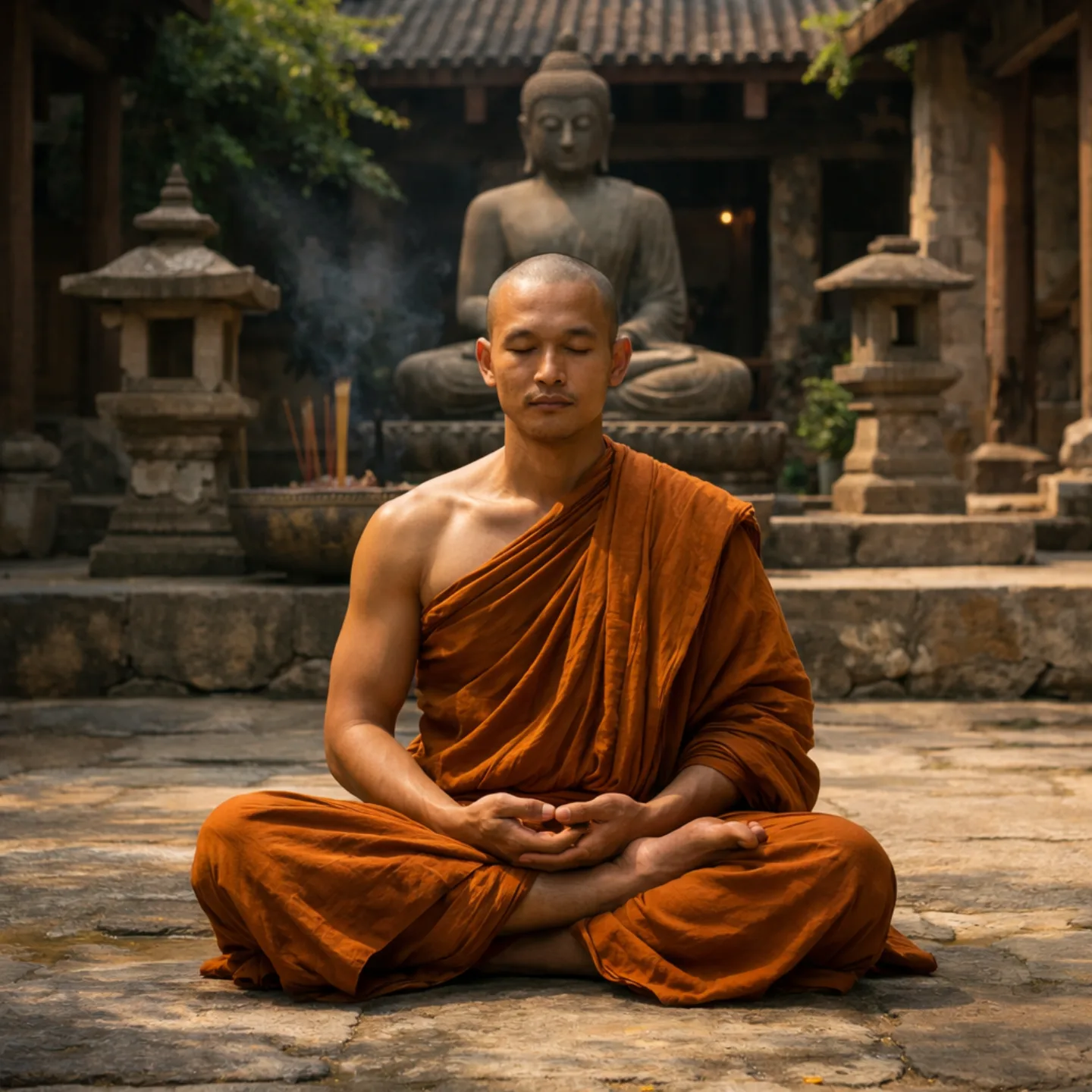
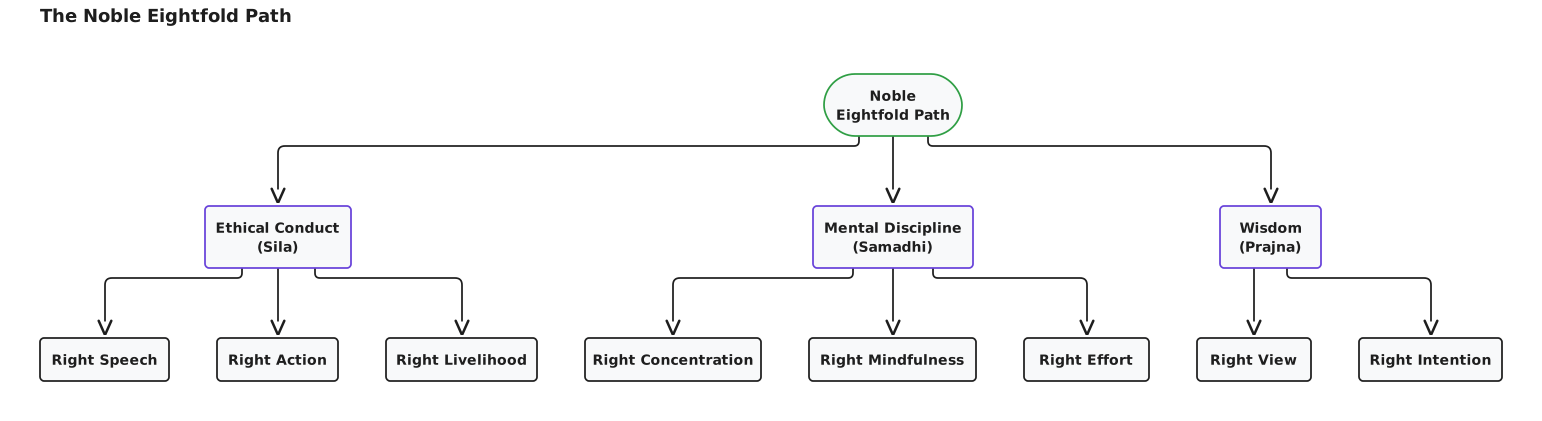
The Eightfold Path is categorized into three essential trainings: Wisdom (Prajna), Ethical Conduct (Sila), and Mental Discipline (Samadhi). Each training comprises specific factors: Right View and Right Intention fall under Wisdom; Right Speech, Right Action, and Right Livelihood are part of Ethical Conduct; while Right Effort, Right Mindfulness, and Right Concentration belong to Mental Discipline. The term samma, meaning "right" or "complete," signifies that these factors are not merely suggestions but essential components of the path to enlightenment.
Not a Staircase
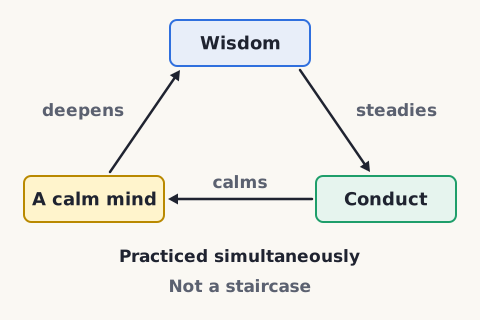
The Eightfold Path is often misunderstood as a linear progression due to its numerical listing. However, it is crucial to recognize that these factors are meant to be practiced simultaneously. Each factor influences and enhances the others — for example, developing Right View can improve Right Speech and Right Action, while a calm mind fosters deeper wisdom. This metaphor of an interwoven rope illustrates the complexity and unity of the path, emphasizing that progress in one area supports growth in all others.
The Eightfold Path, Mapped
The Eightfold Path is systematically organized into the three trainings: Wisdom (Right View and Right Intention), Ethical Conduct (Right Speech, Right Action, and Right Livelihood), and Mental Discipline (Right Effort, Right Mindfulness, and Right Concentration). Understanding this mapping is essential for grasping how each factor contributes to the overall goal of reducing suffering and achieving enlightenment. This structure also aids practitioners in identifying areas for personal development, ensuring a balanced approach to their spiritual journey.
Right Livelihood, for instance, is categorized under Ethical Conduct — a reminder that choosing a trade or occupation that avoids harm is treated as a matter of conduct, alongside speech and action, in the broader pursuit of enlightenment.
Key terms
- Dukkha
- The First Noble Truth: life's inherent suffering and unsatisfactoriness, present even within pleasant experiences.
- Tanha
- "Craving" or "thirst" — the relentless desire (for pleasure, existence, or non-existence) named as the root cause of suffering.
- Avijja
- "Ignorance" — the deep misunderstanding of self and reality that underlies craving; the soil in which tanha grows.
- Dharma
- The body of teachings the Buddha set out, the second of the Three Jewels. To follow it is to live by the truths and practices he described.
- Noble Eightfold Path
- The Buddha's prescription for ending suffering: eight interwoven factors grouped under wisdom, ethical conduct, and mental discipline.
Key concepts
Dukkha
- In the Buddha's physician-like diagnosis of life, this is the identification of the ailment itself — the first of four truths.
- It names a pervasive unsatisfactoriness, likened to a wheel that will not turn smoothly, underlying even happy moments.
- The First Noble Truth: that suffering pervades existence because everything is impermanent.
Samudaya
- The second step of the Buddha's four-part diagnosis — pinpointing the origin of the ailment.
- It blames tanha (craving) together with avijja (ignorance) for driving the cycle of dissatisfaction.
- The Second Noble Truth: that craving for pleasure, existence, and even non-existence is the cause of suffering.
Nirodha
- The hopeful turn in the Buddha's four-part diagnosis — the prognosis that recovery is possible.
- It teaches that mental obscurations, like clouds, are temporary and can clear to reveal nirvana.
- The Third Noble Truth: the cessation of craving and release from the cycle of samsara.
Magga
- The final part of the Buddha's physician-like approach — the prescribed cure, a treatment to follow.
- It organizes practice into three trainings: wisdom, ethical conduct, and mental discipline.
- The Fourth Noble Truth: the Noble Eightfold Path that leads to the end of suffering.
Key facts
The Physician's Diagnosis
The Buddha's central framework — the Four Noble Truths (Cattari Ariya-Saccani) — is famously structured like a physician's process. There is a diagnosis (suffering exists), a cause (craving), a prognosis (the cause can end), and a cure (the path). This is not pessimism but clinical realism: you can't treat what you won't name.

First Truth: Dukkha
Dukkha is the truth of suffering — not only obvious pain, but a subtle unsatisfactoriness that underlies even pleasant experiences. The word literally evokes a wheel with an ill-fitting axle: things don't quite turn the way we want. It covers physical pain, losing what we love, enduring what we hate, and the anxiety of impermanence.

Second Truth: Samudaya
Samudaya is the truth of suffering's cause: tanha ("craving" or "thirst") — the relentless desire for sensory pleasure, for existence, and even for non-existence. Beneath craving the Buddha located avijja ("ignorance"): the fundamental misunderstanding that things, including "we," are permanent, independent, and solid.

Third Truth: Nirodha
Nirodha is the truth of cessation — the Buddha's "good news." Because suffering has a cause, it can end. The mind's obscurations are temporary, like clouds passing over an ever-present sun. The cessation of craving and ignorance leads to nirvana: liberation, peace, and freedom from the cycle of birth and death.

Fourth Truth: Magga
Magga is the truth of the path — the prescription that follows the diagnosis. The way to the cessation of suffering is the Noble Eightfold Path, organized into three training categories: wisdom, ethical conduct, and mental discipline. The first three truths describe the disease and its cure; the fourth tells you what to actually do.
Three Trainings, Eight Factors
The eight factors of the path sort into three categories of training: Wisdom (Prajna) — Right View and Right Intention; Ethical Conduct (Sila) — Right Speech, Action, and Livelihood; and Mental Discipline (Samadhi) — Right Effort, Mindfulness, and Concentration. Each factor begins with samma, "right" or "complete."
Not a Staircase
Despite the numbering, the path is not linear. The eight factors are practiced simultaneously, each supporting the others — wisdom steadies conduct, conduct calms the mind, a calm mind deepens wisdom. It is less a staircase climbed step by step than a single rope woven from eight strands.
The Eightfold Path, Mapped
The eight factors grouped into the three trainings — wisdom, ethical conduct, and mental discipline.
One-pointed focus
Right Concentration, the eighth factor of the path, means training one-pointed focus that leads to deep meditative states known as jhanas.

The two factors of Wisdom
In the Eightfold Path, the Wisdom (Prajna) training is made up of just two factors: Right View and Right Intention.
Matched pairs
Each item on the left goes with the one on the right.
- Right View (Samma Ditthi)
- Accurate understanding of the Four Noble Truths and the nature of reality
- Right Intention (Samma Sankappa)
- Thoughts of renunciation, goodwill, and harmlessness; abandoning attachment, hatred, and cruelty
- Right Speech (Samma Vaca)
- Avoiding lying, divisive speech, harsh speech, and idle chatter
- Right Action (Samma Kammanta)
- Refraining from killing, stealing, and sexual misconduct
- Right Livelihood (Samma Ajiva)
- Avoiding trades that harm others — historically slaves, weapons, meat, intoxicants, or poisons
- Right Effort (Samma Vayama)
- Cultivating wholesome mental states and abandoning unwholesome ones
- Right Mindfulness (Samma Sati)
- Awareness of body, feelings, thoughts, and phenomena
- Right Concentration (Samma Samadhi)
- One-pointed focus leading to deep meditative states (jhanas)
Self-test
Answer each question from memory, then check your work against the answer key.
1. In the physician analogy, which Noble Truth is the diagnosis — the recognition that suffering exists?
- ANirodha
- BMagga
- CDukkha
- DSamudaya
2. Which Noble Truth serves as the 'cure' — the prescription of the path out of suffering?
- ANirodha
- BMagga
- CDukkha
- DSamudaya
3. Nirodha, the Third Noble Truth, corresponds to which stage of the physician's process?
- AThe prescribed treatment
- BThe cause of the illness
- CThe diagnosis of the ailment
- DThe prognosis — that suffering can end
4. Which of these is NOT one of the Four Noble Truths?
- AAvijja
- BDukkha
- CMagga
- DSamudaya
5. Which sequence lists the Four Noble Truths in the order the Buddha's diagnostic framework follows?
- ADukkha, Samudaya, Nirodha, Magga
- BMagga, Dukkha, Samudaya, Nirodha
- CDukkha, Nirodha, Samudaya, Magga
- DSamudaya, Dukkha, Magga, Nirodha
6. Which of the Four Noble Truths identifies craving (tanha) as the cause of suffering?
- ANirodha (cessation)
- BSamudaya (the cause)
- CDukkha (suffering)
- DMagga (the path)
7. Dukkha is best described as which of the following?
- AOnly intense, obvious physical pain
- BA punishment earned by past wrongdoing
- CThe craving for sensory pleasure
- DA pervasive unsatisfactoriness present even within pleasant experiences
8. The Buddha names tanha as the root of suffering. What does tanha mean?
- AMindful awareness
- BCessation
- CCraving or thirst
- DIgnorance
9. What role does avijja (ignorance) play in the arising of suffering?
- AIt is the meditative state that ends craving
- BIt is the ethical training that restrains craving
- CIt is another name for nirvana
- DIt is the deep misunderstanding underlying craving
10. Which is NOT one of the forms of craving (tanha) the Buddha describes?
- ACraving for wealth and social status
- BCraving for non-existence
- CCraving for existence
- DCraving for sensory pleasure
11. What is the Dharma in Buddhism?
- AThe historical person who became the Buddha
- BThe community of ordained monks and nuns
- CThe body of teachings the Buddha set out
- DA trance-like meditative absorption
12. Within the Three Jewels, which position does the Dharma hold?
- AThe fourth Jewel
- BThe second Jewel
- CThe first Jewel
- DThe third Jewel
13. To 'follow the Dharma' means to do what?
- AAcquire wealth through right livelihood
- BRecite the names of past Buddhas each day
- CWithdraw entirely and permanently from society
- DLive by the truths and practices the Buddha described
14. The Four Noble Truths and the Noble Eightfold Path are examples of which of the Three Jewels?
- AThe Sangha
- BThe Buddha
- CThe Dharma
- DNirvana
15. Which statement about the Dharma is FALSE?
- AIt refers to the community of monks who practice it
- BIt is the body of teachings the Buddha set out
- CTo follow it is to live by the truths the Buddha described
- DIt is the second of the Three Jewels
16. Right Livelihood belongs to which of the three training categories?
- AMental Discipline (Samadhi)
- BEthical Conduct (Sila)
- CWisdom (Prajna)
17. The Noble Eightfold Path is best described as which of the following?
- AEight meditative absorptions (jhanas)
- BEight sequential stages climbed strictly one after another
- CEight interwoven factors grouped under wisdom, ethical conduct, and mental discipline
- DEight vows taken upon ordination
18. Which two factors make up the Wisdom (Prajna) training?
- ARight View and Right Intention
- BRight Effort and Right Concentration
- CRight Mindfulness and Right Livelihood
- DRight Speech and Right Action
19. Right Effort, Right Mindfulness, and Right Concentration together form which training category?
- AThe Four Noble Truths (Cattari Ariya-Saccani)
- BMental Discipline (Samadhi)
- CWisdom (Prajna)
- DEthical Conduct (Sila)
20. The Eightfold Path is described as 'not a staircase.' What does this mean?
- AThe factors must be mastered strictly in their numbered order
- BOnly three of the eight factors are truly essential
- CThe path can be abandoned once nirvana is first glimpsed
- DThe eight factors are practiced simultaneously, each supporting the others
21. Which path factor means accurate understanding of the Four Noble Truths and the nature of reality?
- ARight Effort (Samma Vayama)
- BRight Mindfulness (Samma Sati)
- CRight View (Samma Ditthi)
- DRight Intention (Samma Sankappa)
22. Right Intention (Samma Sankappa) involves which of the following?
- AOne-pointed meditative focus
- BThoughts of renunciation, goodwill, and harmlessness
- CRefraining from harmful livelihoods
- DAvoiding lying, divisive, and harsh speech
23. Right Concentration (Samma Samadhi) refers to which of the following?
- AAwareness of body, feelings, thoughts, and phenomena
- BRefraining from killing, stealing, and sexual misconduct
- CAccurate understanding of the Four Noble Truths
- DOne-pointed focus leading to deep meditative states (jhanas)
24. A practitioner deliberately cultivates wholesome mental states and abandons unwholesome ones. Which path factor is she practicing?
- ARight Effort (Samma Vayama)
- BRight View (Samma Ditthi)
- CRight Speech (Samma Vaca)
- DRight Concentration (Samma Samadhi)
25. Which pairing of a path factor with its meaning is INCORRECT?
- ARight Effort — cultivating wholesome mental states
- BRight Speech — one-pointed meditative focus
- CRight Mindfulness — awareness of body and feelings
- DRight Action — refraining from killing and stealing
Go deeper
- WatchA Doctor's Diagnosis A doctor's diagnosis is not pessimism. It starts the cure. The Four Noble Truths work that way.
- StudyBuddhism: A Deep Study in the FlashFeed app
Answer key
- 1. C DukkhaDukkha, the First Truth, is the diagnosis: suffering exists. Samudaya is the cause, Nirodha the prognosis, and Magga the cure.
- 2. B MaggaMagga, the Fourth Truth, is the path (the Noble Eightfold Path) — the cure. Nirodha only states that cessation is possible.
- 3. D The prognosis — that suffering can endNirodha is cessation — the good news that because suffering has a cause, it can end. That maps to the prognosis.
- 4. A AvijjaAvijja (ignorance) is a cause named within the Second Truth, not itself one of the Four Truths. The four are Dukkha, Samudaya, Nirodha, and Magga.
- 5. A Dukkha, Samudaya, Nirodha, MaggaThe framework runs diagnosis (Dukkha), cause (Samudaya), prognosis (Nirodha), then cure (Magga) — the physician must name the ailment before prescribing.
- 6. B Samudaya (the cause)Samudaya names tanha (craving), rooted in avijja (ignorance), as the origin of suffering.
- 7. D A pervasive unsatisfactoriness present even within pleasant experiencesDukkha covers a subtle unsatisfactoriness underlying even pleasant experiences, not just acute pain. Craving is tanha, the cause, not dukkha itself.
- 8. C Craving or thirstTanha means 'craving' or 'thirst' — desire for pleasure, existence, or non-existence. Ignorance is avijja, which lies beneath it.
- 9. D It is the deep misunderstanding underlying cravingAvijja is the fundamental misunderstanding of self and reality — the soil in which tanha grows. It underlies craving rather than ending it.
- 10. A Craving for wealth and social statusThe three forms named are craving for sensory pleasure, for existence, and for non-existence. Craving for wealth and status is not one of the three listed.
- 11. C The body of teachings the Buddha set outThe Dharma is the body of teachings the Buddha set out. The community is the Sangha and the teacher is the Buddha — the other two Jewels.
- 12. B The second JewelThe Dharma is the second of the Three Jewels. There are only three Jewels: the Buddha, the Dharma, and the Sangha.
- 13. D Live by the truths and practices the Buddha describedFollowing the Dharma means living by the truths and practices the Buddha described — putting his teachings into practice.
- 14. C The DharmaBoth are teachings the Buddha set out, so they belong to the Dharma. The Sangha is the community, the Buddha is the teacher, and nirvana is not a Jewel at all.
- 15. A It refers to the community of monks who practice itThe community of monks is the Sangha, not the Dharma. The other three statements accurately describe the Dharma.
- 16. B Ethical Conduct (Sila)Right Speech, Right Action, and Right Livelihood together make up Ethical Conduct (Sila).
- 17. C Eight interwoven factors grouped under wisdom, ethical conduct, and mental disciplineThe path is eight interwoven factors sorted into three trainings, practiced together. It is explicitly not a linear staircase of stages.
- 18. A Right View and Right IntentionWisdom (Prajna) comprises Right View and Right Intention. The other pairs belong to Ethical Conduct or Mental Discipline.
- 19. B Mental Discipline (Samadhi)These three make up Mental Discipline (Samadhi). Ethical Conduct is Speech/Action/Livelihood, and Wisdom is View/Intention.
- 20. D The eight factors are practiced simultaneously, each supporting the othersDespite the numbering, the factors are practiced simultaneously — like a rope woven from eight strands — each reinforcing the rest.
- 21. C Right View (Samma Ditthi)Right View is accurate understanding of the Four Noble Truths and reality. Right Intention concerns thoughts of renunciation, goodwill, and harmlessness.
- 22. B Thoughts of renunciation, goodwill, and harmlessnessRight Intention means thoughts of renunciation, goodwill, and harmlessness — abandoning attachment, hatred, and cruelty. Avoiding harsh speech is Right Speech.
- 23. D One-pointed focus leading to deep meditative states (jhanas)Right Concentration is one-pointed focus leading to the jhanas. Awareness is Right Mindfulness; refraining from harm is Right Action.
- 24. A Right Effort (Samma Vayama)Right Effort is cultivating wholesome mental states and abandoning unwholesome ones. Right Concentration is one-pointed focus leading to the jhanas.
- 25. B Right Speech — one-pointed meditative focusOne-pointed meditative focus is Right Concentration, not Right Speech. Right Speech means avoiding lying, divisive, harsh, and idle speech.
Sources
- BBC Religions — The Four Noble Truths — www.bbc.co.uk/religion/religions/buddhism/beliefs/fournobletruths_1.shtml
- Britannica — Eightfold Path — www.britannica.com/topic/Eightfold-Path
- Wikipedia — Refuge (Buddhism) — en.wikipedia.org/wiki/Refuge_(Buddhism)
- Tricycle — What Are the Three Jewels of Buddhism? — tricycle.org/magazine/three-jewels-of-buddhism/
Image credits
- The Physician's Diagnosis: FlashFeed original diagram · CC-BY-4.0
- First Truth: Dukkha: AI-generated (gpt-image-1.5)
- Second Truth: Samudaya: AI-generated (gpt-image-1.5)
- Third Truth: Nirodha: AI-generated (gpt-image-1.5)
- Fourth Truth: Magga: AI-generated (gpt-image-1.5)
- Three Trainings, Eight Factors: AI-generated (gpt-image-1.5)
- Not a Staircase: FlashFeed original diagram · CC-BY-4.0
- The Eightfold Path, Mapped: FlashFeed original diagram · CC-BY-4.0
- The two factors of Wisdom: AI-generated (gpt-image-1.5)