
Buddhism: A Deep Study study guide · Lesson 3 of 13
Self, Causation & Liberation
The Three Marks and No-Self · Karma, Rebirth and Nirvana · Dependent Origination and Emptiness
This is the lesson's study guide from the FlashFeed app, plus its key facts and a self-test.
What you'll be able to do
- Explain impermanence (anicca) and non-self (anatta) as marks of existence, contrasting anatta with the Hindu belief in an eternal atman.
- Identify the five aggregates (skandhas) that make up what we call the self.
- Explain karma as intention and samsara as the karma-driven cycle of rebirth.
- Distinguish nirvana from parinirvana as states of liberation.
- Explain dependent origination (pratityasamutpada) and emptiness (sunyata), including the bodhisattva ideal.
The Three Marks and No-Self
The concepts of The Three Marks of Existence and No-Self are central to Buddhist philosophy, challenging our understanding of identity and reality. This guide delves deeper into these ideas, providing context and significance to enhance your understanding.
The Three Marks of Existence
Buddhism identifies three fundamental characteristics of all phenomena, known as ti-lakkhana: anicca, dukkha, and anatta. Anicca refers to the transient nature of all things; nothing is permanent, and everything is in a constant state of flux. Dukkha highlights the inherent dissatisfaction in life, stemming from attachment and desire. Lastly, anatta emphasizes the absence of a permanent self. Understanding these marks is essential for achieving right understanding, which is crucial for progressing on the path to enlightenment, as it helps individuals navigate the complexities of existence.
No-Self and the Five Aggregates
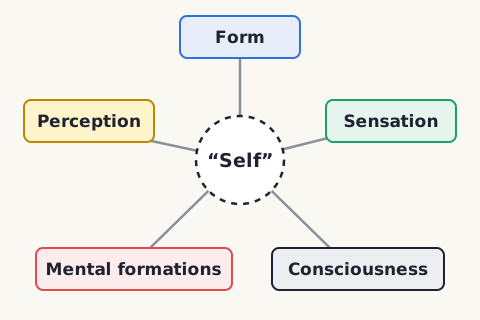
The concept of anatta proposes that what we perceive as the "self" is merely a collection of the five aggregates (skandhas): rupa (form/body), vedana (sensation), sanna (perception), sankhara (mental formations), and vinnana (consciousness). Each aggregate contributes to the experience of self but lacks permanence. This radical departure from the Hindu notion of an eternal atman challenges the deeply rooted belief in a fixed identity. By recognizing that the self is a dynamic interplay of these aggregates, practitioners can cultivate detachment and reduce suffering, leading to greater liberation.
The Modular Mind
In his book Why Buddhism Is True, Robert Wright presents a contemporary interpretation of anatta through the lens of evolutionary psychology. He posits that the human brain operates as a collection of modular subsystems, each evolved to fulfill specific functions and goals. This perspective suggests there is no singular "CEO self" directing our thoughts and actions; instead, our consciousness is a product of various competing modules. The sensation of a unified self is a post-hoc narrative, a useful fiction that helps us make sense of our experiences and navigate social interactions. This understanding aligns with Buddhist teachings on anatta, reinforcing the idea that clinging to a fixed self is an illusion that leads to suffering.
By studying these concepts, you will gain a deeper appreciation of Buddhist philosophy and its practical implications for understanding identity, suffering, and the nature of existence.
Karma, Rebirth and Nirvana
In this section, we explore the concepts of karma, rebirth, and nirvana within Buddhism, highlighting their significance and how they diverge from other belief systems.
Karma Is Intention, Not Fate
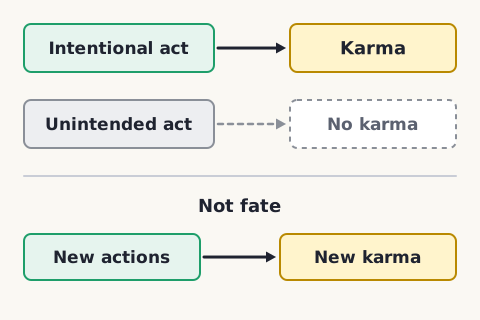
Karma is a fundamental principle in Buddhism, emphasizing that it is the intention behind actions that matters, rather than the actions themselves. This means that a well-intentioned act can generate positive karma, while an unintended harmful act does not carry the same weight. The concept of karma encourages individuals to cultivate mindfulness in their actions, understanding that their choices have consequences. This perspective empowers individuals to change their future by making conscious, ethical decisions, thus reinforcing the belief that one's future is not predetermined.
Rebirth Without a Soul
Buddhist rebirth presents a unique view compared to the idea of reincarnation found in Hinduism. The absence of a permanent self means that there is no soul that travels from one life to another. Instead, rebirth is conceptualized through the lens of causation—actions in one life create conditions for the next. This analogy of billiard balls illustrates that while the effects of past actions persist, there is no tangible entity that migrates. This understanding shifts the focus from a personal identity to the interconnectedness of actions and their consequences, emphasizing the transient nature of existence.
A Question the Buddha Wouldn't Answer
Nirvana, derived from the term meaning "extinguishing," signifies the cessation of suffering and the end of the cycle of samsara—the continuous cycle of birth, death, and rebirth. The Buddha's refusal to clarify whether nirvana equates to personal continuation or total annihilation highlights the limitations of language and thought in grasping ultimate reality. This ambiguity invites practitioners to look beyond the ego-illusion that binds them to suffering, fostering a deeper understanding of liberation. Nirvana represents not just a state of being, but a profound transformation in perception that transcends conventional dualities.
Nirvana and Parinirvana
Buddhist tradition reads the "blowing out" as the extinguishing of three fires, or poisons: greed (craving), hatred (aversion), and delusion (ignorance). It also distinguishes two stages. Nirvana can be reached during life, when the fires go out while body and mind, the five aggregates, carry on; the Buddha's awakening, traditionally placed at age 35, was of this kind, and he went on teaching for decades. Parinirvana, "complete" or final nirvana, is the state entered at death by someone who attained nirvana during life. Such a being is not reborn: the aggregates do not come together again in a new existence. The Buddha's death at about 80 in Kushinagar is remembered as his parinirvana.
In studying these concepts, one can appreciate how karma influences actions, how rebirth operates without a self, and how nirvana represents ultimate freedom from suffering. Understanding these principles is crucial for grasping the Buddhist path towards liberation and enlightenment.
Dependent Origination and Emptiness
Understanding Dependent Origination and Emptiness is crucial for grasping key Buddhist concepts that address the nature of existence and suffering. This section explores how phenomena interrelate and the implications of emptiness in Mahayana Buddhism.
Nothing Arises Independently
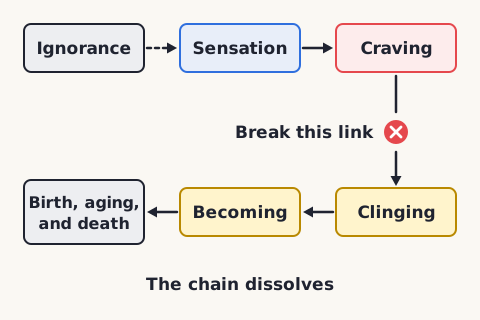
Dependent origination (pratityasamutpada) is a foundational principle in Buddhism, emphasizing that all phenomena arise due to specific causes and conditions. This interconnectedness is illustrated through the Twelve Nidanas, which detail a cyclical process from ignorance to suffering. Recognizing this chain allows individuals to identify where they can intervene, particularly at the level of craving, to break the cycle of suffering. This teaching highlights the importance of mindfulness and awareness in altering one’s experience of reality, ultimately leading to liberation.
Emptiness Is Not Nothingness
Sunyata, or emptiness, is a central tenet in Mahayana Buddhism, particularly articulated by the philosopher Nagarjuna. It asserts that all phenomena lack svabhava, meaning they do not possess an independent or inherent essence. Instead, their existence is relational, depending on various conditions and contexts. This perspective not only challenges our attachment to fixed identities but also emphasizes the fluidity of existence. Importantly, even the concept of emptiness is itself considered empty, reinforcing that no ultimate, unchanging reality exists outside of relational dynamics.
The Two Truths
The Two Truths doctrine provides a framework for understanding the implications of emptiness. Conventional truth (samvriti-satya) refers to the everyday experiences and perceptions we encounter in life, which are valid and practically useful. In contrast, ultimate truth (paramartha-satya) reveals that no phenomenon exists independently, aligning with the concept of sunyata. Both truths coexist and are non-dual, guiding practitioners away from extremes like nihilism, which denies reality, and eternalism, which falsely asserts permanence. This balance is essential for developing a nuanced understanding of reality and cultivating compassion as a Bodhisattva, who seeks enlightenment for the benefit of all beings.
Key terms
- Anicca
- Impermanence — the mark that nothing lasts; all phenomena arise and pass away.
- Anatta
- Non-self (Sanskrit anatman) — there is no permanent, unchanging self; the "I" is a process, not an entity.
- Karma
- "Action" — the law of cause and effect for intentional deeds; the weight of past intentions shaping the present, not fixed fate.
- Samsara
- "Wandering on" — the cycle of birth, aging, death, and rebirth driven by karma and craving, until liberation is reached.
- Nirvana
- "Extinguishing" or "blowing out" (Pali Nibbana) — the snuffing of craving, hatred, and delusion; freedom from samsara.
- Parinirvana
- The final, "complete" nirvana — the death of an enlightened being who will not be reborn.
- Pratityasamutpada
- Dependent origination — all phenomena arise from causes and conditions and cease when those conditions change; nothing arises independently.
- Sunyata
- Emptiness — not nothingness, but the absence of svabhava (inherent, independent existence); everything exists only in relation.
- Bodhisattva
- A being on the path to Buddhahood who, in Mahayana, vows to delay final nirvana to help all sentient beings reach liberation first.
Key concepts
Rupa
- One of five aggregates whose shifting interplay we mistake for a permanent, unified self.
- The only physical one among the five heaps, standing apart from the four mental components.
- The skandha glossed as form, or the material body.
Vedana
- A mental aggregate, one of five impermanent heaps that together fake the feeling of a fixed self.
- Among the five skandhas, the one glossed simply as sensation.
Sanna
- One of the five aggregates the Buddha said we wrongly cling to as an enduring identity.
- The skandha glossed as perception.
Sankhara
- A mental component of experience, one of the five heaps that lack any permanent core.
- The skandha glossed as mental formations.
Vinnana
- One of five aggregates whose combination produces the illusion of a single 'CEO self' in charge.
- The skandha glossed as consciousness.
Key facts

The Three Marks of Existence
Buddhism views all phenomena through three characteristics (ti-lakkhana): anicca (impermanence — nothing lasts), dukkha (unsatisfactoriness — life carries an inherent friction), and anatta (non-self — there is no permanent, unchanging self). Seeing all three clearly is what the tradition calls "right understanding."
No-Self and the Five Aggregates
Anatta is one of Buddhism's most radical teachings — a direct departure from the Hindu atman, the permanent soul. What we call "self" is really a shifting composite of five aggregates (skandhas): rupa (form/body), vedana (sensation), sanna (perception), sankhara (mental formations), and vinnana (consciousness). No aggregate, alone or combined, is a fixed self.

The Modular Mind
In Why Buddhism Is True (2017), Robert Wright reframes no-self in evolutionary terms: the brain is a set of modular subsystems, each shaped by natural selection to chase a different goal. There is no single "CEO self" running the show — what feels like unified consciousness is really a committee of competing modules, and the sense of one unified self is a useful fiction assembled after the fact.
Denying an eternal soul
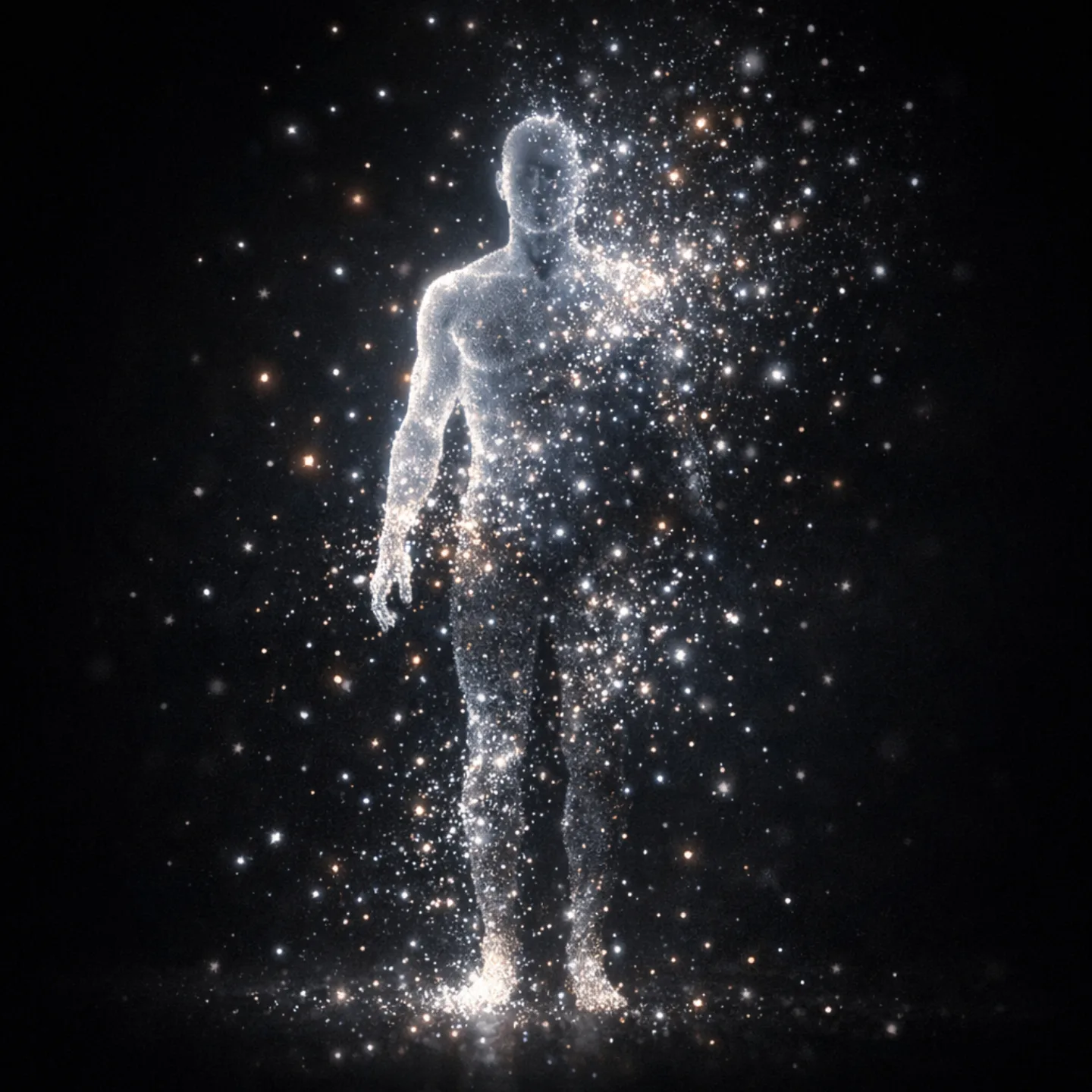
Buddhism's teaching of anatta, or non-self, directly rejects the Hindu concept of atman — an eternal, unchanging soul believed to pass unchanged from life to life.
What Rupa really means
Of the five aggregates that make up the self, Rupa is form, the physical body. The others are vedana (sensation), sanna (perception), sankhara (mental formations), and vinnana (consciousness).
Karma Is Intention, Not Fate
Karma literally means "action" — the law of cause and effect applied to intentional deeds. The key word is intention: an unintended harmful act generates no karma in the Buddhist sense. And karma is not fate or predestination — it is the accumulated weight of past intentional actions shaping the present. New actions create new karma, so no future is locked in.
Rebirth Without a Soul
Buddhist rebirth differs from Hindu reincarnation: there is no transmigrating soul, because there is no permanent self. Karma is likened instead to one billiard ball striking another — nothing physical passes across, yet the speed and direction of the second ball are caused entirely by the first. A candle lighting another candle works the same way: the flame continues, but no "thing" travels.
A Question the Buddha Wouldn't Answer
Nirvana means "extinguishing" — as one blows out a candle — the extinction of craving, hatred, and delusion, and freedom from samsara. The Buddha refused to be drawn on whether nirvana means personal continuation or annihilation, noting that the question itself springs from the very ego-illusion that nirvana dissolves.

Karma Literally Means Action
In Buddhism, the word karma literally means "action." It names the law of cause and effect arising from intentional deeds, not a mystical or external force.
Nirvana Means Extinguishing
The word nirvana (Pali: Nibbana) literally means "extinguishing" or "blowing out," as one might snuff a candle — describing the extinguishing of craving and suffering.
Nothing Arises Independently
Dependent origination (pratityasamutpada) is the teaching that nothing arises on its own: all phenomena arise from causes and conditions, and cease when those conditions change. It is pictured as the Twelve Nidanas — a chain running from ignorance through sensation, craving, clinging, becoming, and finally birth, aging, and death. See the chain clearly and you can intervene: break the link of craving, and the chain to suffering dissolves.

Emptiness Is Not Nothingness
Sunyata (emptiness) is the signature Mahayana doctrine, developed most systematically by Nagarjuna (c. 150–250 CE). It does not mean "nothingness." It means all phenomena are empty of svabhava — independent, inherent, self-contained existence. Everything exists only in relation to everything else, echoing dependent origination. Even emptiness itself is "empty" — it is no absolute realm floating above the world.

The Two Truths
The Two Truths doctrine explains how emptiness works. Conventional truth (samvriti-satya) is the everyday world of tables, selves, and fire burning — valid and usable. Ultimate truth (paramartha-satya) is that, at the deepest level, no phenomenon exists independently — this is sunyata. Both are "true," and their relationship is non-dual. Together they steer between nihilism (denying the world exists) and eternalism (claiming things are solid and permanent).
The Twelve Nidanas
The chain of dependent origination is traditionally pictured as twelve links, or nidanas, running from ignorance through craving and clinging to suffering.
The Bodhisattva Vow
In Mahayana Buddhism, a bodhisattva is a being on the path to Buddhahood who vows to delay their own final nirvana in order to help all beings reach liberation first.
By the numbers
- How many aggregates (skandhas) make up what we call the self?
- 5 aggregates
- How many links (nidanas) are in the chain of dependent origination?
- 12 links
Matched pairs
Each item on the left goes with the one on the right.
- Rupa
- Form — the physical body
- Vedana
- Sensation — the feeling-tone of experience (pleasant, unpleasant, neutral)
- Sanna
- Perception — recognition and identification of objects
- Sankhara
- Mental formations — volitions, emotions, and intentions
- Vinnana
- Consciousness — awareness of sense objects
Self-test
Answer each question from memory, then check your work against the answer key.
1. The Buddhist doctrine of anatta (non-self) is a radical departure from the Hindu belief in what?
- Amoksha — liberation from rebirth
- Bmaya — the illusory nature of the world
- Catman — an eternal, unchanging self or soul
- Ddharma — cosmic law and duty
2. Which of the three marks of existence means impermanence — that nothing lasts?
- AAnatta
- BAnicca
- CSamsara
- DDukkha
3. Which of the following is NOT one of the three marks of existence (ti-lakkhana)?
- AKarma
- BAnicca
- CAnatta
- DDukkha
4. What does the doctrine of anatta claim about the self?
- AThe self is pure consciousness untouched by change
- BThe self is an eternal soul reborn intact
- CThe self dissolves only at death, not before
- DThere is no permanent, unchanging self; the "I" is a process
5. Robert Wright's Why Buddhism Is True describes the brain as competing modular subsystems with no single "CEO" in charge. This is a modern argument for which mark?
- ADukkha
- BAnatta
- CAnicca
- DKarma
6. How many aggregates (skandhas) combine to make up what we call the self?
- ATwelve
- BThree
- CFive
- DFour
7. Which aggregate is form — the physical body?
- ARupa
- BVedana
- CSanna
- DVinnana
8. The aggregate of vedana covers which part of experience?
- AThe physical body and its form
- BAwareness of sense objects
- CRecognition and identification of objects
- DSensation — the feeling-tone (pleasant, unpleasant, neutral)
9. Which of these is NOT one of the five aggregates?
- AAtman
- BVinnana
- CSanna
- DSankhara
10. Which aggregate is defined as mental formations — volitions, emotions, and intentions?
- ASanna
- BVedana
- CSankhara
- DRupa
11. In Buddhism, what most determines whether an action generates karma?
- AThe social status of the person acting
- BThe intention behind it
- CIts visible consequences
- DWhether it breaks a monastic rule
12. Someone accidentally harms another person. How does the Buddhist teaching on karma treat that act?
- AIt weighs as much as a deliberate harm because karma is measured by the harm done
- BIt seals a harmful future for whoever did it because karma is predestined
- CIt travels to the next life in an eternal soul because karma is stored there
- DIt counts for less than a deliberate harm because karma depends on intention
13. What does samsara refer to in Buddhism?
- AThe absence of inherent existence in things
- BThe karma-driven cycle of birth, aging, death, and rebirth
- CThe final extinction of craving and delusion
- DThe intention behind a moral action
14. How does Buddhist rebirth differ from Hindu reincarnation?
- ARebirth ends automatically after a fixed number of lives
- BThe same personality is preserved across every life
- CNo soul transmigrates; karma passes like one billiard ball striking another
- DAn eternal soul moves intact into a new body
15. Which statement about karma is TRUE in Buddhism?
- AIt is decided solely by visible consequences
- BIt is generated by any act, intended or not
- CIt is predestination that cannot be changed
- DIt is shaped by past intentions but is not fixed fate
16. The word nirvana literally means what?
- A"Extinguishing" or "blowing out"
- B"Wandering on"
- C"Action"
- D"Complete self"
17. What does parinirvana specifically refer to?
- AThe first moment craving is extinguished in life
- BThe final, complete nirvana at the death of an enlightened being not reborn
- CThe cycle of rebirth driven by karma
- DThe everyday world of conventional truth
18. What best distinguishes nirvana from parinirvana?
- ANirvana is the extinguishing of craving in life; parinirvana is the final passing of that being
- BNirvana applies to gods; parinirvana applies to humans
- CNirvana is reached only after death; parinirvana is reached during life
- DThey are two words for the exact same event
19. Nirvana is described as the snuffing out of which three things?
- AAnicca, dukkha, and anatta
- BBody, sensation, and perception
- CIgnorance, birth, and death
- DCraving, hatred, and delusion
20. A teacher snuffs out craving, hatred, and delusion at 35, teaches for decades, then dies at 80, never to be reborn. What is that death called?
- ASamsara
- BNirvana
- CParinirvana
- DReincarnation
21. When Mahayana says all things are "empty," they are empty OF what?
- ASvabhava — independent, inherent existence
- BKarma and its consequences
- CAny existence whatsoever
- DSuffering and craving
22. What is the core claim of dependent origination (pratityasamutpada)?
- AA first cause set all phenomena in motion once
- BEverything arises spontaneously without any cause
- CNothing arises on its own; all phenomena arise from causes and conditions
- DOnly the mind is real; matter is illusion
23. The chain of dependent origination is pictured as how many links (nidanas)?
- AEight
- BTwelve
- CThree
- DFive
24. The Two Truths doctrine keeps sunyata from collapsing into which two extremes?
- AConventional truth and ultimate truth
- BSamsara and nirvana
- CKarma and rebirth
- DNihilism, which denies reality, and eternalism, which asserts permanence
25. In Mahayana, what defines a bodhisattva?
- AA teacher who denies that emptiness exists
- BOne who has already entered parinirvana
- COne who vows to delay final nirvana to help all beings reach liberation first
- DA monk who has memorized the Twelve Nidanas
Go deeper
Answer key
- 1. C atman — an eternal, unchanging self or soulAnatta holds that the 'self' is only the five ever-changing aggregates, with no permanent core — directly denying the Hindu atman, the eternal soul thought to pass unchanged through lives.
- 2. B AniccaAnicca is the mark of impermanence: all phenomena arise and pass away. Dukkha is unsatisfactoriness and anatta is non-self.
- 3. A KarmaThe three marks are anicca (impermanence), dukkha (unsatisfactoriness), and anatta (non-self). Karma is the law of intentional action, not a mark of existence.
- 4. D There is no permanent, unchanging self; the "I" is a processAnatta (non-self) holds there is no permanent, unchanging self — the "I" is a process, not an entity, a shifting composite of the five aggregates.
- 5. B AnattaWright reframes anatta in evolutionary terms: unified consciousness is a post-hoc narrative told by a committee of modules. Anicca is impermanence and dukkha is unsatisfactoriness.
- 6. C FiveThe self is a composite of five aggregates: rupa, vedana, sanna, sankhara, and vinnana. Twelve refers to the nidanas of dependent origination.
- 7. A RupaRupa is form, the physical body. Vedana is sensation, sanna is perception, and vinnana is consciousness.
- 8. D Sensation — the feeling-tone (pleasant, unpleasant, neutral)Vedana is sensation, the feeling-tone of experience. Recognition is sanna, form is rupa, and awareness is vinnana.
- 9. A AtmanThe five aggregates are rupa, vedana, sanna, sankhara, and vinnana. Atman is the Hindu eternal soul that Buddhism denies — not an aggregate.
- 10. C SankharaSankhara is mental formations: volitions, emotions, and intentions. Sanna is perception, vedana is sensation, and rupa is the physical body.
- 11. B The intention behind itKarma means 'action,' but the key is intention: a well-meant act builds positive karma while an accidental harm carries no karmic weight. Karma is not fixed fate — new choices shape the future.
- 12. D It counts for less than a deliberate harm because karma depends on intentionKarma depends on the intention behind an act, so an unintended harm does not carry the same weight as a deliberate one. The damage alone does not decide it.
- 13. B The karma-driven cycle of birth, aging, death, and rebirthSamsara ("wandering on") is the cycle of birth, aging, death, and rebirth driven by karma and craving, until liberation. Extinction of craving is nirvana.
- 14. C No soul transmigrates; karma passes like one billiard ball striking anotherBecause there is no permanent self, no soul transmigrates. Karma is likened to a billiard ball striking another: nothing physical crosses, yet the effect is caused entirely by the first.
- 15. D It is shaped by past intentions but is not fixed fateKarma is the weight of past intentional actions shaping the present, not predestination — new choices change the future. Unintended harm generates no karma.
- 16. A "Extinguishing" or "blowing out"Nirvana (Pali Nibbana) means "extinguishing" or "blowing out," as one snuffs a candle. "Wandering on" is samsara and "action" is karma.
- 17. B The final, complete nirvana at the death of an enlightened being not rebornParinirvana is the final, "complete" nirvana — the death of an enlightened being who will not be reborn. Nirvana itself can be attained while still alive.
- 18. A Nirvana is the extinguishing of craving in life; parinirvana is the final passing of that beingNirvana is the snuffing of craving, hatred, and delusion — attainable in life. Parinirvana is the final, complete nirvana at the death of one who will not be reborn.
- 19. D Craving, hatred, and delusionNirvana extinguishes craving, hatred, and delusion, bringing freedom from samsara. The three marks (anicca, dukkha, anatta) are characteristics of existence, not defilements.
- 20. C ParinirvanaHe reached nirvana at 35, while alive. Parinirvana is the final, "complete" nirvana — the death of an enlightened being who will not be reborn.
- 21. A Svabhava — independent, inherent existenceEmptiness means lacking svabhava — inherent, self-contained existence — not lacking existence altogether. Things exist, but only in dependence on other things.
- 22. C Nothing arises on its own; all phenomena arise from causes and conditionsPratityasamutpada teaches that nothing arises independently — all phenomena arise from causes and conditions and cease when those conditions change.
- 23. B TwelveThe chain of dependent origination has twelve nidanas, running from ignorance through craving and clinging to suffering. Five is the number of aggregates.
- 24. D Nihilism, which denies reality, and eternalism, which asserts permanenceConventional and ultimate truth are both "true" and non-dual — together they steer between nihilism (nothing is real) and eternalism (things are permanent). They are the framework, not the extremes.
- 25. C One who vows to delay final nirvana to help all beings reach liberation firstA bodhisattva is a being on the path to Buddhahood who, in Mahayana, vows to delay final nirvana to help all sentient beings reach liberation first.
Sources
- Encyclopaedia Britannica — Anatta — www.britannica.com/topic/anatta
- Lion's Roar — Emptiness (Sunyata) — www.lionsroar.com/buddhism/emptiness-sunyata/
- Wikipedia — Nirvana (Buddhism) — en.wikipedia.org/wiki/Nirvana_(Buddhism)
- Wikipedia — Parinirvana — en.wikipedia.org/wiki/Parinirvana
Image credits
- The Three Marks of Existence: AI-generated (gpt-image-1.5)
- No-Self and the Five Aggregates: FlashFeed original diagram · CC-BY-4.0
- The Modular Mind: AI-generated (gpt-image-1.5)
- Denying an eternal soul: AI-generated (gpt-image-1.5)
- Karma Is Intention, Not Fate: FlashFeed original diagram · CC-BY-4.0
- Karma Literally Means Action: AI-generated (gpt-image-1.5)
- Nothing Arises Independently: FlashFeed original diagram · CC-BY-4.0
- Emptiness Is Not Nothingness: AI-generated (gpt-image-1.5)
- The Two Truths: AI-generated (gpt-image-1.5)