
Buddhism: A Deep Study study guide · Lesson 4 of 13
The Three Vehicles
Theravada, Mahayana, Vajrayana · Schools of Mahayana
This is the lesson's study guide from the FlashFeed app, plus its key facts and a self-test.
What you'll be able to do
- Distinguish the three vehicles — Theravada, Mahayana, and Vajrayana — by their defining features.
- Contrast the Theravada arhat ideal with the Mahayana bodhisattva ideal, and recognize Vipassana and the Vinaya in Theravada practice.
- Match each vehicle to the regions where it predominates and recall when the Pali Canon was written down.
- Identify the major Mahayana schools (Zen, Pure Land, Nichiren, Madhyamaka, Yogacara) by their signature practice or philosophy.
- Explain Zen and the koan as tools for direct insight beyond scripture.
Theravada, Mahayana, Vajrayana
Buddhism is traditionally categorized into three main "vehicles," each offering distinct paths toward enlightenment. Understanding these vehicles—Theravada, Mahayana, and Vajrayana—is crucial for grasping the diversity within Buddhist practice and philosophy.
The Three Vehicles
Buddhism is divided into three vehicles or yanas: Theravada, which emphasizes individual enlightenment; Mahayana, which focuses on the collective liberation of all beings; and Vajrayana, which incorporates esoteric practices. While these vehicles share core teachings, they differ in their approaches and interpretations. For example, Mahayana introduces the concept of the Bodhisattva, a being who seeks enlightenment not just for themselves but for all sentient beings, contrasting with the Arhat ideal in Theravada, which prioritizes personal liberation.
In the Theravada tradition, insight into the Four Noble Truths is itself liberating. An arhat (Sanskrit, "one who is worthy") is a perfected person who has gained that insight and reached nirvana in this life. Because the bonds that tie a being to samsara have been dissolved, an arhat will not be reborn after death.
The Three Baskets
The foundational text of Theravada is the Pali Canon or Tipitaka, which consists of three sections known as the Three Baskets. The Vinaya outlines monastic discipline, the Sutta contains the Buddha's teachings, and the Abhidhamma provides a detailed analysis of Buddhist philosophy and psychology. This canon is central to Theravada practice and belief, guiding practitioners in their spiritual development. The primary practice, Vipassana or insight meditation, aims to cultivate deep awareness and understanding of the nature of reality, leading to enlightenment.
Mantras, Mandalas, and the Guru
Vajrayana is often described as the "Diamond Vehicle" because of its focus on achieving enlightenment swiftly, potentially within a single lifetime. This tradition utilizes tantric practices, which include mantras—sacred phrases believed to embody spiritual power—and mandalas, intricate diagrams that represent the universe and aid in meditation. Mudras, or sacred hand gestures, are also employed to channel energy during rituals. A critical aspect of Vajrayana is the relationship with a guru, or teacher, who provides guidance and empowerment. The Dalai Lama is a prominent figure within this tradition, symbolizing its teachings and practices on a global scale.
In summary, each vehicle of Buddhism presents unique teachings and practices, with Theravada focusing on personal enlightenment, Mahayana emphasizing collective liberation, and Vajrayana offering rapid paths through esoteric rituals. Understanding these distinctions enhances the appreciation of Buddhism's rich tapestry.
Schools of Mahayana
Mahayana Buddhism encompasses a rich tapestry of schools, each with unique practices and philosophies. This guide delves into the essential teachings and historical contexts of these schools, enhancing understanding of their significance in the broader Mahayana tradition.
Zen: Pointing Directly at the Mind
Zen emphasizes direct experience over reliance on texts, a principle that distinguishes it from other Buddhist traditions. The practice of koans serves as a tool to transcend logical reasoning, prompting practitioners to confront their own minds and awaken to their true nature. The legendary figure of Bodhidharma, traditionally credited with transmitting Chan Buddhism to China, symbolizes the transformative journey of Zen, the Japanese form of Chan, which later flourished in Japan. This focus on personal insight resonates deeply with the essence of Mahayana, encouraging practitioners to find enlightenment within themselves.
Pure Land: Calling the Name
Pure Land Buddhism offers a devotional path rooted in the belief in Amitabha Buddha and his pure realm, Sukhavati. The practice of the nembutsu, reciting "Namu Amida Butsu" ("Homage to Amitabha Buddha"), is central, as it embodies faith and reliance on Amitabha's compassion for rebirth in a conducive environment for enlightenment. This school appeals to many who seek a more accessible approach to Buddhist practice, contrasting with the often rigorous meditative techniques found in Zen. The interplay between Pure Land and Zen illustrates the diverse paths available within Mahayana, each catering to different spiritual aspirations.
Nichiren: One Sutra Above All
The teachings of Nichiren revolutionized Japanese Buddhism by elevating the Lotus Sutra as the ultimate truth. His assertive stance against rival schools and governmental authority reflects a passionate commitment to his beliefs. By reducing complex practices to the simple act of chanting "Nam Myoho Renge Kyo," Nichiren made Buddhism accessible to the layperson. In the generations since, organizations like Soka Gakkai International have carried his teachings to a global lay audience, extending Nichiren's vision far beyond Japan.
Two Philosophies: Emptiness and Mind-Only
Mahayana's philosophical depth is captured in the Madhyamaka and Yogacara schools. Madhyamaka, founded by Nagarjuna, scrutinizes the concept of emptiness (sunyata), asserting that all phenomena lack inherent existence. This idea challenges practitioners to reconsider their perceptions of reality. In contrast, Yogacara, developed by Vasubandhu and Asanga, posits that our experiences are mere projections of consciousness, emphasizing the role of the mind in shaping reality. Together, these philosophies enrich the understanding of Mahayana, inviting deeper contemplation on the nature of existence and perception.
Key terms
- Theravada
- "Way of the Elders" — the oldest surviving school, claiming to preserve the Buddha's earliest teachings in the Pali Canon.
- Mahayana
- "Great Vehicle" — the broad later movement built around the bodhisattva ideal and the doctrine of emptiness.
- Vajrayana
- "Diamond" or "Thunderbolt Vehicle" — an esoteric branch of Mahayana using tantric ritual to seek awakening swiftly.
- Arhat
- A "perfected person" who has fully understood the Four Noble Truths and will not be reborn — the Theravada ideal of individual liberation.
- Bodhisattva
- A being on the path to Buddhahood who vows to delay final nirvana in order to help all sentient beings reach liberation — the Mahayana ideal.
- Vinaya
- The basket of Theravada's Pali Canon that outlines monastic discipline.
- Koan
- A paradoxical question or statement used in Zen to short-circuit discursive thinking and provoke direct insight.
- Zen
- Zen is a Mahayana school that grew in China as Chan and flowered in Japan, stressing direct insight through seated meditation. Zen is known for its terse koans and spare aesthetic.
Key concepts
Theravada
- One of Buddhism's three great vehicles, or yanas.
- The vehicle that stresses individual enlightenment, holding up the Arhat as its ideal.
- Its foundational text is the Pali Canon (Tipitaka); its core practice is Vipassana insight meditation.
Mahayana
- One of the three yanas, or vehicles, into which Buddhism is divided.
- The vehicle focused on the collective liberation of all beings rather than personal escape.
- It introduced the Bodhisattva ideal — seeking enlightenment for the sake of every sentient being.
Vajrayana
- The most esoteric of the three vehicles, built on tantric ritual.
- Nicknamed the 'Diamond Vehicle' for aiming at enlightenment within a single lifetime.
- It works through mantras, mandalas, mudras, and a bond with a guru; the Dalai Lama is its best-known figure.
Key facts
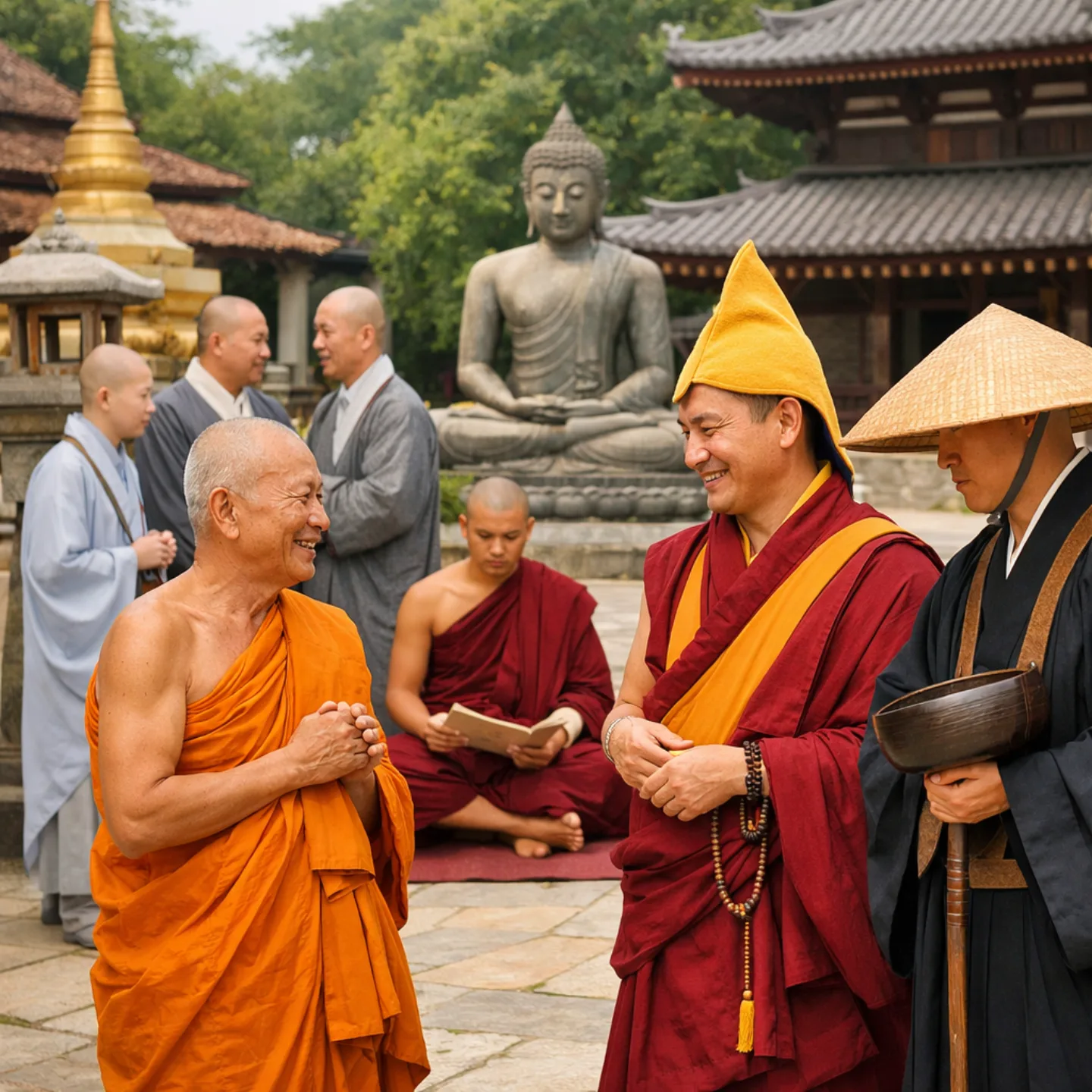
The Three Vehicles
Buddhism is traditionally divided into three great "vehicles" (yana): Theravada, the "Way of the Elders"; Mahayana, the "Great Vehicle"; and Vajrayana, the "Diamond Vehicle." They are not rival religions so much as overlapping streams — Vajrayana, for instance, is built atop Mahayana — but each carries its own ideal, canon, and home territory.
The Three Baskets
Theravada's foundational text is the Pali Canon (Tipitaka, "Three Baskets"), written down in Sri Lanka around 80 BCE after centuries of oral transmission. The three baskets are the Vinaya (monastic rules), the Sutta (the Buddha's discourses), and the Abhidhamma (philosophical and psychological analysis). Its central practice is Vipassana, or insight meditation.
Theravada: Oldest Surviving School
Theravada, the "Way of the Elders," is the oldest surviving Buddhist school. It preserves the Buddha's earliest teachings in the Pali Canon.
The Arhat Ideal
In Theravada Buddhism, an arhat is the ideal of a "perfected person" — someone who has understood the Four Noble Truths, reached liberation, and will not be reborn.
Pure Land: Calling the Name
Pure Land Buddhism centers on devotion to Amitabha Buddha ("Infinite Light"), who created a pure realm, Sukhavati, where those who call on his name with sincere faith are reborn and can easily attain enlightenment. The core practice is the nembutsu — reciting "Namu Amida Butsu" ("Homage to Amitabha Buddha"). Pure Land and Zen became the dominant schools across East Asia.
Nichiren: One Sutra Above All
The 13th-century Japanese monk Nichiren (1222–1282) declared the Lotus Sutra the supreme teaching and reduced all practice to chanting "Nam Myoho Renge Kyo" ("Homage to the Lotus Sutra"). Famously combative, he attacked rival schools and the government alike. A modern branch, Soka Gakkai International, is now a vast global lay organization.
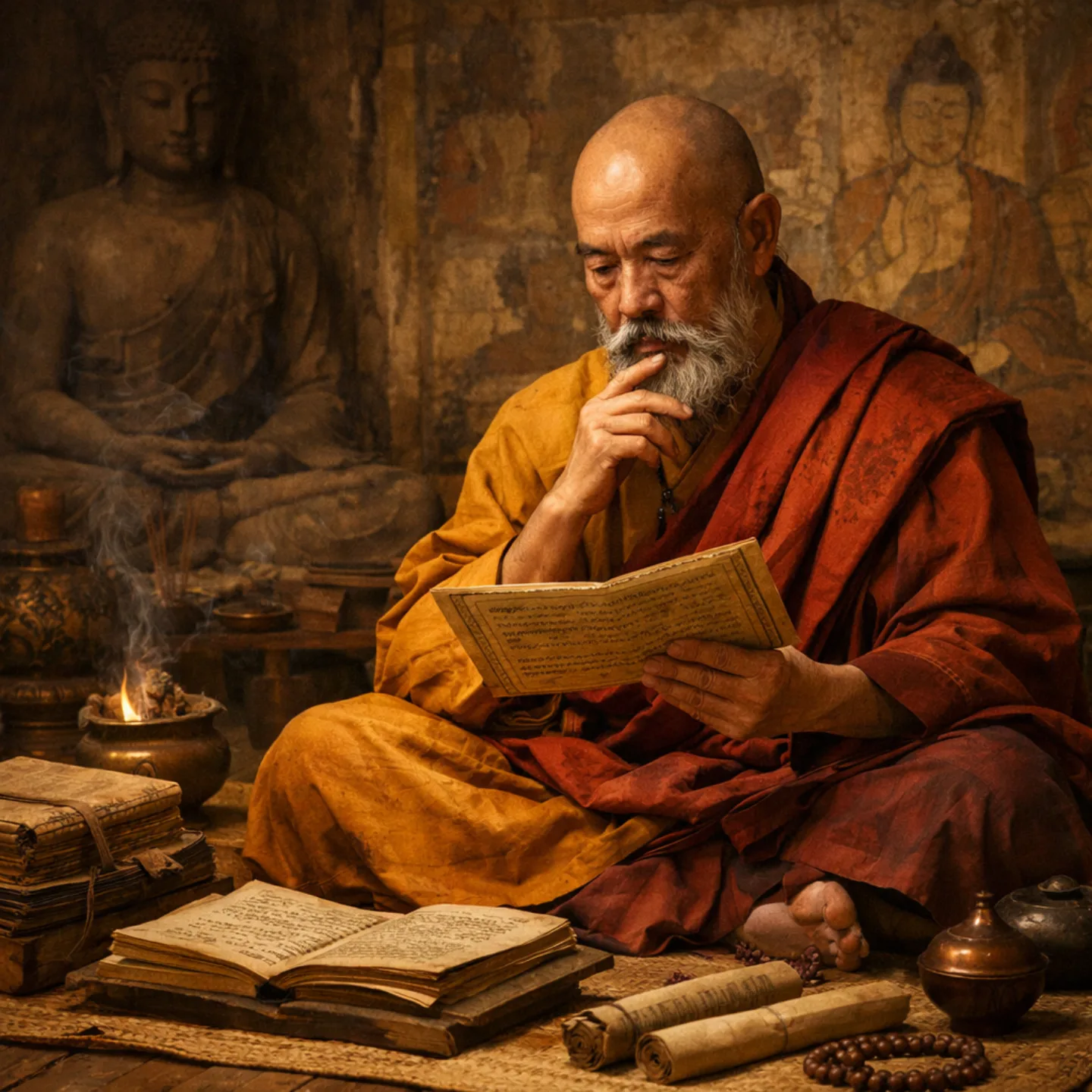
Two Philosophies: Emptiness and Mind-Only
Mahayana produced two great philosophical schools. Madhyamaka ("Middle Way school"), founded by Nagarjuna (c. 150–250 CE), analyzes emptiness (sunyata) rigorously — arguing that nothing exists independently. Yogacara ("Mind-Only school"), developed by Vasubandhu and Asanga (4th–5th century CE), proposes that all phenomena are projections of consciousness — vijnapti-matrata, "representation-only."
Bodhidharma Founded Zen
The semi-legendary Indian monk Bodhidharma, said to have gazed at a wall for nine years, is traditionally credited with bringing meditation practice to China and founding Chan, or Zen.
By the numbers
- Approximate year the Pali Canon was written down in Sri Lanka
- -80 BCE
Matched pairs
Each item on the left goes with the one on the right.
- Theravada
- Sri Lanka and Southeast Asia (Thailand, Myanmar, Laos, Cambodia)
- Mahayana
- China, Japan, Korea, Vietnam
- Vajrayana
- Tibet, Nepal, Mongolia, Bhutan
- Zen / Chan
- Meditation and koans, direct experience over scripture
- Pure Land
- Reciting the nembutsu, "Namu Amida Butsu"
- Nichiren
- Chanting "Nam Myoho Renge Kyo" to the Lotus Sutra
- Madhyamaka (Nagarjuna)
- Rigorous analysis of emptiness (sunyata)
- Yogacara (Vasubandhu & Asanga)
- Mind-Only: all phenomena are projections of consciousness
Self-test
Answer each question from memory, then check your work against the answer key.
1. Which vehicle is known for mantras, mandalas, and the guru relationship?
- AMahayana
- BVajrayana
- CTheravada
2. Which statement correctly describes the Mahayana vehicle?
- AIt relies on mantras, mandalas, and the guru relationship
- BIt prioritizes personal liberation through the arhat ideal
- CIt centers on Vipassana, or insight meditation
- DIt focuses on the collective liberation of all beings
3. Which vehicle takes the Pali Canon, or Tipitaka, as its foundational text?
- AMahayana
- BZen
- CTheravada
- DVajrayana
4. Which vehicle offers a rapid path to awakening through esoteric ritual?
- AVajrayana
- BChan
- CTheravada
- DMahayana
5. Which of the following is NOT one of Buddhism's three vehicles?
- AMahayana
- BTheravada
- CVajrayana
- DNichiren
6. What is the Theravada ideal of a "perfected person" who has understood the Four Noble Truths and will not be reborn?
- AArhat
- BGuru
- CLayperson
- DBodhisattva
7. What does a bodhisattva vow to do?
- AMaster tantric ritual to awaken in one lifetime
- BDelay final nirvana to help all sentient beings reach liberation
- CPreserve the Pali Canon through oral transmission
- DAttain personal liberation and exit the cycle of rebirth alone
8. What happens to an arhat after reaching liberation, in Theravada teaching?
- AThey wait for the next Buddha
- BThey become a guru for students
- CThey will not be reborn
- DThey are reborn as a bodhisattva
9. Which practice is Theravada's primary practice, leading toward the arhat's liberation?
- AKoan contemplation
- BVipassana
- CNembutsu chanting to Amitabha
- DTantric guru empowerment
10. The arhat ideal prioritizes which goal, in contrast to the bodhisattva's aim of universal liberation?
- ASwift awakening through tantra
- BRebirth in a pure land
- CCollective salvation of all beings
- DIndividual liberation
11. In which regions does Theravada predominate?
- AChina, Japan, Korea, and Vietnam
- BCentral Asia and the Middle East
- CSri Lanka and Southeast Asia (Thailand, Myanmar, Laos, Cambodia)
- DTibet, Nepal, Mongolia, and Bhutan
12. Vajrayana is the dominant form of Buddhism in which regions?
- ATibet, Nepal, Mongolia, and Bhutan
- BChina, Japan, and Korea
- CSri Lanka and Vietnam
- DThailand, Myanmar, and Cambodia
13. Which set of regions is most associated with Mahayana Buddhism?
- AMongolia and Bhutan
- BChina, Japan, Korea, Vietnam
- CTibet, Nepal, and Bhutan
- DSri Lanka, Thailand, and Laos
14. Approximately when was the Pali Canon written down in Sri Lanka?
- AAround 100 CE
- BAround 500 BCE
- CAround 80 BCE
- DAround 250 CE
15. Which region is NOT traditionally a Theravada stronghold?
- ACambodia
- BMyanmar
- CThailand
- DTibet
16. Who is credited with bringing meditation practice to China and founding Chan/Zen?
- ABodhidharma
- BNagarjuna
- CAmitabha
- DNichiren
17. What is the central practice of Pure Land Buddhism?
- AChanting "Nam Myoho Renge Kyo"
- BReciting the nembutsu, "Namu Amida Butsu"
- CMeditating on paradoxical koans
- DAnalyzing the emptiness of all phenomena
18. Nichiren reduced Buddhist practice to chanting which phrase, honoring which text?
- A"Om Mani Padme Hum" — a Vajrayana mantra
- B"Namu Amida Butsu" — the name of Amitabha
- C"Nam Myoho Renge Kyo" — the Lotus Sutra
- D"Gate Gate Paragate" — the Heart Sutra
19. The Madhyamaka school, founded by Nagarjuna, is defined by its rigorous analysis of what?
- AEmptiness (sunyata)
- BMind-Only consciousness
- CDevotion to Amitabha
- DThe supremacy of the Lotus Sutra
20. Yogacara, developed by Vasubandhu and Asanga, is known as which school?
- AThe Pure Land school
- BThe Middle Way school
- CThe Diamond Vehicle
- DThe Mind-Only school
21. What is a koan?
- AA sacred hand gesture used in ritual
- BA geometric diagram of the universe
- CA paradoxical question or statement used to short-circuit discursive thinking
- DA devotional chant calling on a Buddha's name
22. Zen distinguishes itself from other traditions by emphasizing what over reliance on texts?
- ADirect experience
- BScriptural memorization
- CDevotional faith
- DTantric ritual
23. Zen is the Japanese form of which Chinese school of Buddhism?
- AYogacara
- BChan
- CMadhyamaka
- DPure Land
24. Which of the following is NOT associated with Zen practice?
- AKoans
- BDirect insight
- CSeated meditation
- DMandalas
25. A Zen teacher hands a student the riddle "What was your original face before your parents were born?" What is this device called?
- AA mantra
- BA koan
- CA mandala
- DA mudra
Go deeper
Answer key
- 1. B VajrayanaMantras, mandalas, mudras, and the guru-disciple empowerment are the signature tools of Vajrayana, the "Diamond Vehicle."
- 2. D It focuses on the collective liberation of all beingsMahayana focuses on the collective liberation of all beings and introduces the bodhisattva, in contrast to the arhat ideal. The other three statements describe Theravada and Vajrayana.
- 3. C TheravadaThe Pali Canon, or Tipitaka, is the foundational text of Theravada. Zen is a school within Mahayana, not a vehicle of its own.
- 4. A VajrayanaVajrayana offers rapid paths through esoteric rituals and is often called the "Diamond Vehicle" for its focus on swift awakening. Chan is a school within Mahayana, not a vehicle.
- 5. D NichirenThe three vehicles are Theravada, Mahayana, and Vajrayana. Nichiren is a school within Mahayana, not a vehicle of its own.
- 6. A ArhatThe Arhat ideal in Theravada, which prioritizes personal liberation, contrasts with the Mahayana Bodhisattva, who seeks enlightenment for all sentient beings. A guru is the Vajrayana teacher.
- 7. B Delay final nirvana to help all sentient beings reach liberationThe Mahayana bodhisattva delays final nirvana to help all beings. Seeking personal liberation alone is the arhat ideal; the other options describe Theravada and Vajrayana concerns.
- 8. C They will not be rebornThe arhat is a 'perfected person' who has understood the Four Noble Truths and will not be reborn — the Theravada ideal of individual liberation.
- 9. B VipassanaTheravada's primary practice is Vipassana, or insight meditation, aimed at cultivating the awareness that leads toward the arhat's liberation.
- 10. D Individual liberationThe Theravada arhat prioritizes individual liberation, whereas the Mahayana bodhisattva seeks the liberation of all sentient beings.
- 11. C Sri Lanka and Southeast Asia (Thailand, Myanmar, Laos, Cambodia)Theravada predominates in Sri Lanka and mainland Southeast Asia. Tibet/Nepal/Mongolia is Vajrayana country; East Asia is Mahayana.
- 12. A Tibet, Nepal, Mongolia, and BhutanVajrayana predominates across the Himalayan and Mongolian world. Thailand/Myanmar is Theravada; China/Japan/Korea is Mahayana.
- 13. B China, Japan, Korea, VietnamMahayana spread across East Asia — China, Japan, Korea, and Vietnam. The Himalayan regions are Vajrayana; Sri Lanka and Southeast Asia are Theravada.
- 14. C Around 80 BCEThe Pali Canon (Tipitaka) was committed to writing in Sri Lanka around 80 BCE, after centuries of oral transmission.
- 15. D TibetTibet is the heartland of Vajrayana, not Theravada. Thailand, Myanmar, and Cambodia are all Theravada countries.
- 16. A BodhidharmaBodhidharma, the semi-legendary Indian monk who reportedly gazed at a wall for nine years, is traditionally credited with founding Chan (Zen) in China.
- 17. B Reciting the nembutsu, "Namu Amida Butsu"Pure Land's core practice is the nembutsu, calling Amitabha's name. Koans are Zen; the Lotus chant is Nichiren; emptiness analysis is Madhyamaka.
- 18. C "Nam Myoho Renge Kyo" — the Lotus SutraNichiren elevated the Lotus Sutra and reduced practice to chanting "Nam Myoho Renge Kyo." The other chants belong to Pure Land and Vajrayana.
- 19. A Emptiness (sunyata)Madhyamaka analyzes emptiness (sunyata), arguing nothing exists independently. Mind-Only is Yogacara; the other options are Pure Land and Nichiren.
- 20. D The Mind-Only schoolYogacara is the "Mind-Only" school, holding that phenomena are projections of consciousness. "Middle Way" is Madhyamaka; the Diamond Vehicle is Vajrayana.
- 21. C A paradoxical question or statement used to short-circuit discursive thinkingA koan is a paradox used in Zen to provoke direct insight beyond logic. The distractors describe a mudra, the nembutsu, and a mandala.
- 22. A Direct experienceZen prizes direct experience — pointing directly at the mind — over textual study. Tantric ritual is Vajrayana; devotional faith is Pure Land.
- 23. B ChanZen is the Japanese form of Chan, the school Bodhidharma is traditionally credited with transmitting to China. Pure Land, Madhyamaka and Yogacara are different Mahayana schools.
- 24. D MandalasMandalas are a Vajrayana visualization tool. Koans, seated meditation, and direct insight are all hallmarks of Zen.
- 25. B A koanSuch a paradoxical riddle is a koan, used in Zen to defeat discursive reasoning and spark direct insight. A mantra is a sacred sound, a mudra a hand gesture, a mandala a cosmic diagram.
Sources
- Britannica — Theravada — www.britannica.com/topic/Theravada
- Wikipedia — Nichiren Buddhism — en.wikipedia.org/wiki/Nichiren_Buddhism
- Wikipedia — Arhat — en.wikipedia.org/wiki/Arhat
- Wikipedia — Four Noble Truths — en.wikipedia.org/wiki/Four_Noble_Truths
- Wikipedia — Nianfo — en.wikipedia.org/wiki/Nianfo
Image credits
- The Three Vehicles: AI-generated (gpt-image-1.5)
- Two Philosophies: Emptiness and Mind-Only: AI-generated (gpt-image-1.5)