
The Hooked Life — Crochet study guide · Lesson 2 of 11
Lesson 2: Crochet vs Knitting
Crochet vs Knitting
This is the lesson's study guide from the FlashFeed app, plus its key facts and a self-test.
What you'll be able to do
- Distinguish crochet from knitting by its single hook and single live loop.
- Compare the fabric each craft produces — texture, forgiveness, and yarn appetite.
- Choose the right craft for a given project or beginner using the crochet-vs-knitting trade-offs.
Crochet vs Knitting
Two yarn crafts, one persistent case of mistaken identity. Let's settle it for good.
The whole debate in one line
If you remember nothing else, remember this: crochet makes knots, knitting makes loops. That single distinction cascades into every difference between the crafts. In crochet, you work with one hook and exactly one live loop at a time — you build the fabric stitch by stitch, knotting each one into place before moving on. In knitting, two needles hold all your stitches open and active at once, and you transfer loops back and forth between them. Same raw material, totally different machinery. Both spin yarn into textile fabric, which is why the confusion exists — but mechanically they're not even cousins.
No its not knitting
Welcome to the single most common sentence a crocheter will ever hear: "Oh, is that knitting?" The honest answer needs a touch more nuance than a flat no. Yes, both crafts use yarn. Yes, both make fabric. But the moment you point out that you're holding one hook instead of two needles, the difference becomes obvious. It's a friendly conversation, not a turf war — knitters and crocheters share the same yarn shops, the same stash problem, and the same joy. Just know that you're allowed to gently correct the record.
Tool & live stitches. The defining gear: crochet uses one hook; knitting uses two or more needles. And the live-stitch count is the quiet superpower here — crochet keeps just one loop active at a time, while knitting holds every stitch open on the needles simultaneously. That's why dropping a stitch feels like a catastrophe in knitting (it can "ladder" all the way down a column) but a shrug in crochet (only one loop is ever live, so there's nothing to unravel beneath it). Crochet is genuinely forgiving.
Texture & yarn appetite. Crochet fabric comes out thicker, denser, and more textured; knitting comes out smoother, drapier, and stretchier. The trade-off for all that crochet substance is yarn: crochet eats roughly 25% more yarn than knitting for the same piece of fabric. Budget your skeins accordingly — and add this to your list of reasons the stash keeps growing.
Learning curve. Good news for beginners: crochet is generally easier to pick up, because there's less to juggle than knitting's two-needle, many-stitch coordination dance. Many people start with a hook for exactly this reason.
Best for. Each craft has a home turf. Crochet's dense, structured fabric is best for 3D shapes, amigurumi, sturdy bags, and thick blankets — anything that needs to hold its form. Knitting's stretchy drape wins for socks, fitted garments, and fine, lightweight fabric. Neither is "better"; they're built for different jobs.
Crochet fabric is typically thicker and sturdier than knitted fabric
Those individual knots stack up into a firm, substantial cloth that holds its shape beautifully — the reason crochet rules at baskets, hats, and chunky throws. Here's the kicker that no knitter can claim: true crochet still cannot be made by machine. Knitting machines have existed for centuries, but that hand-pulled single live loop has never been mechanized. Every real crochet stitch on Earth was made by human hands. Wear that fact with pride.
Key facts
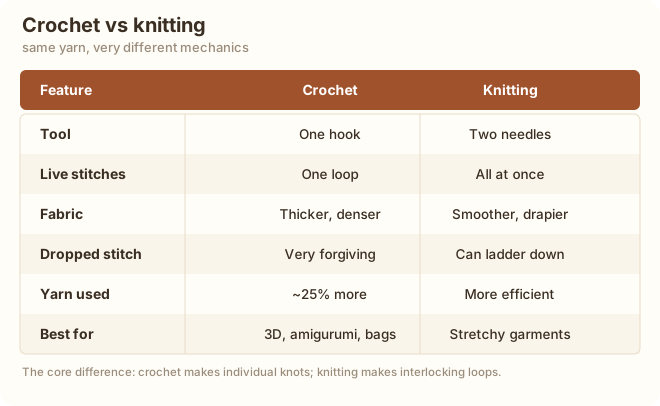
No, it's not knitting
Every crocheter has fielded the question at least a hundred times: "Oh, is that knitting?" Both crafts spin yarn into fabric, but that's where the family resemblance ends. Smile, say no, and maybe show them the hook.
The Easier Craft to Learn
Crochet tends to have a gentler learning curve for beginners than knitting, since its single live loop means less to juggle than knitting's two needles and dozens of active stitches.
Best Craft for Stretchy Socks
For a lightweight, stretchy sock that drapes, knitting usually wins — its interlocked loops make a smoother, stretchier fabric than crochet's denser, knotted structure.
Crochet's Fabric Personality
Crochet fabric generally comes out thicker, denser, and more textured than knitting, because its stacked knots build differently than knitting's smoother, drapier loops.
By the numbers
- Roughly how much more yarn does crochet use than knitting for the same fabric?
- 25 percent
Matched pairs
Each item on the left goes with the one on the right.
- Crochet's tool
- One hook (knitting uses two or more needles)
- Crochet's active stitches
- Just one live loop at a time (knitting keeps all stitches active on the needles)
- Crochet's fabric texture
- Thicker, denser, more textured (knitting is smoother and drapier)
- Crochet's dropped-stitch risk
- Very forgiving — only one live stitch can run (knitting can ladder all the way down)
- Crochet is best for
- 3D shapes, amigurumi, structured bags, thick blankets (knitting wins for stretchy garments and socks)
Self-test
Answer each question from memory, then check your work against the answer key.
1. What is the defining tool of crochet?
- AOne hook
- BTwo or more needles
- CA pair of needles plus a hook
- DA knitting loom
2. At any moment while crocheting, how many live loops are active?
- AAs many as the row is wide
- BEvery stitch in the whole piece
- CExactly two
- DJust one
3. Which statement about crochet's mechanics is NOT true?
- AIt uses a single hook
- BIt holds every stitch open on two needles at once
- CIt builds fabric one knot at a time
- DIt keeps one live loop active at a time
4. In knitting, how many stitches are held active at the same time?
- AExactly two, one per needle
- BNone until the row is finished
- CAll of them, kept open on the needles
- DJust a single live loop
5. The single distinction that cascades into every crochet-vs-knitting difference is that:
- ABoth crafts make knots
- BBoth crafts make loops
- CCrochet makes loops; knitting makes knots
- DCrochet makes knots; knitting makes loops
6. Compared with knitting, crochet fabric generally comes out:
- AThicker, denser, and more textured
- BThinner and more elastic
- CSmoother, drapier, and stretchier
- DIdentical in feel and weight
7. Roughly how much more yarn does crochet use than knitting for the same piece of fabric?
- AAbout 10% more
- BAbout 50% more
- CAbout 25% more
- DAbout the same amount
8. Why is a dropped stitch far less catastrophic in crochet than in knitting?
- ACrochet yarn is stickier and holds itself together
- BOnly one loop is ever live, so nothing unravels beneath it
- CCrochet fabric contains no loops at all
- DCrochet stitches are permanently locked by glue
9. Which is NOT a property of crocheted fabric compared with knitted fabric?
- ASturdier
- BStretchier and drapier
- CDenser
- DMore textured
10. Knitting's fabric, compared with crochet's, tends to be:
- ASmoother, drapier, and stretchier
- BThicker and stiffer
- CDenser and more textured
- DLess elastic overall
11. Roughly how much more yarn does crochet use than knitting to make the same piece of fabric?
- A50% more
- B10% more
- C25% more
- DCrochet uses less yarn
12. Why does crochet typically require more yarn than knitting for the same project?
- ACrochet patterns intentionally waste yarn for stretch
- BIt always uses a larger gauge hook than knitting needles
- CKnitting recycles yarn from dropped stitches
- DIts thicker, denser fabric uses more yarn per stitch
13. Which craft is generally considered easier for beginners to pick up?
- ACrochet
- BKnitting
14. You want a lightweight, stretchy sock that drapes. Which craft usually wins?
- AKnitting
- BCrochet
15. Which project is crochet's dense, firm fabric best suited for?
- ALightweight drapey socks
- BStretchy pullover sweaters
- CFine fitted garments
- DAmigurumi and structured bags
16. For which project is crochet the better choice than knitting?
- AA stretchy fitted sock
- BA firm basket that holds its shape
- CA lightweight drapey shawl
- DA fine ribbed sweater cuff
17. A friend who has never done a yarn craft wants the gentlest start. What makes crochet easier to pick up?
- ALess to juggle — one hook and one live loop
- BIt uses much thicker yarn than knitting
- CIt can be finished quickly by machine
- DIt needs no tools at all
Go deeper
Answer key
- 1. A One hookCrochet's signature gear is a single hook, whereas knitting uses two or more needles. The one-hook giveaway is the fastest way to end the 'is that knitting?' question.
- 2. D Just oneCrochet keeps only one live loop active at a time. Knitting is the craft that holds every stitch open on the needles simultaneously.
- 3. B It holds every stitch open on two needles at onceHolding every stitch open on two needles describes knitting, not crochet. Crochet works one hook, one live loop, knotting each stitch into place.
- 4. C All of them, kept open on the needlesKnitting keeps every stitch open and active on the needles at once — the opposite of crochet's single live loop. That's why a dropped stitch can ladder down a whole column.
- 5. D Crochet makes knots; knitting makes loopsCrochet builds fabric from individual knots on one live loop; knitting interlocks loops across the needles. Same yarn, completely different machinery.
- 6. A Thicker, denser, and more texturedStacked knots make crochet thicker, denser, and more textured. Smoother, drapier, stretchier fabric is knitting's signature.
- 7. C About 25% moreCrochet eats roughly 25% more yarn than knitting for equivalent fabric — one more reason the stash keeps growing. Budget your skeins accordingly.
- 8. B Only one loop is ever live, so nothing unravels beneath itBecause crochet keeps just one live loop, there's nothing below it to run. In knitting every stitch is live, so a dropped one can ladder all the way down a column.
- 9. B Stretchier and drapierStretchier and drapier describes knitting. Crochet's knotted fabric is denser, more textured, and sturdier — great for pieces that need to hold their shape.
- 10. A Smoother, drapier, and stretchierInterlocked loops give knitting a smoother, drapier, stretchier hand. Crochet's stacked knots make the denser, more textured, stiffer cloth.
- 11. C 25% moreCrochet's denser, knotted fabric eats roughly 25% more yarn than knitting for the same finished piece.
- 12. D Its thicker, denser fabric uses more yarn per stitchCrochet's thicker, denser, more textured fabric is the trade-off for its roughly 25% higher yarn appetite compared to knitting.
- 13. A CrochetCrochet's single live loop means less to juggle, so it tends to have a gentler learning curve. Knitting asks beginners to coordinate two needles and dozens of active stitches at once.
- 14. A KnittingKnitting's interlocked loops make a smoother, stretchier, drapier fabric — ideal for socks and fitted garments. Crochet's denser knotted fabric shines for structure, not stretch.
- 15. D Amigurumi and structured bagsCrochet's firm, form-holding fabric excels at 3D shapes, amigurumi, sturdy bags, and thick blankets. Socks and fitted, stretchy garments are knitting's turf.
- 16. B A firm basket that holds its shapeCrochet's dense, sturdy fabric holds its form, ideal for baskets. Socks, drapey shawls, and fine ribbing all want knitting's stretch and drape.
- 17. A Less to juggle — one hook and one live loopCrochet's single hook and single live loop mean far less coordination than knitting's two-needle, many-stitch dance — a gentler learning curve for beginners.
Sources
- The Hooked Life — Crochet vs. Knitting: Settling the Debate
Image credits
- No, it's not knitting: FlashFeed original diagram · CC-BY-4.0