
The Hooked Life — Crochet study guide · Lesson 3 of 11
Lesson 3: Your Materials
Yarn Weights 0 to 7 · What Your Yarn Is Made Of · A Buyer's Guide to Hooks
This is the lesson's study guide from the FlashFeed app, plus its key facts and a self-test.
What you'll be able to do
- Recall the CYC 0–7 yarn-weight scale and place Lace, Worsted, and Jumbo on it.
- Match each yarn weight to the projects it suits best.
- Classify yarns into animal, plant, and synthetic families and recall each fiber's defining traits.
- Define the specialty fibers merino, mohair, and bamboo/viscose and recognize them by description.
- Read hook sizes in millimeters and match hook materials to their strengths.
Yarn Weights 0 to 7
Yarn weight isn't about how heavy the ball is — it's about how thick the strand is. Master the numbers and a pattern stops being a foreign language.
The 0 to 7 system that decodes every pattern
The Craft Yarn Council (CYC) gave the craft a gift: one standardized yarn weight scale, numbered 0 to 7, with an extra Size 8 tacked on for genuinely jumbo work. Before it, "worsted" might mean one thing to a Scottish mill and another to a Texas megastore. Now the number on the label is the number in the pattern, full stop. The ladder runs thin to thick: 0 Lace, 1 Super Fine (Fingering), 2 Fine (Sport), 3 Light (DK), 4 Medium (Worsted), 5 Bulky (Chunky), 6 Super Bulky, and 7 Jumbo. Learn this once and you'll glance at any pattern's recommended weight and instantly know whether you're making a gossamer shawl or a couch-sized blanket. It's the single most useful bit of literacy in this whole lesson.
Why worsted is the workhorse
If the yarn weights were a stable of horses, worsted (Size 4) would be the dependable one you ride every day. Most beginner and intermediate patterns are written for it, and that's no accident. Worsted works up at a satisfying clip — fast enough to feel progress, slow enough to fix mistakes — and it shows stitch definition beautifully, so your shells look like shells and your bobbles look like bobbles. Best of all, it's available in every fiber under the sun, from budget acrylic to buttery merino. Blankets, hats, sweaters, amigurumi: they all live comfortably at Size 4. When a pattern doesn't specify or you're improvising, reaching for a worsted is almost never the wrong call.
The categories at a glance
Each weight has a job it does best. Lace (0) is for doilies and fine, airy shawls — the cobweb end of the spectrum. Super Fine / Fingering (1) is sock-and-baby territory, thin and durable. Fine / Sport (2) suits baby clothes and light accessories. Light / DK (3) handles lighter garments and shawls when worsted feels too heavy. Bulky / Chunky (5) is the instant-gratification weight — scarves and rugs that grow before your eyes. Super Bulky (6) piles on for very thick blankets and chunky hats. And Jumbo (7) is the extreme stuff, the giant-yarn arm-knitting, sculptural-art realm. Pick the weight to match the project's purpose, not just its picture, and your finished piece will feel right in the hand. Bigger numbers want bigger hooks; smaller numbers want patience and a tiny one.
What Your Yarn Is Made Of
Weight tells you how thick. Fiber tells you how it lives — warm or cool, washable or precious, springy or stiff. This is where a project's personality is decided.
Fiber is destiny
Two yarns can share a weight, a color, even a price, and still behave like completely different creatures once they're stitched up. That's the fiber talking. Fiber content governs how a finished piece feels against the skin, how it drapes off a shoulder, how warm it keeps you, and — crucially — whether you can toss it in the machine or must hand-wash it like an heirloom. Broadly, fibers split into three families: animal (warm, cozy, textured), plant (cool, breathable, crisp), and synthetic (practical, durable, budget-friendly). Choosing well means matching the fiber to the job. A breezy summer top wants plant fiber; a winter hat wants animal warmth; a kids' blanket that'll see a hundred washes wants something synthetic and bombproof.
The animal fibers
These come off sheep, goats, and alpacas, and they're the cozy crowd. Wool is the classic: springy, warm, forgiving, and blessed with "memory," meaning it bounces back into shape. It's perfect for hats, sweaters, and blankets, though it can itch sensitive skin and wants gentle washing. Alpaca is softer and even warmer than wool with gorgeous drape, but it can stretch out in garments over time, so respect gravity. Merino wool is a superfine variety of wool, dramatically softer than the standard stuff — the gateway fiber for everyone who swears "wool is scratchy." Mohair comes from Angora goats: incredibly fluffy and lightweight, usually held together with a base yarn, and famous for the dreamy halo of fuzz it throws around each stitch.
The plant fibers
Cool, breathable, and crisp, plant fibers shine in warm weather. Cotton is durable, absorbent, and machine-washable — ideal for dishcloths, summer garments, and baby items. Its one quirk: no stretch, which can make keeping even tension tricky. Linen starts out crisp, almost stiff, then softens beautifully the more you use and wash it; reach for it for airy shawls and warm-weather wear. Bamboo/Viscose is silky and luxurious with a natural sheen, making it a favorite for lacy wraps and lightweight projects that catch the light.
The synthetics and blends
Synthetics are the practical workhorses. Acrylic is the most widely available and affordable yarn there is, machine-washable, colorfast, and endlessly varied — and modern versions can be impressively soft. Nylon is usually blended in to add durability and is a staple in sock yarn. Polyester turns up in many blends and specialty novelty yarns like eyelash, velvet, and chenille.
Blends give you the best of both
Blends are exactly what they sound like — two or more fibers spun together to keep the good and ditch the bad. A wool/acrylic blend gives you warmth with easy care; a cotton/acrylic blend adds strength and washability to cotton's crispness. When no single fiber is perfect, a smart blend usually is.
A Buyer's Guide to Hooks
The hook is the other half of the equation. Get the size and the material right and your hands — and your stitches — will thank you.
The number that actually matters is the millimeter
Crochet hooks carry two labels: a millimeter size and a US letter-number. Only one of them is the truth. The millimeter is the actual shaft diameter, and the shaft is what controls how big each stitch comes out — so that's the figure that genuinely matters. The US letter (B, E, G, H, J, K, N…) is really just a nickname stamped on top, and nicknames can drift between brands. Memorize a few key conversions and you're set: B-1 is 2.25 mm, E-4 is 3.5 mm, G-6 is 4.0 mm, H-8 is 5.0 mm (the most popular size by a mile), J-10 is 6.0 mm, K-10.5 is 6.5 mm, and N-15 is a chunky 10.0 mm. When a pattern's letter and your hook's letter seem to disagree, ignore the letters and match the millimeters. The mm never lies.
Steel hooks count backward
Just when the system makes sense, steel hooks flip it. Numbered 00 to 14, the steel scale runs in reverse — a higher number means a smaller hook, not a bigger one. They shrink all the way down to a hair-thin 0.6 mm, because they're purpose-built for fine thread crochet: doilies, lace edgings, delicate filet work. So don't be alarmed when a "size 14" steel hook turns out to be the tiniest one in the tin. It's not a typo; it's just the thread-crochet world marching to its own backward drum.
Switch to ergonomic before it hurts
Here's the advice every long-time crocheter wishes they'd gotten sooner: if you start crocheting for hours at a time, switch to ergonomic hooks before you develop hand pain, not after. The crucial point is that ergonomic hooks don't affect your stitch quality at all — the aluminum shaft is identical — they only change your comfort. So there's genuinely no trade-off to making the switch early. Treat it as cheap insurance for your hands.
Materials matter more than you'd think
The handle material quietly shapes your whole experience. Aluminum is smooth, consistent, and affordable — the great all-purpose choice that suits almost everyone. Wood and bamboo are slightly grippy and warm to the touch, which makes them lovely with slippery yarns like silk or bamboo that would slide right off metal. Plastic is lightweight and especially popular in the very large N-and-up sizes, where a metal hook would get heavy. And ergonomic hooks — the famous Clover Amour and Tulip Etimo lines — pair a standard aluminum shaft with a large, soft rubberized handle. They're a genuine game-changer for long sessions and for anyone living with arthritis, carpal tunnel, or plain hand fatigue. Try a few materials; your hands have opinions you haven't met yet.
Key terms
- Merino wool
- A superfine variety of sheep fleece, far softer than the standard kind — the gateway fiber for anyone who insists the scratchy stuff hates them.
- Mohair
- An incredibly fluffy, lightweight fiber from Angora goats, often held with a base yarn to create a dreamy halo of fuzz around every stitch.
- Bamboo / Viscose
- A silky, luxurious plant fiber with a natural sheen, prized for lacy wraps and lightweight projects that catch the light.
- Ergonomic hooks
- A standard aluminum shaft fitted with a large, soft rubberized handle — a game-changer for long sessions and for anyone with arthritis, carpal tunnel, or hand fatigue. Clover Amour and Tulip Etimo are the famous names.
Key concepts
Alpaca
- One of the cozy animal fibers, from the same warm-and-fuzzy family as sheep and goats.
- It's softer and even warmer than ordinary sheep's wool, with a gorgeous drape.
- The catch: garments made from it tend to stretch and sag over time, so you must respect gravity.
Mohair
- A featherlight animal fiber, so wispy it's usually carried along with a sturdier base yarn.
- It's sheared from Angora goats and prized for being incredibly fluffy and lightweight.
- Its signature is the dreamy halo of fuzz it throws around every single stitch.
Cotton
- A cool, breathable plant fiber that comes into its own in warm weather.
- Durable, absorbent, and machine-washable, it's the classic pick for dishcloths, summer tops, and baby items.
- Its one quirk is a total lack of stretch, which can make keeping even tension tricky.
Linen
- Another crisp, cool plant fiber, at its best in breezy warm-weather projects.
- It starts out stiff — almost board-like — then softens beautifully the more you use and wash it.
- Reach for it when you want airy shawls with a crisp hand that mellows over time.
Acrylic
- A practical synthetic workhorse rather than a natural fiber.
- It's the most widely available and most affordable yarn there is — machine-washable and colorfast.
- Modern versions can be impressively soft, making it the bombproof choice for a kids' blanket facing a hundred washes.
Key facts
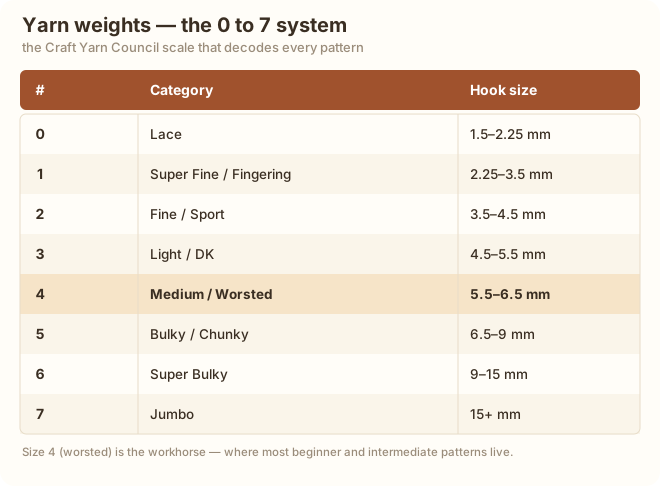
The 0 to 7 system that decodes every pattern
The Craft Yarn Council (CYC) numbered yarns 0 to 7 (plus a Size 8 for jumbo monster yarn) so a pattern in Ohio and a skein in your stash speak the same language. Learn the ladder and reading patterns gets dramatically easier overnight.
Why worsted is the workhorse
Worsted weight (Size 4) is where most beginner and intermediate patterns live, and for good reason: it works up quickly, shows off crisp stitch definition, and comes in literally every fiber type. When in doubt, reach for a 4 — blankets, hats, and sweaters all start here.
Top of the Yarn Ladder
Jumbo yarn sits at weight 7, the top of the standard CYC 0-to-7 ladder — though an extra Size 8 exists for genuinely monster yarn beyond that.
The Sock Yarn Weight
Super Fine / Fingering (weight 1) is the go-to yarn for socks and baby items — thin and durable, in a way Bulky or Jumbo could never manage.
The Instant-Gratification Yarn Weight
Bulky / Chunky (weight 5) is the instant-gratification yarn — perfect for quick projects like scarves and rugs that grow fast under the hook.
Blends give you the best of both
Blends are exactly what they sound like. A wool/acrylic blend hands you warmth with easy care, and a cotton/acrylic blend adds strength and washability to cotton's crispness. Mixing fibers lets a yarn keep the good traits and shed the annoying ones.
Wool's Softer Cousin
Merino wool is a superfine variety of sheep fleece, dramatically softer than standard wool.
The Halo Fiber
Mohair comes from Angora goats — incredibly fluffy and lightweight, usually held together with a base yarn, and famous for the dreamy halo of fuzz it throws around each stitch.
A Plant Fiber That Shines
Bamboo / Viscose is a silky plant fiber with a natural sheen, prized for lacy wraps and lightweight projects that catch the light.
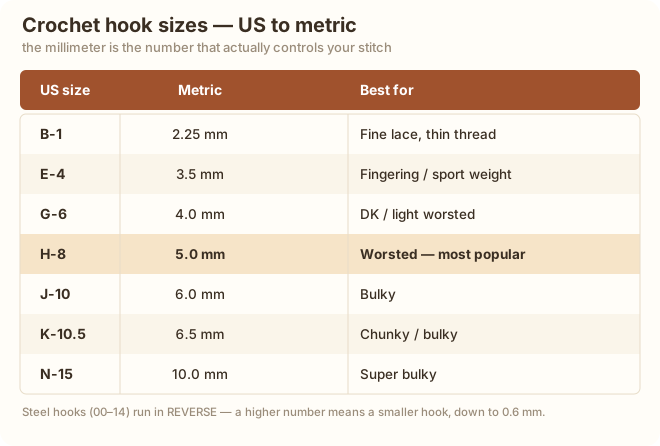
The number that actually matters is the millimeter
Hooks are sized by millimeter — the shaft diameter that genuinely controls how big each stitch comes out — and labeled with US letters and numbers on top. The mm is the truth; the US letter is just the nickname. When a pattern and your hook disagree, trust the millimeter.
Steel hooks count backward
Steel thread hooks, numbered 00 to 14, run in reverse: a higher number means a smaller hook, shrinking all the way down to a tiny 0.6 mm. They're built for delicate thread crochet, so don't panic when a 'size 14' turns out to be the hair-thin one.
Worsted yarn's default hook
H-8 (5.0 mm) is the most popular hook for worsted-weight yarn, the most common yarn weight, so it's the one that ends up in nearly every crocheter's hook bag.
The grip of wood hooks
Wood and bamboo hooks are slightly grippy and warm to the touch, which keeps slippery yarns like silk or bamboo from sliding off the way they would on a metal hook.
By the numbers
- What CYC weight number is Medium / Worsted, the workhorse of yarn?
- 4 CYC weight
- What CYC weight number is the finest category, Lace?
- 0 CYC weight
- What CYC weight number is Jumbo, the thickest standard category?
- 7 CYC weight
- What is the metric size of the H-8 hook, the most popular worsted-weight hook?
- 5 mm
- What is the metric size of a US G-6 hook?
- 4 mm
- What is the metric size of a US B-1 hook, used for fine lace and thread?
- 2.25 mm
- What is the metric size of a US N-15 hook, used for super bulky yarn?
- 10 mm
Matched pairs
Each item on the left goes with the one on the right.
- Weight 0 — Lace
- Doilies and fine, gauzy shawls
- Weight 1 — Super Fine / Fingering
- Socks and baby items
- Weight 2 — Fine / Sport
- Baby clothes and light accessories
- Weight 3 — Light / DK
- Lighter garments and shawls
- Weight 5 — Bulky / Chunky
- Quick projects, scarves, rugs
- Weight 6 — Super Bulky
- Very thick blankets and chunky hats
- Wool
- Springy, warm, has memory — can be itchy
- Alpaca
- Softer and warmer than wool, gorgeous drape — can stretch out
- Cotton
- Durable, absorbent, machine-washable — no stretch, so tension gets tricky
- Linen
- Starts crisp, softens beautifully with use — ideal for airy summer wear
- Acrylic
- Cheap, machine-washable, everywhere — the workhorse synthetic
- Nylon
- Blended in for durability — the secret ingredient in sock yarn
- Polyester
- The basis of specialty yarns — eyelash, velvet, chenille
- Aluminum hooks
- Smooth, consistent, affordable — the great all-purpose pick
- Wood / Bamboo hooks
- Slightly grippy and warm — great for slippery silk or bamboo yarn
- Plastic hooks
- Lightweight — popular for the very large N-and-up sizes
Self-test
Answer each question from memory, then check your work against the answer key.
1. The ___ numbered yarns 0 to 7 (plus a Size 8 for jumbo monster yarn) so a pattern in Ohio and a skein in your stash speak the same language. Learn the ladder and reading patterns gets dramatically easier overnight.
- ACraft Yarn Council
- BThe Knitting Guild Association
- CTextile Society of America
- DCrochet Guild of America
2. On the CYC scale, what weight number is Lace, the finest category?
- A3
- B1
- C0
- D2
3. What CYC weight number is Medium / Worsted, the workhorse weight?
- A5
- B3
- C2
- D4
4. What is the highest number in the standard CYC 0-7 yarn-weight scale?
- A5
- B7
- C8
- D6
5. Which lists these three CYC weights correctly from thinnest to thickest?
- ALace (0), Worsted (4), Jumbo (7)
- BJumbo (7), Worsted (4), Lace (0)
- CLace (0), Jumbo (7), Worsted (4)
- DWorsted (4), Lace (0), Jumbo (7)
6. What CYC number is assigned to Lace, the finest standard yarn-weight category?
- A2
- B0
- C1
- D8
7. On the CYC 0–7 scale, where does Lace weight fall relative to Worsted and Jumbo?
- AThe thickest, above Jumbo
- BTied with Worsted at weight 4
- CThe thinnest, at the bottom of the scale
- DIn the middle, between Sport and DK
8. What CYC number is assigned to Jumbo, the thickest standard yarn-weight category?
- A8
- B6
- C5
- D7
9. Jumbo yarn sits at which end of the CYC 0–7 weight scale?
- AThe thickest end, above Super Bulky
- BThe thinnest end, below Lace
- COutside the numbered scale entirely
- DThe exact middle of the scale
10. Which yarn weight is best suited to socks and baby items?
- ALace (0)
- BBulky / Chunky (5)
- CJumbo (7)
- DSuper Fine / Fingering (1)
11. Bulky / Chunky (5) yarn is best for which kind of project?
- AFine doilies and gauzy shawls
- BQuick projects like scarves and rugs
- CSocks and baby items
- DDelicate thread lace edgings
12. Which weight is the versatile all-rounder for blankets, hats, sweaters, and amigurumi?
- ALace (0)
- BJumbo (7)
- CWorsted / Medium (4)
- DFingering (1)
13. Which weight-to-project pairing is INCORRECT?
- AFingering (1) → socks and baby items
- BLace (0) → very thick blankets and chunky hats
- CBulky (5) → quick scarves and rugs
- DWorsted (4) → blankets, hats, and sweaters
14. Super Bulky (6) yarn is the go-to for which projects?
- AVery thick blankets and chunky hats
- BFine lace doilies
- CAiry summer shawls
- DLightweight baby socks
15. Fibers fall into three families. Which family is described as cool, breathable, and crisp — best for warm-weather projects?
- ASynthetic fibers
- BAnimal fibers
- CPlant fibers
16. Which fiber is springy and warm with 'memory' that bounces it back into shape?
- AAcrylic
- BLinen
- CCotton
- DWool
17. Which of these is NOT an animal fiber?
- ACotton
- BMohair
- CWool
- DAlpaca
18. Which plant fiber is durable, absorbent, and machine-washable, but has no stretch?
- ABamboo / Viscose
- BLinen
- CCotton
- DNylon
19. Which synthetic fiber is usually blended in for durability and is a staple in sock yarn?
- ACotton
- BNylon
- CPolyester
- DWool
20. Which fiber is a superfine variety of sheep fleece, dramatically softer than standard wool?
- AMohair
- BBamboo / Viscose
- CAlpaca
- DMerino wool
21. Which fluffy, lightweight fiber comes from Angora goats and throws a halo of fuzz around each stitch?
- AMohair
- BCotton
- CAlpaca
- DMerino wool
22. Which silky plant fiber has a natural sheen, prized for lacy wraps that catch the light?
- ACotton
- BMohair
- CBamboo / Viscose
- DLinen
23. You want a 'gateway' fiber to prove that not all wool is scratchy. Which do you recommend?
- AAlpaca
- BMohair
- CCotton
- DMerino
24. Among these specialty fibers, which is a PLANT fiber rather than one from an animal?
- AMerino wool
- BBamboo / Viscose
- CMohair
- DAlpaca
25. Which hook is the most popular choice for worsted-weight yarn?
- AB-1 (2.25 mm)
- BK-10.5 (6.5 mm)
- CN-15 (10.0 mm)
- DH-8 (5.0 mm)
26. What is the metric (mm) size of a US G-6 hook?
- A5.0 mm
- B6.0 mm
- C4.0 mm
- D3.5 mm
27. Among these standard hooks, which has the smallest millimeter shaft size?
- AN-15 (10.0 mm)
- BB-1 (2.25 mm)
- CG-6 (4.0 mm)
- DH-8 (5.0 mm)
28. Which hook material is slightly grippy and warm, making it great for slippery silk or bamboo yarn?
- AWood / Bamboo
- BPlastic
- CSteel
- DAluminum
29. Which hook material is lightweight and especially popular in the very large N-and-up sizes?
- AWood / Bamboo
- BPlastic
- CAluminum
- DSteel
Go deeper
Answer key
- 1. A Craft Yarn Council
- 2. C 0Lace sits at the thin end of the CYC ladder as weight 0. Weight 1 is Super Fine / Fingering, not the finest.
- 3. D 4Worsted / Medium is Size 4, where most beginner and intermediate patterns live. Size 3 is Light / DK and Size 5 is Bulky.
- 4. B 7The standard CYC ladder runs 0 to 7, so 7 (Jumbo) is the top. An extra Size 8 exists for genuinely monster yarn, but it sits outside the standard 0-7 scale this question asks about.
- 5. A Lace (0), Worsted (4), Jumbo (7)The ladder runs thin to thick, so Lace (0) is finest, Worsted (4) is in the middle, and Jumbo (7) is thickest.
- 6. B 0Lace sits at the thin end of the CYC ladder as weight 0, the finest standard category.
- 7. C The thinnest, at the bottom of the scaleThe CYC ladder runs thin to thick: Lace (0) sits at the very bottom, far below Worsted (4) and Jumbo (7).
- 8. D 7Jumbo sits at the top of the standard CYC ladder as weight 7 (with an extra Size 8 for genuinely jumbo work).
- 9. A The thickest end, above Super BulkyThe CYC scale runs thin to thick, ending at 7 Jumbo — the thickest standard category, above Super Bulky (6).
- 10. D Super Fine / Fingering (1)Super Fine / Fingering (1) is thin and durable, making it sock-and-baby territory. Bulky and Jumbo are far too thick for socks.
- 11. B Quick projects like scarves and rugsBulky / Chunky is the instant-gratification weight for scarves and rugs that grow fast. Doilies and thread lace need weight 0 or fine steel-hook work.
- 12. C Worsted / Medium (4)Worsted (Size 4) works up at a satisfying clip, shows crisp stitch definition, and comes in every fiber, so blankets, hats, and sweaters all start here.
- 13. B Lace (0) → very thick blankets and chunky hatsLace (0) is for doilies and gauzy shawls, not thick blankets — those want Super Bulky (6). The other three pairings are all correct.
- 14. A Very thick blankets and chunky hatsSuper Bulky (6) piles on for very thick blankets and chunky hats. Airy shawls and doilies want fine weights; baby socks want Fingering.
- 15. C Plant fibersFibers split into three families: animal (warm, cozy, textured), plant (cool, breathable, crisp), and synthetic (practical, durable). Plant fibers like cotton and linen shine in warm weather, which is why a breezy summer top wants plant fiber.
- 16. D WoolWool is the classic animal fiber: springy, warm, forgiving, and blessed with memory. Cotton and linen are crisp plant fibers with no such spring.
- 17. A CottonCotton is a plant fiber (cool, breathable, crisp). Wool, alpaca, and mohair all come from animals — sheep, alpacas, and Angora goats.
- 18. C CottonCotton is durable, absorbent, and machine-washable — great for dishcloths and baby items — but its lack of stretch makes even tension tricky.
- 19. B NylonNylon is blended in to add durability and is a staple of sock yarn. Polyester shows up in novelty yarns; cotton and wool are natural fibers.
- 20. D Merino woolMerino wool is a superfine variety of wool, far softer than the standard stuff. Mohair is from goats, alpaca from alpacas, and bamboo is a plant fiber.
- 21. A MohairMohair comes from Angora goats: incredibly fluffy, lightweight, usually held with a base yarn, and famous for its dreamy halo of fuzz.
- 22. C Bamboo / ViscoseBamboo / Viscose is silky and luxurious with a natural sheen, a favorite for lacy wraps and lightweight projects. Linen starts crisp; cotton has no sheen.
- 23. D MerinoMerino wool is the gateway fiber for everyone who swears wool is scratchy — it is dramatically softer than standard wool while still being warm animal fiber.
- 24. B Bamboo / ViscoseBamboo / Viscose is a plant fiber. Merino comes from sheep, mohair from Angora goats, and alpaca from alpacas — all animal fibers.
- 25. D H-8 (5.0 mm)H-8 (5.0 mm) is the go-to hook for worsted weight, the most common yarn — which is why it lives in nearly every crocheter's bag.
- 26. C 4.0 mmG-6 is 4.0 mm. E-4 is 3.5 mm, H-8 is 5.0 mm, and J-10 is 6.0 mm — remember the mm is the true shaft diameter, not the letter.
- 27. B B-1 (2.25 mm)B-1 is 2.25 mm, the smallest here and used for fine lace and thread. N-15 (10.0 mm) is the chunkiest of the four.
- 28. A Wood / BambooWood and bamboo hooks are slightly grippy and warm to the touch, so slippery yarns like silk or bamboo don't slide off the way they would on metal.
- 29. B PlasticPlastic is lightweight and popular in the very large N-and-up sizes, where a metal hook would get heavy in the hand.
Sources
- The Hooked Life — Your Materials
Image credits
- The 0 to 7 system that decodes every pattern: FlashFeed original diagram · CC-BY-4.0
- The number that actually matters is the millimeter: FlashFeed original diagram · CC-BY-4.0