
The Hooked Life — Crochet study guide · Lesson 4 of 11
Lesson 4: Reading a Pattern
The Core Stitch Abbreviations · Pattern Action Abbreviations · The US vs UK Trap
This is the lesson's study guide from the FlashFeed app, plus its key facts and a self-test.
What you'll be able to do
- Identify the core stitch abbreviations and order them by height.
- Recognize the special stitches — magic ring, popcorn, puff, and bobble — and the move that makes the bump trio.
- Interpret the shaping and loop/post action abbreviations.
- Decode a pattern's housekeeping and orientation shorthand.
- Translate between US and UK stitch names to avoid the terminology trap.
The Core Stitch Abbreviations
Patterns look like alphabet soup until they don't. Once you can glance at "3dc, ch1, sk" and read it as a sentence, you've crossed the real beginner-to-intermediate line. Every abbreviation here is just a stitch's nickname — learn the dozen and the whole pattern world opens up.
Cracking the code
The biggest jump to intermediate isn't a fancy technique — it's fluency. A pattern is a private language shared between makers, and the abbreviations are its vocabulary. They exist because writing "double crochet" forty times per row would be exhausting; "dc" does the job. The good news: the list is short and it never changes. Memorize these once and you'll read patterns for the rest of your hooked life without a cheat sheet taped to your project bag.
Meet dc the workhorse
If you learn one stitch cold, make it the double crochet (dc). It's the single most common stitch in published patterns — taller and airier than single crochet, quick to work up, and the backbone of granny squares, blankets, shawls, and garments alike. Yarn over, insert, pull through, then work off the loops two at a time. It strikes the sweet spot between the dense little single crochet and the towering trebles: enough height to grow fast, enough body to look finished. Spot dc on sight and half of pattern-reading is already done.
A whole alphabet of texture
Stitches aren't just different names — they're different heights and textures. They climb in a tidy ladder: the flat slip stitch (sl st) adds no height at all, single crochet (sc) is short and dense, half double crochet (hdc) is the medium all-rounder, dc is taller and open, treble (tr) is taller still for lace, and double treble (dtr) shoots up fast. The best way to feel the family resemblance is a sampler — a swatch with a band of each, stacked together. Work it once and you'll never confuse them again.
Beyond the height ladder live the special-effect stitches. The chain (ch) is the humble foundation under almost every project. The magic ring (mr / MR) is an adjustable loop you cinch tight to start working in the round — the secret to amigurumi with no hole in the middle. Then come the puffy trio, all built by piling several stitches into one spot: the popcorn (pc) is several dc worked together then folded so it pops proud of the fabric; the puff stitch gathers multiple half-double loops and pulls them all through at once; and the bobble (bo) is like a puff but built from dc, and it conveniently stays on the same side you're working. Together they give you bumps, ridges, and texture on demand — the difference between a flat scarf and one that begs to be touched.
Pattern Action Abbreviations
If stitches are the nouns of a pattern, this lot is the verbs. They don't make new kinds of fabric so much as tell you what to do with the stitches you know — and that's exactly how a flat rectangle becomes a hat, a sphere, or a sleeve.
Verbs of the pattern
A pattern reads like a recipe, and these are its instructions. inc (increase) means work two stitches into the same stitch, fanning the fabric wider; dec (decrease) joins two stitches into one, pulling it narrower. Those two alone are how you shape everything curved. When a pattern wants a specific decrease it spells it out: sc2tog means single crochet two stitches together, dc2tog does the same with doubles. tog on its own just means "together." Master increasing and decreasing and you've unlocked shaping — the whole reason crochet can become a body and not just a blanket.
The loop-and-post family changes where you put the hook. Normally you work under both top loops; FLO / FL (front loop only) and BLO / BL (back loop only) tell you to use just one. Front loop leaves a decorative ridge; back loop creates that stretchy, knit-like ribbing beloved for cuffs and hatbands. Go deeper and you get the post stitches: FP (front post) and BP (back post) wrap the hook around the whole post of the stitch below, raising bold cables and dimensional texture. A ch-sp (chain space) is simply the little gap a chain left in a previous row — lacy patterns love telling you to work into the space rather than a stitch.
Then there's the housekeeping shorthand, the words that keep you oriented. sk means skip a stitch entirely; rep means repeat; rnd means round; RS / WS flag the right side and wrong side of your work; yo is the yarn over that begins most stitches. Color patterns use MC / CC for main color and contrasting color. pm / sm tell you to place a marker or slip a marker — invaluable for tracking the start of a round in amigurumi. And tch is the turning chain: the little stack of chains you make at the beginning of a row to lift the hook to the right height before the first real stitch. None of these are glamorous, but skip one and your whole row drifts off. Learn the verbs and the pattern stops being a wall of letters and starts telling you, step by step, exactly what to do.
The US vs UK Trap
Of all the ways a crochet pattern can go sideways, this is the sneakiest — because nothing looks wrong. The words are familiar, the abbreviations are ones you know, and yet the fabric comes out completely different. Welcome to the most common source of confusion in the craft.
The transatlantic booby trap
Here's the ambush: US and UK patterns use the same words for different stitches. A UK "double crochet" is not a US double crochet — it's what Americans call a single crochet. The two systems are essentially offset by one rung on the height ladder, so every name points to a shorter stitch in UK terms than it does in US terms. That free pattern from a lovely British blog can quietly sabotage your whole project, not because it's wrong, but because it's speaking a different dialect.
The full set of false friends is worth memorizing cold. US single crochet (sc) = UK double crochet (dc). US half double crochet (hdc) = UK half treble crochet (htr). US double crochet (dc) = UK treble crochet (tr). US treble crochet (tr) = UK double treble (dtr). Notice the pattern: each UK term is one step "taller" in name than its US equivalent, because the UK system doesn't have a "single" — it starts counting at double. So when you read a UK instruction, mentally shift it down one notch to find the US stitch your hands already know.
There is exactly one mercy in all this: the slip stitch. US "sl st" and UK "ss" mean the same thing — a flat joining stitch with no height. It's the lone term that survives the crossing unchanged, so at least you have one fixed point of reference.
The practical defense is simple and saves enormous frustration: before you start, find out which system a pattern uses. Many patterns say so up front; if not, the abbreviations themselves are a tell (a UK pattern will use "dc" where you'd expect "sc," and won't mention single crochet at all). And here's the classic diagnostic — if your stitch counts come out wildly wrong, or the fabric looks far denser or far airier than the photo, suspect a terminology mismatch before you suspect yourself. A whole project worked in the wrong-height stitch will throw off gauge, sizing, and counts from the very first row. Check the dialect first, and you'll never frog an afghan over a vocabulary mix-up.
Key concepts
Chain
- The humblest building block in crochet, learned before any of the taller stitches.
- Nearly every project begins by making a long row of these, which you then work all your other stitches into.
Single Crochet
- Near the bottom of crochet's height ladder, one rung above the flat joining stitch that adds no height.
- This short, dense stitch works up the tightest, firmest fabric of the common stitches.
- Beware the transatlantic trap: British patterns call this exact stitch a 'double crochet.'
Half Double Crochet
- Squarely in the middle of crochet's height ladder sits this sensible compromise stitch.
- Taller than the short dense stitch but shorter than the open workhorse, it's the medium all-rounder patterns lean on.
Treble Crochet
- One of the tall stitches on the height ladder, rising well above the everyday workhorse.
- Open and airy, it climbs high fast — the height crocheters reach for when making lace.
- On the US ladder it sits just below the very tallest of the common stitches.
Key facts
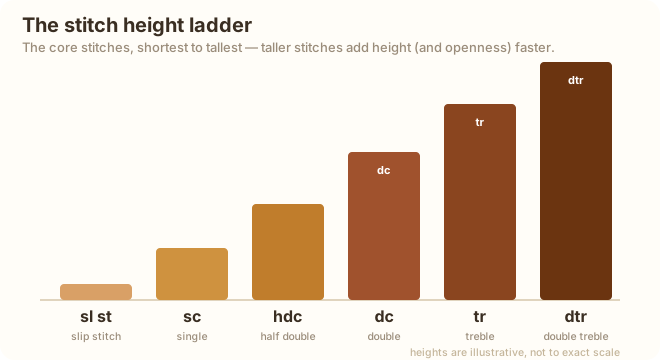
Cracking the code
The leap from beginner to intermediate is mostly this: reading a pattern without flinching. Once "3dc, ch1, sk" reads like a sentence instead of alphabet soup, the whole craft opens up. The abbreviations are just shorthand whispered between makers.
Meet dc, the workhorse
Double crochet (dc) is the most common stitch you'll meet in patterns — taller and airier than single crochet, fast to work, and the backbone of countless blankets, garments, and granny squares. Learn to spot it on sight and half the pattern world becomes legible.
Crochet's zero-height stitch
A slip stitch adds essentially no height to your work — it just moves the yarn along. Single, double, and treble crochet each build in progressively more height.
Crochet's tallest stitch
Ranked by height, double treble is the tallest of the basic crochet stitches — more yarn-overs at the start of a stitch make it stand taller on the fabric.
Verbs of the pattern
Stitch names are the nouns; this batch is the verbs. Increase, decrease, skip, repeat, place a marker — these little instructions are what actually shape your fabric into a hat, a sphere, or a sleeve. Learn them and a pattern stops being a list and starts being a recipe.
The pair that shapes fabric
Increase (inc) and decrease (dec) are the pair of abbreviations that let a pattern shape curved fabric: increase fans it wider, decrease pulls it narrower, and together they turn a flat rectangle into a hat or a sphere.
What back loop only does
Working into the back loop only (BLO) creates a stretchy, knit-like ribbing that's popular for cuffs and hatbands. Its counterpart, front loop only (FLO), leaves a more decorative ridge instead.
How post stitches really work
Front post (FP) and back post (BP) stitches are worked by wrapping the hook around the whole post of the stitch below, rather than into its top loops, which raises bold cables and dimensional texture.
What tch really means
The turning chain (tch) is the little stack of chains at the start of a row that lifts the hook up to the right height before the first real stitch begins.
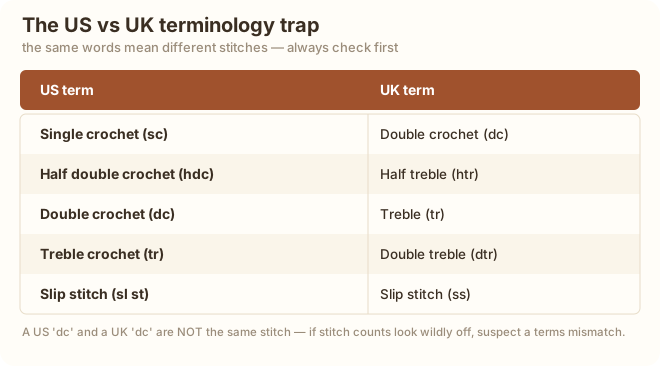
The transatlantic booby trap
Here's the one that ambushes everyone: US and UK terms use the SAME words for DIFFERENT stitches. A UK "double crochet" is what Americans call a single crochet. So a free pattern from a British blog can quietly sabotage your whole project if you don't know which dialect it speaks.
UK's sneakiest stitch name
In UK pattern terms, "double crochet" is the same stitch as US single crochet — same name, different stitch, and the classic transatlantic mix-up for crocheters switching between patterns.
US treble's UK identity
US treble crochet (tr) is the same stitch as UK double treble (dtr). Every UK stitch name sits one step "taller" than its US equivalent.
US hdc's UK alter ego
US half double crochet (hdc) is the same stitch as UK half treble crochet (htr). Each UK name sits one rung "taller" than its US equivalent, because the UK system has no stitch called "single."
One stitch, no translation
The slip stitch is the one stitch that means the same thing in both US and UK terms — a flat, no-height joining stitch either way. Every other stitch name shifts between the two systems.
Matched pairs
Each item on the left goes with the one on the right.
- ch
- Chain stitch — the foundation of almost every project
- sl st
- Slip stitch — joins rounds and moves yarn without adding height
- sc
- Single crochet — a dense, short stitch
- hdc
- Half double crochet — medium height, an excellent all-rounder
- tr
- Treble crochet — taller than dc; loved in lace and decorative work
- dtr
- Double treble crochet — very tall; adds height quickly
- mr / MR
- Magic ring — an adjustable starting circle for working in the round
- pc
- Popcorn stitch — several dc in one stitch, then folded so it pops out
- puff
- A soft, raised cluster made of several half-double loops all pulled through together
- bo
- Bobble — like a puff but with dc; stays on the same side as you work
- inc
- Increase — work 2 stitches into the same stitch
- dec
- Decrease — join two stitches together into one
- sc2tog
- Single crochet 2 stitches together — one way to decrease
- dc2tog
- Double crochet 2 stitches together
- FLO / FL
- Front loop only — work into just the front loop of the stitch
- BLO / BL
- Back loop only — creates a stretchy ribbing effect
- FP
- Front post — work around the post of the stitch below
- BP
- Back post — creates cables and raised texture
- ch-sp
- Chain space — the gap created by a chain in a previous row
- sk
- Skip — jump over a stitch without working into it
- rep
- Repeat
- rnd
- Round
- RS / WS
- Right side / Wrong side
- yo
- Yarn over
- tog
- Together
- MC / CC
- Main color / Contrasting color
- pm / sm
- Place marker / Slip marker
- tch
- Turning chain — chains at the start of a row that bring the hook to the right height
- US single crochet (sc)
- = UK double crochet (dc)
- US half double crochet (hdc)
- = UK half treble crochet (htr)
- US double crochet (dc)
- = UK treble crochet (tr)
- US treble crochet (tr)
- = UK double treble (dtr)
- US slip stitch (sl st)
- = UK slip stitch (ss)
Self-test
Answer each question from memory, then check your work against the answer key.
1. Which stitch adds no height at all to your work?
- ADouble crochet
- BSlip stitch
- CSingle crochet
- DTreble crochet
2. Which abbreviation is the 'workhorse' — the most common stitch and backbone of granny squares and blankets?
- Ahdc
- Btr
- Csc
- Ddc
3. Which stitch is called the 'medium all-rounder'?
- AHalf double crochet
- BTreble crochet
- CDouble treble
- DSingle crochet
4. Ranked by height, which of these stitches is the tallest?
- ASingle crochet
- BDouble crochet
- CDouble treble
- DTreble crochet
5. Which list orders the stitches correctly from shortest to tallest?
- Asl st, sc, dc, hdc, dtr, tr
- Bsc, sl st, dc, hdc, tr, dtr
- Csc, hdc, sl st, tr, dc, dtr
- Dsl st, sc, hdc, dc, tr, dtr
6. The popcorn, puff, and bobble are all made by the same basic move. What is it?
- ASkipping stitches to leave decorative gaps
- BWrapping the hook around the post of the stitch below
- CPiling several stitches into one spot so they pop proud of the fabric
- DWorking into the back loop only to create ribbing
7. What is the magic ring (mr / MR) used for?
- AAn adjustable loop to start working in the round with no center hole
- BJoining two stitches into one to decrease
- CA stack of chains that lifts the hook to the right height
- DWorking around the post of the stitch below
8. How is the popcorn stitch (pc) made?
- ASkip stitches to leave decorative gaps
- BWork several dc into one stitch, then fold it so it pops out
- CGather several half-double loops and pull them all through at once
- DWrap the hook around the post of the stitch below
9. The bobble (bo) is built like a puff, but from which stitch?
- ADouble crochet (dc)
- BSlip stitch (sl st)
- CChain (ch)
- DSingle crochet (sc)
10. The puff stitch is formed by which move?
- AWrapping the hook around the whole post below
- BFolding several dc so they pop off the surface
- CWorking two stitches together to make a decrease
- DGathering several half-double loops and pulling them all through at once
11. Which pair of action abbreviations lets you shape curved fabric — turning a flat rectangle into a hat or sphere?
- APlace marker (pm) and slip marker (sm)
- BSkip (sk) and repeat (rep)
- CIncrease (inc) and decrease (dec)
- DFront loop only (FLO) and back loop only (BLO)
12. What does 'inc' (increase) tell you to do?
- AJoin two stitches together into one
- BWork two stitches into the same stitch
- CWork into the back loop only
- DSkip a stitch without working it
13. Which abbreviation does NOT describe a decrease?
- Ainc
- Bdc2tog
- Cdec
- Dsc2tog
14. Front loop only (FLO) leaves a decorative ridge. What does back loop only (BLO) create?
- AA decrease
- BRaised cables and dimensional texture
- CA popcorn bump
- DA stretchy, knit-like ribbing
15. How are front post (FP) and back post (BP) stitches worked?
- ABy working into just one of the two top loops
- BBy wrapping the hook around the whole post of the stitch below
- CBy working into the gap a chain left
- DBy working two stitches together
16. In a pattern, what does 'sk' tell you to do?
- AWork into the chain space
- BSlip stitch to join a round
- CSkip a stitch entirely
- DPlace a marker
17. What is the turning chain (tch)?
- AThe gap a chain left in the previous row
- BAn adjustable loop for starting in the round
- CChains at the start of a row that lift the hook to the right height
- DA marker slipped at the start of each round
18. In a color pattern, what does 'MC / CC' stand for?
- AMarker count / Color change
- BMain chain / Center chain
- CMachine color / Custom color
- DMain color / Contrasting color
19. What do 'pm' and 'sm' instruct you to do?
- APurl stitch / Slip stitch
- BPlace a marker / Slip a marker
- CPattern repeat / Stitch multiple
- DPress seam / Steam block
20. Which of these is a stitch, NOT a piece of housekeeping or orientation shorthand?
- Adtr
- Brnd
- Crep
- Dsk
21. A pattern written in UK terms says "double crochet". Which US stitch should you actually work?
- AHalf double crochet
- BTreble crochet
- CSingle crochet
- DDouble crochet
22. US treble crochet (tr) is equivalent to which UK stitch?
- ADouble treble
- BHalf treble crochet
- CTreble crochet
- DDouble crochet
23. US half double crochet (hdc) is the same stitch as which UK term?
- AUK double treble (dtr)
- BUK half treble crochet (htr)
- CUK double crochet (dc)
- DUK treble crochet (tr)
24. Which stitch keeps the same meaning in both US and UK terminology?
- ASingle crochet
- BDouble crochet
- CTreble crochet
- DSlip stitch
25. Your stitch counts come out wildly wrong and the fabric looks far denser than the photo. What should you suspect first?
- AA US vs UK terminology mismatch
- BThe wrong yarn fiber
- CA miscounted foundation chain
- DA hook one size too large
Go deeper
Answer key
- 1. B Slip stitchA slip stitch adds essentially no height — it just moves the yarn along. Single, double, and treble crochet each add progressively more height.
- 2. D dcDouble crochet (dc) is the single most common stitch in published patterns — taller and airier than sc, and the backbone of granny squares, blankets, and garments.
- 3. A Half double crochetHalf double crochet (hdc) sits between the short, dense single crochet and the taller, open double crochet — the medium all-rounder on the height ladder.
- 4. C Double trebleBy height: single < double < treble < double treble. More yarn-overs at the start of a stitch make it taller.
- 5. D sl st, sc, hdc, dc, tr, dtrThe height ladder runs sl st (no height), sc, hdc, dc, tr, then dtr — each rung taller than the last.
- 6. C Piling several stitches into one spot so they pop proud of the fabricThe 'puffy trio' — popcorn, puff, and bobble — are all built by piling several stitches into one spot, then gathering them so they bulge off the surface. They give texture on demand: the difference between a flat scarf and one that begs to be touched.
- 7. A An adjustable loop to start working in the round with no center holeThe magic ring is an adjustable loop you cinch tight to start working in the round — the secret to amigurumi with no hole in the middle.
- 8. B Work several dc into one stitch, then fold it so it pops outPopcorn piles several dc into one spot, then folds them so the cluster pops proud of the fabric. Pulling half-double loops through together is the puff, not the popcorn.
- 9. A Double crochet (dc)A bobble is like a puff but built from dc, and it conveniently stays on the same side you're working. The puff, by contrast, gathers half-double loops.
- 10. D Gathering several half-double loops and pulling them all through at onceThe puff gathers multiple half-double loops and pulls them all through together for a soft raised cluster. Folding dc is the popcorn; the post move raises cables.
- 11. C Increase (inc) and decrease (dec)Increase works 2 stitches into one, fanning the fabric wider; decrease joins 2 stitches into 1, pulling it narrower. Together they unlock shaping — the whole reason crochet can become a body and not just a flat blanket.
- 12. B Work two stitches into the same stitchIncrease works 2 stitches into one stitch, fanning the fabric wider. Joining two stitches into one is a decrease (dec).
- 13. A incinc is an increase — it fans the fabric wider. dec, sc2tog, and dc2tog all join stitches together to pull the fabric narrower.
- 14. D A stretchy, knit-like ribbingWorking into the back loop only creates that stretchy, knit-like ribbing loved for cuffs and hatbands. Bold cables come from post stitches (FP/BP), not BLO.
- 15. B By wrapping the hook around the whole post of the stitch belowPost stitches wrap the hook around the whole post of the stitch below, raising bold cables and dimensional texture. Working into one top loop is FLO/BLO.
- 16. C Skip a stitch entirelysk means skip a stitch entirely — skip one you shouldn't and the whole row drifts off. Joining with a flat stitch is sl st, not sk.
- 17. C Chains at the start of a row that lift the hook to the right heightThe tch is the little stack of chains at the beginning of a row that brings the hook to the right height before the first real stitch. The gap left by a chain is a ch-sp.
- 18. D Main color / Contrasting colorMC / CC flag the main color and the contrasting color in colorwork patterns.
- 19. B Place a marker / Slip a markerpm and sm mean place a marker and slip a marker — invaluable for tracking the start of a round in amigurumi.
- 20. A dtrdtr (double treble) is a tall stitch. sk (skip), rep (repeat), and rnd (round) are housekeeping shorthand that keep you oriented in the pattern.
- 21. C Single crochetUK "double crochet" is the same stitch as US single crochet. Same words, different stitch — the classic transatlantic trap.
- 22. A Double trebleEvery UK term sits one step "taller" than its US name, so US treble equals UK double treble (dtr).
- 23. B UK half treble crochet (htr)US half double crochet = UK half treble crochet (htr). Each UK name sits one rung 'taller' than its US equivalent because the UK system has no 'single'.
- 24. D Slip stitchThe slip stitch is the lone mercy: US 'sl st' and UK 'ss' mean the same flat, no-height joining stitch. Every other name shifts between the two systems.
- 25. A A US vs UK terminology mismatchWildly wrong counts, or fabric far denser/airier than the photo, is the classic diagnostic for a US/UK terminology mismatch — a whole project worked in the wrong-height stitch.
Sources
- The Hooked Life — Essential Vocabulary & Pattern Abbreviations
Image credits
- Cracking the code: FlashFeed original diagram · CC-BY-4.0
- The transatlantic booby trap: FlashFeed original diagram · CC-BY-4.0