
The Hooked Life — Crochet study guide · Lesson 9 of 11
Lesson 9: Fun Facts & the Crocheter's Dictionary
Fun Facts Worth Dropping at the Yarn Haul · The Crocheter's Dictionary
This is the lesson's study guide from the FlashFeed app, plus its key facts and a self-test.
What you'll be able to do
- Recall the headline crochet fun-facts and numbers, including why no machine can crochet.
- Break the word amigurumi into its parts, ami and nuigurumi.
- Define the core crocheter slang — frogging, tinking, and yarn chicken.
- Define the prep and tool terms and the stash acronyms — WIP, UFO, SABLE, stash, cake winding, and gauge swatch.
- Tell the slang terms apart from mismatched definitions.
Fun Facts Worth Dropping at the Yarn Haul
Every craft has its party tricks — the little facts you whip out when someone at the yarn shop (or, braver still, a non-crocheter) asks why you love this so much. Here's your ammunition.
No machine can crochet
This is the big one, and it's true: there is no industrial machine that can replicate genuine crochet. Knitting is a different story — its simple looping motion was mechanized centuries ago, which is why your closet is full of machine-knit t-shirts and sweaters. But crochet's defining move, pulling a single live loop through another with a hook, one stitch at a time, has stubbornly resisted automation. Engineers have tried; the geometry just doesn't translate to a machine. The upshot is wonderful: every crocheted object in existence, from a great-grandmother's lace doily to last week's viral granny-square cardigan, was made entirely by human hands. When you finish a piece, you've made something no factory on Earth could.
Amigurumi the art of the adorable
Those big-headed, impossibly cute stuffed critters have a proper name and a homeland. Amigurumi is a Japanese art form, and the word is a tidy compound: ami, meaning crocheted or knitted, plus nuigurumi, meaning stuffed doll. The stitches themselves are nothing exotic — mostly humble single crochet — but the Japanese aesthetic transformed them. Think oversized heads, simplified shapes, and tight spirals worked so densely that stuffing can't peek through the gaps. From that recipe came a worldwide phenomenon: dinosaurs, octopuses, tiny food, and entire fictional casts, all rendered in squishable yarn.
Shauna Richardson and crochetdermy
If you think crochet caps out at hats and baby blankets, meet fine artist Shauna Richardson. She crochets life-sized brown bears, tigers, and other large animals — entirely in crochet — and coined the cheeky term "crochetdermy" for the genre (a wink at taxidermy). Her work hangs in galleries and proves a useful point: a hook and yarn scale all the way from a thumbnail amigurumi to a gallery-filling beast.
Crochet is a yarn hog
Here's a practical one. Crochet uses roughly 25 to 30 percent more yarn than knitting to make a similarly sized piece. All those posts and loops simply pack more fiber into the same square inch. So when a blanket pattern's yarn requirement looks alarming, it isn't a typo — trust it, and buy the extra skein rather than losing a game of yarn chicken later.
Your hook might be good for your brain
Deploy this when someone calls your hobby a time-sink: some research suggests that repetitive craft activities like crochet may help reduce the risk of Alzheimer's disease by keeping the brain engaged. The meditative rhythm isn't just calming — it may double as a quiet cognitive workout.
A few more numbers to round out your trivia arsenal: the global crochet market reached about $1.18 billion by 2023, and around 2011 crochet began overtaking knitting in Google search popularity, with crochet searches climbing while knitting's flattened. Not bad for a craft no machine can touch.
The Crocheter's Dictionary
Walk into any crochet group, online or in person, and you'll hit a wall of insider vocabulary. None of it is gatekeeping — it's affectionate shorthand, born from a shared and slightly chaotic love of the craft. Learn these and you'll never feel lost in a comment thread again.
Crochet has its own glorious dialect
The lingo clusters around three eternal truths of the hobby: we make mistakes, we juggle too many projects, and we own too much yarn. From those truths spring a whole dialect. You'll frog a project, tink back a row, lose a round of yarn chicken, abandon a UFO, and quietly admit your stash has crossed into SABLE territory. The terms below are the core vocabulary; once they're second nature, you're fluent.
A quick tour of the abbreviations you'll meet constantly: WIP is your Work In Progress, the project actively on your hook — and most crocheters keep several going at once. UFO is an Unfinished Object, the project you set aside "for now" months ago; everyone has a graveyard of them, and there's genuinely no shame in it. SABLE is the most beloved acronym of all: Stash Acquired Beyond Life Expectancy, meaning you own more yarn than you could possibly use in a lifetime. It's treated less as a problem and more as a badge of honor. And the stash itself is simply your yarn collection — which, fair warning, will outgrow any storage solution you devise for it.
Frogging
Frogging is ripping out a section of stitches all at once to undo a mistake. The name is a groan-worthy pun: when you tear back your work, you "rip it, rip it" — say it fast and you'll hear the frog. It feels like failure the first few times, but it's a completely normal part of the process. Even expert crocheters frog constantly; the difference is they've made peace with it.
Tinking
Tinking is the gentler cousin of frogging: you undo your work one stitch at a time, in reverse, rather than yanking out a whole section. The name is "knit" spelled backwards — a crafty little joke. It's slower than frogging, but far more precise, which makes it the right tool when you only need to back up a stitch or two and don't want to risk dropping live loops.
Yarn chicken
Yarn chicken is the heart-pounding race to finish a project before your last scrap of yarn runs out. You're rowing along, the ball is shrinking, and you start doing math you don't trust. Win, and you finish with a triumphant six-inch tail to spare. Lose, and you run dry one row from the bind-off — the universal crochet tragedy.
Winding a cake
Winding a cake means rolling a flat-topped, center-pull ball of yarn from a loose skein, using a ball winder and a swift. The payoff is twofold: the yarn feeds smoothly from the center without rolling around the room, and it spares you "yarn barf" — the dreaded moment a skein's center collapses into a tangled knot.
Gauge swatch
A gauge swatch is a small test square, traditionally 4 inches by 4 inches, that you make before starting a garment. You count the stitches per inch and compare to the pattern. If your numbers don't match, you change hook size — going up to loosen, down to tighten — until they do. Skip this step and your "medium" sweater may come out toddler-sized. Tedious, yes; insurance against heartbreak, also yes.
Key terms
- Frogging
- Ripping out a chunk of your stitches all at once to undo a mistake. The name is a pun: you 'rip it, rip it' (rib-bit). Everyone does it; embrace it.
- Tinking
- Carefully undoing your work one stitch at a time, in reverse. The name is 'knit' spelled backwards. Slower than ripping the whole thing out, but far more precise.
- Yarn chicken
- The nerve-wracking race to finish a project before your last bit of yarn runs out. You either triumph with a six-inch tail to spare, or lose dramatically one row from the end.
- Winding a cake
- Rolling a flat-topped, center-pull ball of yarn from a skein using a ball winder and a swift. It prevents tangles and the dreaded 'yarn barf' — when a skein's center collapses into a knot.
- Gauge swatch
- A 4-inch by 4-inch test square you make before starting a garment. Count the stitches per inch; if your count doesn't match the pattern's, change your hook size until it does. Skip it at your peril.
Key facts
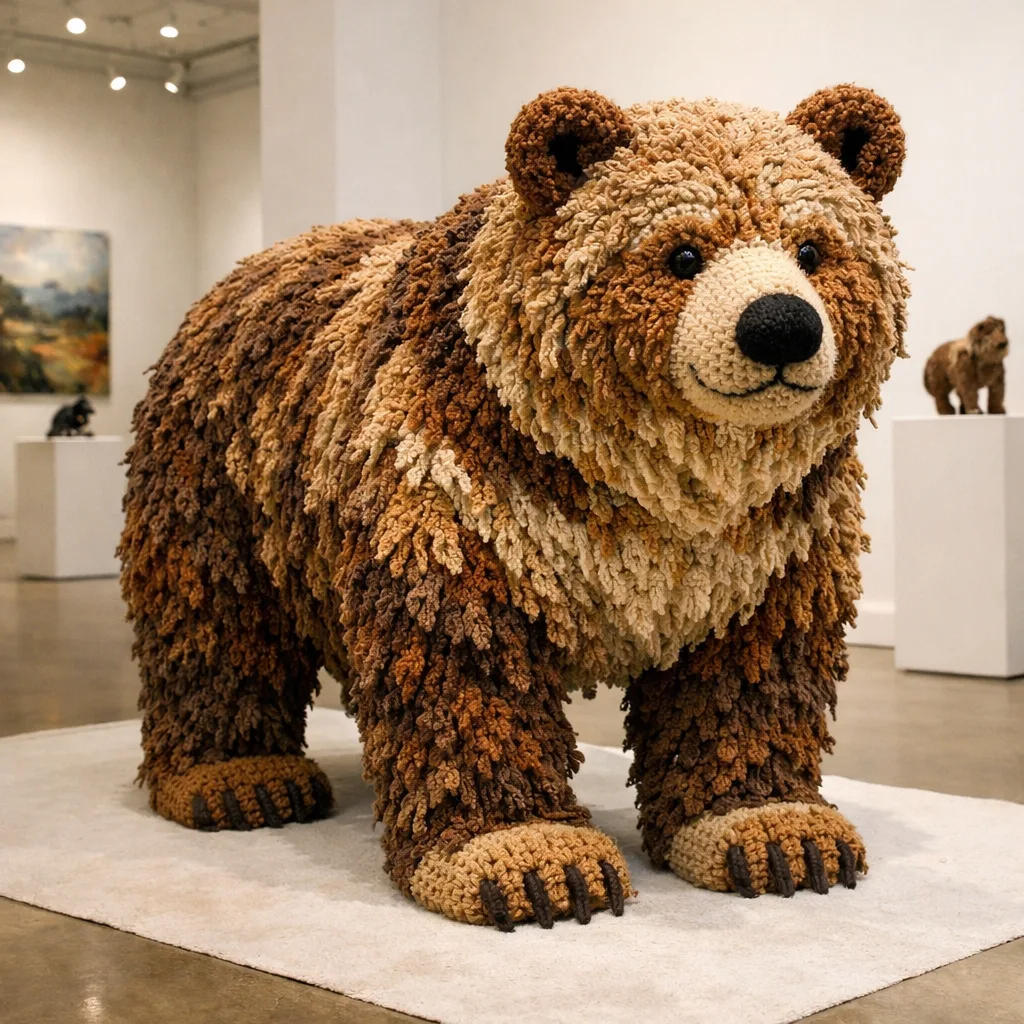
Shauna Richardson and 'crochetdermy'
Think crochet tops out at hats and baby blankets? Fine artist Shauna Richardson crochets life-sized brown bears, tigers, and other large beasts — entirely in crochet. She calls it 'crochetdermy.' It's a glorious reminder that a hook and yarn can scale all the way up to gallery-sized wildlife.
Crochet is a yarn hog (and that's fine)
Ever buy what felt like 'too much' yarn for a blanket and then somehow needed all of it? That's physics, not poor planning. Crochet uses roughly 25–30% more yarn than knitting for a similarly sized piece, because all those loops and posts pack in more fiber. So trust the pattern's quote and buy the extra skein.
Your hook might be good for your brain
Here's a fact to deploy when someone calls your hobby a waste of time: some research suggests that repetitive craft activities like crochet may help reduce the risk of Alzheimer's disease by keeping the brain engaged. So that meditative rhythm of hook-and-loop isn't just relaxing — it may be a low-key cognitive workout.
Yarn chicken
Yarn chicken is the crochet slang for the nerve-wracking race to finish a project before your last bit of yarn runs out — win with a tail to spare, or lose one row from the end.
The SABLE stash
SABLE stands for Stash Acquired Beyond Life Expectancy — more yarn than you could ever use in one lifetime, worn by crocheters as a badge of honor rather than shame.
Crochet's UFO
In the crocheter's dictionary, a UFO is an Unfinished Object — a project set aside for now, distinct from a WIP, the piece currently active on your hook.
The gauge swatch
A gauge swatch is traditionally 4 inches by 4 inches; if your stitch count comes out off from the pattern, you change hook size — up to loosen it, down to tighten it.
By the numbers
- By 2023, what was the approximate value of the global crochet market, in billions of US dollars?
- 1.18 billion USD
- Crochet uses roughly how many percent MORE yarn than knitting for a similarly sized piece (low end of the range)?
- 25 percent
- Around what year did crochet begin overtaking knitting in Google search popularity?
- 2011 year
Matched pairs
Each item on the left goes with the one on the right.
- ami
- crocheted or knitted (the first half of 'amigurumi')
- nuigurumi
- stuffed doll (the second half of 'amigurumi')
- WIP
- Work In Progress — your current active project (most crocheters juggle several)
- UFO
- Unfinished Object — a project you set aside (every crocheter has a graveyard of these)
- SABLE
- Stash Acquired Beyond Life Expectancy — more yarn than you could finish in a lifetime
- Stash
- Your personal yarn collection — destined to grow beyond any rational storage solution
Self-test
Answer each question from memory, then check your work against the answer key.
1. What is the headline fact that makes crochet unique compared to knitting?
- AIt can be mass-produced far more cheaply in factories
- BIt uses noticeably less yarn per piece than knitting
- CGenuine crochet can only be made by human hands
- DIts looping motion was mechanized centuries before knitting's
2. By 2023, roughly what was the value of the global crochet market?
- AAbout $1.18 billion
- BAbout $4.5 billion
- CAbout $12 billion
- DAbout $180 million
3. Crochet uses roughly how much MORE yarn than knitting for a similarly sized piece?
- A50 to 60 percent more
- B25 to 30 percent more
- C5 to 10 percent more
- DAbout the same amount
4. Around what year did crochet begin overtaking knitting in Google search popularity?
- AAround 2016
- BAround 2001
- CAround 1998
- DAround 2011
5. Which statement is NOT a crochet fun fact?
- AShauna Richardson crochets life-sized animals she calls 'crochetdermy'
- BNo industrial machine can replicate genuine crochet
- CRepetitive craft like crochet may help reduce Alzheimer's risk
- DModern machines can now mass-produce genuine crochet cheaply
6. In the word 'amigurumi', what does the part 'ami' mean?
- AStuffed doll
- BCrocheted or knitted
- CTight spiral
- DOversized head
7. In the word 'amigurumi', what does the part 'nuigurumi' mean?
- ACrocheted or knitted
- BJapanese art form
- CStuffed doll
- DSingle crochet
8. Amigurumi is a craft tradition that originated in which country?
- AJapan
- BPeru
- CSweden
- DIreland
9. 'Amigurumi' is best understood as the combination of which two ideas?
- A'Japan' plus 'toy'
- B'Big head' plus 'small body'
- C'Crocheted/knitted' plus 'stuffed doll'
- D'Single crochet' plus 'spiral'
10. Which meaning is INCORRECTLY matched to its amigurumi word-part?
- A'nuigurumi' = stuffed doll
- B'ami' = stuffed doll
- C'amigurumi' = crocheted/knitted stuffed doll
- D'ami' = crocheted or knitted
11. In crochet slang, how does "tinking" differ from "frogging"?
- ATinking rips out a whole section at once, while frogging undoes one stitch at a time
- BTinking works only on knitting, while frogging works only on crochet
- CTinking winds yarn into a cake, while frogging counts your gauge
- DTinking undoes work one stitch at a time in reverse, while frogging rips out a whole section at once
12. In crochet slang, what does 'frogging' mean?
- ARipping out a whole section of stitches at once to undo a mistake
- BUndoing your work one stitch at a time in reverse
- CWinding yarn into a center-pull cake
- DRacing to finish before your yarn runs out
13. What does 'yarn chicken' describe?
- AA test square made before a garment
- BRipping out a whole row of stitches
- CThe tense race to finish a project before your last yarn runs out
- DRolling yarn into a cake
14. Where does the term 'tinking' come from?
- AIt is 'knit' spelled backwards
- BIt imitates the 'rip it' frog sound
- CIt is short for 'tiny knots'
- DIt comes from a Japanese word
15. Why is the term 'frogging' called that?
- AIt is the word 'knit' spelled backwards
- BIt echoes 'rip it, rip it' — which sounds like a frog's croak
- CIt comes from a Japanese word for undoing stitches
- DIt refers to hopping between several unfinished projects
16. What does the crochet slang term "yarn chicken" describe?
- AUndoing your work one stitch at a time, in reverse
- BRolling a center-pull ball from a skein
- CRipping out a whole section of stitches at once
- DRacing to finish a project before your last yarn runs out
17. In a game of yarn chicken, what does it mean to win?
- AYou wind a fresh cake from the leftover scraps
- BYou finish with a few inches of yarn to spare
- CYou have to frog the entire project
- DYou run out one row before the bind-off
18. In crochet abbreviations, what does 'WIP' stand for?
- AWork In Progress
- BWool In Progress
- CWeave In Pattern
- DWound In Place
19. The beloved acronym 'SABLE' stands for what?
- ASkeins Always Bought Locally Everywhere
- BStitches And Bobbins Left Empty
- CStash Acquired Beyond Life Expectancy
- DSoft And Bulky Loose Ends
20. In the crocheter's dictionary, a 'UFO' is best described as which of the following?
- AA center-pull ball of yarn
- BYour entire yarn collection
- CYour active current project
- DAn Unfinished Object set aside for later
21. What does 'winding a cake' produce, and with what tools?
- AA 4-inch test square, using a hook and ruler
- BA tangled 'yarn barf' from the skein's center
- CA graveyard of unfinished projects
- DA flat-topped, center-pull ball, using a ball winder and a swift
22. A gauge swatch is traditionally what size, and what do you change if your count is off?
- A6 inches by 6 inches; change your stitch pattern
- B2 inches by 2 inches; change your yarn brand
- C4 inches by 4 inches; change your hook size
- D1 inch by 1 inch; change your tension only
23. Which definition correctly matches the term 'frogging'?
- AA 4x4 inch test square made before a garment
- BRipping out a chunk of stitches all at once to undo a mistake
- CRolling yarn into a center-pull cake
- DUndoing your work one stitch at a time in reverse
24. Which term-and-definition pairing is a MISMATCH?
- ATinking: ripping out a whole section of stitches at once
- BYarn chicken: racing to finish before your yarn runs out
- CGauge swatch: a 4x4 inch test square
- DFrogging: ripping out stitches all at once to fix a mistake
25. Which term means 'carefully undoing your work one stitch at a time, in reverse'?
- ATinking
- BWinding a cake
- CYarn chicken
- DFrogging
26. Which definition correctly matches 'gauge swatch'?
- AThe race to finish before your yarn runs out
- BUndoing stitches one at a time in reverse
- CA center-pull ball wound with a ball winder and swift
- DA 4x4 inch test square you make before a garment to check stitches per inch
27. Which of these term-and-definition pairs does NOT match?
- ASABLE: more yarn than you could finish in a lifetime
- BFrogging: rolling a center-pull ball of yarn with a ball winder and swift
- CWinding a cake: rolling a center-pull ball with a ball winder and swift
- DWIP: the project actively on your hook
Go deeper
Answer key
- 1. C Genuine crochet can only be made by human handsCrochet's defining move — pulling one live loop through another with a hook, one stitch at a time — has resisted automation, so every crocheted object was made by human hands. Knitting, by contrast, was mechanized centuries ago.
- 2. A About $1.18 billionThe global crochet market was worth about $1.18 billion by 2023.
- 3. B 25 to 30 percent moreCrochet's posts and loops pack more fiber into the same area, so it uses roughly 25-30% more yarn than knitting. Buy the extra skein.
- 4. D Around 2011Around 2011 crochet searches began climbing past knitting's, which had flattened.
- 5. D Modern machines can now mass-produce genuine crochet cheaplyThe headline fact is the opposite: no machine can crochet, so every piece is handmade. The other three are all real fun facts.
- 6. B Crocheted or knitted'Ami' means crocheted or knitted; it combines with 'nuigurumi' (stuffed doll) to form amigurumi.
- 7. C Stuffed doll'Nuigurumi' means stuffed doll; joined with 'ami' (crocheted or knitted) it gives amigurumi.
- 8. A JapanAmigurumi is a Japanese art form, and its name is a Japanese compound of 'ami' and 'nuigurumi'.
- 9. C 'Crocheted/knitted' plus 'stuffed doll'Amigurumi = ami (crocheted or knitted) + nuigurumi (stuffed doll) — literally a crocheted/knitted stuffed doll.
- 10. B 'ami' = stuffed doll'ami' means crocheted or knitted, not stuffed doll — that meaning belongs to 'nuigurumi'.
- 11. D Tinking undoes work one stitch at a time in reverse, while frogging rips out a whole section at onceTinking ('knit' spelled backwards) means undoing one stitch at a time — slow but precise. Frogging ('rip it, rip it') tears out a whole section at once. Both are normal; even expert crocheters do them constantly.
- 12. A Ripping out a whole section of stitches at once to undo a mistakeFrogging means ripping out a chunk of stitches all at once — the pun is 'rip it, rip it.' Undoing one stitch at a time is tinking.
- 13. C The tense race to finish a project before your last yarn runs outYarn chicken is the nerve-wracking gamble of finishing before the yarn runs out — win with a tail to spare, or lose one row from the end.
- 14. A It is 'knit' spelled backwardsTinking is 'knit' spelled backwards, fitting its meaning: undoing stitches one at a time in reverse. The frog sound belongs to frogging.
- 15. B It echoes 'rip it, rip it' — which sounds like a frog's croakFrogging puns on 'rip it, rip it' (rib-bit), a frog's croak, because you rip out your stitches. 'Knit' spelled backwards is where tinking gets its name.
- 16. D Racing to finish a project before your last yarn runs outYarn chicken is the nerve-wracking race to finish a project before your last bit of yarn runs out.
- 17. B You finish with a few inches of yarn to spareWinning yarn chicken means finishing your project with a triumphant tail of yarn left over, rather than running dry early.
- 18. A Work In ProgressWIP is Work In Progress — the project actively on your hook, and most crocheters juggle several at once.
- 19. C Stash Acquired Beyond Life ExpectancySABLE means Stash Acquired Beyond Life Expectancy — more yarn than you could use in a lifetime, worn as a badge of honor.
- 20. D An Unfinished Object set aside for laterUFO is an Unfinished Object — a project set aside 'for now.' The active project is a WIP; the collection is your stash.
- 21. D A flat-topped, center-pull ball, using a ball winder and a swiftWinding a cake rolls a flat-topped, center-pull ball using a ball winder and a swift, which feeds smoothly and prevents yarn barf.
- 22. C 4 inches by 4 inches; change your hook sizeA gauge swatch is traditionally 4x4 inches; if stitches per inch don't match the pattern, you change hook size — up to loosen, down to tighten.
- 23. B Ripping out a chunk of stitches all at once to undo a mistakeFrogging is ripping out a whole section at once. The one-stitch-at-a-time definition is tinking.
- 24. A Tinking: ripping out a whole section of stitches at onceTinking is undoing one stitch at a time in reverse — ripping out a whole section at once is frogging, so that pairing is wrong.
- 25. A TinkingTinking ('knit' backwards) is the slow, precise one-stitch-at-a-time undo; frogging tears out a whole section at once.
- 26. D A 4x4 inch test square you make before a garment to check stitches per inchA gauge swatch is the 4x4 inch test square for checking stitches per inch before starting a garment.
- 27. B Frogging: rolling a center-pull ball of yarn with a ball winder and swiftRolling a center-pull ball is winding a cake, not frogging. Frogging means ripping out stitches to undo a mistake.
Sources
- The Hooked Life — Fun Facts Worth Dropping at Your Next Yarn Haul
- The Hooked Life — Quick Reference: Process Keys
Image credits
- Shauna Richardson and 'crochetdermy': AI-generated (gpt-image-1.5)