
U.S. Permit Test by State (Driving) study guide · Lesson 1 of 18
Road Signs: Shapes, Colors and Key Meanings
Sign shapes · Sign colors · Signs to know on sight
This is the lesson's study guide from the FlashFeed app, plus its key facts and a self-test.
What you'll be able to do
- Identify a road sign from its shape, its color or its message, and say what it tells a driver.
A road sign carries its message through its shape, its color and what it says. A national standard assigns shapes and colors to particular uses. As a result, the look of a sign often shows whether it states a rule, warns of a situation or points the way. Knowing those shapes and colors, plus a short list of key signs, lets a driver tell at a glance what a sign is for.
Sign shapes
The Manual on Uniform Traffic Control Devices (MUTCD) is the national standard for traffic control devices on any street, highway or bicycle trail open to public travel. Road signs are one kind of traffic control device. As of 30 October 2026, the Federal Highway Administration (FHWA) names the 11th Edition with Revision 1 (December 2025) as the current edition of the MUTCD. FHWA also wrote that by 18 January 2026, each State needed to have either the national MUTCD or a State MUTCD or supplement that substantially conforms to it.
Shape carries part of a sign's message. The MUTCD reserves certain shapes for specific signs or series of signs. Shapes used this way are exclusive sign shapes. They include:
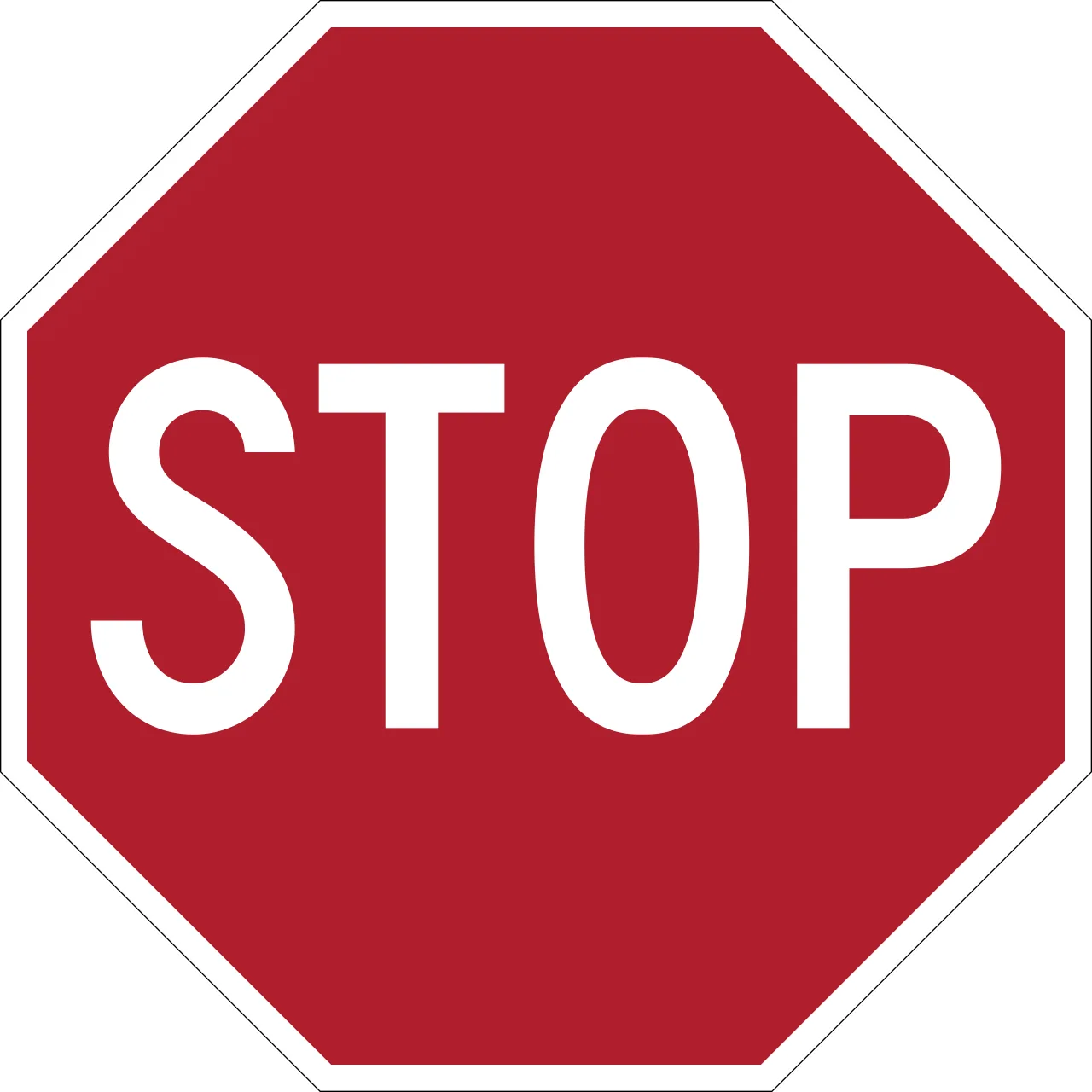
- The octagon is the shape reserved for the STOP sign.
- Only the YIELD sign uses the downward-pointing equilateral triangle, a triangle with all sides equal.
- The circle is exclusive to the Grade Crossing Advance Warning sign, the sign that comes before a grade crossing, where a road and a railroad cross at the same level.
- The pennant, an isosceles triangle with its longer axis horizontal and pointing to the right, is the shape of the NO PASSING ZONE sign. That sign is installed on the left-hand side of the roadway where a no-passing zone begins.
- The upward-pointing pentagon is the shape of two signs, School and County Route. The School sign has four applications: school area, school zone, school advance crossing and school crossing. The county route marker shows a yellow county name, route number and border on a blue background.
- The crossbuck, two rectangles crossed in an X, belongs only to the Grade Crossing sign, the sign at the railroad crossing itself.
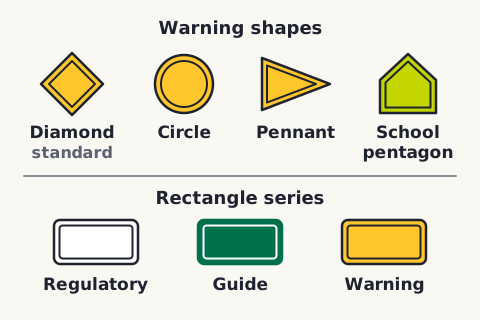
Not every sign shape is reserved. The diamond, a square with one diagonal vertical, is the standard shape of warning signs unless a sign is designated otherwise, and it is not an exclusive shape. A diamond sign may not have its left and right points cut off. The circle, the pennant and the school pentagon are warning shapes too, so a warning sign is not always a diamond. The rectangle, square included, is not an exclusive shape either: it appears in the regulatory, guide and warning series. Regulatory signs, which notify road users of traffic laws or regulations, are rectangular unless specifically designated otherwise.
Sources
Sign colors
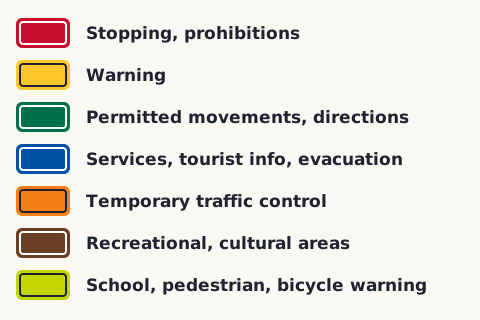
The MUTCD's color code gives colors general meanings. A color from the code may be used only for the devices or applications it prescribes. Some of the meanings are:
- Red is the color the MUTCD assigns to stopping and to prohibitions. The ALL-WAY plaque, which is used with STOP signs, has a white legend (the words and symbols on a sign) and border on a red background.
- The MUTCD gives yellow the general meaning of warning.
- Green carries the general meaning of permitted movements and direction guidance.
- Blue marks guidance on road-user services, tourist information and evacuation routes. General Service signs are white on blue, and so is the Emergency Notification System sign at a railroad crossing.
- Orange is the MUTCD's general color for temporary traffic control. Added work-zone guide signs are black on orange.
- Brown marks guidance to recreational and cultural interest areas. Symbol signs for these areas are white on brown.
- Fluorescent yellow-green carries the general meaning of pedestrian, bicycle, playground, school bus and school warning. School and school bus warning signs must carry a black legend and border on this background, while pedestrian, bicycle and playground warning signs may use it or yellow.
Colors also combine in set patterns on whole signs:
- On an ordinary warning sign, the legend and border are black and the background is yellow.
- Unless the MUTCD provides otherwise, a guide sign, which gives route and destination information, has a white message and white border on a green background.
- In a work zone, warning signs are normally diamonds with a black legend and border on orange, except the Grade Crossing Advance Warning sign, which stays yellow.
The two kinds of warning sign differ in background color: permanent warning signs normally use a yellow background, while work-zone warning signs normally use orange. There are exceptions to the usual pattern: school and school bus warning signs must use fluorescent yellow-green, and the MUTCD allows a few other options in work zones.
Sources
Signs to know on sight
Regulatory signs notify road users of traffic laws or regulations, while warning signs alert road users to a situation that might not be readily apparent. Guide signs tell road users about routes and destinations, directions and distances, services, points of interest, and other geographical, recreational or cultural information.
Regulatory and warning signs also differ in look: regulatory signs are normally rectangular, while warning signs are normally diamond-shaped with a black legend and border on yellow. Black and white are the colors for regulation. Some signs break the usual look: STOP and YIELD are regulatory signs that are not rectangles.
Key regulatory signs include:
- A STOP sign is the MUTCD's sign for an intersection approach where a full stop is always required.
- A YIELD sign tells road users to give the right-of-way to other traffic, slowing to a reasonable speed or stopping when necessary so they do not interfere with conflicting traffic. Giving the right-of-way means letting other traffic go first.
- A STOP sign means a full stop is always required, while a YIELD sign means giving the right-of-way and stopping only when necessary.
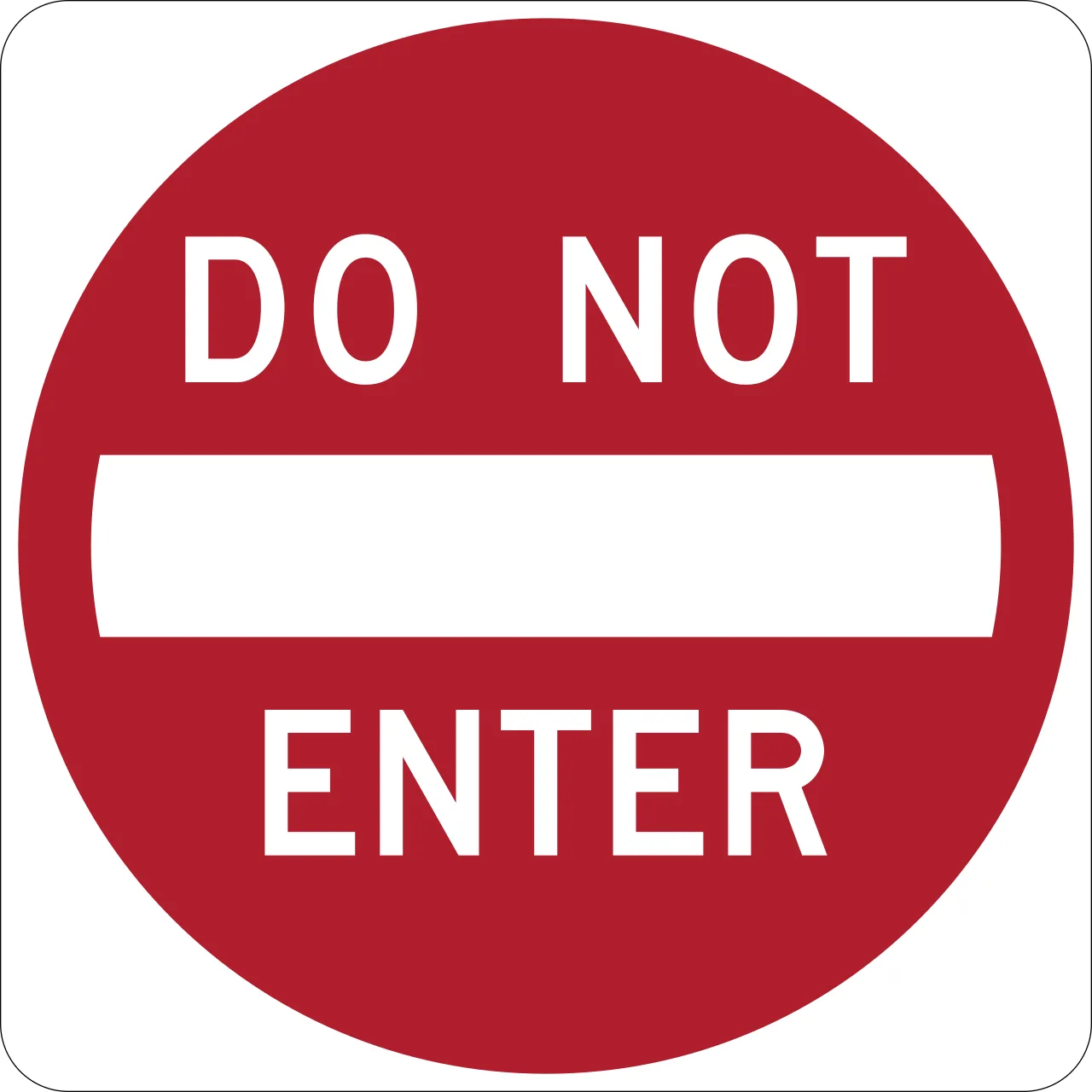
- The MUTCD requires a DO NOT ENTER sign at listed locations, including where a two-way roadway becomes one-way.
- A WRONG WAY sign may be added to supplement a DO NOT ENTER sign where a crossroad meets a one-way roadway in a way that does not physically discourage or prevent wrong-way entry.
- A NO TURN ON RED sign is required where a right turn on a circular red signal is to be prohibited.
- Where every approach to an intersection has a STOP sign, an ALL-WAY plaque goes below each of them.
Other key signs include:
- The MUTCD requires a Stop Ahead, Yield Ahead or Signal Ahead sign when a primary traffic control device cannot be seen from far enough away for road users to respond.
- A ROAD WORK sign gives a general warning that the road ahead has obstructions or restrictions.
- A Grade Crossing Advance Warning sign is required on each highway in advance of every grade crossing, with listed exceptions.
- The Emergency Notification System sign at a highway-rail crossing shows the United States Department of Transportation (USDOT) inventory number and an emergency phone number.
Sources
Key concepts
Octagon
- Reserved for the sign used where a full stop is always required on an approach to an intersection
- The sign it is reserved for is the STOP sign
Downward triangle
- Reserved for the sign that tells road users to give the right-of-way to other traffic
- Its sign calls for slowing to a reasonable speed, or stopping only when necessary, to avoid interfering with conflicting traffic
Circle
- Reserved for the sign required on each highway in advance of every grade crossing, with listed exceptions
- Its sign keeps a yellow background in a work zone, where other warning signs normally use orange
Pennant
- Reserved for the sign that marks where a no-passing zone begins
- Its sign is installed on the left-hand side of the roadway
- An isosceles triangle with its longer axis horizontal, pointing to the right
Pentagon
- Used for a sign with four applications: school area, school zone, school advance crossing and school crossing
- It is also the shape of the county route marker, which shows a yellow county name, route number and border on a blue background
Crossbuck
- Belongs only to the sign at the railroad crossing itself
- Two rectangles crossed in an X
Red
- The Manual on Uniform Traffic Control Devices assigns it to stopping and to prohibitions
- The ALL-WAY plaque, which is used with STOP signs, has a white legend and border on this background
Yellow
- The Manual on Uniform Traffic Control Devices gives it the general meaning of warning
- On an ordinary warning sign, the legend and border are black and the background is this color
- The Grade Crossing Advance Warning sign keeps this background in a work zone
Green
- Its general meaning is permitted movements and direction guidance
- Unless the Manual on Uniform Traffic Control Devices provides otherwise, a guide sign has a white message and white border on this background
Blue
- Its general meaning is guidance on road-user services, tourist information and evacuation routes
- General Service signs are white on this background
- The Emergency Notification System sign at a railroad crossing is also white on this background
Orange
- Its general meaning is temporary traffic control
- In a work zone, warning signs are normally diamonds with a black legend and border on this background
- Added work-zone guide signs are black on this background
Brown
- Its general meaning is guidance to recreational and cultural interest areas
- Symbol signs for these areas are white on this background
Key facts
Shapes Reserved for Specific Signs
The Manual on Uniform Traffic Control Devices (MUTCD) reserves particular shapes for specific signs or series of signs, making them exclusive sign shapes. The octagon is reserved for the STOP sign, and only the YIELD sign uses the downward-pointing equilateral triangle. The circle is exclusive to the Grade Crossing Advance Warning sign, the crossbuck only to the Grade Crossing sign. The pennant is the shape of the NO PASSING ZONE sign, and the upward-pointing pentagon is the shape of the School and County Route signs.
Diamonds and Rectangles Are Not Exclusive
The diamond, a square with one diagonal vertical, is the standard shape of warning signs unless a sign is designated otherwise, and it is not an exclusive shape. The circle, the pennant and the school pentagon are warning shapes too, so a warning sign is not always a diamond. The rectangle, square included, is not an exclusive shape either: it appears in the regulatory, guide and warning series, and regulatory signs are rectangular unless specifically designated otherwise.
What Each Sign Color Marks
In the Manual on Uniform Traffic Control Devices' color code, red is assigned to stopping and to prohibitions, and yellow carries the general meaning of warning. Green carries the general meaning of permitted movements and direction guidance, while blue marks guidance on road-user services, tourist information and evacuation routes. Orange is the general color for temporary traffic control, and brown marks guidance to recreational and cultural interest areas. Fluorescent yellow-green carries the general meaning of pedestrian, bicycle, playground, school bus and school warning.
Color Schemes on Whole Signs
On an ordinary warning sign, the legend (the words and symbols) and border are black and the background is yellow. In a work zone, warning signs are normally diamonds with a black legend and border on orange, except the Grade Crossing Advance Warning sign, which stays yellow. The two kinds differ in background color: permanent warning signs normally use yellow, while work-zone warning signs normally use orange. Unless the Manual on Uniform Traffic Control Devices provides otherwise, a guide sign has a white message and white border on a green background.
Regulatory, Warning and Guide Signs
Regulatory signs notify road users of traffic laws or regulations, while warning signs alert road users to a situation that might not be readily apparent. Guide signs tell road users about routes and destinations, directions and distances, services, points of interest, and other geographical, recreational or cultural information. Regulatory signs are normally rectangular, while warning signs are normally diamond-shaped with a black legend and border on yellow. Black and white are the colors for regulation.
STOP, YIELD and the ALL-WAY Plaque
A STOP sign is the Manual on Uniform Traffic Control Devices' sign for an intersection approach where a full stop is always required. A YIELD sign tells road users to give the right-of-way to other traffic, slowing to a reasonable speed or stopping only when necessary so they do not interfere with conflicting traffic. Giving the right-of-way means letting other traffic go first. Where every approach to an intersection has a STOP sign, an ALL-WAY plaque goes below each of them.
Required Signs and Advance Warnings
The Manual on Uniform Traffic Control Devices requires a DO NOT ENTER sign at listed locations, including where a two-way roadway becomes one-way. It also requires a Stop Ahead, Yield Ahead or Signal Ahead sign when a primary traffic control device cannot be seen from far enough away for road users to respond. A Grade Crossing Advance Warning sign is required on each highway in advance of every grade crossing, with listed exceptions. A ROAD WORK sign gives a general warning that the road ahead has obstructions or restrictions.
Matched pairs
Each item on the left goes with the one on the right.
- ALL-WAY plaque
- Goes below each STOP sign where every approach has one
Self-test
Answer each question from memory, then check your work against the answer key.
1. Which sign tells road users to give the right-of-way, stopping only when necessary?
- AStop Ahead sign
- BYIELD sign
- CSTOP sign
- DWRONG WAY sign
2. Which sign does the Manual on Uniform Traffic Control Devices (MUTCD) require where a two-way roadway becomes one-way?
- ADO NOT ENTER sign
- BYield Ahead sign
- CNO TURN ON RED sign
- DWRONG WAY sign
3. Which sign gives a general warning that the road ahead has obstructions or restrictions?
- ASignal Ahead sign
- BSTOP sign
- CROAD WORK sign
- DNO TURN ON RED sign
4. Which sign has the crossbuck shape, two rectangles crossed in an X?
- ANO PASSING ZONE sign
- BGrade Crossing Advance Warning sign
- CSTOP sign
- DGrade Crossing sign
5. In a work zone, what background color do warning signs normally have?
- ARed
- BOrange
- CYellow
- DGreen
Go deeper
- WatchOne Shape, One Sign Some road sign shapes are reserved for one sign. Spot the shape, know the sign.
- WatchThe Sign Color Code A yellow warning sign and an orange one don't mean the same thing.
- WatchYield Is Not Stop Does a YIELD sign mean stop? Not always.
- StudyU.S. Permit Test by State (Driving) in the FlashFeed app
Answer key
- 1. B YIELD signA YIELD sign means giving the right-of-way and stopping only when necessary. A STOP sign is the one for which a full stop is always required, so it is not the answer.
- 2. A DO NOT ENTER signThe MUTCD requires a DO NOT ENTER sign at listed locations, including where a two-way roadway becomes one-way. A WRONG WAY sign may be added to supplement a DO NOT ENTER sign, but it is an option rather than the required sign.
- 3. C ROAD WORK signA ROAD WORK sign gives a general warning of obstructions or restrictions ahead. A Signal Ahead sign is different: it is required when a primary traffic control device cannot be seen from far enough away.
- 4. D Grade Crossing signThe crossbuck belongs only to the Grade Crossing sign, at the railroad crossing itself. The Grade Crossing Advance Warning sign comes before a grade crossing and uses the circle instead.
- 5. B OrangeIn a work zone, warning signs are normally diamonds with a black legend and border on orange, except the Grade Crossing Advance Warning sign, which stays yellow.
Sources
- Federal Highway Administration — Manual on Uniform Traffic Control Devices for Streets and Highways, 11th Edition with Revision 1 incorporated — mutcd.fhwa.dot.gov/pdfs/11th_Editionr1/mutcd11theditionr1hl.pdf
Image credits
- Shapes Reserved for Specific Signs: Wikimedia Commons · Federal Highway Administration · Public domain — commons.wikimedia.org/wiki/File:MUTCD_R1-1.svg
- Diamonds and Rectangles Are Not Exclusive: FlashFeed original diagram · CC-BY-4.0
- What Each Sign Color Marks: FlashFeed original diagram · CC-BY-4.0
- Required Signs and Advance Warnings: Wikimedia Commons · Federal Highway Administration · Public domain — commons.wikimedia.org/wiki/File:MUTCD_R5-1.svg

