
U.S. Permit Test by State (Driving) study guide · Lesson 2 of 18
Traffic Signals and Pavement Markings
Traffic signals · Pavement markings · Pedestrian signals and crossings
This is the lesson's study guide from the FlashFeed app, plus its key facts and a self-test.
What you'll be able to do
- Read a traffic signal or a pavement marking, including flashing signals, arrows and line patterns, and say what it tells a driver.
Signals and road markings tell drivers and pedestrians when to stop, when to go with care, and where passing or crossing is allowed. The topics are the lights at an intersection, the lines marked on the road, and the signals and crosswalks that pedestrians use. The federal Manual on Uniform Traffic Control Devices (MUTCD) sets what these devices mean. A driver who misreads one can enter an intersection when the signal says to stop, or cross a line that prohibits crossing.
Traffic signals
A signal indication is the light or arrow that a traffic signal shows, and the MUTCD sets what each one means. The three steady circular lights mean the following:
- Traffic facing a steady circular green may go straight, turn right or left, or make a U-turn, unless signs, markings or other devices modify the movement.
- A steady circular yellow warns traffic that the green movement is ending and that red will follow.
- A steady circular red requires traffic to stop, unless the driver is entering the intersection to make another movement permitted by another signal indication.
In the usual order, a circular green is followed by a steady yellow and then by a circular red.
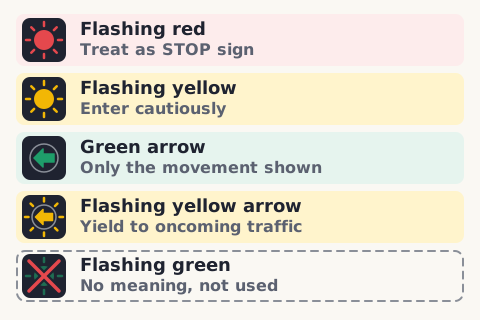
Flashing circular lights do not work like steady ones:
- A flashing circular red means stop at the marked point, after which the right to proceed follows the rules for a stop at a STOP sign.
- A flashing circular yellow lets traffic enter the intersection cautiously, yielding as it would at a steady green.
In the MUTCD, yielding at a steady green means giving way to pedestrians lawfully in the crosswalk, the pedestrian crossing. It also means giving way to vehicles lawfully within the intersection. A driver turning left or making a U-turn to the left must also give way to oncoming vehicles close enough to be an immediate hazard.
The first move tells the two flashing lights apart. At a flashing circular red, traffic stops and then proceeds as at a STOP sign, while at a flashing circular yellow it may enter the intersection cautiously. A steady yellow and a flashing yellow differ: the first warns that red will follow, and the second permits cautious entry.
An arrow shows one direction only. A green arrow permits traffic to enter cautiously only to make the movement the arrow indicates, yielding to pedestrians lawfully in the crosswalk and to vehicles lawfully within the intersection. A flashing yellow arrow permits the same cautious entry, only for the movement the arrow shows, with the same duty to yield; a driver turning left or making a U-turn to the left must also yield to oncoming vehicles close enough to be an immediate hazard.
The MUTCD gives a flashing green indication no meaning and does not allow it to be used.
Sources
Pavement markings
Pavement markings include the lines on the road, and each pattern carries meaning. A broken line indicates a permissive condition, meaning crossing with care is allowed. A solid line either discourages or prohibits crossing, depending on the specific application. A double line indicates maximum or special restrictions.
Yellow center-line patterns tell a driver whether passing is allowed:
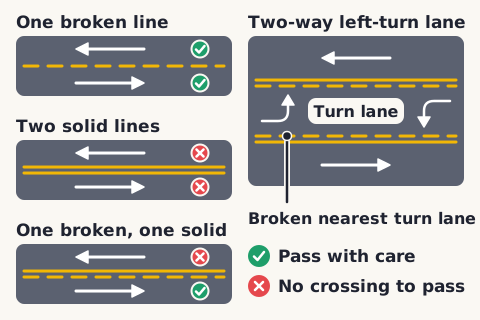
- One normal broken yellow line down the center of a two-lane, two-way road permits passing with care in either direction.
- A double yellow center line made of one broken and one solid line permits passing with care only for traffic next to the broken line.
- Two solid yellow center lines prohibit crossing to pass in either direction.
Compared directly, two solid yellow center lines prohibit crossing to pass in either direction, while one broken yellow center line permits passing with care in either direction.
A two-way left-turn lane is a lane set aside for left turns by traffic going either way. The MUTCD describes a two-way left-turn lane as a lane that can be used by traffic in either direction as part of a left-turn maneuver (Section 3B.05). The MUTCD describes a reversible lane as a lane in which the direction of travel is reversed from time to time (Section 3B.04). A two-way left-turn lane that is never operated as a reversible lane has a broken and a solid yellow line on each side. The broken line is on the side nearest the turn lane. A reversible lane is a lane whose direction of travel can change.
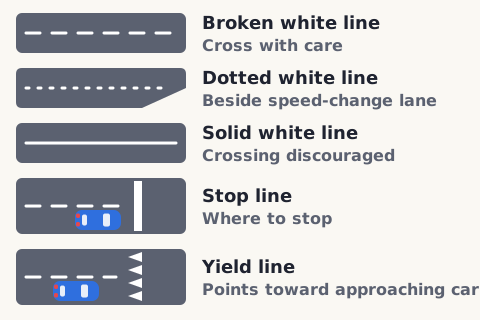
White lane lines use the same idea. A normal-width broken white lane line is used where crossing with care is neither discouraged nor prohibited. The exception is that a dotted white line separates a through lane from an adjacent acceleration or deceleration lane. A Federal Highway Administration (FHWA) research report on interchange ramps says speed-change lanes let entering and exiting vehicles speed up or slow down without conflicting with through traffic: the speed-change lane for an on-ramp is an acceleration lane, and the one for an off-ramp is a deceleration lane (Chapter 1). A through lane carries traffic that keeps going along the road, an acceleration lane is for speeding up, and a deceleration lane is for slowing down. A dotted lane line warns that the function of the lane changes farther along the road.
A normal-width solid white lane line is used where crossing is discouraged.
A stop line is a solid white line across the approach lanes that marks the point where a stop is intended or required. Approach lanes are the lanes vehicles use to reach the line. A yield line is a row of solid white triangles pointing toward approaching vehicles. A yield line may not be installed without a YIELD sign or another device that requires a yield.
Sources
Pedestrian signals and crossings
Pedestrian signals show a WALKING PERSON or an UPRAISED HAND, and the meaning changes with whether the symbol is steady or flashing. The four combinations of symbol and display mean the following:
- At a steady WALKING PERSON signal, which shows the figure in white, pedestrians may start across.
- A flashing WALKING PERSON pedestrian signal has no meaning and may not be used.
- A steady UPRAISED HAND pedestrian signal, shown in Portland orange, means do not enter.
- Under the MUTCD, at a flashing UPRAISED HAND pedestrians must not start to cross, but anyone already crossing continues.
A flashing WALKING PERSON gives pedestrians no instruction, just as a flashing green gives drivers none.
Under the MUTCD, a steady UPRAISED HAND means do not enter, while a flashing one means do not start to cross but let anyone already crossing finish. For example, a pedestrian already partway across while the hand is flashing continues, and one who has not yet stepped into the crossing must not start. Because anyone already crossing continues, a crossing may still hold pedestrians while the UPRAISED HAND flashes. A state's own law can differ on when a pedestrian may start to cross.
A pedestrian countdown shows the seconds left in the pedestrian change interval. Where a pedestrian countdown is used, it is always displayed at the same time as the flashing UPRAISED HAND and only then, not during the steady WALKING PERSON or the steady UPRAISED HAND. Not every flashing hand has a countdown: it is optional where the pedestrian change interval is 7 seconds or less.
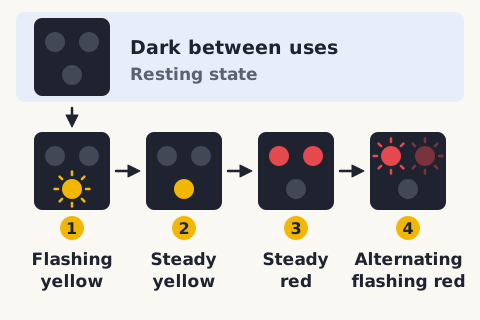
After being dark between uses, a pedestrian hybrid beacon shows four lit stages in this order:
- Flashing yellow.
- Steady yellow.
- Steady red.
- Alternating flashing red.
The dark state is the resting state between uses, so it is not one of the four steps.
A crosswalk includes any part of a roadway, at an intersection or elsewhere, that pavement marking lines clearly indicate as a pedestrian crossing. So a crosswalk can be at an intersection or at another place along the road. That wording gives one part of what a crosswalk is, and it does not say that every crosswalk is marked. Crosswalk markings show where pedestrians cross, while a stop line shows where traffic is to stop.
Sources
Key concepts
Steady green light
- In the usual order, it is followed by a yellow and then by a red
- Permits going straight or turning right or left, unless signs, markings or other devices modify the movement
Steady yellow light
- In the usual order, it comes after a circular green and before a circular red
- Warns traffic that the green movement is ending and that red will follow
Steady red light
- In the usual order, it comes after a yellow
- Requires traffic to stop, unless the driver is entering the intersection to make another movement permitted by another signal indication
Flashing red light
- Traffic stops, and then proceeds as it would at a STOP sign
- The stop is made at the marked point, after which the right to proceed follows the rules for a stop at a STOP sign
Flashing yellow light
- A circular indication that lets traffic enter the intersection cautiously
- Entry is cautious, with traffic yielding as it would at a steady green
Flashing yellow arrow
- A signal that blinks in a caution color and shows one direction only
- Permits only the one movement it shows; a left turn also yields to close oncoming traffic
One broken yellow line
- Only one stripe runs down the center of a two-lane, two-way road
- Passing with care is permitted in either direction
Mixed double yellow
- Made of one broken line and one solid line
- Passing with care is permitted only for traffic next to the broken line
Double solid yellow
- Made of two lines, neither of them broken
- Crossing to pass is prohibited in either direction
Two-way left-turn lane
- Set aside for traffic going either way
- Has a broken and a solid yellow line on each side, when it is never operated as a reversible one
Stop line
- A solid white stripe that extends across the approach lanes
- Marks the point where vehicles are intended or required to halt
Yield line
- Made up of a row of triangles
- The triangles are solid white and point toward approaching vehicles
Key facts
Steady green, yellow and red
Traffic facing a steady circular green may go straight, turn right or left, or make a U-turn unless signs, markings or other devices modify the movement. A steady circular yellow warns traffic that the green movement is ending and that red will follow. A steady circular red requires traffic to stop, unless the driver is entering the intersection to make another movement permitted by another signal indication. In the usual order, a circular green is followed by a steady yellow and then by a circular red.
Flashing lights and arrows
At a flashing circular red, traffic stops at the marked point and then proceeds as at a STOP sign, while at a flashing circular yellow it may enter the intersection cautiously, yielding as it would at a steady green. A green arrow permits cautious entry only for the movement it shows, yielding to pedestrians in the crosswalk and vehicles lawfully in the intersection. A flashing yellow arrow permits the same, and a left turn or left U-turn under it must also yield to oncoming traffic close enough to be an immediate hazard. A flashing green indication has no meaning and may not be used.
Yellow center-line patterns
One normal broken yellow line down the center of a two-lane, two-way road permits passing with care in either direction, while two solid yellow center lines prohibit crossing to pass in either direction. A double yellow center line made of one broken and one solid line permits passing with care only for traffic next to the broken line. A two-way left-turn lane that is never operated as a reversible lane has a broken and a solid yellow line on each side, with the broken line on the side nearest the turn lane.
Lane lines, stop lines, yield lines
A normal-width broken white lane line is used where crossing with care is neither discouraged nor prohibited, except that a dotted white line separates a through lane from an adjacent acceleration or deceleration lane. A normal-width solid white lane line is used where crossing is discouraged. A stop line is a solid white line across the approach lanes that marks the point where a stop is intended or required. A yield line is a row of solid white triangles pointing toward approaching vehicles.
Walking person and upraised hand
At a steady WALKING PERSON signal, which shows the figure in white, pedestrians may start across, while a flashing WALKING PERSON pedestrian signal has no meaning and may not be used. A steady UPRAISED HAND pedestrian signal, shown in Portland orange, means do not enter. Under the Manual on Uniform Traffic Control Devices, at a flashing UPRAISED HAND pedestrians must not start to cross, but anyone already crossing continues. A state's own law can differ on when a pedestrian may start to cross.
Pedestrian countdown and hybrid beacon
A pedestrian countdown shows the seconds left in the pedestrian change interval. It is displayed only during the flashing UPRAISED HAND, and not every flashing hand has one. After being dark between uses, a pedestrian hybrid beacon shows flashing yellow, then steady yellow, then steady red, then alternating flashing red. The dark state is the resting state between uses, so it is not one of these lit stages.
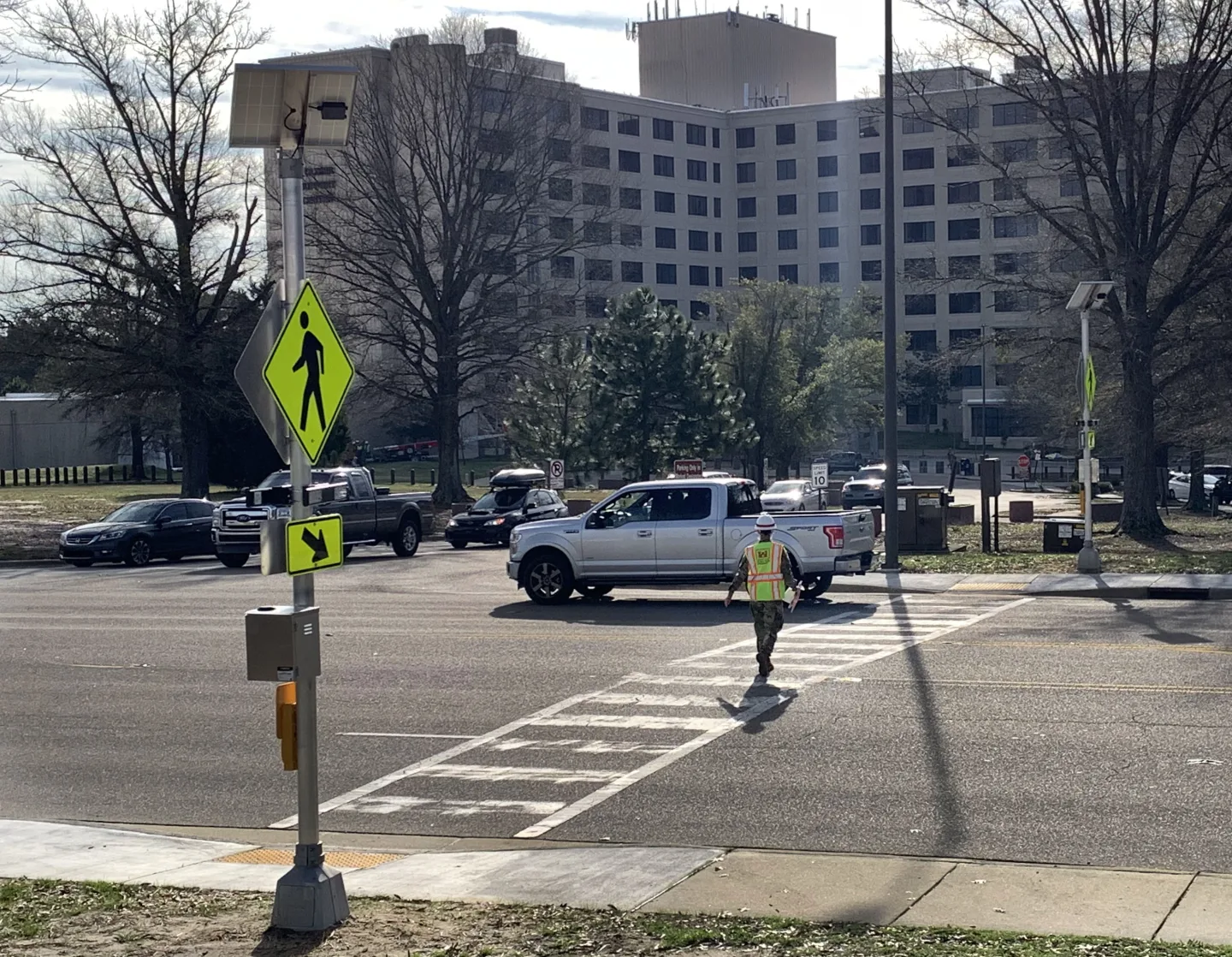
Crosswalks and stop lines
A crosswalk includes any part of a roadway, at an intersection or elsewhere, that pavement marking lines clearly indicate as a pedestrian crossing. Crosswalk markings show where pedestrians cross, while a stop line, a solid white line across the approach lanes, shows where traffic is to stop.
Step by step
The lit stages a pedestrian hybrid beacon shows, in order, after it has been dark between uses
- Flashing yellow
- Steady yellow
- Steady red
- Alternating flashing red
Self-test
Answer each question from memory, then check your work against the answer key.
1. A pedestrian is already partway across a street when the signal begins to flash an UPRAISED HAND. What does that pedestrian do?
- AStops where standing
- BGoes back to the curb
- CWaits for a WALKING PERSON
- DContinues crossing
2. Which pedestrian signal indication is displayed at the same time as a pedestrian countdown?
- AA flashing UPRAISED HAND
- BA flashing WALKING PERSON
- CA steady UPRAISED HAND
- DA steady WALKING PERSON
3. Which signal indication has no meaning and is not allowed to be used?
- AFlashing red
- BFlashing yellow
- CFlashing green
- DSteady yellow
4. What does a green arrow tell a driver?
- AThat the green movement is ending and red will follow
- BThat the movement the arrow indicates is permitted
- CThat a stop is required before proceeding
- DThat any movement through the intersection is permitted
5. A normal-width solid white lane line is used under which condition?
- AWhere a stop is intended or required
- BWhere passing with care is permitted
- CWhere pedestrians are to cross
- DWhere crossing is discouraged
Go deeper
- WatchThe Flashing Yellow Arrow A yellow arrow is flashing. Can you turn? Yes, with care.
- WatchThe Flashing Hand A hand is flashing at a crosswalk. That hand says two things at once.
- StudyU.S. Permit Test by State (Driving) in the FlashFeed app
Answer key
- 1. D Continues crossingUnder the Manual on Uniform Traffic Control Devices, at a flashing UPRAISED HAND pedestrians must not start to cross, but anyone already crossing continues. Stopping where standing is the tempting mistake: the flashing hand rules out starting, not finishing.
- 2. A A flashing UPRAISED HANDA pedestrian countdown is displayed only during the flashing UPRAISED HAND, although not every flashing hand has a countdown. The steady UPRAISED HAND is a different indication: it means do not enter.
- 3. C Flashing greenA flashing green indication has no meaning and is not allowed to be used. A flashing red, a flashing yellow and a steady yellow each carry a meaning.
- 4. B That the movement the arrow indicates is permittedA green arrow permits the movement the arrow indicates. An arrow shows one direction only, so it does not open every movement. A steady yellow warns that red will follow, and a flashing red means stopping first.
- 5. D Where crossing is discouragedA normal-width solid white lane line is used where crossing is discouraged. Passing with care is permitted by a broken yellow center line, and a stop line marks where a stop is intended or required.
Sources
- Federal Highway Administration — Manual on Uniform Traffic Control Devices for Streets and Highways, 11th Edition with Revision 1 incorporated — mutcd.fhwa.dot.gov/pdfs/11th_Editionr1/mutcd11theditionr1hl.pdf
Image credits
- Flashing lights and arrows: FlashFeed original diagram · CC-BY-4.0
- Yellow center-line patterns: FlashFeed original diagram · CC-BY-4.0
- Lane lines, stop lines, yield lines: FlashFeed original diagram · CC-BY-4.0
- Pedestrian countdown and hybrid beacon: FlashFeed original diagram · CC-BY-4.0
- Crosswalks and stop lines: Wikimedia Commons · U.S. Army Corps of Engineers Savannah District · CC BY 2.0 — commons.wikimedia.org/wiki/File:Pedestrian_in_crosswalk_in_Fort_Bragg.jpg
