
U.S. Permit Test by State (Driving) study guide · Lesson 3 of 18
Seeing, Space and Stopping
Scanning, mirrors, blind spots and the space cushion · Reaction, braking and stopping distance
This is the lesson's study guide from the FlashFeed app, plus its key facts and a self-test.
What you'll be able to do
- Describe how to scan ahead, use mirrors, cover blind spots, keep a space cushion around the vehicle and count a following distance.
- Explain how perception, reaction and braking distance make up stopping distance, why speed lengthens it, and what else makes stopping take longer.
A driver can stay out of trouble before any law applies by looking far ahead, knowing what mirrors do not show, and keeping space around the vehicle. Space gives a driver time to act when things go wrong. Stopping also takes distance, and a faster vehicle needs more of it.
Scanning, mirrors, blind spots and the space cushion
All drivers look ahead, but many do not look far enough ahead. Looking far enough ahead means looking well down the road, not only at the vehicle directly ahead. It matters because stopping or changing lanes can take a lot of distance. Safety researchers define hazard perception as a driver's ability to foresee situations that could lead to a crash.
A blind spot is an area alongside a vehicle that the driver cannot see. Mirrors help a driver see around the vehicle, but they do not allow a driver to see everything. The National Highway Traffic Safety Administration (NHTSA) makes both points in a May 2025 handout. The handout also gives a head position for each outside mirror: against the driver's window for the driver's-side mirror, and in the middle of the vehicle for the passenger's-side mirror. Each mirror is set so the driver can just see the side of the driver's own vehicle.
Enhanced mirror settings shrink the blind spots, but the handout still says to look over the shoulder before changing lanes. Checking the blind spots means looking over the right and left shoulders out of the side windows, turning only the head. A driver does this before moments such as changing lanes, merging with traffic or backing up.
A safe driver needs space around the vehicle on all sides, a space cushion. When things go wrong, that space gives time to think and to take action. Staying alongside another vehicle is risky for two reasons: the other driver may change lanes suddenly and turn into the driver's vehicle, and the driver may be trapped when a lane change is needed.
Tailgating means driving too close behind another vehicle. A driver needs space ahead in case of a sudden stop, so the counting method checks the following distance behind the vehicle ahead in three steps:
- The driver waits for the vehicle ahead to pass a fixed landmark, such as a shadow on the road or a pavement marking.
- The driver counts seconds, one thousand-and-one, one thousand-and-two and so on, until the driver's vehicle reaches the same spot.
- The driver compares the count with the target number of seconds.
The order matters, because each step needs the one before it. The target differs by source and vehicle, so the method gives no number.
Sources
- NHTSA, Minimize Blind Spots
- NHTSA, Hazard Perception Training
- Model Commercial Driver License Manual, Section 2
- Driver handbook, safe driving
- Driver handbook, glossary
Reaction, braking and stopping distance
Stopping takes more than braking, because the vehicle keeps traveling before the driver applies the brakes. The Federal Highway Administration (FHWA) defines stopping distance as the sum of three distances:
- Perception distance is the distance a vehicle travels during perception time, which runs from the moment a driver sees a hazard until the brain recognizes it.
- Reaction distance is the distance the vehicle continues to travel, in ideal conditions, before the driver applies the brakes in response to the hazard.
- Braking distance is the distance the vehicle travels, in ideal conditions, while the driver is braking, from the time the brakes are applied until it stops.
These definitions count perception distance separately from reaction distance. The difference between reaction distance and braking distance is timing: reaction distance is covered before the brakes are applied, and braking distance is covered while the driver is braking.
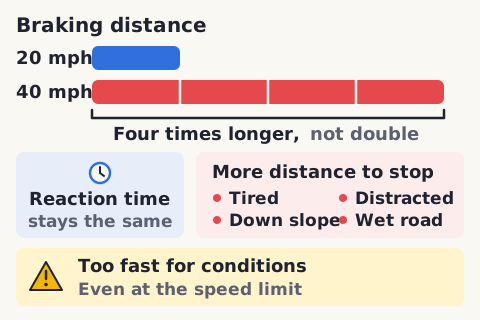
NHTSA's speed-enforcement training says human reaction time stays the same at higher speeds. During the time it takes the driver to perceive and react, the vehicle keeps moving at the same speed toward the hazard. A faster vehicle therefore covers more ground while the driver perceives and reacts.
Braking distance does not double when speed doubles. In FHWA's example, going from 20 to 40 miles per hour (mph) makes it four times longer. That figure is for braking distance only, not for the whole stopping distance, which also includes the reaction distance.
The Insurance Institute for Highway Safety (IIHS) says that as speed goes up, crash energy goes up faster than speed does. It also says higher speed raises the risk of losing control in an evasive steer, which means steering around a hazard.
FHWA also says substantially more distance is needed to stop in four cases:
- a fatigued (tired) driver
- a distracted driver
- a driver on a down slope
- stopping on a wet roadway
The speed limit is set by state law, yet NHTSA says a driver can be going too fast for road conditions even at the speed limit. Its examples include bad weather, a road under repair, or an area at night that is not well lit.
Sources
Key facts
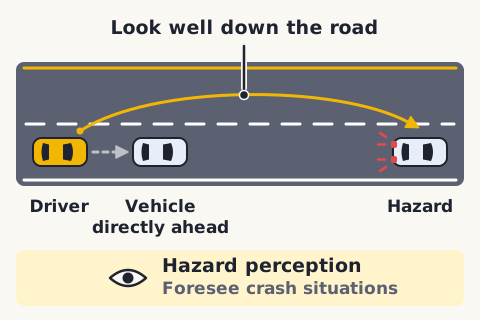
Looking Far Enough Ahead
All drivers look ahead, but many do not look far enough ahead. Looking far enough ahead means looking well down the road, not only at the vehicle directly ahead, because stopping or changing lanes can take a lot of distance. Safety researchers define hazard perception as a driver's ability to foresee situations that could lead to a crash.
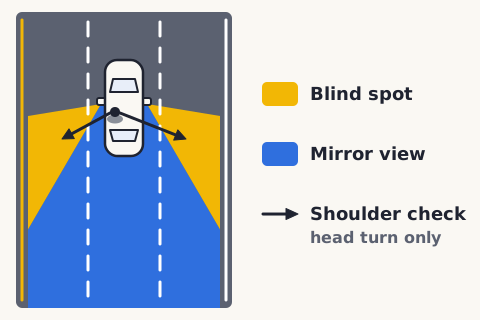
Mirrors Do Not Show Everything
A blind spot is an area alongside a vehicle that the driver cannot see. Mirrors help a driver see around the vehicle, but they do not allow a driver to see everything. Checking the blind spots means looking over the right and left shoulders out of the side windows, turning only the head, before moments such as changing lanes, merging with traffic or backing up. Enhanced mirror settings shrink the blind spots, but the federal handout still says to look over the shoulder before changing lanes.
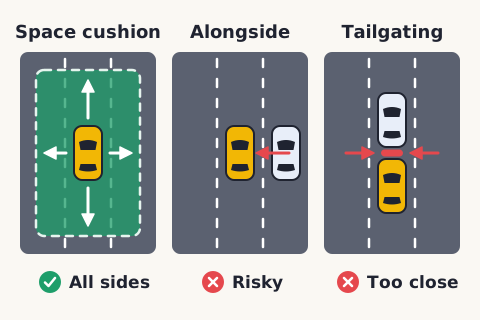
Space Around the Vehicle
A safe driver needs space around the vehicle on all sides, a space cushion, because when things go wrong that space gives time to think and to take action. Staying alongside another vehicle is risky: the other driver may change lanes suddenly and turn into the driver's vehicle, and the driver may be trapped when a lane change is needed. Tailgating means driving too close behind another vehicle. To check the following distance, a driver counts the seconds from when the vehicle ahead passes a landmark until reaching the same spot, then compares the count with the target number of seconds.
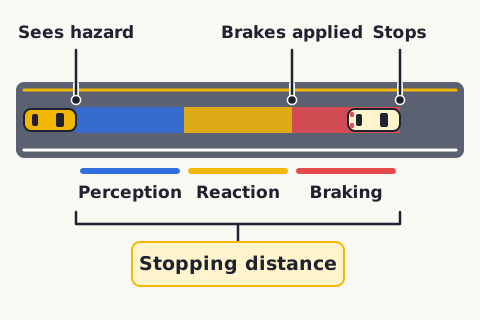
What Stopping Distance Includes
The Federal Highway Administration defines stopping distance as the sum of perception distance, reaction distance and braking distance. Reaction distance is the distance the vehicle continues to travel, in ideal conditions, before the driver applies the brakes in response to the hazard. Braking distance is the distance the vehicle travels, in ideal conditions, while the driver is braking, from the time the brakes are applied until it stops.
Speed, Conditions and Stopping
Human reaction time stays the same at higher speeds, so a faster vehicle covers more ground while the driver perceives and reacts. Braking distance does not double when speed doubles: in the Federal Highway Administration's example, going from 20 to 40 mph makes it four times longer. Substantially more distance is needed to stop for a fatigued driver, a distracted driver, a driver on a down slope, and when stopping on a wet roadway. A driver can also be going too fast for road conditions even at the speed limit.
Step by step
Counting a following distance to keep space ahead for a sudden stop; the target differs by source and vehicle, so the method gives no number
- The driver waits for the vehicle ahead to pass a landmark
- The driver counts seconds until reaching the same spot
- The driver compares the count with the target
Self-test
Answer each question from memory, then check your work against the answer key.
1. A driver watches only the vehicle directly ahead. Which describes looking far enough ahead?
- AWatching the vehicle directly ahead more closely
- BLooking at the road just in front of the vehicle
- CLooking at the traffic alongside the vehicle
- DLooking well down the road and at the vehicle ahead
2. A driver checks both outside mirrors and sees no vehicle alongside. Which statement is true?
- AA vehicle can still be alongside in a blind spot
- BA vehicle can be alongside only if mirrors are not set
- CNo vehicle can be alongside since mirrors show everything
- DA vehicle can be missed only when it is far down the road
3. Which gives a driver time to think and to take action when things go wrong?
- AWatching only the vehicle directly ahead
- BStaying alongside another vehicle
- CKeeping space all around the vehicle
- DRelying on the mirrors to show everything
4. A driver's vehicle has enhanced mirror settings, which shrink the blind spots. What does the federal handout still say to do before changing lanes?
- AWaiting for blind spots to clear
- BLooking over the shoulder
- CUsing only the center mirror
- DUsing the mirrors alone
5. A driver checks a following distance by the counting method. The vehicle ahead has just passed a shadow on the road. What does the driver do next?
- ACounts seconds until the vehicle reaches the same spot
- BSlows down until the vehicle ahead is out of sight
- CWaits for a second landmark before counting
- DCompares the count with the target number of seconds
6. Human reaction time stays the same at higher speeds. What does a faster vehicle do while its driver perceives and reacts?
- ACovers less ground toward the hazard
- BCovers the same ground as a slower vehicle
- CStops sooner than a slower vehicle would
- DCovers more ground toward the hazard
7. In the Federal Highway Administration's example, a vehicle's speed doubles from 20 to 40 mph. What happens to its braking distance?
- AIt becomes three times longer
- BIt becomes four times longer
- CIt stays the same length
- DIt becomes twice as long
8. Which case needs substantially more distance to stop?
- AA driver stopping on a level road
- BA driver stopping on a dry roadway
- CA driver stopping on a wet roadway
- DA driver stopping while rested and alert
9. Which condition can make a driver too fast for the road even at the speed limit?
- AA road that is in good repair
- BAn area at night that is well lit
- CDry and clear daytime weather
- DA road that is under repair
10. Which describes braking distance?
- AThe distance kept behind the vehicle ahead
- BThe distance covered from seeing a hazard to a stop
- CThe distance covered while the driver is braking
- DThe distance covered before the brakes are applied
Go deeper
- WatchThree Parts of Stopping Go from 20 to 40 miles per hour. In one federal example, braking distance gets 4× longer.
- WatchWhere to Put Your Head Mirrors do not show everything. A blind spot is an area alongside the vehicle you cannot see.
- StudyU.S. Permit Test by State (Driving) in the FlashFeed app
Answer key
- 1. D Looking well down the road and at the vehicle aheadLooking far enough ahead means looking well down the road, not only at the vehicle directly ahead, because stopping or changing lanes can take a lot of distance. Watching that vehicle more closely does not extend the view.
- 2. A A vehicle can still be alongside in a blind spotA blind spot is an area alongside a vehicle that the driver cannot see. Mirrors help a driver see around the vehicle, but they do not allow a driver to see everything, so an empty mirror does not mean an empty blind spot.
- 3. C Keeping space all around the vehicleKeeping space around the vehicle on all sides gives that time. Staying alongside another vehicle is risky, because the other driver may change lanes suddenly and turn into the driver's vehicle.
- 4. B Looking over the shoulderEnhanced mirror settings shrink the blind spots, but the handout still says to look over the shoulder before changing lanes. Mirrors alone do not allow a driver to see everything.
- 5. A Counts seconds until the vehicle reaches the same spotAfter the vehicle ahead passes the landmark, the driver counts seconds until the driver's vehicle reaches the same spot, and only then compares the count with the target. Each step needs the one before it.
- 6. D Covers more ground toward the hazardDuring the time the driver perceives and reacts, the vehicle keeps moving at the same speed toward the hazard. Reaction time does not shorten at higher speeds, so a faster vehicle covers more ground in that time.
- 7. B It becomes four times longerBraking distance does not double when speed doubles. In the example, going from 20 to 40 mph makes it four times longer. That figure is for braking distance only, not the whole stopping distance.
- 8. C A driver stopping on a wet roadwaySubstantially more distance is needed to stop for a fatigued driver, a distracted driver, a driver on a down slope, and when stopping on a wet roadway. A dry roadway, a level road and a rested, alert driver are not on that list.
- 9. D A road that is under repairThe National Highway Traffic Safety Administration's examples are bad weather, a road under repair and an area at night that is not well lit. A road in good repair, a well-lit area and dry, clear weather are the opposite cases.
- 10. C The distance covered while the driver is brakingBraking distance is the distance the vehicle travels, in ideal conditions, while the driver is braking, from the time the brakes are applied until it stops. Distance covered before the brakes are applied belongs to the other parts of stopping distance.
Sources
- FMCSA (host); copyright AAMVA — Model Commercial Driver License Manual, Section 2; NHTSA — Countermeasures That Work, hazard perception training; FMCSA (host); copyright AAMVA — Model Commercial Driver License Manual, Section 2 — www.fmcsa.dot.gov/sites/fmcsa.dot.gov/files/docs/2005%20CDL%20DRIVER%20MANUAL%20FINAL%20July%202010.pdf
- NHTSA — Minimize Blind Spots handout (16608-050125-v4) — www.nhtsa.gov/sites/nhtsa.gov/files/2025-05/vehicle-blind-spots-handout-en-2025-16608-v4-tag.pdf
- Federal Highway Administration, Office of Operations — Pilot/Escort Vehicle Operators Training Manual, Module 7: Driver Safety Issues (FHWA-HOP-16-050) — ops.fhwa.dot.gov/publications/fhwahop16050/m7.htm
- NHTSA — Speed-Measuring Device Operator Training, CORE participant manual — www.nhtsa.gov/sites/nhtsa.gov/files/documents/core_participant_manual-smd-2018.pdf
- NHTSA — Speeding and Aggressive Driving Prevention — www.nhtsa.gov/risky-driving/speeding
Image credits
- Looking Far Enough Ahead: FlashFeed original diagram · CC-BY-4.0
- Mirrors Do Not Show Everything: FlashFeed original diagram · CC-BY-4.0
- Space Around the Vehicle: FlashFeed original diagram · CC-BY-4.0
- What Stopping Distance Includes: FlashFeed original diagram · CC-BY-4.0
- Speed, Conditions and Stopping: FlashFeed original diagram · CC-BY-4.0