
U.S. Permit Test by State (Driving) study guide · Lesson 4 of 18
Sharing the Road
Pedestrians, bicyclists and motorcyclists · Trucks, buses, work zones and animals
This is the lesson's study guide from the FlashFeed app, plus its key facts and a self-test.
What you'll be able to do
- Describe how to share the road with pedestrians, bicyclists, motorcyclists, large trucks and buses, road crews and work zones, and animals.
Drivers share the road with pedestrians, bicyclists and motorcyclists, with large trucks and buses, with road crews and with animals. Each of them needs room, and several are easy for a driver to miss. Knowing what each of them may do, and where a driver cannot see them, makes it easier to leave the room they need.
Pedestrians, bicyclists and motorcyclists
The National Highway Traffic Safety Administration (NHTSA) advises drivers to look out for pedestrians everywhere and to minimize blind spots. It also tells drivers to use extra caution at night or in bad weather, because pedestrians can be harder to see at those times and may show up suddenly.
NHTSA also advises drivers never to pass vehicles stopped at a crosswalk, because there may be people crossing where the driver cannot see. A driver stopping at a crosswalk should stay well back from it, NHTSA says, so that other vehicles can see the pedestrians and stop too. Some pedestrians give a visible clue: one guided by an assistance animal or carrying a white cane may be fully or partly blind, or may have a disability.
A multiple threat is a pedestrian-car crash type in which one car stops for a pedestrian in the crosswalk and a second car approaches with its driver's view of the pedestrian blocked by another vehicle.
Bicyclists and motorcyclists face challenges that include being smaller and harder to see than other road users. NHTSA advises drivers not to underestimate the speed of bicyclists.
NHTSA says the majority of multi-vehicle motorcycle crashes are generally caused when other drivers simply did not see the motorcyclist. A 7 May 2015 advisory from the Department of Transportation (DOT) and NHTSA tells drivers to allow a motorcycle the full width of a lane at all times. The 2015 advisory also tells drivers to look for motorcycles in every mirror and blind spot before they change lanes or merge, especially at intersections.
A flashing motorcycle turn signal does not prove the rider is about to turn, because motorcycle signals often do not cancel on their own. A rider may have forgotten to turn the signal off.
The legal duty to stop or yield at a crosswalk, and any passing distance the law requires, are set by state law.
Sources
- NHTSA, Pedestrian Safety
- NHTSA, Share the Road
- NHTSA, Bicycle Safety
- NHTSA, Motorcycle Safety
- DOT and NHTSA, Motorcyclist Advisory
- DL 600, Pedestrians
- DL-7, p. 61
Trucks, buses, work zones and animals
The Federal Motor Carrier Safety Administration (FMCSA) says a large truck or bus has a blind spot on the right that is significantly larger than the one on the left. For that reason, it advises drivers never to pass a large truck or bus on the right. This is advice about large trucks and buses only, not a rule about passing on the right in general.
FMCSA also says that if a driver cannot see a truck or bus driver's face in that driver's mirror, the truck or bus driver cannot see the car. It adds that when turning right, large trucks and buses may first move to the left to get enough room to turn. Trucks and buses are slow to speed up and often slow down when going up a hill, FMCSA says.
FMCSA advises staying a safe distance back when stopped behind a truck or bus, particularly going up an incline, where large vehicles might roll backward. It warns that in a crash behind a truck, a passenger vehicle could slide or be pushed under it, because trucks sit much higher off the ground than passenger vehicles.
FMCSA advises making sure a truck or bus is visible in the rearview mirror before merging in front of it, and leaving extra space when doing so.
The Federal Highway Administration (FHWA) says speed was a factor in over one-third of fatal work-zone crashes in 2024. FHWA's 2026 work-zone fact sheet gives drivers six calls:
- to pay attention
- to keep their distance
- to slow down
- to watch for pedestrians
- to allow extra space
- to avoid distractions
A deer biologist, quoted in the National Safety Council's November 2021 Traffic Safety newsletter, says deer are most active at dawn and dusk. In that November 2021 newsletter, the Council itself says that when a deer is seen near the road, more are likely to follow.
Sources
Key terms
- Multiple threat
- A crash type in which one car stops for a pedestrian in the crosswalk and a second car's driver cannot see the pedestrian past another vehicle.
Key facts
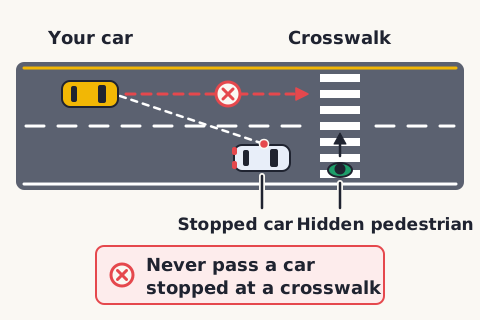
Watching for pedestrians everywhere
Drivers are advised to look out for pedestrians everywhere and to minimize blind spots. The National Highway Traffic Safety Administration (NHTSA) also advises drivers never to pass a vehicle stopped at a crosswalk, because there may be people crossing where the driver cannot see.
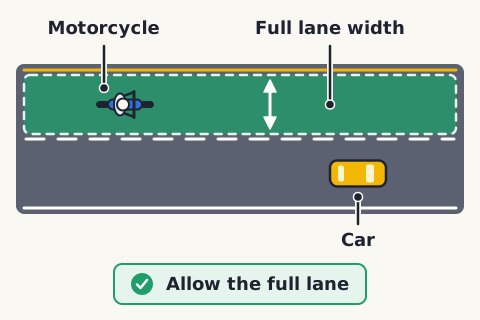
Smaller road users are easy to miss
Bicyclists and motorcyclists are smaller and harder to see than other road users, and drivers are advised not to underestimate a bicyclist's speed. The National Highway Traffic Safety Administration (NHTSA) says most multi-vehicle motorcycle crashes are generally caused when other drivers did not see the motorcyclist. A 7 May 2015 U.S. Department of Transportation and NHTSA advisory tells drivers to allow a motorcycle the full width of a lane at all times. A flashing turn signal does not prove the rider is about to turn, because motorcycle signals often do not cancel on their own.
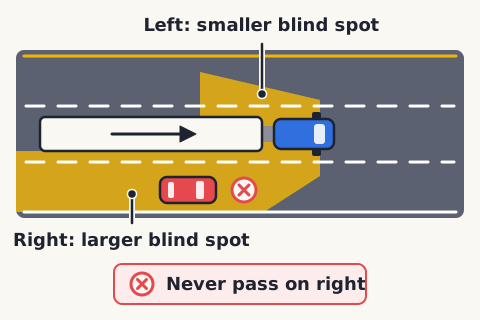
Seeing and being seen by trucks
A large truck or bus has a blind spot on the right that is significantly larger than the one on the left, so the Federal Motor Carrier Safety Administration (FMCSA) advises never passing it on the right. If a driver cannot see the truck or bus driver's face in that driver's mirror, the truck or bus driver cannot see the car. When turning right, large trucks and buses may first move to the left to get enough room to turn. In a crash behind a truck, a passenger vehicle could slide or be pushed under it, because trucks sit much higher off the ground.
Staying alert in work zones and deer country
The 2026 work-zone fact sheet from the Federal Highway Administration (FHWA) gives drivers six calls: to pay attention, to keep their distance, to slow down, to watch for pedestrians, to allow extra space and to avoid distractions. A deer biologist quoted in the National Safety Council's November 2021 newsletter says deer are most active at dawn and dusk.
Self-test
Answer each question from memory, then check your work against the answer key.
1. A car ahead has stopped at a crosswalk. Why are drivers advised never to pass it?
- APeople may be crossing out of the driver's view
- BThe stopped car may suddenly back up
- CThe traffic signal ahead may be about to change
- DThe stopped car may be about to change lanes
2. A driver is judging how fast a bicyclist ahead is traveling. What are drivers advised to do about a bicyclist's speed?
- ATo assume it is slower than cars
- BNot to bother judging it at all
- CTo treat it as a runner's speed
- DNot to underestimate its speed
3. A driver sees a large truck about to turn right. What does the Federal Motor Carrier Safety Administration say the truck may do first?
- ASpeed up first to clear the corner
- BMove left first to get turning room
- CStop short of the corner to wait
- DMove right first to hug the curb
4. A driver is passing through a work zone. Which action is one of the six calls to drivers in the Federal Highway Administration's 2026 work-zone fact sheet?
- ATo clear the zone quickly
- BTo follow closely behind
- CTo allow extra space
- DTo change lanes often
5. A driver shares the road with a motorcycle. How much of a lane is the driver advised to allow it?
- AWhatever width the driver's vehicle leaves
- BThe full width of the lane, at all times
- CHalf the lane, as motorcycles are narrow
- DOnly the width the motorcycle takes up
Go deeper
- WatchThe Truck's Right Side A large truck has a blind spot on each side. The right one is significantly larger.
- WatchThe Car That Stopped for a Reason A car stops at a crosswalk. The driver behind cannot see why.
- StudyU.S. Permit Test by State (Driving) in the FlashFeed app
Answer key
- 1. A People may be crossing out of the driver's viewDrivers are advised never to pass a vehicle stopped at a crosswalk because there may be people crossing where the passing driver cannot see. A car backing up, changing lanes or a signal changing is not the reason given.
- 2. D Not to underestimate its speedDrivers are advised not to underestimate the speed of bicyclists. Assuming the speed is low, or not judging it at all, does not follow that advice.
- 3. B Move left first to get turning roomWhen turning right, large trucks and buses may first move to the left to get enough room to turn. Moving right toward the curb is the opposite of what is described.
- 4. C To allow extra spaceThe six calls are to pay attention, keep distance, slow down, watch for pedestrians, allow extra space and avoid distractions. Clearing the zone quickly or following closely behind runs against them.
- 5. B The full width of the lane, at all timesA 7 May 2015 advisory from the Department of Transportation and National Highway Traffic Safety Administration tells drivers to allow a motorcycle the full width of a lane at all times, not half of it or only the width it takes up.
Sources
- NHTSA — Pedestrian Safety: Prevent Pedestrian Crashes — www.nhtsa.gov/road-safety/pedestrian-safety
- U.S. Department of Transportation and NHTSA — CONSUMER ADVISORY: Safely 'Share the Road' with Motorcyclists — www.transportation.gov/briefing-room/consumer-advisory-safely-share-road-motorcyclists
- NHTSA — Bicycle Safety: Bike Safety Tips for Kids and Adults — www.nhtsa.gov/road-safety/bicycle-safety
- Federal Motor Carrier Safety Administration — Tips for Passenger Vehicle Drivers (Our Roads, Our Safety) — www.fmcsa.dot.gov/ourroads/tips-driving-safely-around-large-trucks-or-buses
- FHWA — 2026 National Work Zone Awareness Week fact sheet (HOP-26-060) — ops.fhwa.dot.gov/publications/HOP-26-060_FHWA_NWZAW_Factsheet.pdf
- FMCSA — Teen Zone: Driving Safely Near Large Trucks and Buses — www.fmcsa.dot.gov/TeenZone
- National Safety Council — Avoid deer-vehicle collisions (Traffic Safety, Vol. 21, No. 11) — www.nsc.org/getmedia/48e7a578-b3a2-4db8-aed6-4c9fa07e0506/traffic-safety-1121.pdf
Image credits
- Watching for pedestrians everywhere: FlashFeed original diagram · CC-BY-4.0
- Smaller road users are easy to miss: FlashFeed original diagram · CC-BY-4.0
- Seeing and being seen by trucks: FlashFeed original diagram · CC-BY-4.0