
U.S. Permit Test by State (Driving) study guide · Lesson 5 of 18
Alcohol, Drugs, Fatigue and Distraction: How They Impair Driving
Alcohol and other drugs · Distraction and fatigue
This is the lesson's study guide from the FlashFeed app, plus its key facts and a self-test.
What you'll be able to do
- Explain how alcohol, other drugs (drugged driving and mixing drugs), fatigue and distraction impair driving, and why a legal limit is not a safe amount.
Alcohol, other drugs, distraction and tiredness all impair driving, which means each one leaves a driver less able to drive safely. Each does it in its own way, and some ideas about them do not hold up. A driver can also be impaired without realizing it, which is why the facts about each cause matter.
Alcohol and other drugs
Blood alcohol concentration (BAC) is the weight of alcohol in a given volume of a person's blood. The type of drink does not matter: one standard drink, meaning a set amount of alcohol, is the same as another.
A legal blood alcohol limit is a legal line, not a safe amount. The legal limit itself is set by state law. Staying under the legal limit does not make it safe to drive. The Centers for Disease Control and Prevention (CDC) says that impairment starts at lower BAC levels than the legal limit. The Federal Motor Carrier Safety Administration (FMCSA) says that no amount of drinking before driving is safe.
Drivers find it very difficult to judge their own BAC or impairment. Failing to recognize alcohol impairment is often itself a symptom, or sign, of impairment. One myth says a person can drive as long as he or she is not slurring words or acting erratically. In fact, the coordination needed for driving is compromised long before signs of intoxication show, and reaction time is slowed.
Coffee does not sober a driver up: caffeine may help with drowsiness (sleepiness) but not with alcohol's effects on decision-making or coordination. There is no quick cure for alcohol impairment; only time helps.
Drugged driving is driving a vehicle while impaired by the intoxicating effects of recent drug use. Alcohol, marijuana and other drugs can impair driving because they slow a driver's coordination, judgment and reaction times. The CDC also states that using any alcohol or any other drug impairs a person's ability to drive safely. Using two or more drugs at the same time, alcohol included, can amplify, or strengthen, each drug's impairing effects.
One rumor says that marijuana cannot impair driving or even makes a safer driver. That rumor is a misconception: several scientific studies indicate it is false.
Over-the-counter (OTC) cold and allergy medicines, sleep aids and other OTC medications can cause side effects, including drowsiness, nausea and blurred vision. A medicine's warning against operating heavy machinery covers driving a vehicle.
Sources
- NHTSA, Drunk Driving
- CDC, Impaired Driving
- FMCSA, Tips for Drivers
- NIAAA, Holiday Spirits
- NHTSA, Drug-Impaired Driving
- NHTSA, Medicines and Driving
- NIDA, Drugged Driving
Distraction and fatigue
Distracted driving is any activity that pulls a driver's attention away from driving. The definition is not limited to phones. The CDC names three types of distraction, and each one takes something different off the task of driving:
- Visual distraction is taking the eyes off the road.
- Manual distraction is taking the hands off the wheel.
- Cognitive distraction is taking the mind off driving.
Texting and similar tasks involve all three types of distraction at the same time: the eyes leave the road, the hands leave the wheel and the mind leaves driving. Sending or reading a text keeps a driver's eyes off the road for about 5 seconds, which at 55 miles per hour (mph) is like driving the length of a football field with the eyes closed. Teen and young adult drivers face a higher risk of distracted driving than other age groups do.
Fatigue, or tiredness, is a different problem from distraction. Signs of drowsy driving include driving across the lines on the road, hitting a rumble strip (a strip that rumbles under the tires), yawning often and having trouble keeping the eyes open. These are only some of the signs, not a complete list. Drowsy-driving crashes occur most frequently between midnight and 6 a.m., or in the late afternoon. These crashes often involve a single driver, with no passengers, who runs off the road at high speed with no sign of braking. They also often happen on rural roads and highways.
A micro sleep is a brief loss of consciousness that can last four or five seconds, though the length is not fixed. In plain words, the driver is briefly asleep at the wheel. If a micro sleep lasts four or five seconds, a driver at 55 miles per hour travels more than 100 yards down the road while asleep.
Coffee or an energy drink alone is not always enough against drowsy driving. It might help a driver feel more alert, but the effects last only a short time, and the driver might not be as alert as he or she thinks.
Sources
Key terms
- BAC
- The weight of alcohol in a given volume of a person's blood
- Micro sleep
- A brief loss of consciousness that can last four or five seconds
Key facts
A Legal Line, Not a Safe Amount
A legal blood alcohol limit is a legal line, not a safe amount. The Centers for Disease Control and Prevention says that impairment starts at lower blood alcohol levels than the legal limit, so staying under the limit does not make it safe to drive. The Federal Motor Carrier Safety Administration says that no amount of drinking before driving is safe.
Why Feeling Fine Is Not Enough
Drivers find it very difficult to judge their own impairment, and failing to recognize alcohol impairment is often itself a symptom of impairment. One myth says a person can drive as long as he or she is not slurring words or acting erratically, but the coordination needed for driving is compromised long before signs of intoxication show, and reaction time is slowed. Coffee does not sober a driver up: caffeine may help with drowsiness, but not with alcohol's effects on decision-making or coordination. There is no quick cure for alcohol impairment; only time helps.
How Other Drugs Impair Driving
Drugged driving is driving a vehicle while impaired by the intoxicating effects of recent drug use. Alcohol, marijuana and other drugs can impair driving because they slow a driver's coordination, judgment and reaction times. Using two or more drugs at the same time, alcohol included, can amplify each drug's impairing effects. The rumor that marijuana cannot impair driving, or even makes a safer driver, is a misconception: several scientific studies indicate it is false.
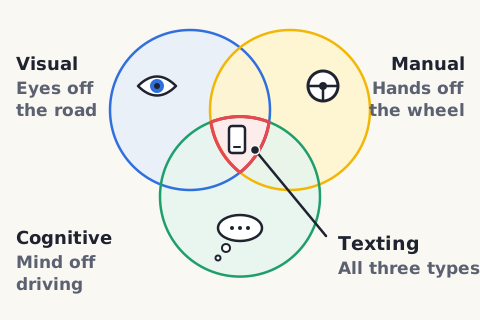
Three Types of Distraction
Distracted driving is any activity that pulls a driver's attention away from driving. The Centers for Disease Control and Prevention names three types: visual distraction is taking the eyes off the road, manual distraction is taking the hands off the wheel and cognitive distraction is taking the mind off driving. The Federal Highway Administration notes that texting and similar tasks involve all three types of distraction at the same time.
Coffee, Energy Drinks and Drowsy Driving
Coffee or an energy drink alone is not always enough against drowsy driving. It might help a driver feel more alert, but the effects last only a short time, and the driver might not be as alert as he or she thinks. Drowsy-driving crashes occur most frequently between midnight and 6 a.m., or in the late afternoon.
Matched pairs
Each item on the left goes with the one on the right.
- Cognitive distraction
- Taking the mind off driving
Self-test
Answer each question from memory, then check your work against the answer key.
1. A driver who has been drinking alcohol has a cup of coffee. What might the caffeine help with?
- ADecision-making and coordination, but not drowsiness
- BSobering the driver up enough to be fit to drive
- CCoordination, but not decision-making
- DDrowsiness, but not decision-making or coordination
2. A driver has used marijuana and has also been drinking alcohol. Which statement about using both at the same time is correct?
- AEach can amplify the impairing effects of the other
- BOnly the alcohol impairs driving; marijuana does not
- CThe effects stay separate, so neither is stronger
- DMarijuana can offset the alcohol, making the driver safer
3. A driver reads and answers a text message while driving. Which types of distraction are involved at the same time?
- AVisual and manual, not cognitive
- BVisual, manual and cognitive
- CManual and cognitive, not visual
- DVisual only
4. A driver relies on an energy drink alone to stay awake on a late-night drive. Which statement about relying on it is correct?
- AIts effects do not fade during a night of driving
- BIt fixes drowsy driving every time it is used
- CIt is not always enough against drowsy driving
- DIt is enough as long as the driver feels alert
5. A driver's blood alcohol concentration is under the legal limit. Which statement about impairment is correct?
- AImpairment starts sooner with certain types of drink
- BImpairment starts only once the legal limit is reached
- CImpairment starts at lower levels than the legal limit
- DImpairment starts only once signs of intoxication show
Go deeper
- WatchFive Seconds Blind 5 seconds. That's about how long a text keeps your eyes off the road.
- WatchOnly Time Helps Coffee does not sober a driver up. Caffeine may help with drowsiness, not with alcohol's effects on decisions or coordination.
- StudyU.S. Permit Test by State (Driving) in the FlashFeed app
Answer key
- 1. D Drowsiness, but not decision-making or coordinationCaffeine may help with drowsiness but not with alcohol's effects on decision-making or coordination. There is no quick cure for alcohol impairment, so coffee does not sober a driver up; only time helps.
- 2. A Each can amplify the impairing effects of the otherUsing two or more drugs at the same time, alcohol included, can amplify each drug's impairing effects. Marijuana does not offset the alcohol: several scientific studies indicate that the rumor it makes a safer driver is false.
- 3. B Visual, manual and cognitiveTexting and similar tasks involve all three types of distraction at the same time: the eyes leave the road, the hands leave the wheel and the mind leaves driving. A text is therefore not only a visual distraction.
- 4. C It is not always enough against drowsy drivingCoffee or an energy drink alone is not always enough against drowsy driving. It might help a driver feel more alert, but the effects last only a short time, and the driver might not be as alert as he or she thinks.
- 5. C Impairment starts at lower levels than the legal limitA legal limit is a legal line, not a safe amount: impairment starts at lower blood alcohol levels than the limit, so staying under it does not make it safe to drive.
Sources
- CDC, National Center for Injury Prevention and Control — Impaired Driving — www.cdc.gov/impaired-driving/about/index.html
- National Institute on Alcohol Abuse and Alcoholism — The Truth About Holiday Spirits — www.niaaa.nih.gov/publications/brochures-and-fact-sheets/truth-about-holiday-spirits
- NHTSA — Drug-Impaired Driving — www.nhtsa.gov/risky-driving/drug-impaired-driving
- NHTSA — Drunk Driving — www.nhtsa.gov/risky-driving/drunk-driving
- CDC — Distracted Driving; FHWA — Driver Safety Issues; CDC — Distracted Driving — www.cdc.gov/distracted-driving/about/index.html
- NHTSA — Drowsy Driving: Avoid Falling Asleep Behind the Wheel — www.nhtsa.gov/risky-driving/drowsy-driving
- Federal Highway Administration, Office of Operations — Pilot/Escort Vehicle Operators Training Manual, Module 7: Driver Safety Issues (FHWA-HOP-16-050) — ops.fhwa.dot.gov/publications/fhwahop16050/m7.htm
Image credits
- Three Types of Distraction: FlashFeed original diagram · CC-BY-4.0