
U.S. Permit Test by State (Driving) study guide · Lesson 6 of 18
Night, Bad Weather and Vehicle Emergencies
Night, fog, rain and ice · Skids and vehicle emergencies
This is the lesson's study guide from the FlashFeed app, plus its key facts and a self-test.
What you'll be able to do
- Describe the correct response to night glare, fog, rain, a skid, a blowout, brake failure and a stall on railroad tracks.
Darkness, fog, rain and ice each change how a driver should drive. Night gives a driver less time to respond, and some slick roads do not look slick. A skid, a tire blowout, brake failure or a stall on railroad tracks can put a driver in danger. For each of these, the safe response has a reason behind it.
Night, fog, rain and ice
Night driving carries greater risk mainly because drivers cannot see hazards as quickly as in daylight, so they have less time to respond. Glare is harsh light, such as the bright headlights of an oncoming vehicle. Driver factors in night-driving problems include vision, glare and fatigue. It can take drivers several seconds to see normally again after glare.
To handle glare, a driver should not look directly into the bright headlights of an oncoming vehicle. Instead, the driver should look toward the right side of the lane: at its right edge, or down toward its lower right side.
At night a driver must be able to stop within the distance the headlights light up. More generally, drivers have to make certain they can come to a stop within the distance they can see ahead. Choosing a speed that lets the vehicle stop inside that distance is one way a driver matches speed to conditions.
Low-beam headlights, the dimmer setting, should be turned on when approaching fog. High beams, the brighter setting, can actually limit a driver's visibility in poor weather such as rain, fog and snow. State law sets when headlights must be on and the distance for lowering high beams.
In fog, a driver should not change lanes or pass other vehicles unless absolutely necessary. The National Weather Service (NWS) lists three small decisions for driving in fog: to slow down, not use cruise control, and delay travel. Cruise control is a setting that holds a steady speed. Slowing down also fits the idea of stopping within the distance a driver can see ahead.
After a long dry stretch, oil and debris have built up on the road, so the road becomes slick when it first starts to rain. If the rain continues, it washes the oil away. Roads can be slippery even when they only appear wet. Four-wheel drive does not prevent a vehicle from losing traction, or grip, in snow. Trucks and sport utility vehicles (SUVs) can still lose grip in snow even when they have four-wheel drive. Black ice can form on a road without the driver even seeing it.
Sources
- Federal Highway Administration, Pilot/Escort Manual, Module 7
- NWS, Fog Safety
- NWS, Winter Driving
- National Safety Council, High Beams
- Model Commercial Driver License Manual, Section 2
- California Driver's Handbook, Safe Driving
- DL-7, p. 47
Skids and vehicle emergencies
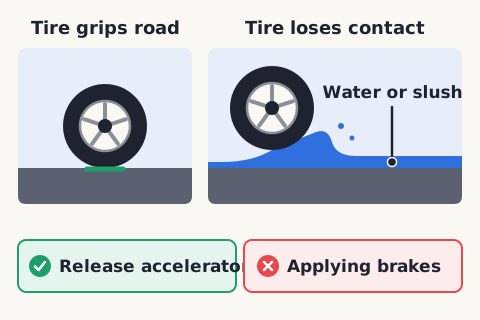
Hydroplaning happens on water or slush, when the tires lose contact with the road and have little or no traction. The driver may not be able to steer or brake. A driver who is hydroplaning should release the accelerator (the gas pedal) and avoid applying the brakes. A driver handbook says to slow down gradually, without using the brakes.
A skid is different: it is any time the tires lose their grip on the road. A skid has four named causes: over-braking, over-steering, over-acceleration and driving too fast.
Recovering from a skid takes three steps, and the aim is to regain control of the vehicle. The driver:
- stays calm and eases the foot off the gas;
- turns the wheels in the direction the driver wants the front of the car to go;
- straightens the wheels gently as control comes back.
NWS gives the first two steps and a driver handbook the third.
The goal in any tire blowout is to keep the vehicle balanced and controllable. Overreacting, such as slamming on the brakes, can cause a loss of control. The National Highway Traffic Safety Administration (NHTSA) lists five steps for a blowout, including these three. The driver:
- holds the steering wheel with both hands;
- corrects the steering as necessary to stabilize the vehicle and regain control;
- once the vehicle is stable, continues to slow down and pulls off the road where and when it is safe.
After brake failure, the longer a driver waits, the faster the vehicle will go and the harder it will be to stop. The shared core of the response has three steps, and the parking brake is used because it is a different system from the hydraulic brakes. The driver:
- shifts to a lower gear;
- applies the parking brake with care, ready to let go of it if the vehicle starts to skid;
- looks for an escape route.
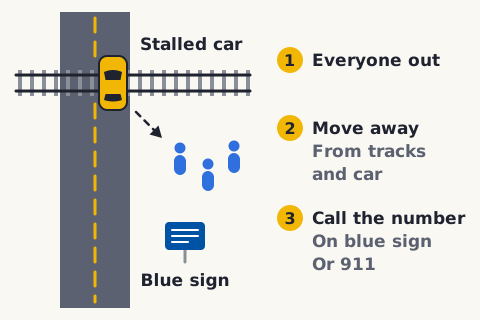
A freight train can take a very long distance to stop. The aim is to get people away from a vehicle stalled on railroad tracks before a train arrives. In NHTSA's order, a driver whose car has stalled at a crossing should:
- get everyone out of the vehicle;
- move away from the tracks and the vehicle;
- call the number on the blue emergency notification system sign, or 911 if the sign is not visible.
Sources
Key facts
Night driving and glare
Night driving carries greater risk mainly because drivers cannot see hazards as quickly as in daylight, so they have less time to respond. After glare, such as from the bright headlights of an oncoming vehicle, it can take several seconds to see normally again. A driver should not look directly into those headlights and should look toward the right side of the lane instead. At night, a driver must also be able to stop within the distance the headlights light up.
Headlights and fog
Low-beam headlights should be turned on when approaching fog, and the National Safety Council notes that high beams can actually limit a driver's visibility in poor weather such as rain, fog and snow. In fog, a driver should not change lanes or pass other vehicles unless absolutely necessary. The National Weather Service lists small decisions for driving in fog: to slow down, not to use cruise control, and to delay travel.
Roads slicker than they look
After a long dry stretch, oil and debris have built up on the road, so the road becomes slick when it first starts to rain; continuing rain washes the oil away. Roads can be slippery even when they only appear wet. Trucks and sport utility vehicles can still lose grip in snow even when they have four-wheel drive. Black ice can form on a road without the driver even seeing it.
Hydroplaning and skids
Hydroplaning happens on water or slush, when the tires lose contact with the road and have little or no traction, so the driver may not be able to steer or brake. A hydroplaning driver should release the accelerator and avoid applying the brakes. A skid is different: it is any time the tires lose their grip on the road. Recovery from a skid takes three steps: staying calm and easing the foot off the gas, turning the wheels in the direction the driver wants the front of the car to go, and gently straightening them as control comes back.
Brake failure and stalls on tracks
After brake failure, the longer a driver waits, the faster it will go and the harder to stop. Driver manuals share three steps: shifting to a lower gear, applying the parking brake with care and being ready to let go of it if the car starts to skid, and looking for an escape route. A freight train can take a long distance to stop, so the National Highway Traffic Safety Administration's order for a car stalled at a crossing is to get everyone out, move away from the tracks and the vehicle, and call the number on the blue emergency notification system sign, or 911 if it is not visible.
Step by step
In a tire blowout, a driver takes three of the five steps to keep the vehicle balanced and controllable; slamming on the brakes can cause a loss of control
- Holds the steering wheel with both hands
- Corrects the steering as necessary to regain control
- Once stable, slows down and pulls off where and when safe
The National Highway Traffic Safety Administration lists five steps for a blowout; these three keep its numbered order, and the last step comes once the vehicle is stable.
Self-test
Answer each question from memory, then check your work against the answer key.
1. At night, a driver meets the bright headlights of an oncoming vehicle. Where should the driver look to handle the glare?
- AStraight at the oncoming lights
- BThe right side of the lane
- CThe center of the road ahead
- DThe left side of the lane
2. In fog, what should a driver do about speed and cruise control?
- ASlowing down, no cruise control
- BHolding speed, cruise control on
- CHolding speed, no cruise control
- DSlowing down, cruise control on
3. What should a driver whose car is hydroplaning do?
- APress the accelerator harder to regain control
- BRelease the accelerator and then brake hard
- CBrake hard to slow down as fast as possible
- DRelease the accelerator and avoid the brakes
4. A car begins to skid. What does the driver do first?
- AStraightens the wheels at once
- BPresses harder on the gas
- CEases the foot off the gas
- DPulls the parking brake
5. After brake failure, how should a driver apply the parking brake?
- AHard and fast, to stop as soon as possible
- BAll the way, and kept on if the vehicle starts to skid
- CWith care, ready to let go if it starts to skid
- DOnly after the vehicle has stopped
6. In the order from the National Highway Traffic Safety Administration (NHTSA) for a vehicle stalled on railroad tracks, what should the driver do first?
- AGet everyone out of the vehicle
- BMove away from the tracks and the vehicle
- CTry to restart the engine
- DCheck the tracks for an oncoming train
Go deeper
- WatchSteer Out of a Skid Your tires lose their grip on the road. That's a skid.
- WatchSlicker Than It Looks After a long dry stretch, the first rain makes the road slick. Oil and debris have built up on it.
- StudyU.S. Permit Test by State (Driving) in the FlashFeed app
Answer key
- 1. B The right side of the laneA driver should not look directly into the oncoming headlights and should look toward the right side of the lane instead. Looking straight at the lights is what the guidance rules out.
- 2. A Slowing down, no cruise controlSlowing down and not using cruise control are two of the National Weather Service's small decisions for driving in fog. Slowing down with cruise control still on gets only half of it right.
- 3. D Release the accelerator and avoid the brakesWith little or no traction, a driver who is hydroplaning should release the accelerator and avoid applying the brakes. Braking, even after releasing the accelerator, goes against the instruction to avoid the brakes.
- 4. C Eases the foot off the gasRecovery starts with staying calm and easing the foot off the gas. Pressing harder on the gas works against recovery. The wheels are straightened only gently, as control comes back, and the parking brake is not one of the steps.
- 5. C With care, ready to let go if it starts to skidThe parking brake is applied with care, and the driver is ready to let go of it if the vehicle starts to skid. Applying it hard and fast goes against that caution.
- 6. A Get everyone out of the vehicleIn NHTSA's order, everyone gets out first; only then can the group move away from the tracks and the vehicle. The aim is to get people away before a train arrives, because a freight train can take a very long distance to stop.
Sources
- Federal Highway Administration, Office of Operations — Pilot/Escort Vehicle Operators Training Manual, Module 7: Driver Safety Issues (FHWA-HOP-16-050) — ops.fhwa.dot.gov/publications/fhwahop16050/m7.htm
- National Weather Service — Social Media: Fog Safety (Weather-Ready Nation); National Safety Council (Drive It Home) — How to Use High Beams Properly; National Weather Service — Social Media: Fog Safety (Weather-Ready Nation) — www.weather.gov/wrn/fog-sm
- National Weather Service — Social Media: Winter Driving (Weather-Ready Nation) — www.weather.gov/wrn/winter-driving-sm
- National Safety Council (Drive It Home) — How to Use High Beams Properly — nsc.org/driveithome/dih-blog/how-to-use-high-beams-properly
- FMCSA (host); copyright AAMVA — Model Commercial Driver License Manual, Section 2 (hydroplaning); NWS — Caught in a Winter Storm; DL-7, p. 48 (skid recovery); FMCSA (host); copyright AAMVA — Model Commercial Driver License Manual, Section 2 — www.fmcsa.dot.gov/sites/fmcsa.dot.gov/files/docs/2005%20CDL%20DRIVER%20MANUAL%20FINAL%20July%202010.pdf
- FMCSA (host); copyright AAMVA — Model Commercial Driver License Manual, Section 2 (brake failure); NHTSA — Train & Railroad Crossing Safety for Drivers; NHTSA — Train & Railroad Crossing Safety for Drivers — www.nhtsa.gov/campaign/railroad-crossing
- National Weather Service — What To Do If You're Caught in a Winter Storm — www.weather.gov/safety/winter-during
- NHTSA — Tire Safety Ratings and Awareness (Tire Blowouts section) — www.nhtsa.gov/vehicle-safety/tires
Image credits
- Hydroplaning and skids: FlashFeed original diagram · CC-BY-4.0
- Brake failure and stalls on tracks: FlashFeed original diagram · CC-BY-4.0