
U.S. Permit Test by State (Driving) study guide · Lesson 7 of 18
California: Right of Way
Intersections and who goes first · Traffic signals and pedestrian signals · Pedestrians and crosswalks · Emergency vehicles and railroad crossings
This is the lesson's study guide from the FlashFeed app, plus its key facts and a self-test.
What you'll be able to do
- In California, decide who must yield or stop at intersections, signals, crosswalks and railroad crossings, when turning or entering, and for emergency vehicles
Right-of-way is about who goes first, and who must stop or yield, when vehicles, pedestrians and bicyclists meet. California's rules cover intersections, signals, crosswalks, emergency vehicles and railroad crossings. Laws change, and the rules here are California law as of 30 October 2026. The California Driver's Handbook (DL 600, Rev. 6/2025) from the Department of Motor Vehicles (DMV) describes itself as a summary of the Vehicle Code. It says the DMV, law enforcement and the courts follow the code's full, exact language, so the code governs where the two differ.
Intersections and who goes first
California's Vehicle Code defines a highway as a way or place of whatever nature, publicly maintained and open to the public for vehicular travel, and says that a highway includes a street (Vehicle Code section 360). California's Vehicle Code defines right-of-way as the privilege of immediate use of the highway. The handbook glossary adds that it helps determine who may go first when vehicles, pedestrians and bicyclists meet. The code defines an intersection as the area within the prolongation of the lateral curb lines (or boundary lines, if there are no curbs) of two highways that join at about right angles. It also covers the area where vehicles on highways joining at any other angle may come into conflict. The handbook calls it any place where one road meets another.
Where no sign or signal controls an intersection, the vehicle that arrives first has the right-of-way. Under the Vehicle Code, a driver approaching an intersection must yield to any vehicle that has already entered it from a different highway.
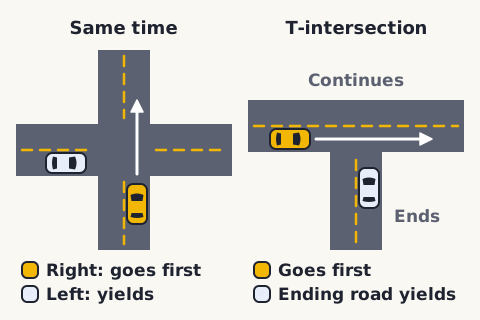
An uncontrolled intersection has no signs or signals, and an all-way stop has stop signs on every approach. At either kind of intersection, when two vehicles enter from different highways at the same time, California's Vehicle Code has the driver on the left yield to the vehicle on the driver's immediate right. At an uncontrolled intersection, a driver on a terminating highway instead yields to any vehicle on the continuing highway (Vehicle Code section 21800(b)); the code gives no such exception at an intersection with stop signs on every approach (section 21800(c)). At a T-intersection with no signs or signals, the highway that ends is the terminating one, and its driver yields to traffic on the highway that continues.
At an all-way stop, California's handbook order is that the driver stops and lets the vehicle that arrived first go. The driver yields to the vehicle on the right if arriving at the same moment, and proceeds after checking all directions.
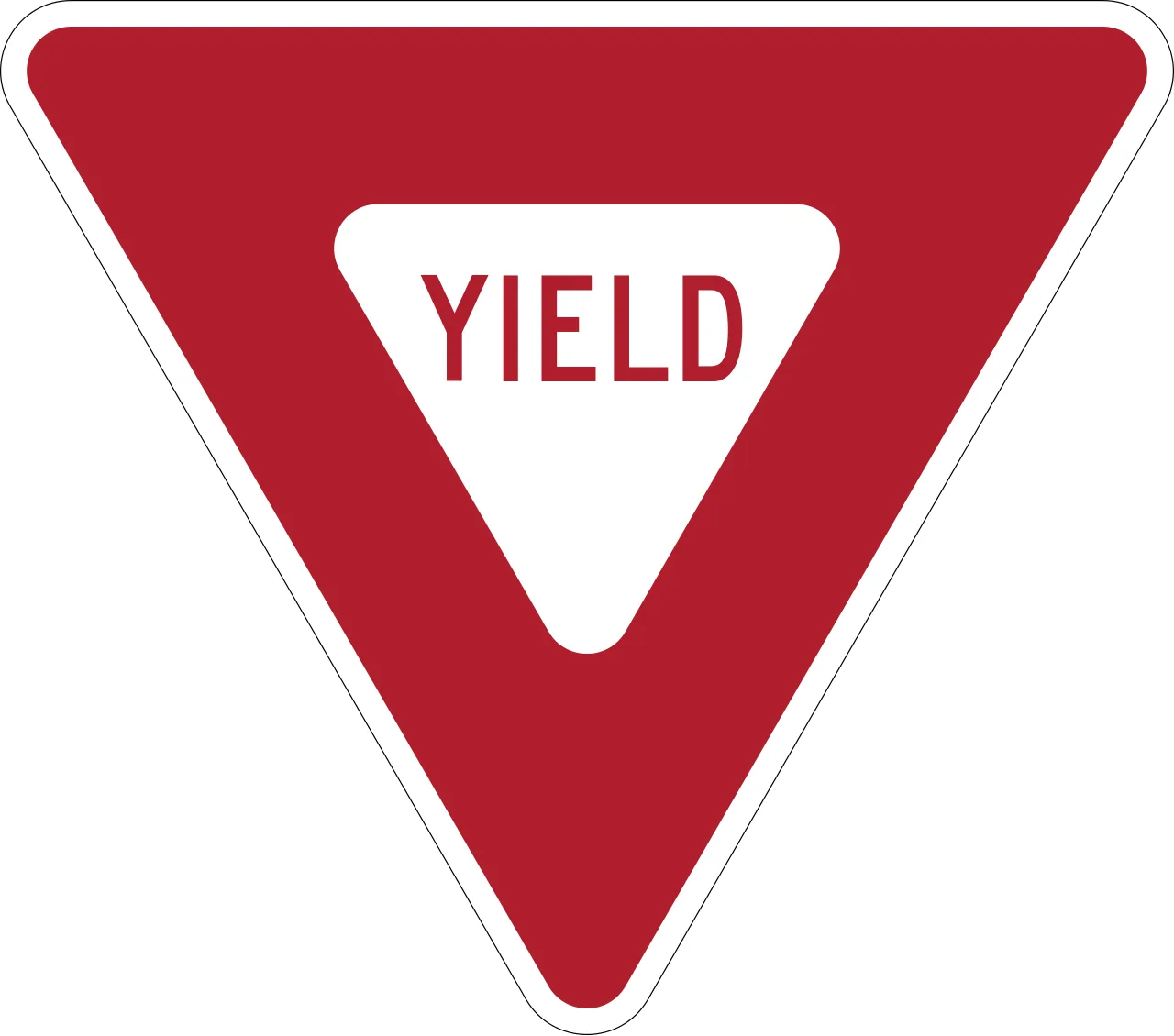
After a full stop at a stop sign, a California driver must yield to vehicles that have approached from another highway or that are approaching so closely as to be an immediate hazard. That duty does not apply where stop signs are on all approaches. A yield sign, by contrast, means slowing down and being ready to stop to let any vehicle, bicyclist or pedestrian pass before proceeding. California's handbook tells a driver approaching a roundabout to yield to traffic already in it.
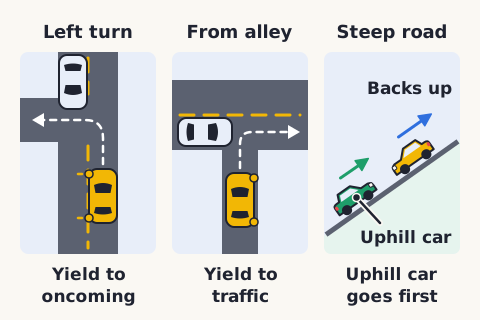
A California driver turning left, including by U-turn, must yield to oncoming vehicles that are near enough to be a hazard. A driver entering a highway from private property or an alley must yield to traffic that is an immediate hazard. California's Vehicle Code defines an alley as a highway with a roadway no wider than 25 feet that is used mainly to reach the rear or side entrances of abutting property (Vehicle Code section 110). The handbook has any driver entering traffic yield to vehicles already in the lanes. On a steep, narrow road where two vehicles cannot pass each other, the uphill vehicle has the right-of-way. The downhill vehicle yields and, if necessary, backs up to a place where the vehicles can pass.
Sources
- Vehicle Code §110
- Vehicle Code §360
- Vehicle Code §365
- Vehicle Code §525
- Vehicle Code §21661
- Vehicle Code §21800
- Vehicle Code §21801
- Vehicle Code §21802
- Vehicle Code §21804
- DL 600, p. ii
- DL 600, p. 35
- DL 600, p. 39
- DL 600, p. 40
- DL 600, p. 42
- DL 600, p. 84
Traffic signals and pedestrian signals
California's signal rules depend on the indication:
- Steady circular red: the driver stops at a marked limit line if there is one, otherwise before the near crosswalk, otherwise before the intersection. The driver stays stopped until an indication to proceed is shown. The exception: after stopping, the driver may turn right (or turn left from a one-way street onto a one-way street) unless a sign prohibits the turn, yielding to pedestrians in the adjacent crosswalk and to vehicles that are an immediate hazard. California's handbook defines a limit line, its term for a stop line, as a wide white line marking where drivers stop before an intersection or crosswalk.
- Steady yellow: warns either that the green movement it follows is ending or that red will appear immediately afterward. The code gives a yellow arrow the same warning.
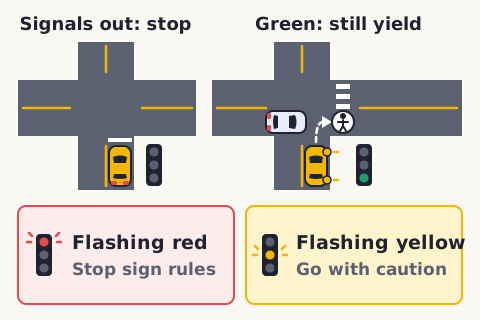
- Flashing red: requires a stop at the limit line, the near crosswalk or the point with a view of crossing traffic. After stopping, the driver may go on under the rules for a stop sign, so a flashing red works like a stop sign.
- Flashing yellow: lets a driver go through only with caution. The handbook adds that the driver should slow down, be alert and need not stop.
- Green arrow: lets a driver enter the intersection only to make the movement the arrow shows, or another movement the other indications permit. The driver still yields to other traffic and to pedestrians lawfully in the intersection or adjacent crosswalk. The handbook calls a green arrow a protected turn.
When traffic signals at an intersection are not working, a California driver must stop there and may go on with caution only when it is safe.
On a green signal a California driver, even one turning, must yield to vehicles and pedestrians lawfully within the intersection or an adjacent crosswalk. The handbook words this as proceeding with caution on a green, with pedestrians keeping the right-of-way.
Under Vehicle Code section 21456, operative 1 January 2024, a pedestrian facing a WALK signal or the walking-person symbol may cross in the direction of the signal. The pedestrian must yield to vehicles already lawfully within the intersection when the signal is first shown. Under that section, a steady DON'T WALK, or a flashing DON'T WALK with no countdown, means a California pedestrian must not start to cross. A pedestrian who started on WALK and is partway across continues to a sidewalk or safety zone or otherwise leaves the roadway. California's Vehicle Code defines a safety zone as space within a roadway lawfully set apart for the exclusive use of pedestrians that is protected, or marked by vertical signs, raised markers or raised buttons, so that it is plainly visible at all times (Vehicle Code section 540).
A flashing signal with a countdown means a pedestrian may start to cross. The pedestrian must finish before the steady DON'T WALK appears when the countdown ends. California's handbook says drivers must yield even while DON'T WALK is flashing, and tells a pedestrian not to start then. The code's countdown rule, operative 1 January 2024, governs the pedestrian.
Sources
- Vehicle Code §540
- Vehicle Code §21451
- Vehicle Code §21452
- Vehicle Code §21453
- Vehicle Code §21456
- Vehicle Code §21457
- Vehicle Code §21800
- DL 600, p. 18
- DL 600, p. 33
- DL 600, p. 34
- DL 600, p. 35
- DL 600, p. 39
Pedestrians and crosswalks
A California driver must yield to a pedestrian crossing in a marked crosswalk, or in an unmarked crosswalk at an intersection. The Vehicle Code defines a crosswalk as either the extension of the sidewalk lines where roads meet at about right angles (except the extension of lines from an alley across a street) or any part of a roadway marked for pedestrian crossing. There is no crosswalk where local authorities have posted signs indicating no crossing. The handbook adds that not every crosswalk is marked. California's own 2026 edition of the Manual on Uniform Traffic Control Devices (MUTCD) requires yellow crosswalk markings beside school grounds, citing Vehicle Code section 21368. The handbook words this differently, saying crossings at schools can be marked with yellow lines.
A driver approaching a pedestrian in a crosswalk must exercise all due care and reduce speed or take any other action as necessary to safeguard the pedestrian. A California driver may not pass a vehicle that has stopped at a crosswalk to let a pedestrian cross. A vehicle may pass a bus or trolley coach stopped at a safety zone in California only at 10 miles per hour (mph) or slower. The handbook likewise gives 10 mph for passing a bus, streetcar or trolley stopped at a safety zone or traffic light.
A totally or partially blind pedestrian carrying a white cane or using a guide dog has the right-of-way under the Vehicle Code. California's handbook says such pedestrians hold it at all times.
A pedestrian outside a crosswalk in California must yield to vehicles so near on the roadway as to be an immediate hazard. That does not relieve a driver of the duty to use due care for the safety of any pedestrian on the roadway. The handbook words this more broadly, as pedestrians always having the right-of-way.
In California, unless the Vehicle Code expressly permits otherwise, a motor vehicle may be driven on or across a sidewalk only as necessary to enter or leave adjacent property. The handbook says a driver may cross a sidewalk to enter or exit a driveway or alley.
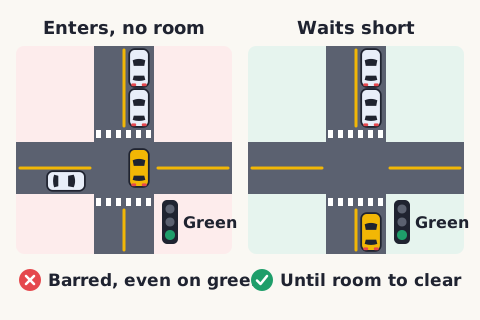
California's Anti-Gridlock Act bars a driver from entering an intersection or marked crosswalk without room to clear it on the far side, even on a green signal.
Sources
- Vehicle Code §275
- Vehicle Code §21663
- Vehicle Code §21756
- Vehicle Code §21950
- Vehicle Code §21951
- Vehicle Code §21954
- Vehicle Code §21963
- Vehicle Code §22526
- Caltrans, California MUTCD 2026
- DL 600, p. 39
- DL 600, p. 41
- DL 600, p. 42
- DL 600, p. 43
- DL 600, p. 51
Emergency vehicles and railroad crossings
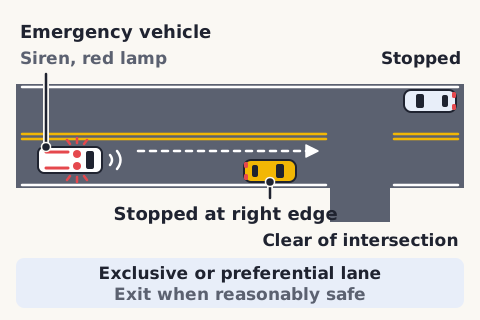
California's Vehicle Code defines an authorized emergency vehicle by a list that includes publicly owned and operated ambulances, certain publicly owned peace-officer and fire-department vehicles, and other vehicles the code lists (Vehicle Code section 165). When an authorized emergency vehicle approaches sounding a siren, with a lighted red lamp visible from 1,000 feet in front of the vehicle under normal atmospheric conditions, California drivers must yield unless a traffic officer directs otherwise. To give it a clear path, a driver yields by driving immediately to the right-hand edge or curb, clear of any intersection, and then stops and stays stopped until it passes. A driver in an exclusive or preferential lane must instead exit that lane as soon as that can be done with reasonable safety.
In the same situation, all pedestrians on a California highway must go to the nearest curb or place of safety and stay there until the vehicle has passed, unless a traffic officer directs otherwise. California's handbook says a driver already in an intersection when an emergency vehicle approaches continues through it, then pulls to the right and stops.
California bars other motor vehicles from following within 300 feet of an emergency vehicle that is responding under the Vehicle Code's exemption, and the handbook gives the same distance. Going to the scene of an emergency for the purpose of viewing it, and so impeding police, firefighters or other emergency personnel, is a misdemeanor under Penal Code section 402. The handbook words this more broadly, warning that a driver can be arrested for driving to the scene of a fire, collision or other disaster.
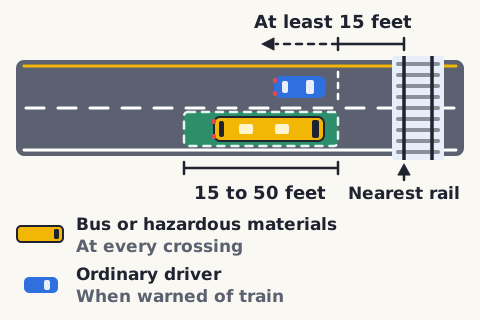
At a railroad or rail transit crossing, an ordinary driver must stop at least 15 feet from the nearest rail when a signal device or flagman warns, or when a train is visible or audible and an immediate hazard. California bars a driver from going through, around or under a closed railroad crossing gate. The handbook says to wait at a crossing until the flashing red lights stop, even when the gate goes up. No person may park a vehicle upon a railroad track or within seven and a half feet of the nearest rail.
A stricter rule applies to a bus carrying passengers, a school bus carrying pupils, and a commercial motor vehicle placarded for listed hazardous materials. Such a vehicle must stop at every California railroad crossing, 15 to 50 feet from the nearest rail, and listen and look both ways, unless the Vehicle Code excuses the stop, for example where an officer or traffic signal directs traffic to proceed. It must not shift gears manually while crossing the tracks.
Sources
Key terms
- Intersection
- In California, the area within the curb lines of two highways joining at about right angles, or where vehicles on highways joining at another angle may conflict
- Crosswalk
- In California, the extension of sidewalk lines where roads meet (except lines from an alley) or a marked pedestrian crossing; none where signs say no crossing
Key facts
Who Goes First at an Intersection
Where no sign or signal controls an intersection, the vehicle that arrives first has the right-of-way, the privilege of immediate use of the highway. When two vehicles from different highways enter an intersection with no signs or signals at the same time, California's Vehicle Code has the driver on the left yield to the vehicle on the right, unless that vehicle is on a terminating highway, the highway that ends at a T-intersection, whose driver yields to traffic on the continuing highway. An all-way stop has no such exception: the driver on the left yields to the vehicle on the right.
All-Way Stops, Stop Signs and Yield Signs
At an all-way stop in California, the driver stops, lets the vehicle that arrived first go, yields to the vehicle on the right if arriving at the same moment, and proceeds after checking all directions. After a full stop at a stop sign, a California driver must yield to vehicles that have approached from another highway or that are approaching so closely as to be an immediate hazard, except where stop signs are on all approaches. A yield sign means slowing down and being ready to stop to let any vehicle, bicyclist or pedestrian pass before proceeding.
Yielding When Turning or Entering
A California driver turning left, including by U-turn, must yield to oncoming vehicles that are near enough to be a hazard. A driver entering a highway from private property or an alley must yield to traffic that is an immediate hazard. On a steep, narrow road where two vehicles cannot pass each other, the uphill vehicle has the right-of-way, and the downhill vehicle yields and, if necessary, backs up to a place where the vehicles can pass.
Steady Red and Steady Yellow Signals
At a steady circular red, a California driver stops at a marked limit line if there is one, otherwise before the near crosswalk, otherwise before the intersection, and stays stopped until an indication to proceed is shown. The exception: after stopping, the driver may turn right (or turn left from a one-way street onto a one-way street) unless a sign prohibits the turn, yielding to pedestrians in the adjacent crosswalk and to vehicles that are an immediate hazard. A steady yellow warns that the green movement is ending or that red will appear immediately afterward.
Flashing, Non-Working and Green Signals
A flashing red signal requires a stop at the limit line, the near crosswalk or the point with a view of crossing traffic, after which a California driver may go on under the rules for a stop sign; a flashing yellow lets a driver go through only with caution. When traffic signals at an intersection are not working, a California driver must stop there and may go on with caution only when it is safe. On a green signal, even a turning driver must yield to vehicles and pedestrians lawfully within the intersection or an adjacent crosswalk.
Pedestrian Signals and the Countdown
A California pedestrian facing a WALK signal may cross in the direction of the signal but must yield to vehicles already lawfully within the intersection when the signal is first shown. A steady DON'T WALK, or a flashing DON'T WALK with no countdown, means the pedestrian must not start to cross; one who started on WALK and is partway across continues to a sidewalk or safety zone or otherwise leaves the roadway. A flashing signal with a countdown lets the pedestrian start, but the crossing must be finished before the steady DON'T WALK appears when the countdown ends.
Yielding to Pedestrians in Crosswalks
A California driver must yield to a pedestrian crossing in a marked crosswalk, or in an unmarked crosswalk at an intersection. A driver approaching a pedestrian in a crosswalk must exercise all due care and reduce speed or take any other action as necessary to safeguard the pedestrian. A driver may not pass a vehicle that has stopped at a crosswalk to let a pedestrian cross. A totally or partially blind pedestrian carrying a white cane or using a guide dog has the right-of-way under the Vehicle Code.
Outside Crosswalks, Sidewalks and Gridlock
A pedestrian outside a crosswalk in California must yield to vehicles so near on the roadway as to be an immediate hazard, but that does not relieve a driver of the duty to use due care for the safety of any pedestrian on the roadway. Unless the Vehicle Code expressly permits otherwise, a motor vehicle may be driven on or across a sidewalk only as necessary to enter or leave adjacent property. California's Anti-Gridlock Act bars a driver from entering an intersection or marked crosswalk without room to clear it on the far side, even on a green signal.
When an Emergency Vehicle Approaches
When an authorized emergency vehicle approaches sounding a siren, with a lighted red lamp visible from 1,000 feet under normal atmospheric conditions, a California driver must, unless a traffic officer directs otherwise, drive immediately to the right-hand edge or curb, clear of any intersection, and stay stopped until it passes. A driver in an exclusive or preferential lane must instead exit that lane as soon as that can be done with reasonable safety. Going to an emergency scene to view it, and so impeding emergency personnel, is a misdemeanor under California law.
Distances Near Emergency Vehicles and Rails
California bars other motor vehicles from following within 300 feet of an emergency vehicle responding under the Vehicle Code's exemption. At a railroad or rail transit crossing, an ordinary driver must stop at least 15 feet from the nearest rail when a signal device or flagman warns, or when a train is visible or audible and an immediate hazard. No person may park a vehicle upon a railroad track or within seven and a half feet of the nearest rail. A driver may not go through, around or under a closed railroad crossing gate.
Buses and Hazardous-Material Vehicles at Crossings
A bus carrying passengers, a school bus carrying pupils and a commercial motor vehicle placarded for listed hazardous materials must stop at every California railroad crossing, 15 to 50 feet from the nearest rail, and listen and look both ways, unless the Vehicle Code excuses the stop, for example where an officer or traffic signal directs traffic to proceed. Such a vehicle must not shift gears manually while crossing the tracks. An ordinary driver, by contrast, stops at least 15 feet from the nearest rail when warned of a train.
Matched pairs
Each item on the left goes with the one on the right.
- Steep, narrow road with no room to pass
- California: the uphill vehicle has the right-of-way
Step by step
California drivers give an approaching emergency vehicle a clear path, unless a traffic officer directs otherwise (a driver in a preferential lane exits it)
- Moving immediately to the right-hand edge or curb
- Stopping at that edge or curb, clear of any intersection
- Staying stopped until the emergency vehicle has passed
Self-test
Answer each question from memory, then check your work against the answer key.
1. Two vehicles from different highways reach an all-way stop in California at the same moment. Which driver yields?
- AThe driver in the smaller vehicle yields to the larger one
- BThe driver on the left yields to the vehicle on the right
- CThe driver on the narrower highway yields to the wider one
- DThe driver on the right yields to the vehicle on the left
2. The traffic signals at a California intersection are not working. What does the Vehicle Code require of an approaching driver?
- AStopping and going on with caution only when it is safe
- BSlowing down and going through only if no vehicle is close
- CWaiting there until the signals are working again
- DGoing through at normal speed since no signal applies
3. A pedestrian starts to cross at a California intersection where no crosswalk lines are painted. How must an approaching driver respond under the Vehicle Code?
- AYielding only when the pedestrian has a WALK signal
- BContinuing because the pedestrian must yield to the vehicle
- CContinuing because only painted crosswalks count
- DYielding because an intersection has an unmarked crosswalk
4. A California driver comes up behind an emergency vehicle that is responding under the Vehicle Code's exemption. California bars following it within how many feet?
- A1,000 feet
- B50 feet
- C300 feet
- D100 feet
5. Which action does the California Vehicle Code bar at a railroad crossing?
- AStopping when a flagman warns of a train
- BStopping a bus 40 feet from the nearest rail
- CParking ten feet from the nearest rail
- DGoing around a closed crossing gate
Go deeper
- WatchWho Goes First Two cars reach a four-way stop at the same moment. Who goes first?
- WatchGate Up, Lights Flashing A railroad gate goes up, but its red lights still flash. California's handbook says wait until they stop.
- StudyU.S. Permit Test by State (Driving) in the FlashFeed app
Answer key
- 1. B The driver on the left yields to the vehicle on the rightFor an intersection controlled from all directions by stop signs, California law has the driver on the left yield to the vehicle on that driver's immediate right, with no exception for a terminating highway. The handbook's all-way-stop order gives the same result.
- 2. A Stopping and going on with caution only when it is safeA California driver must stop at an intersection whose signals are not working, and may go on with caution only when it is safe. Slowing and going through skips the required stop, and waiting for the signals adds a wait the rule does not require.
- 3. D Yielding because an intersection has an unmarked crosswalkA California driver must yield to a pedestrian crossing in a marked crosswalk or in an unmarked crosswalk at an intersection, so painted lines are not required. The pedestrian is not the one who must yield here.
- 4. C 300 feetCalifornia bars other motor vehicles from following within 300 feet of an emergency vehicle responding under the Vehicle Code's exemption. The bar is 300 feet, not 50, 100 or 1,000.
- 5. D Going around a closed crossing gateCalifornia bars a driver from going through, around or under a closed railroad crossing gate. Stopping when a flagman warns is required, ten feet is outside the seven-and-a-half-foot zone where parking is barred, and a bus carrying passengers may stop 15 to 50 feet away.
Sources
- California Legislature — California Vehicle Code section 21800 — leginfo.legislature.ca.gov/faces/codes_displaySection.xhtml?lawCode=VEH§ionNum=21800
- California Legislature — California Vehicle Code section 21802 — leginfo.legislature.ca.gov/faces/codes_displaySection.xhtml?lawCode=VEH§ionNum=21802
- California Legislature — California Vehicle Code sections 21801, 21804 and 21661; California Legislature — California Vehicle Code section 21661 — leginfo.legislature.ca.gov/faces/codes_displaySection.xhtml?lawCode=VEH§ionNum=21661
- California Legislature — California Vehicle Code section 365 — leginfo.legislature.ca.gov/faces/codes_displaySection.xhtml?lawCode=VEH§ionNum=365
- California Legislature — California Vehicle Code section 21801 — leginfo.legislature.ca.gov/faces/codes_displaySection.xhtml?lawCode=VEH§ionNum=21801
- California Legislature — California Vehicle Code section 21453 — leginfo.legislature.ca.gov/faces/codes_displaySection.xhtml?lawCode=VEH§ionNum=21453
- California Legislature — California Vehicle Code section 21457 — leginfo.legislature.ca.gov/faces/codes_displaySection.xhtml?lawCode=VEH§ionNum=21457
- California Legislature — California Vehicle Code section 21456 — leginfo.legislature.ca.gov/faces/codes_displaySection.xhtml?lawCode=VEH§ionNum=21456
- California Legislature — California Vehicle Code section 21451 — leginfo.legislature.ca.gov/faces/codes_displaySection.xhtml?lawCode=VEH§ionNum=21451
- California Legislature — California Vehicle Code section 275 — leginfo.legislature.ca.gov/faces/codes_displaySection.xhtml?lawCode=VEH§ionNum=275
- California Legislature — California Vehicle Code sections 21950, 21951 and 21963; California Legislature — California Vehicle Code section 21950 — leginfo.legislature.ca.gov/faces/codes_displaySection.xhtml?lawCode=VEH§ionNum=21950
- California Legislature — California Vehicle Code sections 21954, 21663 and 22526; California Legislature — California Vehicle Code section 22526 — leginfo.legislature.ca.gov/faces/codes_displaySection.xhtml?lawCode=VEH§ionNum=22526
- California Legislature — California Vehicle Code section 21951 — leginfo.legislature.ca.gov/faces/codes_displaySection.xhtml?lawCode=VEH§ionNum=21951
- California Legislature — California Vehicle Code section 21806 — leginfo.legislature.ca.gov/faces/codes_displaySection.xhtml?lawCode=VEH§ionNum=21806
- California Legislature — California Vehicle Code sections 22451, 21706 and 22521; California Legislature — California Vehicle Code section 22451 — leginfo.legislature.ca.gov/faces/codes_displaySection.xhtml?lawCode=VEH§ionNum=22451
- California Legislature — California Vehicle Code section 22452 — leginfo.legislature.ca.gov/faces/codes_displaySection.xhtml?lawCode=VEH§ionNum=22452
- California Legislature — California Penal Code section 402 — leginfo.legislature.ca.gov/faces/codes_displaySection.xhtml?lawCode=PEN§ionNum=402
- California Legislature — California Vehicle Code section 21706 — leginfo.legislature.ca.gov/faces/codes_displaySection.xhtml?lawCode=VEH§ionNum=21706
Image credits
- Who Goes First at an Intersection: FlashFeed original diagram · CC-BY-4.0
- All-Way Stops, Stop Signs and Yield Signs: Wikimedia Commons · Federal Highway Administration · Public domain — commons.wikimedia.org/wiki/File:MUTCD_R1-2.svg
- Yielding When Turning or Entering: FlashFeed original diagram · CC-BY-4.0
- Flashing, Non-Working and Green Signals: FlashFeed original diagram · CC-BY-4.0
- Outside Crosswalks, Sidewalks and Gridlock: FlashFeed original diagram · CC-BY-4.0
- When an Emergency Vehicle Approaches: FlashFeed original diagram · CC-BY-4.0
- Buses and Hazardous-Material Vehicles at Crossings: FlashFeed original diagram · CC-BY-4.0
