
U.S. Permit Test by State (Driving) study guide · Lesson 8 of 18
California: Speed Limits and Following Distance
Maximum limits and the basic speed law · Lower limits in zones and special places · Following distance and driving to conditions
This is the lesson's study guide from the FlashFeed app, plus its key facts and a self-test.
What you'll be able to do
- In California, state the basic speed law, the prima facie and maximum limits, the limits by road type and zone, and the rules on following distance.
California's Vehicle Code (VC) sets speed limits in miles per hour (mph) by road type and zone. Its general rule on following distance asks what is reasonable and prudent rather than for a number. The California Driver's Handbook (DL 600, Rev. 6/2025) adds figures of its own, such as a three-second count for following distance. Knowing which rules come from the code and which figures are only the handbook's advice shows a driver what is required and what is only suggested.
Maximum limits and the basic speed law
California's basic speed law (VC 22350) bars driving faster than is reasonable or prudent given weather, visibility, traffic, and the surface and width of the road. The handbook puts it as never driving faster than is safe for current conditions, whatever the posted limit.
A prima facie speed limit, such as California's 15 and 25 mph limits, makes a speed within it lawful unless clearly proved to violate the basic speed law. A speed above it is prima facie unlawful unless the driver shows otherwise. Maximum speed limits, such as the 65 mph maximum, are not prima facie limits (VC 22348): no one may exceed them, while a prima facie limit lets a driver show that a higher speed was not unlawful.
California's general maximum speed limit is 65 mph (VC 22349), except that VC 22356 lets the Department of Transportation declare and post 70 mph on some state highways. On a two-lane undivided highway the maximum speed in California is 55 mph unless a higher limit is posted after a survey. The 55 mph limit under VC 22406 includes trucks with three or more axles, trucks and passenger vehicles drawing another vehicle, and school buses carrying pupils.
A posted 70 mph limit is for vehicles not subject to VC 22406, on a state highway otherwise limited to 65 mph, where the Department of Transportation declares it. Under VC 22356, the declaration is made after an engineering and traffic survey and with California Highway Patrol approval. Like the 65 mph limit, a posted 70 mph limit is a maximum limit that no one may exceed.
California's minimum speed rule (VC 22400) bars driving so slowly as to impede traffic unless necessary. The handbook adds that driving faster or slower than the limit may be cited and that slow drivers use the right lane.
Sources
- Vehicle Code §22348
- Vehicle Code §22349
- Vehicle Code §22350
- Vehicle Code §22351
- Vehicle Code §22352
- Vehicle Code §22356
- Vehicle Code §22400
- Vehicle Code §22406
- DL 600, p. 50
- DL 600, p. 67
Lower limits in zones and special places
VC 22352 sets California's 15 and 25 mph prima facie limits for particular places.
The speed limit on any alley in California is 15 mph. The limit is also 15 mph at a railway crossing where, in the last 100 feet of the approach, the driver cannot see 400 feet in both directions. That limit does not apply where a flagperson is on duty or a signal device is not warning of a train.
California also sets 15 mph at an intersection where, in the last 100 feet of the approach, the driver cannot see 100 feet along every entering highway, unless stop signs, yield signs or signals control it.
California sets 25 mph on any highway in a business or residence district unless another speed is set. The Vehicle Code defines a business district as a stretch of highway where buildings in use for business occupy 50 percent or more of the fronting property, for 600 feet on one side or 300 feet on both sides together. It defines a residence district as a stretch of highway, other than a business district, where the fronting property within a quarter mile holds 13 or more separate dwelling houses or business structures on one side, or 16 or more on both sides together. A residence district may be longer than a quarter mile if that ratio holds.
California sets 25 mph when a driver is approaching or passing a school marked with a SCHOOL warning sign while children are going to or leaving school during school hours or the noon recess. It also sets a 25 mph prima facie limit when a driver passes a senior center or similar facility used mainly by senior citizens, next to a street other than a state highway and posted with a standard SENIOR warning sign. Both rules are in the version of VC 22352 in effect only until 1 Jan 2031.
California's handbook words the school zone as a distance: within 500 feet of a school, 25 mph applies while children are outside or crossing the street, and some zones go as low as 15 mph.
Under VC 22358.4, as amended on 1 Jan 2026, a local authority may declare 15 mph for a school zone in two cases:
- when an engineering and traffic survey shows the 25 mph school limit is more than reasonable or safe
- in a residence district, on a highway that has at most two traffic lanes and a posted limit of 30 mph or slower immediately before and after the school zone
Sources
Following distance and driving to conditions
California's general following rule, VC 21703, sets no time or distance: a driver must not follow more closely than is reasonable and prudent given speed, traffic and the road. Doing so is following too closely.
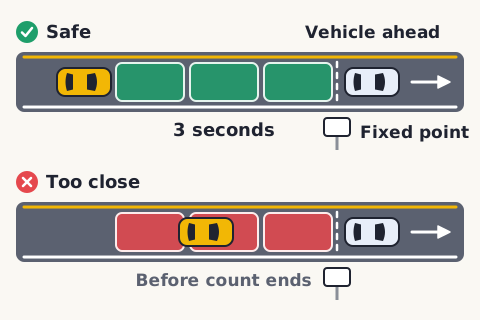
California's driver handbook teaches a safe following distance of three seconds behind the vehicle ahead. Its glossary defines the three-second rule as counting three seconds after the vehicle ahead passes a fixed point, such as a sign; a driver who passes the same point before finishing the count is following too closely.
The code's general following rule, VC 21703, judges what is reasonable and prudent with no number, while the handbook's three-second rule counts a number of seconds. Other code sections give a distance in their own cases, so the no-number point holds for the general rule only. California's driver handbook gives three seconds of space when merging onto a highway and behind a motorcyclist ahead, and says to scan at least 10 seconds ahead. These are the handbook's own figures, not rules of law.
California's driver handbook says to reduce speed by 5 to 10 mph on wet roads, by half on packed snow, and to no more than 5 mph on ice. It says to slow down at the first rain after a dry, hot spell, because oil and dust are not yet washed off the road. In a heavy storm where the driver can see 100 feet or less, it says 30 mph is the most that is safe.
In a traffic break, a California law enforcement officer turns on emergency lights and weaves across lanes to slow or stop traffic for hazards, heavy fog or unusual conditions. When this happens, the handbook tells drivers to:
- turn on their emergency flashers
- slow gradually to the officer's speed without braking suddenly unless needed to avoid a collision, keeping a safe distance from the patrol vehicle
- not drive past the patrol vehicle
- not speed up until the officer turns off the emergency lights and traffic conditions allow a return to normal speed
In heavy fog or smoke, California's handbook says to use low beams, because high beams reflect back and cause glare. It says never to drive in fog using only the parking lights or fog lights.
Sources
Key facts
Basic speed law and limit types
California's basic speed law bars driving faster than is reasonable or prudent given weather, visibility, traffic, and the surface and width of the road. A prima facie speed limit, such as California's 15 and 25 mph limits, makes a speed within it lawful unless clearly proved to violate that law, and a speed above it prima facie unlawful unless the driver shows otherwise. A maximum limit, such as 65 mph, is not prima facie: no one may exceed it.
Maximum limits and slow driving
California's general maximum speed limit is 65 mph, except that the Vehicle Code lets the Department of Transportation declare and post 70 mph on some state highways. On a two-lane undivided highway the maximum is 55 mph unless a higher limit is posted after a survey. California's separate 55 mph vehicle limit includes trucks with three or more axles, trucks and passenger vehicles drawing another vehicle, and school buses carrying pupils. California's minimum speed rule bars driving so slowly as to impede traffic unless necessary.
Where California sets 15 mph
Under the Vehicle Code, the speed limit on any alley in California is 15 mph. The limit is also 15 mph at a railway crossing where, in the last 100 feet of the approach, the driver cannot see 400 feet in both directions, except where a flagperson is on duty or a signal device is not warning of a train.
Where California sets 25 mph
California sets 25 mph on any highway in a business or residence district unless another speed is set. It also sets 25 mph when a driver is approaching or passing a school marked with a SCHOOL warning sign while children are going to or leaving school during school hours or the noon recess. The school rule is in the current version of the law setting these limits, which is in effect only until 1 Jan 2031.
The handbook's three-second rule
California's driver handbook teaches a safe following distance of three seconds behind the vehicle ahead, while the general following rule in the Vehicle Code sets no time or distance. Its glossary defines the three-second rule as counting three seconds after the vehicle ahead passes a fixed point, such as a sign; passing the same point before finishing the count means following too closely.
Matched pairs
Each item on the left goes with the one on the right.
- California's basic speed law
- No driving faster than is reasonable or prudent for conditions
Self-test
Answer each question from memory, then check your work against the answer key.
1. What is the general maximum speed limit on California highways under the Vehicle Code?
- A50 mph
- B55 mph
- C65 mph
- D70 mph
2. Until 1 Jan 2031, what limit does California set when a driver is approaching or passing a school marked with a SCHOOL warning sign while children are going to or leaving school?
- A10 mph
- B35 mph
- C30 mph
- D25 mph
3. In California, what limit applies at a railway crossing where, in the last 100 feet of the approach, the driver cannot see 400 feet in both directions?
- A35 mph
- B15 mph
- C10 mph
- D25 mph
4. Under California's general following rule, when is your gap behind the vehicle ahead too close?
- AOnly when it is closer than is reasonable and prudent
- BOnly when it is shorter than a single car length
- COnly when you are traveling at freeway speeds
- DOnly when the vehicle ahead has to brake hard
5. How many seconds behind the vehicle ahead does California's driver handbook teach as a safe following distance?
- AFour seconds
- BThree seconds
- CFive seconds
- DTwo seconds
Go deeper
- WatchCan the Limit Be Too Fast? The sign says 65. Can 65 still be too fast?
- WatchCount to Three The car ahead passes a sign. Count 3 seconds. Reach it before 3? Following too closely.
- StudyU.S. Permit Test by State (Driving) in the FlashFeed app
Answer key
- 1. C 65 mphCalifornia's general maximum is 65 mph, except that the Vehicle Code lets the Department of Transportation declare and post 70 mph on some state highways. On a two-lane undivided highway the maximum is 55 mph unless a higher limit is posted after a survey.
- 2. D 25 mphThe Vehicle Code sets 25 mph there during school hours or the noon recess, in the version in effect only until 1 Jan 2031, so 30 and 35 mph do not apply. California's handbook words the zone differently, as within 500 feet of a school while children are outside or crossing the street.
- 3. B 15 mphThe Vehicle Code sets 15 mph there, except where a flagperson is on duty or a signal device is not warning of a train. The business and residence district limit is a separate rule.
- 4. A Only when it is closer than is reasonable and prudentCalifornia's general following rule treats a gap as too close when it is closer than is reasonable and prudent for your speed, the traffic and the road. That rule sets no fixed time or distance, so a gap can be too close at any speed, even if the vehicle ahead never brakes hard.
- 5. B Three secondsCalifornia's driver handbook teaches three seconds behind the vehicle ahead; two, four and five seconds are not its figure. The Vehicle Code's general following rule sets no time or distance.
Sources
- California Legislature — California Vehicle Code section 22350 — leginfo.legislature.ca.gov/faces/codes_displaySection.xhtml?lawCode=VEH§ionNum=22350
- California Legislature — California Vehicle Code section 22349 — leginfo.legislature.ca.gov/faces/codes_displaySection.xhtml?lawCode=VEH§ionNum=22349
- California Legislature — California Vehicle Code section 22351 — leginfo.legislature.ca.gov/faces/codes_displaySection.xhtml?lawCode=VEH§ionNum=22351
- California Legislature — California Vehicle Code section 22406 — leginfo.legislature.ca.gov/faces/codes_displaySection.xhtml?lawCode=VEH§ionNum=22406
- California Legislature — California Vehicle Code section 22352 — leginfo.legislature.ca.gov/faces/codes_displaySection.xhtml?lawCode=VEH§ionNum=22352
- California Legislature — California Vehicle Code section 21703 — leginfo.legislature.ca.gov/faces/codes_displaySection.xhtml?lawCode=VEH§ionNum=21703
- California Department of Motor Vehicles — California Driver's Handbook (DL 600, Rev. 6/2025), p. 84 — www.dmv.ca.gov/portal/file/california-driver-handbook-pdf?printedPage=84#page=90
- California Department of Motor Vehicles — California Driver's Handbook (DL 600, Rev. 6/2025), p. 57 — www.dmv.ca.gov/portal/file/california-driver-handbook-pdf?printedPage=57#page=63
- California Legislature — California Vehicle Code section 22400 — leginfo.legislature.ca.gov/faces/codes_displaySection.xhtml?lawCode=VEH§ionNum=22400
Image credits
- The handbook's three-second rule: FlashFeed original diagram · CC-BY-4.0