
U.S. Permit Test by State (Driving) study guide · Lesson 9 of 18
California: Turns, Lanes, Passing and Parking
Signals, turns and turns on red · Lanes, lane lines and U-turns · Passing, keeping right and high-occupancy vehicle (HOV) lanes · Parking, curbs, lights and distances in feet
This is the lesson's study guide from the FlashFeed app, plus its key facts and a self-test.
What you'll be able to do
- In California, choose the legal signal, turn, lane, passing, parking or lighting action in a described situation, and state the lighting distances.
California's rules for signaling, turning, lane use, passing and parking come from the California Vehicle Code (VC), and the California Driver's Handbook (DL 600, Rev. 6/2025) adds guidance in places. A driver needs to know how to signal a move, where to position a turn, which lines may be crossed, and where a vehicle may stop or park. Small details decide many of these rules, such as a red arrow instead of a steady red, a broken line instead of a solid one, or a distance in feet.
Signals, turns and turns on red
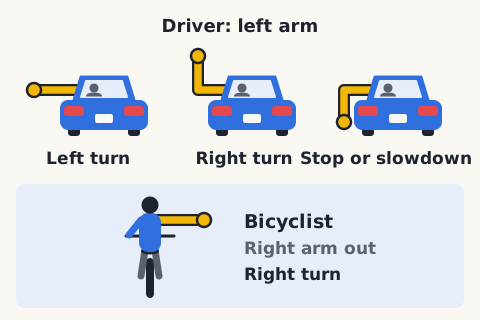
A California driver gives turn and stop signals with signal lamps. A vehicle not required to have signal lamps, such as a bicycle, uses hand and arm signals, and so does any driver whose lamps stop working while driving. In California the three hand signals are:
- A left turn is signaled by holding the left arm out horizontally.
- A right turn is signaled by holding the left arm up.
- A stop or slowdown is signaled by holding the left arm down.
A bicyclist in California may signal a right turn by pointing the right arm out.
A California driver may not come to a stop or abruptly slow on a highway without first giving an appropriate signal to the driver immediately behind, when there is an opportunity to give one (VC 22109).
A driver may not turn from a direct course or move right or left on a roadway until the move can be made with reasonable safety. The driver must give an appropriate signal first whenever another vehicle may be affected (VC 22107). California's handbook advises signaling for lane changes and, unlike the code, even when no other vehicles are in view.
In California a driver must give an audible warning with the horn when reasonably necessary for safe operation, and may not otherwise use the horn except as a theft alarm (VC 27001). California's handbook advises using the horn to avoid collisions. A California motor vehicle must have a horn that can be heard under normal conditions from at least 200 feet away (VC 27000), and the handbook repeats that distance.
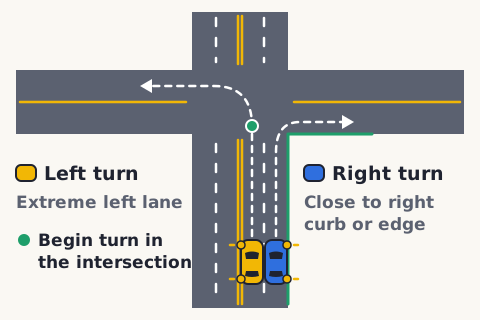
A California driver makes a right turn, in both the approach and the turn, as close as practicable (reasonably possible) to the right curb or edge, with exceptions such as for one-way roads and marked turn lanes. California's handbook shows the turn ending in the lane nearest the right edge.
A California left turn is approached as close as practicable to the left-hand edge of the extreme left (leftmost) lane lawfully available to traffic going that way, and is not begun before the vehicle enters the intersection.
On a steady red signal a California driver may turn right after stopping, unless a sign bars the turn. On a steady circular red, a driver may also turn left from a one-way street onto a one-way street after stopping, unless a sign bars the turn. A driver making either turn must yield to pedestrians in the adjacent crosswalk and to vehicles that are an immediate hazard. A red arrow is different: it bars the turn the arrow points to, and it permits neither the right turn on red nor the left turn from a one-way street onto a one-way street that a steady red allows after a stop.
Sources
- Vehicle Code §22110
- Vehicle Code §22111
- Vehicle Code §22109
- Vehicle Code §22107
- Vehicle Code §27001
- Vehicle Code §27000
- Vehicle Code §22100
- Vehicle Code §21453
- DL 600, p. 6
- DL 600, p. 10
- DL 600, p. 11
- DL 600, p. 20
- DL 600, p. 21
Lanes, lane lines and U-turns
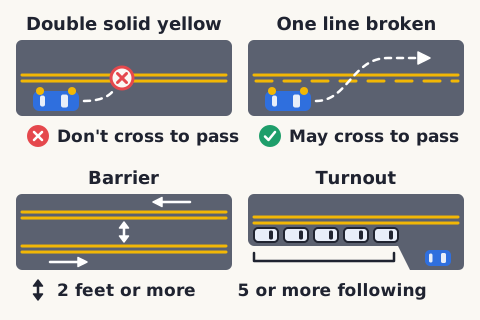
A California driver may not drive to the left of double solid yellow lines except as the Vehicle Code permits. A pair with one broken line is different: a driver on the broken-line side may cross to pass. California's handbook calls two sets of double yellow lines two or more feet apart a barrier, and Vehicle Code section 21651 describes a dividing section not less than two feet wide, marked by curbs, double parallel lines or other markings.
On a roadway with two or more marked lanes in one direction, a California driver must stay as nearly as practical entirely within a single lane and not leave it until the move can be made with reasonable safety (VC 21658). The handbook adds not to weave in and out of traffic. On a two-lane road in California, a slow vehicle with five or more vehicles following must use a turnout, a place to pull off the road so others can pass, where passing is unsafe.
In California a center left-turn lane is bounded by double yellow lines, the inner line dashed and the outer line solid. It may be used only to prepare for or make a left turn, or a U-turn where otherwise permitted by law. Where a two-way left-turn lane has been designated, no left turn or U-turn may be made from any other lane (VC 21460.5).
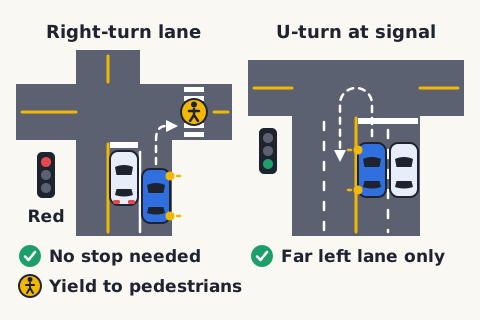
A dedicated right-turn lane in California does not merge into another lane. It lets a driver turn right without stopping, even on a red light for through traffic, but the driver must obey a light or sign at the right curb of that lane and always yield to pedestrians in the crosswalk. The Vehicle Code lets a driver turn right from any lane designated and marked for that movement.
For a right turn from a one-way street onto a one-way street, California's handbook has the driver start in the far-right lane and, if it is safe, end in any lane. The code lets a right turn from a one-way highway finish in any lane lawfully available to traffic going that way.
In a business district, California allows a U-turn only at an intersection or at an opening in a divided highway. At a signal-controlled intersection, a U-turn may be made only from the far left lane lawfully available in the direction of travel (VC 22100.5), and the handbook advises signaling and using the left turn lane or far-left lane.
Sources
- Vehicle Code §21460
- Vehicle Code §21651
- Vehicle Code §21658
- Vehicle Code §21656
- Vehicle Code §21460.5
- Vehicle Code §22100
- Vehicle Code §22102
- Vehicle Code §22100.5
- DL 600, p. 13
- DL 600, p. 15
- DL 600, p. 16
- DL 600, p. 19
- DL 600, p. 20
- DL 600, p. 22
Passing, keeping right and high-occupancy vehicle (HOV) lanes
A California vehicle moving slower than the normal speed of traffic keeps to the right-hand lane or as close as practicable to the right-hand edge or curb, except when overtaking and passing or preparing for a left turn (VC 21654).
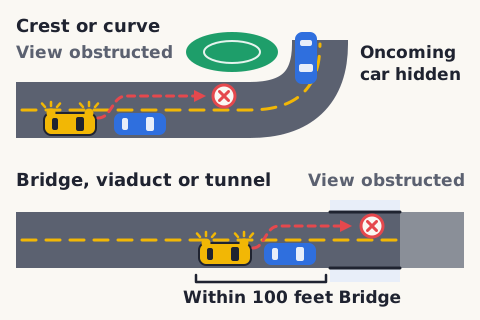
A California driver passes on the left at a safe distance. On a two-lane highway no vehicle may be driven to the left of center to pass unless the view of the left side is clear and no oncoming traffic is there for far enough ahead to finish the pass safely (VC 21751). California bars passing on the left on a crest or curve where the view is obstructed, and within 100 feet of a bridge, viaduct or tunnel when the view is obstructed. It also bars passing on the left within 100 feet of, or while traversing, a railroad grade crossing or an intersection, with no obstructed-view condition. None of these bars applies on a one-way roadway (VC 21752). The handbook lists bridges and tunnels among its 100-foot places without the obstructed-view condition.
California allows passing on the right when the vehicle ahead is turning left and on multi-lane and one-way roads. It bars passing on the right by driving off the paved portion of the road. Except where passing on the right is permitted, a driver who is being overtaken must not increase speed until the overtaking vehicle has completely passed (VC 21753).
California's high-occupancy vehicle (HOV) lanes follow the posted occupancy and hours, and motorcycles may use them unless prohibited. Where double parallel solid lines lie to the right of an HOV lane, no driver may cross them to enter or exit the lane, except when leaving the lane for an approaching emergency vehicle displaying a red light or siren. Entry and exit are otherwise allowed only in designated areas or where a single broken line is in place (VC 21655.8). California's Clean Air Vehicle (CAV) decal program has ended: from 1 October 2025, CAV decals are no longer valid for HOV lane access, and vehicles must meet the posted occupancy requirement.
In California a driver required to enter a bus-only (transit-only) lane to turn right, to turn left where there is no left-turn lane for motorists, or to enter or exit a highway may do so, unless signs prohibit turns across the lane or a physical separation delineates it. Otherwise no one may drive in it except as a peace officer or official traffic control device directs (VC 21655.1). No one may stop, park or leave a vehicle standing in it, except when necessary to avoid conflict with other traffic or as a peace officer or official traffic control device directs (VC 22500(m)).
Sources
- Vehicle Code §21654
- Vehicle Code §21750
- Vehicle Code §21751
- Vehicle Code §21752
- Vehicle Code §21753
- Vehicle Code §21655.8
- Vehicle Code §21655.1
- Vehicle Code §22500
- DMV, Clean Air Vehicle Decals
- DL 600, p. 16
- DL 600, p. 24
- DL 600, p. 25
Parking, curbs, lights and distances in feet
California's Vehicle Code sets these distances in feet:
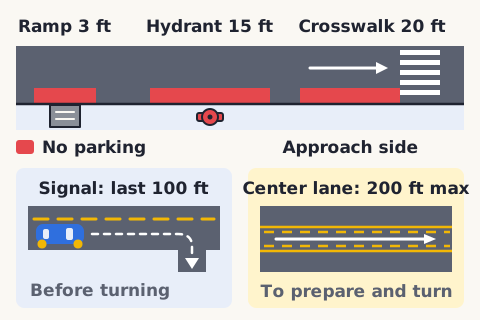
- California bars parking within 3 feet of a signed or red-painted sidewalk access ramp.
- California bars parking within 15 feet of a fire hydrant, with exceptions.
- From 1 January 2024, California bars stopping or parking within 20 feet of the approach side of a marked or unmarked crosswalk (15 feet where a curb extension exists), except to avoid conflict with other traffic or as directed by a peace officer or official traffic control device; a local authority may mark a different distance.
- A driver must signal an intended turn continuously during the last 100 feet traveled before turning, by lamp or by hand.
- A driver may drive in a center left-turn lane for no more than 200 feet while preparing for and making a turn.
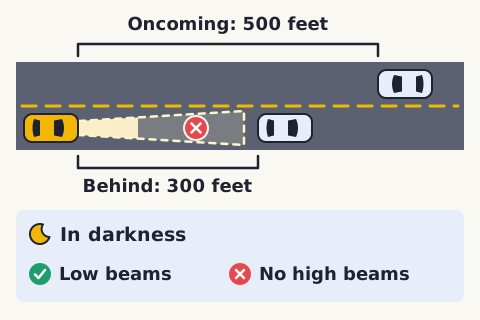
- In darkness, California requires low beams within 300 feet behind another vehicle.
- In darkness, California requires low beams within 500 feet of an oncoming vehicle.
California's handbook lists the distances but its crosswalk line leaves out the approach side.
California also bars stopping or parking in an intersection, on a crosswalk, in front of a driveway, on a sidewalk, in a tunnel, on a bridge, or double-parked, except when necessary to avoid conflict with other traffic or as directed by a peace officer or official traffic control device, and each place has its own narrow exceptions (VC 22500).
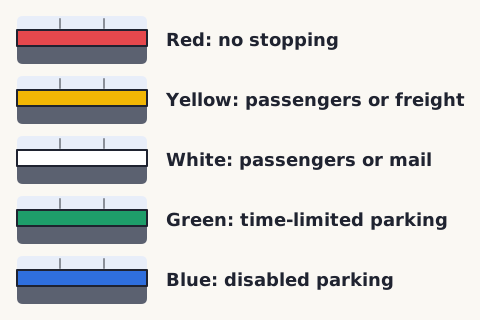
California's Vehicle Code lets local authorities mark curbs in five colors, called curb colors:
- A red curb means no stopping, standing or parking, though a bus may stop in a bus-marked zone.
- A yellow curb is for loading or unloading passengers or freight.
- A white curb is for loading or unloading passengers or depositing mail.
- A green curb means time-limited parking.
- A blue curb is for parking for disabled persons and disabled veterans.
California's handbook words the white curb more briefly, mentioning passengers only. In California a parked vehicle sits parallel to and within 18 inches of the right-hand curb, or, on a one-way road that is not part of a divided highway, the left-hand curb (VC 22502).
For lights, California's Vehicle Code counts darkness as the period between half an hour after sunset and half an hour before sunrise, and any time sight is under 1,000 feet. California's handbook has headlights on from 30 minutes after sunset to 30 minutes before sunrise. California requires headlamps in inclement weather: under Vehicle Code section 24400, a motor vehicle other than a motorcycle must have at least two lighted headlamps when a weather condition prevents seeing a person or vehicle from 1,000 feet or requires continuous use of the windshield wipers. California's handbook separately lists conditions such as clouds, dust, smoke or fog that prevent a driver from seeing other vehicles among the times to use headlights, and the code's definition does not name dust or smoke.
On a hill, California's handbook advises setting the parking brake and leaving the vehicle in park, or in gear if it has a manual transmission. The code goes less far: VC 22515 requires only setting the brake and stopping the motor of an unattended vehicle. California's handbook teaches parallel parking in five numbered steps: find a space at least three feet longer than the vehicle and signal, pull up beside the vehicle ahead of the space about two feet away, check blind spots, back in at about a 45-degree angle, then straighten out and finish parallel to and within 18 inches of the curb.
Sources
Key facts
California Hand and Arm Signals
A California driver gives turn and stop signals with signal lamps. A vehicle not required to have signal lamps, such as a bicycle, uses hand and arm signals, and so does any driver whose lamps stop working while driving. In California, the left arm held out horizontally signals a left turn, held up signals a right turn, and held down signals a stop or slowdown. A bicyclist in California may signal a right turn by pointing the right arm out.
California Signaling and Turn Position
A California driver may not come to a stop or abruptly slow on a highway without first giving an appropriate signal to the driver immediately behind, when there is an opportunity to give one. A right turn is made, in both the approach and the turn, as close as practicable to the right curb or edge, with exceptions such as for one-way roads and marked turn lanes. A left turn is approached as close as practicable to the left-hand edge of the extreme left lane lawfully available to traffic going that way, and is not begun before the vehicle enters the intersection.
California Red Arrows
A red arrow in California bars the turn the arrow points to. Unlike a steady circular red, which allows a right turn, or a left turn from a one-way street onto a one-way street, after a stop unless a sign bars it, a red arrow does not allow its turn, even after stopping.
California Yellow Lines and Turnouts
A California driver may not drive to the left of double solid yellow lines except as the Vehicle Code permits. Where one line of a double yellow pair is broken, a driver on the broken-line side may cross to pass. Two sets of double yellow lines two or more feet apart are a barrier, a dividing section not less than two feet wide marked by curbs, double parallel lines or other markings. On a two-lane road, a slow vehicle with five or more vehicles following must use a turnout, a place to pull off the road, where passing is unsafe.
California Lane Use and the Center Lane
On a roadway with two or more marked lanes in one direction, a California driver must stay as nearly as practical entirely within a single lane and not leave it until the move can be made with reasonable safety. A California center left-turn lane is bounded by double yellow lines, the inner line dashed and the outer line solid, and may be used only to prepare for or make a left turn, or a U-turn where otherwise permitted by law. Where a two-way left-turn lane has been designated, no left turn or U-turn may be made from any other lane.
California Turn Lanes and U-Turns
A dedicated right-turn lane in California does not merge into another lane and lets a driver turn right without stopping, even on a red light for through traffic, but the driver must obey a light or sign at the right curb of that lane and always yield to pedestrians in the crosswalk. A right turn from a one-way highway may finish in any lane lawfully available. In a business district, California allows a U-turn only at an intersection or at an opening in a divided highway. At a signal-controlled intersection, a U-turn may be made only from the far left lane lawfully available.
California Passing on the Left
A California driver passes on the left at a safe distance. On a two-lane highway, no vehicle may be driven to the left of center to pass unless the view of the left side is clear and no oncoming traffic is there for far enough ahead to finish the pass safely. California bars passing on the left on a crest or curve where the view is obstructed, and within 100 feet of a bridge, viaduct or tunnel when the view is obstructed. It also bars passing on the left within 100 feet of, or while traversing, an intersection or a railroad grade crossing. These bars do not apply on a one-way roadway.
California Passing Right and HOV Lines
California allows passing on the right when the vehicle ahead is turning left and on multi-lane and one-way roads, but not by driving off the paved portion. A vehicle moving slower than the normal speed of traffic keeps to the right-hand lane or as close as practicable to the right-hand edge or curb, except when overtaking and passing or preparing for a left turn. Where double parallel solid lines lie to the right of a high-occupancy vehicle (HOV) lane, no driver may cross them to enter or exit it, except to leave for an approaching emergency vehicle displaying a red light or siren.
California Parking and Signal Distances
California bars parking within 15 feet of a fire hydrant, with exceptions, and within 3 feet of a signed or red-painted sidewalk access ramp. From 1 January 2024, it also bars stopping or parking within 20 feet of the approach side of a marked or unmarked crosswalk (15 feet with a curb extension), except to avoid traffic conflict or as an officer or traffic control device directs; a local authority may mark another distance. A driver must signal continuously for the last 100 feet before turning, and may use a center left-turn lane for no more than 200 feet to prepare for and make a turn.
California Low Beams and Headlamps
In darkness, California requires low beams within 300 feet behind another vehicle and within 500 feet of an oncoming vehicle. Darkness is the period from half an hour after sunset to half an hour before sunrise, and any time sight is under 1,000 feet. A motor vehicle other than a motorcycle must have at least two lighted headlamps in inclement weather, a weather condition that prevents seeing a person or vehicle from 1,000 feet or requires continuous use of the windshield wipers. The handbook names clouds, dust, smoke or fog that prevent seeing other vehicles as times to use headlights.
California Curb Colors
Under California's Vehicle Code, local authorities may mark curbs in curb colors. A red curb means no stopping, standing or parking, though a bus may stop in a bus-marked zone. A yellow curb is for loading or unloading passengers or freight, and a white curb is for loading or unloading passengers or depositing mail. A green curb means time-limited parking, and a blue curb is for parking for disabled persons and disabled veterans.
By the numbers
- California bars parking within how many feet of a signed or red-painted sidewalk ramp?
- 3 feet
- California bars parking within how many feet of a fire hydrant, with exceptions?
- 15 feet
- With exceptions, California bars stopping within how many feet of a crosswalk approach?
- 20 feet
- California requires a turn signal during the last how many feet traveled before turning?
- 100 feet
- In darkness, California requires low beams within how many feet behind another vehicle?
- 300 feet
- In darkness, California requires low beams within how many feet of an oncoming vehicle?
- 500 feet
Matched pairs
Each item on the left goes with the one on the right.
- Left arm held up
- Signals a right turn in California
- California white curb
- Loading or unloading passengers, or depositing mail
Self-test
Answer each question from memory, then check your work against the answer key.
1. A California driver approaches an intersection to turn left. Which approach does the Vehicle Code require?
- AIn the leftmost lane for that direction, near its left edge
- BIn the rightmost lane, to stay clear of through traffic
- CIn whichever lane has the fewest vehicles waiting
- DIn any lane, as long as the driver signals first
2. A California driver enters a center lane bounded by double yellow lines, the inner line dashed and the outer line solid. Which purpose does the Vehicle Code allow?
- ATo reach the next intersection
- BTo pass slower traffic
- CTo wait for a parking space
- DTo prepare for a left turn
3. In a California business district, where may a driver make a U-turn?
- AAt a driveway or a parking lot entrance on the block
- BAnywhere the road ahead is clear of oncoming traffic
- CAt an intersection or an opening in a divided highway
- DAnywhere the center line is a broken line
4. A California driver on a two-lane highway nears a curve where the view ahead is obstructed. What does the Vehicle Code do about passing on the left there?
- AIt bars the pass only when oncoming traffic is in sight
- BIt bars the pass while the view is obstructed
- CIt allows the pass if the driver signals first
- DIt allows the pass if the vehicle ahead is slower
5. Double parallel solid lines lie to the right of a California high-occupancy vehicle (HOV) lane. When may a driver cross them to leave the lane?
- AOnly for an approaching emergency vehicle
- BWhenever the driver is leaving at an exit
- CWhenever traffic in the lane ahead is slow
- DOnly after the driver has signaled first
Go deeper
- WatchRead the Curb Pull up to a painted curb in California. Can you park there? The color tells you.
- WatchThe Red Arrow Two drivers stop. One faces a steady circular red, the other a red arrow. Only one may turn.
- StudyU.S. Permit Test by State (Driving) in the FlashFeed app
Answer key
- 1. A In the leftmost lane for that direction, near its left edgeA California left turn is approached as close as practicable to the left-hand edge of the extreme left lane lawfully available to traffic going that way, and is not begun before the vehicle enters the intersection. Signaling does not change the lane.
- 2. D To prepare for a left turnA center left-turn lane may be used only to prepare for or make a left turn, or a U-turn where otherwise permitted by law. Passing, waiting for a parking space and traveling on to the next intersection are not permitted uses.
- 3. C At an intersection or an opening in a divided highwayIn a business district, California allows a U-turn only at an intersection or at an opening in a divided highway. A clear road, a driveway or parking lot entrance, or a broken center line does not make a U-turn lawful there.
- 4. B It bars the pass while the view is obstructedCalifornia bars passing on the left on a crest or curve where the view is obstructed. Signaling, a slower vehicle ahead, or no oncoming traffic in sight does not lift the bar while the view stays obstructed.
- 5. A Only for an approaching emergency vehicleNo driver may cross double parallel solid lines to the right of an HOV lane to enter or exit it, except when leaving the lane for an approaching emergency vehicle displaying a red light or siren. Signaling or slow traffic does not change that.
Sources
- California Legislature — California Vehicle Code section 22111 — leginfo.legislature.ca.gov/faces/codes_displaySection.xhtml?lawCode=VEH§ionNum=22111
- California Legislature — California Vehicle Code section 22109 — leginfo.legislature.ca.gov/faces/codes_displaySection.xhtml?lawCode=VEH§ionNum=22109
- California Legislature — California Vehicle Code section 21453 — leginfo.legislature.ca.gov/faces/codes_displaySection.xhtml?lawCode=VEH§ionNum=21453
- California Legislature — California Vehicle Code section 22100 — leginfo.legislature.ca.gov/faces/codes_displaySection.xhtml?lawCode=VEH§ionNum=22100
- California Legislature — California Vehicle Code section 21460 — leginfo.legislature.ca.gov/faces/codes_displaySection.xhtml?lawCode=VEH§ionNum=21460
- California Legislature — California Vehicle Code section 21460.5 — leginfo.legislature.ca.gov/faces/codes_displaySection.xhtml?lawCode=VEH§ionNum=21460.5
- California Department of Motor Vehicles — California Driver's Handbook (DL 600, Rev. 6/2025), pp. 19-20; Vehicle Code sections 22100, 22100.5 and 22102 — www.dmv.ca.gov/portal/file/california-driver-handbook-pdf?printedPage=19#page=25
- California Department of Motor Vehicles — California Driver's Handbook (DL 600, Rev. 6/2025), p. 13 — www.dmv.ca.gov/portal/file/california-driver-handbook-pdf?printedPage=13#page=19
- California Legislature — California Vehicle Code section 22102 — leginfo.legislature.ca.gov/faces/codes_displaySection.xhtml?lawCode=VEH§ionNum=22102
- California Legislature — California Vehicle Code section 21656 — leginfo.legislature.ca.gov/faces/codes_displaySection.xhtml?lawCode=VEH§ionNum=21656
- California Legislature — California Vehicle Code sections 21751 and 21752; California Legislature — California Vehicle Code section 21752 — leginfo.legislature.ca.gov/faces/codes_displaySection.xhtml?lawCode=VEH§ionNum=21752
- California Legislature — California Vehicle Code section 21655.8 — leginfo.legislature.ca.gov/faces/codes_displaySection.xhtml?lawCode=VEH§ionNum=21655.8
- California Legislature — California Vehicle Code section 21755 — leginfo.legislature.ca.gov/faces/codes_displaySection.xhtml?lawCode=VEH§ionNum=21755
- California Legislature — California Vehicle Code section 21654 — leginfo.legislature.ca.gov/faces/codes_displaySection.xhtml?lawCode=VEH§ionNum=21654
- California Legislature — California Vehicle Code sections 22500, 22514, 22522, 22108 and 21460.5; California Legislature — California Vehicle Code section 22500 — leginfo.legislature.ca.gov/faces/codes_displaySection.xhtml?lawCode=VEH§ionNum=22500
- California Legislature — California Vehicle Code section 24409 — leginfo.legislature.ca.gov/faces/codes_displaySection.xhtml?lawCode=VEH§ionNum=24409
- California Legislature — California Vehicle Code section 21458 — leginfo.legislature.ca.gov/faces/codes_displaySection.xhtml?lawCode=VEH§ionNum=21458
- California Legislature — California Vehicle Code section 22522 — leginfo.legislature.ca.gov/faces/codes_displaySection.xhtml?lawCode=VEH§ionNum=22522
- California Legislature — California Vehicle Code section 22514 — leginfo.legislature.ca.gov/faces/codes_displaySection.xhtml?lawCode=VEH§ionNum=22514
- California Legislature — California Vehicle Code section 22108 — leginfo.legislature.ca.gov/faces/codes_displaySection.xhtml?lawCode=VEH§ionNum=22108
Image credits
- California Hand and Arm Signals: FlashFeed original diagram · CC-BY-4.0
- California Signaling and Turn Position: FlashFeed original diagram · CC-BY-4.0
- California Yellow Lines and Turnouts: FlashFeed original diagram · CC-BY-4.0
- California Turn Lanes and U-Turns: FlashFeed original diagram · CC-BY-4.0
- California Passing on the Left: FlashFeed original diagram · CC-BY-4.0
- California Parking and Signal Distances: FlashFeed original diagram · CC-BY-4.0
- California Low Beams and Headlamps: FlashFeed original diagram · CC-BY-4.0
- California Curb Colors: FlashFeed original diagram · CC-BY-4.0