
U.S. Permit Test by State (Driving) study guide · Lesson 10 of 18
California: Phones, Restraints and Road-User Laws
Phones, devices and windshield view · Seat belts, child restraints and school buses · Bicycles, motorcycles and move-over · Loads, slow vehicles and work zones
This is the lesson's study guide from the FlashFeed app, plus its key facts and a self-test.
What you'll be able to do
- In California, state rules on phones, restraints, school buses, move-over zones, bicycles, motorcycles, loads and slow vehicles.
California sets specific rules for phone use, seat belts and child restraints, school buses, bicycles and motorcycles, loads, windshield view, slow vehicles and work zones. Many of them protect a person at risk, such as a child in a car, a student getting on or off a school bus, a bicyclist at night or a worker in a work zone. The rules come from the California Vehicle Code, other California codes and the California Driver's Handbook (DL 600, Rev. 6/2025).
Phones, devices and windshield view
California's handheld device ban says a driver may not hold and operate a handheld phone or electronic wireless communications device unless it is designed for voice-operated, hands-free use and is used that way. A driver may touch a wireless device only if it is mounted on the windshield in the manner permitted for a portable Global Positioning System (GPS), or on the dashboard or center console without hindering the driver's view. Even then, a mounted device may be touched only with a single swipe or tap.
California's phone ban for drivers under 18 goes further. The handheld ban allows hands-free use, but a hands-free phone is not allowed for a driver under 18, because the under-18 ban covers hands-free devices. A driver under 18 may not use a wireless phone or device at all, including a hands-free one, except for emergency purposes, such as an emergency call. The handbook words the under-18 rule more narrowly, as answering calls and sending or responding to texts.
California's handbook says to let a ringing cell phone go to voicemail rather than answer it. If a driver must return or make a call, the handbook says to pull safely off the road. It also says adults should use hands-free mode only when necessary, and not to read or send texts or emails while driving. California also bars drivers and bicyclists from wearing a headset or earplugs in both ears.
A California driver may not drive with a television or video screen that is operating forward of the back of the driver's seat or is visible to the driver. Vehicle Code section 27602 makes exceptions for vehicle information, navigation and mapping displays; a display that helps the driver see forward, behind or to the sides to maneuver, such as a backup-camera screen; and screens that an interlock disables or that keep the driver from viewing them while driving.
California also bars objects on the windshield and windows. Among the exceptions for signs, stickers and other materials are:
- a seven-inch square at the lower corner of the windshield farthest from the driver;
- a seven-inch square at the lower corner of the rear window farthest from the driver;
- a five-inch square at the lower corner of the windshield nearest the driver.
The handbook places the five-inch square on the driver's side window. Vehicle Code section 26708 also allows a five-inch square at the top center for a toll or California Highway Patrol (CHP) device, and bars driving when snow or ice blocks the driver's clear vision through the windshield or the side or rear windows.
A California driver may not drive a vehicle so loaded, or with so many people in the front seat, that the view to the front or sides is obstructed or control of the vehicle is interfered with.
Sources
- Vehicle Code §21700
- Vehicle Code §23123.5
- Vehicle Code §23124
- Vehicle Code §26708
- Vehicle Code §27400
- Vehicle Code §27602
- DL 600, p. 53
- DL 600, p. 70
- DL 600, p. 71
Seat belts, child restraints and school buses
In California, a driver and all passengers 16 or older must be properly restrained by a safety belt. A child under 8 must be properly secured in a rear seat in an appropriate child passenger restraint system, except as Vehicle Code section 27363 provides. For example, a child 4 feet 9 inches or taller may be restrained by a safety belt, an exception that section 27363 keeps from 1 January 2027 as re-enacted by Assembly Bill 435. The driver is exempt if the child's parent or legal guardian is a passenger.
A child under 2 rides rear-facing in California unless the child weighs 40 or more pounds or is 40 or more inches tall, subject to the exceptions in Vehicle Code section 27363.
The handbook says a child 8 or older, or 4 feet 9 inches or taller, may use a safety belt; that rule applies until 31 December 2026. California's current Vehicle Code sections 27360.5 (children 8 to under 16) and 27363 (child restraint exceptions) both say that they remain in effect only until 1 January 2027, when they are repealed. From 1 January 2027, Assembly Bill 435 (AB 435) re-enacts both sections. Under it:
- a child 8 to under 16 must be in a child passenger restraint or properly restrained by a safety belt;
- a child under 8 who is 4 feet 9 inches or taller may be properly restrained by a safety belt;
- properly restrained by a safety belt means passing a five-step test.
California's handbook asks drivers to sit with the breastbone at least 10 inches from the center of the steering wheel's airbag cover when they can still keep full control of the vehicle. It asks passengers to keep 10 inches from the passenger-side air bag as well.
Leaving children or animals in a hot vehicle is dangerous and illegal in California, the handbook says. Penal Code section 597.7 also bars leaving or confining an animal in an unattended vehicle under conditions that endanger it through heat, cold, poor ventilation or lack of food or water. It is unlawful in California to smoke a tobacco product in a motor vehicle, whether moving or parked, when a minor is in it. The handbook tells drivers not to smoke when a minor is in the vehicle.
Flashing yellow lights on a California school bus mean slow down and prepare to stop. Flashing red lights mean stop from either direction, so children can cross safely, unless the bus is on the other roadway of a divided or multiple-lane highway (two or more lanes in each direction). Under the Vehicle Code, a driver meeting or overtaking, from either direction, a school bus stopped to load or unload schoolchildren and displaying a flashing red light signal and stop signal arm must stop immediately before passing it, except on the other roadway of a divided or multiple-lane highway. A driver who must stop may not proceed until the flashing red light and the stop signal arm, if equipped, cease operation.
A California school bus shows flashing red lights and a stop signal arm while it is stopped to load or unload pupils, and at no other time, except that they are not operated where an officer controls traffic or at the school loading zones and other locations listed in Vehicle Code section 22112(e). A school bus equipped with amber lights turns them on 200 feet before a stop where pupils are loading or unloading, with listed exceptions, such as where an officer controls traffic.
Sources
- Vehicle Code §27315
- Vehicle Code §27360
- Vehicle Code §27363
- Vehicle Code §27360.5 (2027)
- Penal Code §597.7
- Health and Safety Code §118948
- Vehicle Code §22454
- Vehicle Code §22112
- DL 600, p. 51
- DL 600, p. 52
- DL 600, p. 66
- DL 600, p. 67
Bicycles, motorcycles and move-over
California's move-over duty covers a stationary:
- emergency vehicle with emergency lights;
- tow truck or highway maintenance vehicle with flashing amber lights;
- other vehicle that shows flashing hazard lights or another warning device.
A California driver approaching one of them must approach with due caution and, before passing in a lane immediately adjacent to it and absent other direction by a peace officer, change to a non-adjacent lane, with due regard for safety and traffic conditions, if practicable and not prohibited by law. If that would be unsafe or impracticable, the driver must slow to a reasonable and prudent speed. The duty does not apply if the stationary vehicle is not adjacent to the highway or is separated from it by a protective physical barrier.
A California driver passing a bicycle in the same direction must keep at least three feet between any part of the vehicle and any part of the bicycle or its operator. When the bicycle is in the same lane and another lane going the same way is available, the driver must change lanes before passing, if practicable and lawful. If traffic or roadway conditions make that impossible, the driver must slow to a reasonable and prudent speed and pass only when it would not endanger the bicyclist. A motor vehicle may use a bicycle lane only to park where permitted, to enter or leave the road, or to prepare for a turn within 200 feet of the intersection.
A bicyclist in California has all the rights and is subject to all the provisions applicable to the driver of a vehicle, except those that by their very nature can have no application. Bicyclists must go the same way as traffic on a roadway or shoulder. A bicyclist riding slower than the normal speed of traffic must ride as close as practicable to the right-hand curb or edge of the roadway, except when:
- passing another bicycle or vehicle in the same direction;
- preparing for a left turn at an intersection or into a private road or driveway;
- reasonably avoiding conditions that make it unsafe to stay there, including a lane too narrow for a bicycle and a vehicle to share safely;
- approaching a place where a right turn is authorized.
In California, on a one-way road with two or more marked lanes, a bicyclist may ride as near the left curb or edge as practicable.
At night a California bicycle needs a front lamp with a white light visible from 300 feet in front and from the sides, and a red reflector, or a solid or flashing red light with a built-in reflector, on the rear, visible from 500 feet to the rear when directly in front of the lawful upper beams of a motor vehicle's headlamps. It also needs a white or yellow reflector on each pedal, shoe or ankle visible from 200 feet, plus side or wheel reflectors or reflectorized tires.
California requires a person under 18 to wear a properly fitted and fastened helmet meeting a standard of the American Society for Testing and Materials (ASTM) or the United States Consumer Product Safety Commission (CPSC) when operating a bicycle, a nonmotorized scooter or a skateboard, wearing in-line or roller skates, or riding as a passenger on a bicycle, scooter or skateboard on a street, bikeway or public path.
California's handbook says that sharing lanes with motorcycles, which it calls lane splitting, is legal. It also says to give a motorcycle the full lane when possible and never to pass one within the same lane.
Sources
- Vehicle Code §21809
- Vehicle Code §21760
- Vehicle Code §21209
- Vehicle Code §21200
- Vehicle Code §21650.1
- Vehicle Code §21202
- Vehicle Code §21201
- Vehicle Code §21212
- DL 600, p. 44
- DL 600, p. 47
Loads, slow vehicles and work zones
It is unlawful in California to throw any lighted or unlighted cigarette, cigar, match or other flaming or glowing substance from a vehicle. A driver may not carry a load that can drop, blow or spill out of the vehicle.
A California passenger vehicle's load may not extend beyond the fender line on the left or more than six inches beyond the fenders on the right. A load extending four feet or more beyond the rear, as measured from the taillamps, needs two red lights at its extreme end, plainly visible from at least 500 feet to the sides and rear, during darkness. Otherwise, such a load needs a solid red or fluorescent orange flag or cloth at least 18 inches square, where the handbook says 12 inches; a load wider than two feet needs two.
On a California highway, no person may ride in the back of a pickup or flatbed truck unless secured by a restraint system that meets the federal standards, with narrow exceptions for farm and ranch trucks on the owner's lands, emergency response by a public agency, and supervised parades at 8 miles per hour (mph) or less. An animal riding in the back of a pickup, flatbed or other motor vehicle on a highway must be in an enclosed space or behind side and tail racks at least 46 inches high (measured vertically from the floor), or the vehicle must have installed means of preventing it from being discharged, or the animal must be cross tethered or in a secured container or cage, in a way that keeps it from being thrown, falling or jumping out. Livestock and certain ranch and farm dogs are exempt.
A low-speed vehicle (the handbook calls it a neighborhood electric vehicle) has four wheels, can reach more than 20 and not more than 25 mph in one mile, and has a gross vehicle weight rating under 3,000 pounds. Gross vehicle weight rating means the loaded weight the manufacturer specifies for a single vehicle. The handbook gives 25 mph as its maximum speed. A low-speed vehicle is restricted from roads where the speed limit is greater than 35 mph, except in an area with an adopted neighborhood electric vehicle transportation plan. The Vehicle Code lets it cross a faster road at an intersection of about 90 degrees if the crossing begins and ends on a road with a limit of 35 mph or less, but not an uncontrolled intersection with a state highway unless the enforcing agency has approved and authorized it.
The handbook describes the slow-moving vehicle emblem as an orange and red triangle on the back, and the Vehicle Code requires one on a vehicle designed to be and operated at 25 mph or less, except certain utility vehicles and highway-authority vehicles while working at a jobsite. A driver approaching a horse-drawn vehicle, a ridden animal or livestock must keep proper control and reduce speed or stop as appears necessary or as the person in charge signals or requests, and the handbook adds that intentionally scaring horses or livestock is illegal.
In California, a designated Safety Enhancement-Double Fine Zone doubles the fine, or raises an infraction one category, for violations of the passing and speed chapters and for reckless driving, speed contest, drunk-driving and open-container offenses, but only when signs have been placed. The handbook adds highway construction or maintenance zones when workers are present. For work zones, it says to slow down, allow extra space, expect sudden slowing, watch for lane changes, avoid distractions and merge early, as soon as it is safe, without crossing the cones or drums.
Sources
Key terms
- Low-speed vehicle
- In California, a four-wheeled vehicle that can reach more than 20 and not more than 25 mph in one mile, with a gross vehicle weight rating under 3,000 pounds
Key facts
Handheld ban and mounted devices
California's handheld device ban bars a driver from holding and operating a handheld phone or electronic wireless communications device unless it is designed for voice-operated, hands-free use and is used that way. A driver may touch a wireless device only if it is mounted on the windshield in the manner permitted for a portable GPS, or on the dashboard or center console without hindering the driver's view, and then only with a single swipe or tap. Drivers and bicyclists in California may not wear a headset or earplugs in both ears.
Phone ban for drivers under 18
California's phone ban for drivers under 18 goes further than the handheld ban, which allows hands-free use. A driver under 18 may not use a wireless phone or device at all, including a hands-free one, except for emergency purposes, such as an emergency call. The handbook words the under-18 rule more narrowly, as answering calls and sending or responding to texts. For a ringing phone, California's handbook says not to answer, to let the call go to voicemail and, if a driver must return or make a call, to pull safely off the road.
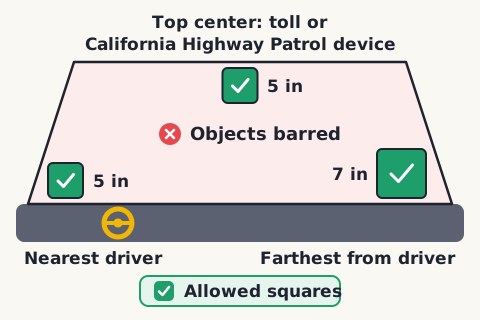
Windshield objects and the driver's view
California bars objects on the windshield and windows, with exceptions such as a seven-inch square at the lower windshield corner farthest from the driver and a five-inch square at the lower corner nearest the driver. The Vehicle Code allows a five-inch square at the top center for a toll or California Highway Patrol device, and bars driving when snow or ice blocks vision through the windshield or the side or rear windows. A driver may not drive so loaded, or with so many people in the front seat, that the view to the front or sides is obstructed or control is interfered with.
Safety belts and child restraints
In California, a driver and all passengers 16 or older must properly wear a safety belt. A child under 8 must be properly secured in a rear seat in an appropriate child passenger restraint system, except as the Vehicle Code provides; for example, one who is 4 feet 9 inches or taller may use a safety belt (an exception the law keeps from 1 January 2027). The driver is exempt if the child's parent or legal guardian is a passenger. A child under 2 rides rear-facing unless the child weighs 40 or more pounds or is 40 or more inches tall, subject to the exceptions in the Vehicle Code.
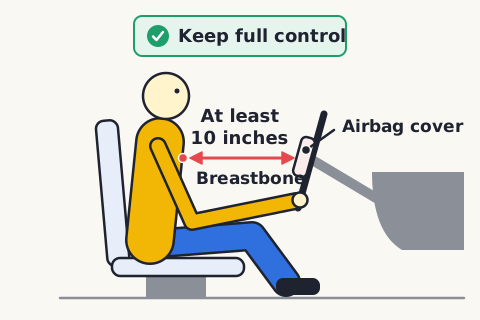
Airbag distance, heat and smoking
California's handbook asks drivers, when they can still keep full control of the vehicle, to sit with the breastbone at least 10 inches from the center of the steering wheel's airbag cover. Leaving children or animals in a hot vehicle is dangerous and illegal in California, the handbook says, and California law bars leaving or confining an animal in an unattended vehicle where heat, cold, poor ventilation or lack of food or water endangers it. It is also unlawful in California to smoke a tobacco product in a motor vehicle, whether moving or parked, when a minor is in it.
School bus lights and stops
Flashing yellow lights on a California school bus mean slow down and prepare to stop. Flashing red lights mean stop from either direction, so children can cross safely, unless the bus is on the other roadway of a divided or multiple-lane highway (two or more lanes in each direction). A driver meeting or overtaking a stopped school bus with a flashing red light signal and stop signal arm must stop immediately before passing it, and may not proceed until the flashing red light and the stop signal arm, if equipped, cease operation.
Moving over and passing a bicycle
California's move-over duty: a driver approaching a stationary emergency vehicle with emergency lights must use due caution and, before passing in the lane next to it and absent other direction by a peace officer, change to a non-adjacent lane if practicable and lawful, unless the vehicle is not adjacent to the highway or is separated from it by a protective physical barrier. If that is unsafe or impracticable, slow to a reasonable and prudent speed. Passing a bicycle going the same way takes at least three feet; if impossible, slow likewise and pass only when safe for the rider.
Bicyclist rights, direction and helmets
A bicyclist in California has all the rights and is subject to all the provisions applicable to the driver of a vehicle, except those that by their very nature can have no application. Bicyclists must go the same way as traffic on a roadway or shoulder. A motor vehicle may use a bicycle lane only to park where permitted, to enter or leave the road, or to prepare for a turn within 200 feet of the intersection. California requires a person under 18 to wear a properly fitted and fastened helmet when operating a bicycle, a nonmotorized scooter or a skateboard.
Bicycle night lights and lane splitting
At night a California bicycle needs a front lamp with a white light visible from 300 feet in front and from the sides. It also needs a red reflector, or a solid or flashing red light with a built-in reflector, on the rear, visible from 500 feet to the rear when directly in front of the lawful upper beams of a motor vehicle's headlamps. California's handbook says that sharing lanes with motorcycles, which it calls lane splitting, is legal.
Loads that spill, reach or trail
California bars throwing a lit or unlit cigarette, cigar, match or other flaming or glowing substance from a vehicle, or carrying a load that can drop, blow or spill out. A passenger vehicle's load may not extend past the fender line on the left or more than six inches beyond the fenders on the right. A rear load extending four feet or more beyond the taillamps needs two red lights at its extreme end, visible from at least 500 feet in darkness, and by day a solid red or fluorescent orange flag or cloth at least 18 inches square, one if the load is two feet wide or less and two if wider.
Riders and animals in a pickup bed
On a California highway, no person may ride in the back of a pickup or flatbed unless secured by a restraint system that meets the federal standards, with narrow exceptions for farm and ranch trucks on the owner's lands, emergency response by a public agency and supervised parades at 8 mph or less. On a highway, an animal in the back of a pickup must be in an enclosed space, behind side and tail racks at least 46 inches high, cross tethered or in a secured container or cage, or protected by installed means of preventing its discharge; livestock and certain ranch and farm dogs are exempt.
Low-speed roads and double fine zones
A low-speed vehicle in California reaches a maximum of 25 mph and is restricted from roads where the speed limit is greater than 35 mph, except in an area with an adopted neighborhood electric vehicle transportation plan or at the limited crossings the Vehicle Code allows. A designated Safety Enhancement-Double Fine Zone doubles the fine, or raises an infraction one category, for violations of the passing and speed chapters and for reckless driving, speed contest, drunk-driving and open-container offenses, but only when signs have been placed.
Self-test
Answer each question from memory, then check your work against the answer key.
1. Which response to a ringing cell phone does California's driver handbook give for a driver?
- ATo pick up if the call is urgent
- BTo let the call go to voicemail
- CTo reply by text message
- DTo hold it to the ear for a short call
2. In California, how must a child under 2 ride unless the child weighs 40 or more pounds or is 40 or more inches tall?
- ASeated in a booster seat
- BSeated in a regular safety belt
- CFacing the rear of the vehicle
- DFacing the front of the vehicle
3. A California driver has stopped for a school bus loading children with a flashing red light and stop signal arm. When may the driver proceed?
- AWhen the bus driver waves the driver on
- BWhen the driver has waited for a few seconds
- CWhen traffic in the other direction starts moving
- DWhen the red light and stop arm cease operation
4. Before passing in the lane next to a stationary emergency vehicle with emergency lights, what must a California driver do if a lane change is practicable and lawful, absent an officer's direction?
- AChange to a lane not next to it
- BKeep the same lane and speed
- CPull onto the shoulder behind it
- DStop until the lights are turned off
5. At night, a California bicycle needs a front lamp with a white light visible from how far in front and from the sides?
- A500 feet
- B300 feet
- C200 feet
- D100 feet
Go deeper
- WatchNot Even Hands-Free In California, adult drivers may use a phone hands-free. Drivers under 18 may not.
- WatchStop From Either Direction A California school bus flashes yellow lights. That means slow down and prepare to stop.
- StudyU.S. Permit Test by State (Driving) in the FlashFeed app
Answer key
- 1. B To let the call go to voicemailCalifornia's handbook says to let a ringing cell phone go to voicemail rather than answer it, so picking up an urgent call, holding it to the ear or replying by text is not the advice. If a driver must return or make a call, the handbook says to pull safely off the road.
- 2. C Facing the rear of the vehicleA child under 2 rides rear-facing unless the child weighs 40 or more pounds or is 40 or more inches tall, subject to the exceptions in the Vehicle Code. A forward-facing position does not meet the rule for a child below both limits.
- 3. D When the red light and stop arm cease operationA driver who must stop may not proceed until the flashing red light and the stop signal arm, if equipped, cease operation. The bus driver's wave, a wait of a few seconds, or other traffic moving does not end the stop.
- 4. A Change to a lane not next to itThe duty is a change to a lane not adjacent to the stationary vehicle, with due regard for safety and traffic conditions, if practicable and not prohibited by law. It does not apply if the stationary vehicle is not adjacent to the highway or is separated from it by a protective physical barrier.
- 5. B 300 feetA California bicycle's white front light must be visible from 300 feet in front and from the sides at night. The red rear reflector or light is the one that must be visible from 500 feet to the rear.
Sources
- California Legislature — California Vehicle Code section 23123.5 — leginfo.legislature.ca.gov/faces/codes_displaySection.xhtml?lawCode=VEH§ionNum=23123.5
- California Legislature — California Vehicle Code section 23124 — leginfo.legislature.ca.gov/faces/codes_displaySection.xhtml?lawCode=VEH§ionNum=23124
- California Legislature — California Vehicle Code section 26708 — leginfo.legislature.ca.gov/faces/codes_displaySection.xhtml?lawCode=VEH§ionNum=26708
- California Department of Motor Vehicles — California Driver's Handbook (DL 600, Rev. 6/2025), p. 70 — www.dmv.ca.gov/portal/file/california-driver-handbook-pdf?printedPage=70#page=76
- California Legislature — California Vehicle Code section 27360 — leginfo.legislature.ca.gov/faces/codes_displaySection.xhtml?lawCode=VEH§ionNum=27360
- California Legislature — California Health and Safety Code section 118948 — leginfo.legislature.ca.gov/faces/codes_displaySection.xhtml?lawCode=HSC§ionNum=118948
- California Legislature — California Vehicle Code section 22454 — leginfo.legislature.ca.gov/faces/codes_displaySection.xhtml?lawCode=VEH§ionNum=22454
- California Legislature — California Vehicle Code sections 21809 and 21760; California Legislature — California Vehicle Code section 21809 — leginfo.legislature.ca.gov/faces/codes_displaySection.xhtml?lawCode=VEH§ionNum=21809
- California Legislature — California Vehicle Code section 21200 — leginfo.legislature.ca.gov/faces/codes_displaySection.xhtml?lawCode=VEH§ionNum=21200
- California Legislature — California Vehicle Code section 21201 — leginfo.legislature.ca.gov/faces/codes_displaySection.xhtml?lawCode=VEH§ionNum=21201
- California Legislature — California Vehicle Code section 21760 — leginfo.legislature.ca.gov/faces/codes_displaySection.xhtml?lawCode=VEH§ionNum=21760
- California Department of Motor Vehicles — California Driver's Handbook (DL 600, Rev. 6/2025), p. 44 — www.dmv.ca.gov/portal/file/california-driver-handbook-pdf?printedPage=44#page=50
- California Legislature — California Vehicle Code section 385.5 — leginfo.legislature.ca.gov/faces/codes_displaySection.xhtml?lawCode=VEH§ionNum=385.5
- California Legislature — California Vehicle Code sections 24604, 35111, 23111 and 23114; California Legislature — California Vehicle Code section 24604 — leginfo.legislature.ca.gov/faces/codes_displaySection.xhtml?lawCode=VEH§ionNum=24604
- California Legislature — California Vehicle Code section 23116 — leginfo.legislature.ca.gov/faces/codes_displaySection.xhtml?lawCode=VEH§ionNum=23116
- California Legislature — California Vehicle Code sections 21260 (low-speed vehicles) and 42010 (Safety Enhancement-Double Fine Zones); California Legislature — California Vehicle Code section 21260 — leginfo.legislature.ca.gov/faces/codes_displaySection.xhtml?lawCode=VEH§ionNum=21260
- California Legislature — California Vehicle Code section 42010 — leginfo.legislature.ca.gov/faces/codes_displaySection.xhtml?lawCode=VEH§ionNum=42010
Image credits
- Windshield objects and the driver's view: FlashFeed original diagram · CC-BY-4.0
- Airbag distance, heat and smoking: FlashFeed original diagram · CC-BY-4.0