
U.S. Permit Test by State (Driving) study guide · Lesson 11 of 18
California: Alcohol, Insurance and Crashes
Alcohol limits and drivers under 21 · Chemical tests, open containers and DUI arrests · Insurance and crash duties · Crash reports, police stops and driving offenses
This is the lesson's study guide from the FlashFeed app, plus its key facts and a self-test.
What you'll be able to do
- In California, state alcohol limits, where open containers go, who suspends a license after a DUI arrest, insurance minimums, and crash and police-stop steps.
California sets exact rules for drivers who drink or use drugs, for minimum liability insurance, for a driver's duties after a crash, and for a police stop. The California Driver's Handbook (DL 600, Rev. 6/2025) teaches them. Breaking them can mean a license suspension, an impounded vehicle or time in jail.
Alcohol limits and drivers under 21
In California, driving under the influence (DUI) of any alcoholic beverage, any drug, or both together is unlawful. Alcohol, marijuana and other drugs can impair the ability to drive because they slow coordination, judgment and reaction times. California's handbook says the law draws no line between illegal drugs and medicines from a doctor or pharmacy. It adds that at any age it is illegal to drive after:
- drinking excessive alcohol in any form, including medications such as cough syrup;
- taking any drug that affects driving, prescription or over-the-counter;
- any combination of alcohol or drugs that reduces the ability to drive safely.
California's blood alcohol concentration (BAC) limit is 0.08 percent for an adult driver but 0.01 percent for a driver under 21. The Vehicle Code applies the 0.08 percent limit to any driver, although the handbook words it as applying to drivers over 21 years old. A driver of any age who is on DUI probation has a limit of 0.01 percent. For a driver under 21, the Vehicle Code makes a blood alcohol level of 0.05 percent or more a separate offense. These limits are legal lines, never safe amounts of alcohol. California's handbook adds that, depending on how badly a driver is impaired, the driver may be arrested and convicted of DUI even without a BAC measurement.
A California driver under 21 may not knowingly drive a vehicle carrying alcohol unless accompanied by a parent, legal guardian, responsible adult relative or adult designated by a parent or guardian. The ban also does not apply when the driver is working for a licensee under the Alcoholic Beverage Control Act during regular hours and in the course of the employment. A passenger under 21 may not knowingly possess or control alcohol, with the same exceptions. California's handbook words these exceptions as accompaniment by a person aged 21 or older with a full, sealed container, or working for someone with an off-site liquor sales license and carrying closed containers. A vehicle registered to a driver under 21 who is caught carrying alcohol may be impounded at the owner's expense for one to 30 days for each violation. A conviction is a misdemeanor. The handbook says the impound is for up to 30 days.
A California peace officer who lawfully detains a driver under 21 and has reasonable cause to believe the 0.01 percent limit is violated shall request a preliminary alcohol screening (PAS) test if a device is immediately available. The handbook says officers can require a hand-held breath test, PAS or another chemical test. It adds that if the PAS of a driver under 21 shows 0.05 percent or higher, the officer may require a breath or blood test.
Sources
- Vehicle Code §13388
- Vehicle Code §23136
- Vehicle Code §23140
- Vehicle Code §23152
- Vehicle Code §23154
- Vehicle Code §23224
- NHTSA, Drug-Impaired Driving
- DL 600, p. 72
- DL 600, p. 73
- DL 600, p. 75
Chemical tests, open containers and DUI arrests
California's Vehicle Code deems a driver to have given consent to chemical testing of blood or breath on a lawful DUI arrest. For drugs, the consent covers blood, or urine if blood is unavailable. California's handbook words this as consent to a breath, blood or urine test when an officer suspects DUI.
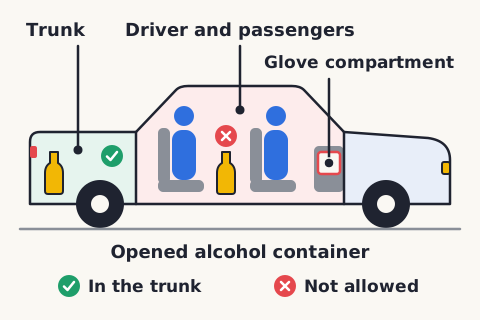
A driver in California may not drink alcohol, or smoke or ingest cannabis, while driving on a highway. A passenger may not do so while the vehicle is being driven on a highway. On a highway, an opened alcohol container must be kept in the trunk. If the vehicle has no trunk, it must be kept in an area the driver and passengers do not normally occupy. This rule does not apply to the living quarters of a housecar or camper, and an off-highway vehicle subject to identification with no trunk needs a locked container. A glove compartment or utility compartment counts as part of the area the driver and passengers occupy, so an opened alcohol container may not be kept in it.
In California, a driver who has an opened or unsealed cannabis container, or loose cannabis flower not in a container, commits an infraction unless it is in the trunk. A qualified medical patient with an identification card or physician's recommendation may carry it if it is sealed, resealed or closed. California's handbook words this for alcohol and cannabis alike: a container must be sealed and unopened, and an open one goes in the trunk or a place where passengers do not sit.
Under the Administrative Per Se law that California's handbook describes, the California Department of Motor Vehicles (DMV) must suspend the driving privilege after a DUI arrest on the grounds set in the Vehicle Code. The code says the department shall immediately suspend it for:
- a person who drove with a blood alcohol level of 0.08 percent or more;
- a person under 21 with 0.01 percent or more on a PAS or other chemical test;
- a commercial-vehicle driver with 0.04 percent or more;
- a driver on DUI probation with 0.01 percent or more.
California's handbook says the officer may take the driver's license after a DUI arrest and give a temporary license for 30 days. For a driver under 21 who refuses to take or fails to complete the PAS test, or whose test shows 0.01 percent or more, the Vehicle Code has the officer take the license and issue a temporary license. The temporary license is valid for 30 days from issuance or until the DMV's order of suspension is received, whichever comes first.
A first DUI conviction in California can bring up to six months in jail, with a code minimum of 96 hours. California's handbook lists other consequences of a DUI conviction: the driver must complete a DUI program and must file a California Insurance Proof Certificate (SR 22/SR 1P). It adds that the driver can be ordered to install an ignition interlock device (IID).
It is unlawful to ride a bicycle on a California highway while under the influence of alcohol or a drug. A person aged 13 to 20 who is convicted has the driving privilege suspended for one year or, if not yet licensed, delayed for one year after becoming eligible.
Sources
- Vehicle Code §13202.5
- Vehicle Code §13353.2
- Vehicle Code §13388
- Vehicle Code §21200.5
- Vehicle Code §23221
- Vehicle Code §23222
- Vehicle Code §23225
- Vehicle Code §23536
- Vehicle Code §23612
- DL 600, p. 72
- DL 600, p. 74
Insurance and crash duties
For policies issued or renewed on or after 1 January 2025, California's minimum liability insurance limits are:
- $30,000 for one person's injury or death;
- $60,000 for injury to or death of more than one person;
- $15,000 for property damage.
These limits replace earlier limits of 15,000, 30,000 and $5,000. California drivers and owners must carry evidence of financial responsibility in the vehicle. They must show it on an officer's demand, electronically if they choose. A parent or guardian who signs a minor's application accepts financial responsibility for the minor's driving. A driver in a collision who has no proper insurance coverage faces suspension of the driving privilege no matter who was at fault. Under the Vehicle Code, the privilege is suspended 30 days after the DMV mails notice, unless coverage at the time of the accident is shown.
After a crash that injures anyone other than the driver, or kills anyone, a California driver must stop immediately at the scene. After a crash with injury or death, the driver gives name, current address and vehicle registration number to those involved and to any officer at the scene. The driver also renders reasonable help and, on request, shows a driver's license if available. After a crash with property damage only, the driver stops at the nearest spot that will not impede traffic. The driver then either finds the owner or leaves a written note and notifies police or the California Highway Patrol (CHP).
Every driver involved in a California accident must, unless incapable, exchange these with the other driver or property owner at the scene:
- name and current address;
- license number;
- vehicle identification number;
- the registered owner's current address;
- evidence of financial responsibility, giving the insurer's name, address and policy number if the responsibility is insurance.
To cover a driver's duties after a crash, California's handbook lists these steps, in an unnumbered order that is not a required sequence:
- stopping at the scene;
- calling 911 at once if anyone is hurt;
- moving the vehicle out of traffic and then calling 911 if no one is hurt;
- exchanging information with the others involved;
- making the required reports.
California's handbook lists the most common causes of collisions as:
- driver distractions;
- unsafe speed;
- improper turns;
- not following right-of-way rules;
- not following stop signals and signs;
- driving on the wrong side of the road;
- traveling faster or slower than the flow of traffic.
Sources
- Vehicle Code §16020
- Vehicle Code §16025
- Vehicle Code §16028
- Vehicle Code §16056
- Vehicle Code §16070
- Vehicle Code §17707
- Vehicle Code §20001
- Vehicle Code §20002
- Vehicle Code §20003
- DL 600, p. 3
- DL 600, p. 76
- DL 600, p. 77
Crash reports, police stops and driving offenses
A crash with injury or death in California requires a written report to the CHP or city police within 24 hours. Every driver involved in a crash must also report it to the DMV within 10 days, on form SR 1, if it caused damage over 1,000 to one person's property or any injury or death. The DMV report is required no matter who caused the crash. The report can be made personally or through an insurance agent, broker or legal representative. The reporting rule also covers a reportable off-highway accident. That is one off the street or highway involving a vehicle subject to registration, with damage over 1,000 to one person's property or any injury or death. The accident does not count if the damage is only to the driver's or owner's own property. The handbook says the rule applies even on private property.
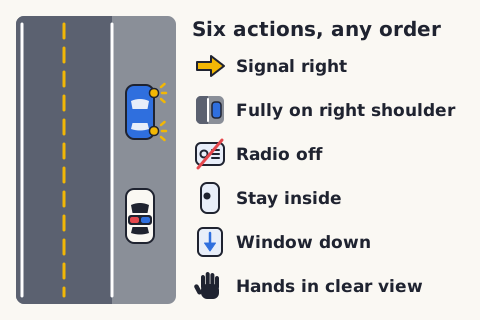
California's handbook lists six actions, in no required order, so that a police stop is calm and safe for everyone:
- turning on the right turn signal;
- moving completely onto the right shoulder;
- turning off the radio;
- staying inside unless told to get out;
- rolling down the window before the officer makes contact;
- keeping the driver's and all passengers' hands in clear view.
A California driver must obey a lawful order or signal of a uniformed officer. A driver stopped by an officer must produce a license, proof of insurance and registration. Since 1 January 2024, a peace officer must state the reason for a stop before questioning related to a criminal investigation or traffic violation, and must document it on any citation or report, unless the officer reasonably believes that withholding it is necessary to protect life or property from imminent threat.
In California, evading a peace officer is a misdemeanor punishable by up to one year in county jail. It applies when a driver flees a pursuing peace officer's marked vehicle, which has a lighted red lamp and siren, with the intent to evade. When evading causes serious bodily injury, the penalty is state prison for three, five or seven years, county jail for up to one year, or a fine. The handbook says up to seven years in state prison or a county jail term of one year or less. When evading causes death, the penalty is state prison for 4, 6 or 10 years.
In California, a vehicle driven by a person who was never issued a driver's license may be impounded for 30 days. The Vehicle Code defines reckless driving as driving with willful or wanton disregard for the safety of people or property. A speed contest includes a race against another vehicle, a clock or another timing device.
As of 31 October 2026, the California Highway Patrol's Freeway Service Patrol is a free program of privately owned tow trucks patrolling designated routes on congested urban freeways. It may offer a gallon of gas, a jump-start for a dead battery, a radiator refill with taped hoses, or a flat-tire change.
Sources
- Vehicle Code §2800
- Vehicle Code §2800.1
- Vehicle Code §2800.3
- Vehicle Code §2806.5
- Vehicle Code §12951
- Vehicle Code §14602.6
- Vehicle Code §16000
- Vehicle Code §16000.1
- Vehicle Code §20008
- Vehicle Code §23103
- Vehicle Code §23109
- CHP, Freeway Service Patrol
- DL 600, p. 29
- DL 600, p. 30
- DL 600, p. 53
- DL 600, p. 78
Key facts
DUI and California's adult limit
In California, driving under the influence (DUI) of any alcoholic beverage, any drug, or both together is unlawful. Alcohol, marijuana and other drugs can impair the ability to drive because they slow coordination, judgment and reaction times. California's blood alcohol concentration (BAC) limit for adult drivers is 0.08 percent, and the Vehicle Code applies it to any driver. The limit is a legal line, never a safe amount of alcohol.
Limits for under 21 and on probation for driving under the influence (DUI)
California's blood alcohol limit is 0.08 percent for an adult driver but 0.01 percent for a driver under 21, and a driver of any age on probation for DUI also has a limit of 0.01 percent. For a driver under 21, the Vehicle Code makes a blood alcohol level of 0.05 percent or more a separate offense. A peace officer who lawfully detains a driver under 21 and has reasonable cause to believe the 0.01 percent limit is violated shall request a preliminary alcohol screening (PAS) test if a device is immediately available.
Under 21 carrying alcohol
A California driver under 21 may not knowingly drive a vehicle carrying alcohol unless accompanied by a parent, legal guardian, responsible adult relative or adult designated by a parent or guardian, or working for a licensee under the Alcoholic Beverage Control Act during regular hours and in the course of the employment. A passenger under 21 may not knowingly possess or control alcohol, with the same exceptions. A vehicle registered to a driver under 21 caught carrying alcohol may be impounded at the owner's expense for one to 30 days for each violation; a conviction is a misdemeanor.
Implied consent and the license suspension
A driver is deemed to consent to chemical testing of blood or breath on a lawful arrest for driving under the influence (DUI), and of blood, or urine if blood is unavailable, for drugs. Under the Administrative Per Se law, the California Department of Motor Vehicles (DMV) must immediately suspend the driving privilege after a DUI arrest on these Vehicle Code grounds: blood alcohol of 0.08 percent or more, 0.01 percent or more under 21 on a preliminary alcohol screening or other chemical test, 0.04 percent or more for a commercial-vehicle driver, and 0.01 percent or more on DUI probation.
Opened containers in a California vehicle
On a highway, an opened alcohol container must be kept in the trunk or, if there is none, in an area the driver and passengers do not normally occupy; a glove or utility compartment counts as part of the area they occupy. That rule does not cover a housecar's or camper's living quarters, and an off-highway vehicle subject to identification with no trunk needs a locked container. A driver with an opened or unsealed cannabis container, or loose cannabis flower, commits an infraction unless it is in the trunk; a qualified medical patient may carry it if it is sealed, resealed or closed.
Temporary license, jail and cycling under the influence
California's handbook says that after an arrest for driving under the influence (DUI) the officer may take the driver's license and give a temporary license for 30 days. A first DUI conviction in California can bring up to six months in jail, with a code minimum of 96 hours. Riding a bicycle on a California highway while under the influence of alcohol or a drug is unlawful, and a person aged 13 to 20 who is convicted has the driving privilege suspended for one year or, if not yet licensed, delayed for one year after becoming eligible.
California's minimum liability limits
For policies issued or renewed on or after 1 January 2025, California's minimum liability insurance limits are 30,000 for one person's injury or death, 60,000 for injury to or death of more than one person, and $15,000 for property damage. California drivers and owners must carry evidence of financial responsibility in the vehicle and show it on an officer's demand. In California, a driver in a collision who has no proper insurance coverage faces suspension of the driving privilege no matter who was at fault, unless coverage at the time of the accident is shown.
Duties at the scene of a crash
After a crash that injures anyone other than the driver, or kills anyone, a California driver must stop immediately at the scene. After a crash with injury or death, the driver gives name, current address and vehicle registration number to those involved and to any officer at the scene, renders reasonable help, and on request shows a driver's license if available. After a crash with property damage only, the driver stops at the nearest spot that will not impede traffic and then either finds the owner or leaves a written note and notifies police or the California Highway Patrol (CHP).
Exchanging information after a crash
Every driver involved in a California accident must, unless incapable, exchange name and current address, license number, vehicle identification number, the registered owner's current address, and evidence of financial responsibility with the other driver or property owner at the scene. California's handbook lists these steps after a crash, in no required order: stopping at the scene; calling 911 at once if anyone is hurt; moving the vehicle out of traffic and then calling 911 if no one is hurt; exchanging information; and making the required reports.
Crash reports to police and the California Department of Motor Vehicles (DMV)
A crash with injury or death in California requires a written report to the California Highway Patrol or city police within 24 hours. Every driver involved in a crash must also report it to the DMV within 10 days, on form SR 1, if it caused damage over $1,000 to one person's property or any injury or death, whoever caused the crash. The DMV report can be made personally or through an insurance agent, broker or legal representative, and the rule also covers a reportable off-highway accident, but not damage only to the driver's or owner's own property.
At a police stop in California
The handbook lists six actions for a calm, safe police stop, in no required order: signaling right, moving completely onto the right shoulder, turning off the radio, staying inside unless told to get out, rolling down the window before the officer makes contact, and keeping the driver's and all passengers' hands in clear view. Since 1 January 2024, a peace officer must state the reason for a stop before questioning related to a criminal investigation or traffic violation, unless the officer reasonably believes withholding it is necessary to protect life or property from imminent threat.
Orders, documents and evading an officer
A California driver must obey a lawful order or signal of a uniformed officer and, when stopped, produce a license, proof of insurance and registration. A driver who flees a pursuing peace officer's marked vehicle, which has a lighted red lamp and siren, with the intent to evade commits a misdemeanor punishable by up to one year in county jail. When evading causes serious bodily injury, the penalty is state prison for three, five or seven years, county jail for up to one year, or a fine. A vehicle driven by a person never issued a driver's license may be impounded for 30 days.
Self-test
Answer each question from memory, then check your work against the answer key.
1. A California driver of any age is on driving under the influence (DUI) probation. What is that driver's blood alcohol limit?
- A0.04 percent
- B0.05 percent
- C0.01 percent
- D0.08 percent
2. Under the Vehicle Code, a California driver with an opened cannabis container commits an infraction unless the container is kept where?
- AIn the trunk of the vehicle
- BIn the front center console
- CIn the glove compartment
- DUnder the front passenger seat
3. A California driver renews a liability policy on or after 1 January 2025. What is the minimum limit for one person's injury or death?
- A$60,000
- B$5,000
- C$15,000
- D$30,000
4. A California driver's crash injures another person. Which action does the Vehicle Code require of the driver?
- AStop at the nearest safe spot
- BStop immediately at the scene
- CGo to the nearest police station
- DStop at the next safe exit
5. A California driver is signaled to stop by an officer. Which action does the handbook list for the stop?
- AStay in unless told to get out
- BMove onto the left shoulder
- CKeep the window up until asked
- DGet out unless told to stay in
Go deeper
- WatchTwo Limits, One Line In California, the alcohol limit depends on who's driving.
- WatchNot the Glove Compartment Not the glove compartment. In California, an opened alcohol container on a highway belongs in the trunk.
- StudyU.S. Permit Test by State (Driving) in the FlashFeed app
Answer key
- 1. C 0.01 percentA driver of any age who is on DUI probation has a limit of 0.01 percent, which is lower than the 0.08 percent adult limit.
- 2. A In the trunk of the vehicleAn opened or unsealed cannabis container, or loose flower not in a container, is an infraction unless it is in the trunk, so the other places listed do not qualify. A qualified medical patient may carry it if it is sealed, resealed or closed.
- 3. D $30,000For policies issued or renewed on or after 1 January 2025, the minimum for one person's injury or death is $30,000. The other two limits cover more than one person and property damage, and have their own figures.
- 4. B Stop immediately at the sceneAfter a crash that injures anyone other than the driver, or kills anyone, a California driver must stop immediately at the scene. Stopping at the nearest spot that will not impede traffic is the rule for a crash with property damage only.
- 5. A Stay in unless told to get outCalifornia's handbook lists staying inside unless told to get out, moving completely onto the right shoulder and rolling down the window before the officer makes contact, among six actions. Getting out, the left shoulder and a raised window are not on that list.
Sources
- California Legislature — California Vehicle Code section 23152 — leginfo.legislature.ca.gov/faces/codes_displaySection.xhtml?lawCode=VEH§ionNum=23152
- California Legislature — California Vehicle Code section 23136 — leginfo.legislature.ca.gov/faces/codes_displaySection.xhtml?lawCode=VEH§ionNum=23136
- California Legislature — California Vehicle Code section 23224 — leginfo.legislature.ca.gov/faces/codes_displaySection.xhtml?lawCode=VEH§ionNum=23224
- California Legislature — California Vehicle Code section 23154 — leginfo.legislature.ca.gov/faces/codes_displaySection.xhtml?lawCode=VEH§ionNum=23154
- California Legislature — California Vehicle Code section 23140 — leginfo.legislature.ca.gov/faces/codes_displaySection.xhtml?lawCode=VEH§ionNum=23140
- California Legislature — California Vehicle Code sections 23612 and 13353.2; California Legislature — California Vehicle Code section 13353.2 — leginfo.legislature.ca.gov/faces/codes_displaySection.xhtml?lawCode=VEH§ionNum=13353.2
- California Legislature — California Vehicle Code sections 23225 and 23222; California Legislature — California Vehicle Code section 23225 — leginfo.legislature.ca.gov/faces/codes_displaySection.xhtml?lawCode=VEH§ionNum=23225
- California Department of Motor Vehicles — California Driver's Handbook (DL 600, Rev. 6/2025), p. 74 — www.dmv.ca.gov/portal/file/california-driver-handbook-pdf?printedPage=74#page=80
- California Legislature — California Vehicle Code section 23222 — leginfo.legislature.ca.gov/faces/codes_displaySection.xhtml?lawCode=VEH§ionNum=23222
- California Legislature — California Vehicle Code section 16056 — leginfo.legislature.ca.gov/faces/codes_displaySection.xhtml?lawCode=VEH§ionNum=16056
- California Legislature — California Vehicle Code section 20001 — leginfo.legislature.ca.gov/faces/codes_displaySection.xhtml?lawCode=VEH§ionNum=20001
- California Legislature — California Vehicle Code section 16025 — leginfo.legislature.ca.gov/faces/codes_displaySection.xhtml?lawCode=VEH§ionNum=16025
- California Department of Motor Vehicles — California Driver's Handbook (DL 600, Rev. 6/2025), p. 77 — www.dmv.ca.gov/portal/file/california-driver-handbook-pdf?printedPage=77#page=83
- California Legislature — California Vehicle Code section 16070 — leginfo.legislature.ca.gov/faces/codes_displaySection.xhtml?lawCode=VEH§ionNum=16070
- California Legislature — California Vehicle Code section 16000 — leginfo.legislature.ca.gov/faces/codes_displaySection.xhtml?lawCode=VEH§ionNum=16000
- California Department of Motor Vehicles — California Driver's Handbook (DL 600, Rev. 6/2025), p. 29 — www.dmv.ca.gov/portal/file/california-driver-handbook-pdf?printedPage=29#page=35
- California Legislature — California Vehicle Code section 2800.1 — leginfo.legislature.ca.gov/faces/codes_displaySection.xhtml?lawCode=VEH§ionNum=2800.1
- California Department of Motor Vehicles — California Driver's Handbook (DL 600, Rev. 6/2025), p. 30 — www.dmv.ca.gov/portal/file/california-driver-handbook-pdf?printedPage=30#page=36
- California Legislature — California Vehicle Code section 20008 — leginfo.legislature.ca.gov/faces/codes_displaySection.xhtml?lawCode=VEH§ionNum=20008
Image credits
- Opened containers in a California vehicle: FlashFeed original diagram · CC-BY-4.0
- At a police stop in California: FlashFeed original diagram · CC-BY-4.0