
U.S. Permit Test by State (Driving) study guide · Lesson 12 of 18
California: Teen Licensing and the DMV Written Test
From permit to license · Supervised practice and the provisional license · Limit exceptions, points and citations · The tests and what a driver owes the DMV
This is the lesson's study guide from the FlashFeed app, plus its key facts and a self-test.
What you'll be able to do
- Lay out California's steps to a provisional license and its practice hours, who supervises and signs for a minor, first-year limits and point consequences.
- Describe what California's license exam must test, the drive test's attempts and allowed technology, traffic violator school, and what a driver owes the DMV.
A California teen reaches a driver's license in stages: an instruction permit, supervised practice, then a provisional license with limits on night driving and passengers. The California Department of Motor Vehicles (DMV) gives a knowledge test and a drive test along the way, and it requires notice when a driver moves. These rules appear in the Vehicle Code and in the California Driver's Handbook (DL 600, Rev. 6/2025). They decide who may supervise practice, when a new driver may drive, and what a driver owes the DMV.
From permit to license
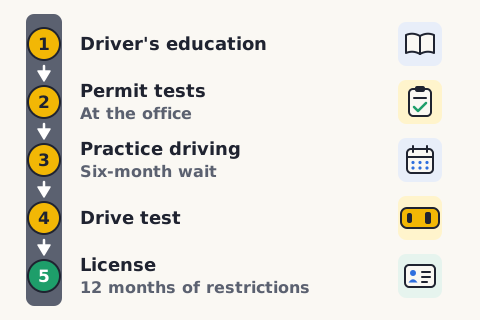
In California, a learner's permit is also called an instruction permit. A permit held by a person under 18 is called a provisional instruction permit. The DMV's Teen Driver Roadmap sets the path from permit to license in twelve numbered steps, from requirements and restrictions to DMV online services. Along that path, a teen passes through five main stages:
- Driver's education.
- Applying and passing the permit tests at the office.
- Practice driving and a six-month wait.
- The drive test.
- The license, with 12 months of restrictions.
A California applicant for an instruction permit under 18 must be at least 15 years and 6 months old. The DMV's page words this as 15 and a half. An applicant who is 15 and a half to 17 and a half years old must have a certificate of completion of driver education, or of enrollment in an approved integrated driver education/driver training program. A parent or guardian must sign the application. Both must sign if the parents or guardians share joint custody.
A parent or guardian must attend the teen's DMV appointment in California. An applicant has three attempts at each knowledge test, a multiple-choice exam, before reapplying.
A California minor's license application must be signed and verified (Vehicle Code section 17701):
- by both the father and the mother, if both are living and have custody;
- otherwise by the one parent, guardian or custodian;
- for a dependent or ward of the court, it may also be signed by a grandparent, a sibling over 18, an aunt, an uncle or a foster parent with whom the minor lives.
A parent or guardian who signs is jointly and severally liable with the minor for damages from the minor's negligent or wrongful driving (Vehicle Code section 17707). The handbook adds that signers become financially responsible for drivers under 18 and pay for damages if the driver is in a collision. A signer can end responsibility for the minor's later driving by applying to the DMV to cancel the minor's license (section 17711). The handbook describes this as completing a Request for Cancellation or Surrender of a Driver License or ID Card form.
An applicant for a California instruction permit must qualify for and be issued the permit within 12 months from the date of the application (Vehicle Code section 12509). The code lets a permit be valid for up to 24 months from the date of the application. As of 31 October 2026, the DMV's Teen Driver Roadmap says permits are good for up to one year from the application date. The Vehicle Code governs where the two differ.
Sources
- Vehicle Code §12509
- Vehicle Code §17701
- Vehicle Code §17707
- Vehicle Code §17711
- DMV, Teen Driver Roadmap
- DMV, Learner's Permits
- DL 600, p. 3
- DL 600, p. 4
- DL 600, p. 5
- DL 600, p. 76
Supervised practice and the provisional license
In California, an adult permit holder's supervising driver must be a licensed driver at least 18. A minor's supervising driver must be at least 25, unless the supervisor is the permit holder's parent, spouse, guardian or a licensed or certified driving instructor, who may be any age. The handbook words the same split as 18 for adults and 25 for minors. For a minor, the supervisor must also be a California-licensed driver whose driving privilege is not on probation. The handbook adds that the supervisor must sit near enough to take over driving if needed.
For an adult permit holder (one not in the minor program), Vehicle Code section 12509 allows driving accompanied by a California-licensed driver who:
- is 18 or older;
- holds a valid license of the appropriate class;
- has a driving privilege not subject to probation; and
- is seated in the driver's compartment so as to help control the vehicle.
California's handbook says a driver under 18 holds a license marked as provisional. To get a provisional license, a minor must be at least 16, older than the permit's minimum age of 15 years and 6 months. The minor must also have held the instruction permit for six months. A California minor getting a provisional license must have practiced driving for 50 hours. Of those 50 hours, 10 are at night. The minor needs proof of driver education and training. The DMV states six hours of professional driver training for a teen license.
In the first 12 months, a California provisional licensee may not drive between 11 p.m. and 5 a.m. The licensee also may not carry passengers under 20. Each limit applies unless the licensee is accompanied and supervised by a parent or guardian, a licensed driver 25 or older, or, under the Vehicle Code, a licensed or certified driving instructor. For night driving, limited exceptions apply for medical, school, work or family necessity, with a signed note, and for an emancipated minor. For passengers, the code lets a licensee transport an immediate family member without a supervising driver for medical, school, work or family necessity, with a signed note, or as an emancipated minor.
In short, a California minor's instruction permit means supervised driving. The supervisor is a licensed driver at least 25, or a parent, spouse, guardian or driving instructor of any age, seated near enough to take over. A provisional license instead carries night-driving and passenger limits for the first 12 months, with limited exceptions.
Sources
Limit exceptions, points and citations
Four exceptions to California's provisional night-driving and passenger limits each need a signed note from a different person:
- Medical need: a note signed by a physician, stating the condition and the expected recovery date.
- School: a note signed by the school principal, dean or designee.
- Work: a note signed by the employer, confirming the employment.
- An immediate family member: a note signed by a parent or legal guardian, stating the reason, the family member and the date the need will end.
The Vehicle Code lists an emancipated minor as a fifth exception that needs no note (section 12814.6).
California's handbook says a minor with a provisional license cannot drive for pay or operate vehicles that need a commercial Class A, B or C license. The Vehicle Code bars hiring someone under 18 to drive a motor vehicle on the highways for pay (section 12515).
California's Vehicle Code counts violation points on a driving record (section 12810): two points for convictions such as reckless driving or failing to stop after an accident, and one point for most other traffic convictions involving safe driving and for a traffic accident in which the operator is deemed by the department (the DMV) to be responsible. Two or more violation points in 12 months bring a California provisional licensee a 30-day restriction. Three or more violation points in 12 months bring the licensee a six-month suspension and one year of probation. The suspension and the probation both run their full length even after the 18th birthday. A provisional licensee on probation must violate no law whose conviction is reportable to the DMV. The licensee must also stay free of responsibility for any accident (Vehicle Code section 12814.6).
For adults, California's handbook says a driver's license may be suspended when the record shows any of these totals:
- 4 points within a 12-month window;
- 6 points within a 24-month window;
- 8 points within a 36-month window.
The Vehicle Code presumes a driver with such a record to be a negligent operator (section 12810.5). These adult totals differ from the two and three points in 12 months that apply to a provisional licensee.
California's handbook glossary defines a traffic citation as a formal summons that law enforcement issues for breaking a traffic law, also called a ticket. For a one-point violation, a judge may offer traffic violator school only once in any 18 months. The handbook says the school keeps the citation off the insurance record but on the driver record. Vehicle Code section 41501 has the court notify the person of the one-conviction limit within 18 months.
Sources
- Vehicle Code §12515
- Vehicle Code §12810
- Vehicle Code §12810.5
- Vehicle Code §12814.6
- Vehicle Code §41501
- DL 600, p. 4
- DL 600, p. 54
- DL 600, p. 55
- DL 600, p. 84
The tests and what a driver owes the DMV
The DMV says California's knowledge tests are multiple choice. The DMV also says every question comes from the handbook. The Vehicle Code requires the driver license examination to cover the code itself, the ability to read the simple English used on traffic signs, and knowing what traffic signs and signals mean.
As of 30 October 2026, the DMV's learner's permit page gives 80 percent as the passing score on the knowledge tests. The DMV's 28 December 2023 release says California's online exam is offered in 35 languages. As of 30 October 2026, the Vehicle Code requires a minor who fails a knowledge test to wait at least one week before retaking it. The handbook says the wait is seven days, not counting the day of failure.
In California's handbook glossary, the behind-the-wheel test, or drive test, is a test in which the applicant controls the vehicle with a DMV examiner riding along. A minor has three attempts at the drive test. The glossary defines the Driving Performance Evaluation (DPE) as the part of the drive test where the applicant drives their own car and a DMV examiner evaluates their driving skills.
For the drive test, California's handbook tells an applicant to bring, among other things:
- another California-licensed driver at least 18 years old (25 for minors), unless the applicant is already licensed to drive;
- a vehicle that is safe to drive for the test;
- valid proof of insurance and vehicle registration.
California's handbook also says advanced driver assistance systems, such as automated parallel parking, lane departure features and adaptive cruise control, may not be used on the drive test. It adds that a backup camera or blind spot monitor may be used, but neither takes the place of actually checking the mirrors and blind spots by eye.
A California driver who moves must notify the DMV of both the old and new address within 10 days (Vehicle Code section 14600). The handbook gives the same 10 days. Driving with an expired driver's license is against the law. The code bars driving on a highway unless the person holds a valid driver's license, except those persons expressly exempted under the code (section 12500).
Sources
Key terms
- Instruction permit
- The California Department of Motor Vehicles' term for what is also called a learner's permit
- DPE
- In California's handbook glossary, the part of the drive test where the applicant drives their own car and a California Department of Motor Vehicles examiner evaluates their driving skills
Key facts
A California minor's permit rules
In California, a permit held by a person under 18 is called a provisional instruction permit. To apply for an instruction permit, a California applicant under 18 must be at least 15 years and 6 months old, which the California Department of Motor Vehicles' page words as 15 and a half. An applicant who is 15 and a half to 17 and a half must have a certificate of completion of driver education, or of enrollment in an approved integrated driver education/driver training program. A parent or guardian must sign the application, and both must sign if the parents or guardians share joint custody.
Who signs for a California minor
A California minor's license application must be signed and verified by both parents if both are living and have custody, and otherwise by the one parent, guardian or custodian; for a dependent or ward of the court, a grandparent, sibling over 18, aunt, uncle or foster parent with whom the minor lives may also sign. A signer is jointly and severally liable with the minor for damages from the minor's negligent or wrongful driving and can end responsibility for the minor's later driving by applying to cancel the license.
The path from permit to license
The Teen Driver Roadmap sets California's path from permit to license in twelve numbered steps. Along that path, a teen passes through driver's education, the permit tests at the office, practice and a six-month wait, the drive test, and the license with 12 months of restrictions. Under California law, an applicant must qualify for and be issued the instruction permit within 12 months from the date of the application. A parent or guardian must attend the teen's appointment, and an applicant has three attempts at each knowledge test before reapplying.
Who supervises a California permit holder
In California, the supervising driver of an adult permit holder, one not in the minor program, must be a California-licensed driver 18 or older, with a valid license of the appropriate class and a driving privilege not subject to probation. A permit holder under 18 practices with a California-licensed driver whose driving privilege is not on probation and who is at least 25, unless the supervisor is the permit holder's parent, spouse, guardian or a licensed or certified driving instructor, who may be any age.
First-year limits on a provisional license
In the first 12 months, a California provisional licensee may not drive between 11 p.m. and 5 a.m. or carry passengers under 20, unless accompanied and supervised by a parent or guardian, a licensed driver 25 or older, or, under the Vehicle Code, a licensed or certified driving instructor. Limited exceptions apply to night driving for medical, school, work or family necessity, with a signed note, and for an emancipated minor. A minor's instruction permit instead means supervised driving, with the supervisor seated close enough to take control.
Four exceptions and their signers
Four of the exceptions to California's provisional night-driving limit each need a signed note from a different person. A medical need calls for a note signed by a physician, stating the condition and the expected recovery date, and school for one signed by the principal, dean or designee. Work calls for one signed by the employer, confirming the employment, and an immediate family member for one signed by a parent or legal guardian, stating the reason, the family member and the date the need will end.
Points and paid driving for minors
A California minor with a provisional license cannot drive for pay or operate vehicles that need a commercial Class A, B or C license, and the Vehicle Code bars hiring someone under 18 to drive a motor vehicle on the highways for pay. Two or more violation points in 12 months bring a provisional licensee a 30-day restriction. Three or more bring a six-month suspension and one year of probation, which both run their full length even after the 18th birthday.
Adult point totals and citations
An adult California driver's license may be suspended when the record shows 4 points within 12 months, 6 points within 24 months or 8 points within 36 months, and the Vehicle Code presumes such a driver to be a negligent operator. California's handbook glossary defines a traffic citation as a formal summons that law enforcement issues for breaking a traffic law, also called a ticket. For a one-point violation, a judge may offer traffic violator school, which keeps the citation off the insurance record but on the driver record, only once in any 18 months.
California's knowledge test
The California Department of Motor Vehicles says California's knowledge tests are multiple choice and that every question comes from the handbook. The Vehicle Code requires the driver license examination to cover the code itself, the ability to read the simple English used on traffic signs, and knowing what traffic signs and signals mean.
California's drive test
A California minor has three attempts at the behind-the-wheel test, or drive test, which the handbook defines as one where the applicant controls the vehicle with an examiner riding along. The handbook says to bring, among other things, a safe vehicle, valid proof of insurance and registration, and another California-licensed driver at least 18 (25 for minors), unless already licensed to drive. It also bars driver assistance systems such as adaptive cruise control; a backup camera or blind spot monitor may be used but does not replace a visual check of mirrors and blind spots.
What a driver owes the California Department of Motor Vehicles (DMV)
A California driver who moves must notify the DMV of both the old and new address within 10 days. Driving with an expired driver's license is against the law in California, and the Vehicle Code bars driving on a highway unless the person holds a valid driver's license, except those persons expressly exempted under the code.
Matched pairs
Each item on the left goes with the one on the right.
- California's school exception note
- Signed by the principal, dean or designee
Step by step
The five main stages a California teen passes through from permit to license, a path the Teen Driver Roadmap sets in twelve numbered steps
- Driver's education
- Applying and passing the permit tests at the office
- Practice driving and a six-month wait
- The drive test
- The license, with 12 months of restrictions
Self-test
Answer each question from memory, then check your work against the answer key.
1. A California parent signed a minor's license application, and the minor later caused damage through negligent driving. Under the Vehicle Code, who is liable for the damages?
- AOnly the signer as the adult
- BOnly the minor as the driver
- CNeither once the minor is licensed
- DBoth the minor and the signer
2. What is the minimum age for a California applicant under 18 to apply for an instruction permit?
- A15 years and 6 months
- B15 years and 9 months
- C16 years and 6 months
- D14 years and 6 months
3. To qualify for a California provisional license, a minor must have practiced driving for how many hours, and how many of them at night?
- A25 hours, 5 of them at night
- B50 hours, 15 of them at night
- C50 hours, 10 of them at night
- D30 hours, 10 of them at night
4. In its first 12 months, a California provisional licensee may not drive between which hours, unless a parent, guardian, licensed driver 25 or older or licensed or certified instructor supervises?
- A11 p.m. to 6 a.m.
- B11 p.m. to 5 a.m.
- C12 a.m. to 5 a.m.
- D10 p.m. to 5 a.m.
5. A California provisional licensee gets three or more violation points in 12 months. How long is the resulting suspension?
- AThree months
- BOne year
- CThirty days
- DSix months
6. In California, the Vehicle Code requires the driver license examination to test the ability to read what?
- AVehicle registration forms
- BSimple English on traffic signs
- CBillboards and advertising signs
- DMaps and driving directions
7. A California minor is about to take the drive test. How many attempts at it does a minor have?
- A5 attempts
- B2 attempts
- C3 attempts
- D4 attempts
8. Which of these does California's handbook allow an applicant to use on the drive test?
- ABlind spot monitor
- BAdaptive cruise control
- CLane departure features
- DAutomated parking
9. A California driver moves to a new home. Within how many days must the California Department of Motor Vehicles (DMV) be notified of both the old and new address?
- A10 days
- B7 days
- C30 days
- D20 days
10. For a one-point violation, a California judge may offer traffic violator school. How often may a driver have that option?
- AOnce in any 36 months
- BOnce in any 18 months
- COnce in any 12 months
- DOnce in any 24 months
Go deeper
- WatchAfter 11 at Night It's 11:30 at night. A California 16-year-old got a license. Can they drive?
- WatchBy Eye A car can park itself. On the California drive test, that is not allowed.
- StudyU.S. Permit Test by State (Driving) in the FlashFeed app
Answer key
- 1. D Both the minor and the signerUnder the Vehicle Code, the signer is jointly and severally liable with the minor for damages from the minor's negligent or wrongful driving, so the minor's own liability does not replace the signer's.
- 2. A 15 years and 6 monthsThe Vehicle Code sets the minimum at 15 years and 6 months, which the California Department of Motor Vehicles' page words as 15 and a half. Waiting until 16 years and 6 months, or applying at 14 years and 6 months, misstates it by a full year.
- 3. C 50 hours, 10 of them at nightA California minor must have practiced driving for 50 hours, and 10 of those hours are at night. Fifteen night hours would overstate the requirement even though the 50-hour total matches.
- 4. B 11 p.m. to 5 a.m.The limit runs from 11 p.m. to 5 a.m. in the first 12 months, unless a parent or guardian, a licensed driver 25 or older, or a licensed or certified driving instructor supervises. An earlier 10 p.m. start is not the rule.
- 5. D Six monthsThree or more points in 12 months bring a six-month suspension and one year of probation, both running their full length past the 18th birthday. The 30-day period is the restriction that two points bring.
- 6. B Simple English on traffic signsThe Vehicle Code requires the examination to cover the code itself, the simple English used on traffic signs, and what signs and signals mean. Advertising signs, maps and registration forms are not on that list.
- 7. C 3 attemptsA California minor has three attempts at the drive test. Each knowledge test also allows three attempts, so a fourth attempt is not the rule for either test.
- 8. A Blind spot monitorCalifornia's handbook allows a backup camera or blind spot monitor, though neither replaces checking the mirrors and blind spots by eye. It bars driver assistance systems such as adaptive cruise control and lane departure features.
- 9. A 10 daysA California driver who moves must notify the DMV of both the old and new address within 10 days, so 20 or 30 days would be too long.
- 10. B Once in any 18 monthsIn California a judge may offer traffic violator school for a one-point violation only once in any 18 months, and the Vehicle Code has the court tell the person of that limit; 12, 24 and 36 months are not the limit.
Sources
- California Legislature — California Vehicle Code section 12509 — leginfo.legislature.ca.gov/faces/codes_displaySection.xhtml?lawCode=VEH§ionNum=12509
- California Legislature — California Vehicle Code section 17707 — leginfo.legislature.ca.gov/faces/codes_displaySection.xhtml?lawCode=VEH§ionNum=17707
- California Department of Motor Vehicles — Teen Driver Roadmap - California DMV — www.dmv.ca.gov/portal/teen-drivers/
- California Department of Motor Vehicles — Learner's Permits - California DMV — www.dmv.ca.gov/portal/driver-licenses-identification-cards/learners-permits/
- California Legislature — California Vehicle Code section 12814.6 — leginfo.legislature.ca.gov/faces/codes_displaySection.xhtml?lawCode=VEH§ionNum=12814.6
- California Department of Motor Vehicles — California Driver's Handbook (DL 600, Rev. 6/2025), p. 4 — www.dmv.ca.gov/portal/file/california-driver-handbook-pdf?printedPage=4#page=10
- California Department of Motor Vehicles — California Driver's Handbook (DL 600, Rev. 6/2025), p. 54 — www.dmv.ca.gov/portal/file/california-driver-handbook-pdf?printedPage=54#page=60
- California Legislature — California Vehicle Code section 12804.9 — leginfo.legislature.ca.gov/faces/codes_displaySection.xhtml?lawCode=VEH§ionNum=12804.9
- California Department of Motor Vehicles — California Driver's Handbook (DL 600, Rev. 6/2025), pp. 6-7, and Teen Driver Roadmap — www.dmv.ca.gov/portal/file/california-driver-handbook-pdf?printedPage=6#page=12
- California Legislature — California Vehicle Code section 14600 — leginfo.legislature.ca.gov/faces/codes_displaySection.xhtml?lawCode=VEH§ionNum=14600
- California Department of Motor Vehicles — California Driver's Handbook (DL 600, Rev. 6/2025), p. 84 — www.dmv.ca.gov/portal/file/california-driver-handbook-pdf?printedPage=84#page=90
- California Department of Motor Vehicles — California Driver's Handbook (DL 600, Rev. 6/2025), p. 7 — www.dmv.ca.gov/portal/file/california-driver-handbook-pdf?printedPage=7#page=13
- California Legislature — California Vehicle Code section 12500 — leginfo.legislature.ca.gov/faces/codes_displaySection.xhtml?lawCode=VEH§ionNum=12500
Image credits
- The path from permit to license: FlashFeed original diagram · CC-BY-4.0