
U.S. Permit Test by State (Driving) study guide · Lesson 13 of 18
Texas: Right of Way
Intersections: stops, yields and who goes first · Pedestrians and emergency vehicles · Railroad crossings
This is the lesson's study guide from the FlashFeed app, plus its key facts and a self-test.
What you'll be able to do
- In Texas, decide who must yield or stop at an intersection, a crosswalk, a railroad crossing or when an emergency vehicle approaches.
Right of way in Texas decides who goes first when two road users could collide, and the Transportation Code sets most of the answers for intersections, crosswalks, emergency vehicles and railroad crossings. The Texas Driver Handbook (DL-7, revised January 2026) adds some guidance of its own. Laws change, so the Texas rules here are described as of 30 October 2026.
Intersections: stops, yields and who goes first
In Texas, right-of-way is the entitlement of one vehicle or pedestrian to go ahead of another vehicle or pedestrian that is approaching close enough to risk a collision, unless one of them gives way.
At a Texas stop sign, the driver stops at a clearly marked stop line. Without a line, the driver stops before entering the crosswalk on the near side. Without a line or crosswalk, the driver stops at the place nearest the intersecting roadway with a view of approaching traffic. DL-7 adds that slowing down is not enough.
The Texas Transportation Code defines a highway or street as the width between the boundary lines of a publicly maintained way, any part of which is open to the public for vehicular travel (section 541.302(5)). After stopping at a Texas stop sign, the driver yields to a vehicle that entered the intersection from another highway or is close enough to be an immediate hazard. A stop sign requires a full stop before yielding, while a yield sign requires slowing and yielding, and a stop only if safety requires it.
A dark signal is a traffic signal that shows no indication in any of its signal heads. Texas law treats it as a stop sign, except when it is a freeway entrance ramp control signal or a pedestrian hybrid beacon.
At an uncontrolled intersection, which no sign or signal controls, Texas law sets these yield rules:
- A driver on a road with one or two lanes yields to traffic on a divided road or on a road with three or more marked lanes.
- A driver on an unpaved road yields to traffic on a paved road.
- A driver on a street that ends yields to the other road.
- At other uncontrolled intersections, a driver yields to a vehicle that has entered, or is approaching in hazardous proximity, from the driver's right.
A Texas driver turning left yields to oncoming traffic that is close enough to be an immediate hazard.
At an all-way stop, every approach has a stop sign. To decide who goes first, DL-7 teaches this three-step order as handbook guidance:
- Every driver stops at the stop sign.
- Traffic then goes in the order of arrival.
- When two vehicles arrive at once, the driver yields to the vehicle on the right.
A Texas driver leaving an alley or driveway stops before the sidewalk and yields to highway traffic and to pedestrians on the sidewalk. The Texas Transportation Code defines an alley as a street that is not used primarily for through traffic and that provides access to rear entrances of buildings or lots along a street (section 541.302(1)).
Texas's DL-7 handbook teaches a roundabout as a one-way circle where traffic flows counterclockwise and entering vehicles are controlled by yield signs.
Sources
- Transportation Code chapter 541
- Transportation Code chapter 544
- Transportation Code chapter 545
- Transportation Code chapter 552
- DL-7, pp. 30-31, 49-50
Pedestrians and emergency vehicles
Where no traffic signal is operating, a Texas driver must stop and yield to a pedestrian in a crosswalk. The duty covers a pedestrian on the driver's half of the roadway, or one approaching from the other half closely enough to be in danger.
A Texas driver coming up behind a vehicle that has stopped at a crosswalk to let a pedestrian cross the roadway may not pass it.
On a green signal, a Texas driver yields to pedestrians who are lawfully in the intersection or in an adjacent crosswalk.
Approaching an intersection or crosswalk where a pedestrian with a white cane or guided by an assistance animal is crossing or attempting to cross, a Texas driver must take necessary precautions to avoid injuring or endangering the pedestrian. The driver must stop completely if injury or danger can be avoided only by that action.
Texas's own 2025 Manual on Uniform Traffic Control Devices (TMUTCD) took effect on 18 January 2026. In that manual, the Stop Here for Pedestrians sign replaces the Yield Here to Pedestrians sign, as the Texas Department of Transportation summarizes the changes. The manual also puts stop lines in place of yield lines before crosswalks.
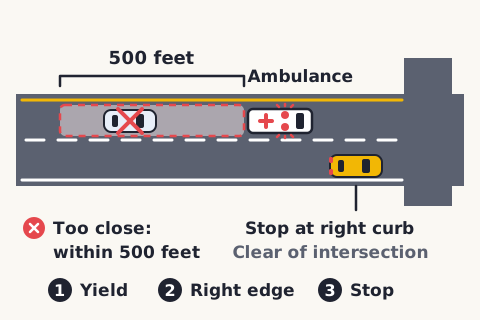
The Texas Transportation Code lists the authorized emergency vehicles, including a fire department or police vehicle and a public or private ambulance operated by a person licensed by the Department of State Health Services (section 541.201(1)(A) and (B)). The Texas duty to yield to an authorized emergency vehicle applies when the vehicle is using audible and visual signals; for police vehicles, either kind of signal is enough. DL-7 words the warning as a siren, bell or flashing red light.
To yield to an approaching authorized emergency vehicle, a Texas driver follows three steps in the order the Transportation Code states them, unless a police officer directs otherwise:
- The driver yields the right-of-way to the emergency vehicle.
- The driver immediately drives to a position parallel to the right-hand edge or curb of the roadway, as close as possible and clear of any intersection.
- The driver stops and stays stopped until the emergency vehicle has passed.
Unless on official business, a Texas driver may not follow closer than 500 feet behind a fire apparatus responding to a fire alarm or an ambulance with flashing red lights.
Sources
- Transportation Code chapter 541
- Transportation Code chapter 544
- Transportation Code chapter 545
- Transportation Code chapter 552
- Texas TMUTCD page
- 2025 TMUTCD list of changes
- 2025 TMUTCD, Part 3
- DL-7, p. 22
Railroad crossings
When a warning applies at a Texas railroad crossing, a driver stops no closer than 15 feet and no farther than 50 feet from the nearest rail. This is a stopping position at a crossing warning, not a parking distance. The Transportation Code section behind it was amended effective 1 September 2025.
A stop condition is a situation that triggers this stop. The Transportation Code lists several, and a Texas driver must stop 15 to 50 feet from the nearest rail in each of these four:
- A visible signal warns of a train or other on-track equipment.
- A crossing gate is lowered or a flagger gives a warning.
- A train is plainly visible and in hazardous proximity.
- An engine within about 1,500 feet sounds a signal and is an immediate hazard.
The Federal Highway Administration's (FHWA) Highway-Rail Crossing Handbook says that in the railroad context a flagger is a person authorized by the railroad to warn of an approaching train or of roadway workers along the right-of-way. Texas law treats two kinds of crossing differently. At a crossing where a signal warns of a train, a gate is lowered or a flagger gives a warning, the driver must stop 15 to 50 feet from the nearest rail and remain stopped until permitted and safe. At a crossbuck-only crossing, one marked only by a crossbuck, the driver yields to a train in hazardous proximity and stops only if safety requires it.
Driving around, under or through a closed railroad crossing gate is an offense in Texas.
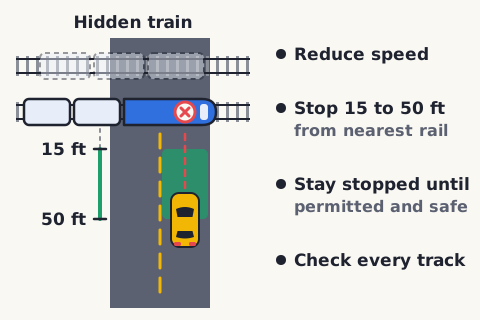
DL-7 warns that at a crossing with two or more tracks, one train can hide another. So a Texas driver crossing railroad tracks follows four steps, aiming to cross only when permitted and safe, with every track checked:
- The driver reduces speed as the crossing approaches.
- When a warning applies, the driver stops 15 to 50 feet from the nearest rail.
- The driver stays stopped until permitted to proceed and it is safe to proceed.
- At a crossing with two or more tracks, the driver checks every track before crossing.
This sequence combines the Transportation Code with DL-7. No single source lists the four steps in this order, and the code itself orders only the stop and the wait.
Sources
Key facts
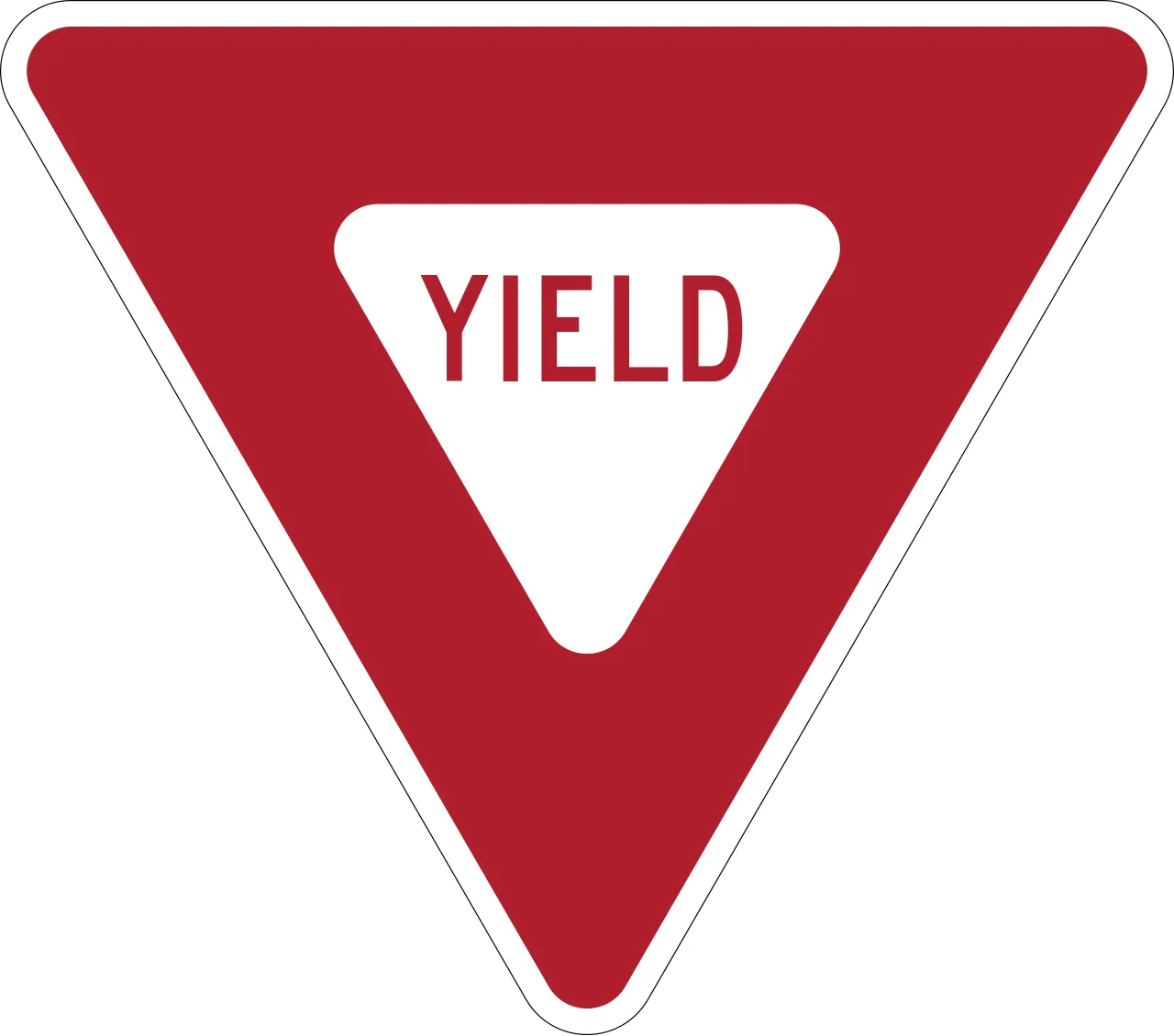
Right of Way, Stop Signs and Dark Signals
In Texas, right-of-way is the entitlement of one vehicle or pedestrian to go ahead of another that is approaching close enough to risk a collision, unless one of them gives way. At a stop sign the driver stops, then yields to a vehicle that entered from another highway or is close enough to be an immediate hazard; a yield sign requires slowing and yielding, and a stop only if safety requires it. A signal that shows no indication in any signal head counts as a stop sign, except a freeway entrance ramp control signal or a pedestrian hybrid beacon.
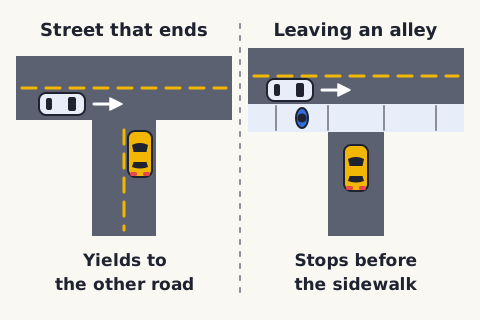
Uncontrolled Intersections and Alleys
At a Texas uncontrolled intersection, which no sign or signal controls, a driver on a road with one or two lanes yields to traffic on a divided road or a road with three or more marked lanes, and a driver on an unpaved road yields to traffic on a paved road. A driver on a street that ends yields to the other road; at other uncontrolled intersections, a driver yields to a vehicle that has entered, or is approaching in hazardous proximity, from the driver's right. A driver leaving an alley or driveway stops before the sidewalk and yields to highway traffic and to sidewalk pedestrians.
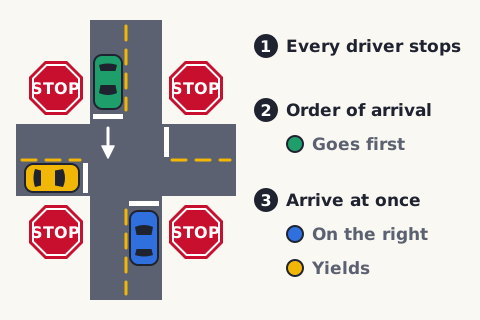
Who Goes First at an All-Way Stop
At an all-way stop, every approach has a stop sign. To decide who goes first, the Texas Driver Handbook teaches this order as guidance: every driver stops, traffic then goes in the order of arrival, and when two vehicles arrive at once, the driver yields to the vehicle on the right.
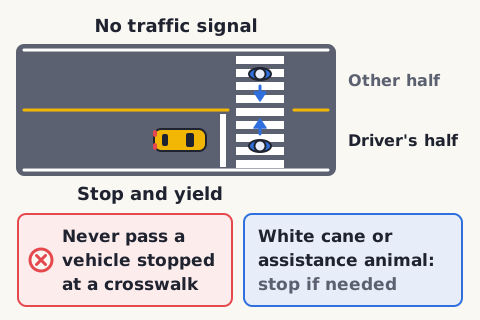
Pedestrians and Crosswalks
Where no traffic signal is operating, a Texas driver must stop and yield to a pedestrian in a crosswalk on the driver's half of the roadway or approaching from the other half closely enough to be in danger. A driver may not pass a vehicle stopped at a crosswalk to let a pedestrian cross. At an intersection or crosswalk where a pedestrian with a white cane or guided by an assistance animal is crossing or attempting to cross, a driver must take necessary precautions to avoid injuring or endangering the pedestrian, and must stop completely if that is the only way to avoid injury or danger.
Emergency Vehicles and Following Distance
The Texas duty to yield to an authorized emergency vehicle applies when it is using audible and visual signals; for police vehicles, either kind is enough. When one approaches, the driver yields, drives immediately to the right edge or curb clear of any intersection, and stops until the vehicle passes, unless a police officer directs otherwise. Unless on official business, a driver may not follow closer than 500 feet behind a fire apparatus responding to a fire alarm or an ambulance with flashing red lights.
Where to Stop at a Railroad Crossing
When a warning applies at a Texas railroad crossing, a driver stops no closer than 15 feet and no farther than 50 feet from the nearest rail; this is a stopping position, not a parking distance. A stop condition is a situation that triggers this stop. Among them are a visible signal that warns of a train or other on-track equipment, a lowered gate or a flagger's warning, a train that is plainly visible and in hazardous proximity, and an engine within about 1,500 feet that sounds a signal and is an immediate hazard.
Gated and Crossbuck-Only Crossings
At a Texas crossing where a signal warns of a train, a crossing gate is lowered or a flagger gives a warning, the driver must stop 15 to 50 feet from the nearest rail and remain stopped until it is permitted and safe to proceed. At a crossbuck-only crossing, one marked only by a crossbuck, the driver yields to a train in hazardous proximity and stops only if safety requires it. Driving around, under or through a closed crossing gate is an offense in Texas.
The Steps for Crossing Railroad Tracks
In Texas, crossing railroad tracks involves reducing speed as the crossing approaches, stopping 15 to 50 feet from the nearest rail when a warning applies, staying stopped until permitted to proceed and it is safe to proceed, and checking every track at a crossing with two or more tracks, because one train can hide another. No single source lists these steps in this order, and the Transportation Code orders only the stop and the wait.
Step by step
At a Texas all-way stop, where every approach has a stop sign, the Texas Driver Handbook teaches this order as guidance for deciding who goes first
- Every driver stops at the stop sign
- Traffic then goes in the order of arrival
- When two arrive at once, the driver yields to the vehicle on the right
To let an approaching authorized emergency vehicle pass, a Texas driver follows the Transportation Code's order, unless a police officer directs otherwise
- Yields the right-of-way to the emergency vehicle
- Immediately drives to the right edge or curb, clear of any intersection
- Stops and stays stopped until the vehicle has passed
Self-test
Answer each question from memory, then check your work against the answer key.
1. At a Texas intersection with no sign or signal, which of these drivers yields to the other road?
- AA driver on a three-lane road that meets a one-lane road
- BA driver on a divided road that meets a two-lane road
- CA driver on a paved road that meets an unpaved road
- DA driver on a street that ends where it meets another road
2. A traffic signal at a Texas intersection shows no indication in any of its signal heads and is neither a freeway entrance ramp control signal nor a pedestrian hybrid beacon. How is it treated?
- AAs a flashing yellow signal for drivers
- BAs a stop sign for approaching drivers
- CAs an intersection with no sign or signal
- DAs a yield sign for approaching drivers
3. No traffic signal is operating at a Texas crosswalk, and a pedestrian on the other half of the roadway is approaching closely enough to be in danger. What must the driver do?
- AStopping and yielding because the pedestrian is in danger
- BSlowing and passing because the driver's lane is clear
- CYielding only after the pedestrian enters the driver's lane
- DContinuing because the pedestrian is on the other half
4. A police vehicle approaches a Texas driver with its flashing lights on and no siren. Under the Texas duty to yield to an emergency vehicle, what must the driver do?
- ANothing: the duty needs a siren as well as lights
- BNothing: the duty covers only fire vehicles and ambulances
- CYield: one kind of signal is enough for a police vehicle
- DYield only if the police vehicle is in the driver's lane
5. A crossing gate is lowered at a Texas railroad crossing. How far from the nearest rail must an approaching driver stop?
- A55 to 100 feet from the nearest rail
- B100 to 500 feet from the nearest rail
- C3 to 8 feet from the nearest rail
- D15 to 50 feet from the nearest rail
Go deeper
- WatchWho Goes First Two cars stop at a Texas all-way stop at the same time. Who goes first?
- WatchOne Train Can Hide Another Two tracks, one crossing. One train can hide another, the Texas driver handbook warns. So crossing takes four steps.
- StudyU.S. Permit Test by State (Driving) in the FlashFeed app
Answer key
- 1. D A driver on a street that ends where it meets another roadA driver on a street that ends yields to the other road. In the other three the yield runs the opposite way: an unpaved road yields to a paved road, and a road with one or two lanes yields to a divided road or one with three or more marked lanes.
- 2. B As a stop sign for approaching driversTexas law treats a signal that shows no indication in any signal head as a stop sign, except a freeway entrance ramp control signal or a pedestrian hybrid beacon. It is not an uncontrolled intersection, where the yield rules apply.
- 3. A Stopping and yielding because the pedestrian is in dangerWhere no traffic signal is operating, a Texas driver must stop and yield to a pedestrian in a crosswalk on the driver's half of the roadway or approaching from the other half closely enough to be in danger. Being on the other half does not excuse continuing.
- 4. C Yield: one kind of signal is enough for a police vehicleFor a police vehicle, either kind of signal is enough to trigger the Texas duty to yield, so its flashing lights alone mean the driver must yield; no siren is needed.
- 5. D 15 to 50 feet from the nearest railWhen a warning applies, a Texas driver stops no closer than 15 feet and no farther than 50 feet from the nearest rail, and a lowered gate is one such warning. The other ranges are too close or too far.
Sources
- Texas Legislature — Texas Transportation Code, Chapter 545: Operation and Movement of Vehicles — tcss.legis.texas.gov/resources/TN/htm/TN.545.htm
- Texas Department of Public Safety, Driver License Division — Texas Driver Handbook, DL-7, revised January 2026 — www.dps.texas.gov/Internetforms/Forms/DL-7.pdf
- Texas Legislature — Texas Transportation Code, Chapter 544: Traffic-Control Devices — tcss.legis.texas.gov/resources/TN/htm/TN.544.htm
- Texas Legislature — Texas Transportation Code, Chapter 552: Pedestrians — tcss.legis.texas.gov/resources/TN/htm/TN.552.htm
Image credits
- Right of Way, Stop Signs and Dark Signals: Wikimedia Commons · Federal Highway Administration · Public domain — commons.wikimedia.org/wiki/File:MUTCD_R1-2.svg
- Uncontrolled Intersections and Alleys: FlashFeed original diagram · CC-BY-4.0
- Who Goes First at an All-Way Stop: FlashFeed original diagram · CC-BY-4.0
- Pedestrians and Crosswalks: FlashFeed original diagram · CC-BY-4.0
- Emergency Vehicles and Following Distance: FlashFeed original diagram · CC-BY-4.0
- Gated and Crossbuck-Only Crossings: Wikimedia Commons · Federal Highway Administration · Public domain — commons.wikimedia.org/wiki/File:MUTCD_R15-1.svg
- The Steps for Crossing Railroad Tracks: FlashFeed original diagram · CC-BY-4.0

