
U.S. Permit Test by State (Driving) study guide · Lesson 14 of 18
Texas: Speed Limits and Following Distance
Speed limits by road type and zone · Following distance and driving to conditions
This is the lesson's study guide from the FlashFeed app, plus its key facts and a self-test.
What you'll be able to do
- In Texas, state the speed limits for each road type and zone and the rules on following distance.
Texas sets default speeds by road type, and it requires a driver to slow down when conditions call for it. It also requires a driver who follows another vehicle to leave room to stop. The Texas Driver Handbook (DL-7, revised January 2026) puts that room in seconds, which the Transportation Code does not. Knowing both the law and the handbook helps a Texas driver pick a lawful speed and a safe gap.
Speed limits by road type and zone
In Texas, the basic speed law in Transportation Code section 545.351(a) bars driving faster than is reasonable and prudent under existing circumstances. The Texas driver handbook, DL-7, adds in its glossary that this applies whatever the posted limit says. Section 545.351(c) of the same code requires reduced speed at intersections and railroad crossings, on curves and hill crests, on narrow or winding roads, and whenever a special hazard exists.
For the default speeds below, Texas Transportation Code section 545.352(d)(3) treats an area as an urban district when structures for business, industry or dwellings stand less than 100 feet apart over at least a quarter mile. Unless a special hazard requires less, section 545.352(b) makes these default speeds lawful in Texas:
- 30 miles per hour (mph) on a street in an urban district, other than an alley
- 15 mph in an alley
- 70 mph on a highway numbered by Texas or the United States outside an urban district, farm-to-market and ranch-to-market roads included
- 60 mph on other highways outside an urban district
- 60 mph for a school bus outside an urban district that has passed a commercial motor vehicle inspection and is on a highway numbered by Texas or the United States
- 50 mph for a school bus outside an urban district that has not passed that inspection or is on a highway not numbered by Texas or the United States
Texas requires an entity that sets a speed limit to set the same limit for daytime and nighttime (section 545.352(e)). The handbook's sign entry on page 30 speaks of day and night maximums, while the code's rule is one limit for both. The Texas Transportation Commission may set a speed limit of 75 mph where it finds that reasonable and safe (section 545.353(h), as last amended in 2023), and other subsections allow higher limits in listed cases.
Texas law limits slow driving as well, through its ban on impeding traffic. A Texas driver may not drive so slowly as to impede the normal and reasonable movement of traffic, except when reduced speed is necessary for safe operation or in compliance with law (section 545.363(a)).
A school crossing zone is a reduced-speed zone that a local authority designates for children going to or leaving school (Texas Transportation Code section 541.302(13)). The speed sections cited above set no statewide school-zone speed, and the handbook gives no mph figure for one. A school-zone sign entry in the handbook (page 31) says the posted school-zone speed applies while the yellow light is flashing.
Sources
Following distance and driving to conditions
Transportation Code section 545.062(a) requires a Texas driver following another vehicle to leave an assured clear distance. That means a gap from which the driver can safely stop, considering the vehicles' speed, the traffic and the highway conditions. Stopping safely means not hitting the vehicle ahead and not veering into another vehicle, object or person.
Texas law words a safe following distance as an assured clear distance with no count of seconds, while the driver handbook DL-7 expresses it as a time gap of at least two seconds. Texas's driver handbook (DL-7, January 2026) advises leaving at least two seconds between a vehicle and the one ahead of it, and more in poor conditions.
The handbook's pages do not all give the same figures, and two seconds is the lowest gap that every page supports. DL-7's chapter 8 (page 45) gives a minimum gap of 2 seconds for speeds of 30 mph or less in good conditions and a gap of 4 seconds for speeds above 30 mph. Its highway section (page 48) calls for at least two seconds, and for four seconds or more in bad weather.
The handbook's less-than-two-seconds check (page 45) says a Texas driver who reaches a fixed object in less than two seconds after the vehicle ahead passed it is following too closely. Following too closely is the same as tailgating, which means driving too close behind another vehicle.
Driving to conditions means slowing down and leaving more room when the road or the driver's view calls for it. Stopping on a wet roadway takes substantially more distance. The handbook tells Texas drivers to slow down and lengthen the following gap on wet or crowded roads or when vision is limited, and not to drive faster than their range of vision allows. At night, a driver has to be able to stop within the distance the headlights light up.
Sources
Key terms
- Basic speed law
- In Texas, a driver may not drive faster than is reasonable and prudent under existing circumstances
Key facts
Reduced speed and slow driving
The Texas Transportation Code requires reduced speed at intersections and railroad crossings, on curves and hill crests, on narrow or winding roads, and whenever a special hazard exists. The glossary of the Texas Driver Handbook adds that the basic speed law applies whatever the posted limit says. Texas also bars impeding traffic: a driver may not drive so slowly as to impede the normal and reasonable movement of traffic, except when reduced speed is necessary for safe operation or in compliance with law.
Texas's default speed limits
Unless a special hazard requires less, the Texas Transportation Code makes default speeds lawful. Texas treats an area as an urban district when structures for business, industry or dwellings stand less than 100 feet apart over at least a quarter mile. The default is 30 mph on a street in an urban district other than an alley, and 15 mph in an alley. Outside an urban district it is 70 mph on a highway numbered by Texas or the United States (farm-to-market and ranch-to-market roads included) and 60 mph on other highways.
Day-night limits, school buses and school zones
Texas requires an entity that sets a speed limit to set the same limit for daytime and nighttime. Unless a special hazard requires less, the default for a school bus outside an urban district is 60 mph if the bus has passed a commercial motor vehicle inspection and is on a highway numbered by Texas or the United States, and 50 mph otherwise. A school crossing zone is a reduced-speed zone that a local authority designates for children going to or leaving school.
Texas's assured clear distance
The Texas Transportation Code requires a driver following another vehicle to leave an assured clear distance. That is a gap from which the driver can safely stop, considering the speed of the vehicles, the traffic and the highway conditions, without hitting the vehicle ahead or veering into another vehicle, object or person. Texas law gives no count of seconds, while the Texas Driver Handbook expresses a safe following distance as a time gap of at least two seconds.
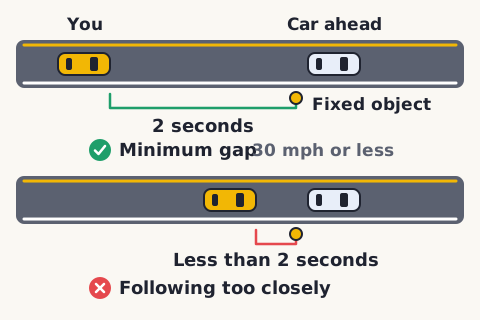
Time gap and driving to conditions in the Texas Driver Handbook
The Texas Driver Handbook (January 2026) gives a minimum gap of two seconds at 30 mph or less in good conditions and four seconds above 30 mph; its highway section advises at least two seconds, and at least four in bad weather. Under the less-than-two-seconds check, a driver who reaches a fixed object less than two seconds after the vehicle ahead passed it is following too closely. Drivers should slow down and lengthen the following gap on wet or crowded roads or when vision is limited, and not drive faster than their range of vision allows.
Matched pairs
Each item on the left goes with the one on the right.
- Alley in Texas
- 15 mph by default, unless a special hazard requires less
Self-test
Answer each question from memory, then check your work against the answer key.
1. Unless a special hazard requires less, which default speed does Texas make lawful on a highway numbered by Texas or the United States outside an urban district?
- A60 mph
- B70 mph
- C50 mph
- D75 mph
2. A Texas street has structures for business, industry or dwellings less than 100 feet apart for at least a quarter mile. Unless a special hazard requires less, what default speed is lawful there?
- A30 mph
- B40 mph
- C15 mph
- D50 mph
3. A Texas driver is traveling slowly enough to impede the normal and reasonable movement of traffic. When is that lawful under Texas law?
- AWhen saving fuel matters more to the driver
- BWhen the driver stays below the default limit
- CWhen the driver is looking for an address
- DWhen reduced speed is necessary for safe operation
4. Texas law requires a driver following another vehicle to leave an assured clear distance. Which factors does the driver consider in judging that gap?
- AThe posted limit, the traffic and the highway conditions
- BThe vehicles' speed, the traffic and the time of day
- CThe vehicles' speed, the traffic and the highway conditions
- DThe posted limit, the traffic and the time of day
5. The Texas Driver Handbook says a Texas driver is following too closely on reaching a fixed object in less than how many seconds after the vehicle ahead passed it?
- AOne second
- BThree seconds
- CTwo seconds
- DFive seconds
Go deeper
- WatchFifteen in an Alley In a Texas alley, the default speed is just 15 miles per hour.
- WatchThe Two-Second Check In Texas, the car ahead passes a fixed object. Reaching it less than 2 seconds later is following too closely.
- StudyU.S. Permit Test by State (Driving) in the FlashFeed app
Answer key
- 1. B 70 mphTexas law makes 70 mph the default on a highway numbered by Texas or the United States outside an urban district, farm-to-market and ranch-to-market roads included. Other highways outside an urban district default to 60 mph.
- 2. A 30 mphThat stretch is an urban district, and Texas law makes 30 mph the default on a street there other than an alley, unless a special hazard requires less. Faster defaults apply on highways outside an urban district, not on a street inside one.
- 3. D When reduced speed is necessary for safe operationTexas law bars slow driving that impedes traffic, except when reduced speed is necessary for safe operation or in compliance with law. Saving fuel, looking for an address or staying below the default limit is not an exception.
- 4. C The vehicles' speed, the traffic and the highway conditionsThe gap must let the driver stop safely, considering the vehicles' speed, the traffic and the highway conditions. The posted limit and the time of day are not factors the code names.
- 5. C Two secondsThe Texas Driver Handbook's less-than-two-seconds check treats a Texas driver who reaches a fixed object in less than two seconds after the vehicle ahead passed it as following too closely. Three or five seconds is not the figure in that check.
Sources
- Texas Legislature — Texas Transportation Code, Chapter 545: Operation and Movement of Vehicles — tcss.legis.texas.gov/resources/TN/htm/TN.545.htm
- Texas Department of Public Safety, Driver License Division — Texas Driver Handbook, DL-7, revised January 2026 — www.dps.texas.gov/Internetforms/Forms/DL-7.pdf
Image credits
- Time gap and driving to conditions in the Texas Driver Handbook: FlashFeed original diagram · CC-BY-4.0