
U.S. Permit Test by State (Driving) study guide · Lesson 15 of 18
Texas: Turns, Lanes, Passing and Parking
Signals, turns and turns on red · Lanes and passing · Parking, lights and distances in feet
This is the lesson's study guide from the FlashFeed app, plus its key facts and a self-test.
What you'll be able to do
- In Texas, choose the legal signal, turn, lane, passing or parking action in a described situation, and state the parking and lighting distances.
A signal shows other road users what a Texas driver intends to do. The Texas Transportation Code sets exact rules for when to signal, where a turn is made, how to pass, and where a vehicle may not stop, stand or park. Many of the rules are distances in feet, and similar numbers belong to different situations. The Texas Driver Handbook (DL-7, revised January 2026) covers the same ground.
Signals, turns and turns on red
As of 30 October 2026, a Texas driver must signal to show an intention to turn, change lanes or start from a parked position (Section 545.104(a) of the Transportation Code). DL-7 (page 38) lists lane changes and turning among the times to signal.
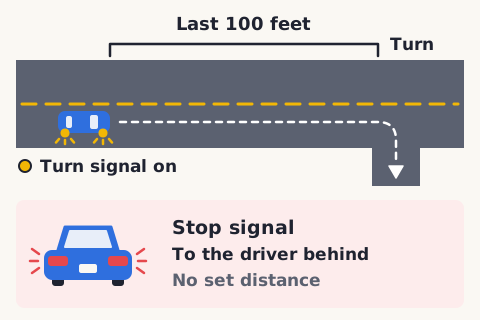
The turn signal has a set length: a Texas driver intending to turn must signal continuously for not less than the last 100 feet the vehicle travels before the turn (Section 545.104(b)). The Transportation Code sets that distance for turns only. The stop signal works differently: a Texas driver may not stop or suddenly slow down without first giving a stop signal to the driver behind when there is an opportunity to give it (Section 545.105). The code states no distance for that signal.
DL-7 also lists slowing or stopping among the times to signal, and it applies the 100 feet to stopping as well as turning. Texas's handbook further lists entering or leaving a highway, and pulling over, among the times a driver should signal.
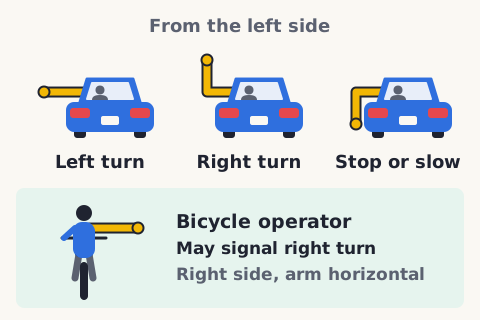
A Texas driver gives hand signals from the left side of the vehicle (Section 545.107). The arm positions are:
- left turn: the arm held horizontal;
- right turn: the arm pointed upward;
- stop or slow: the arm pointed downward.
In Texas, a bicycle operator may instead signal a right turn from the right side with the hand and arm extended horizontally.
After stopping at a steady red signal and yielding, a Texas driver may turn right (a right turn on red) unless a posted notice bans the turn. After stopping and yielding, a Texas driver may also turn left if both streets are one-way and a left turn is permissible, unless a posted notice bans it.
The Texas Transportation Commission, a city or a county may ban a turn at a steady red signal by posting notice. These rules come from Section 544.007 of the Transportation Code, as amended effective 1 September 2025. The 2025 Texas Manual on Uniform Traffic Control Devices (TMUTCD), effective 18 January 2026, also permits a driver facing a steady red arrow to turn right, or to turn left from a one-way street into a one-way street, in the arrow's direction after stopping, unless a device prohibits a turn on red. That turn follows the rules for a driver who has stopped at a stop sign.
Sources
- Transportation Code §544.007
- Transportation Code §§545.104, 545.105, 545.107
- TMUTCD 2025, Part 4, §4A.03
- DL-7, p. 38
Lanes and passing
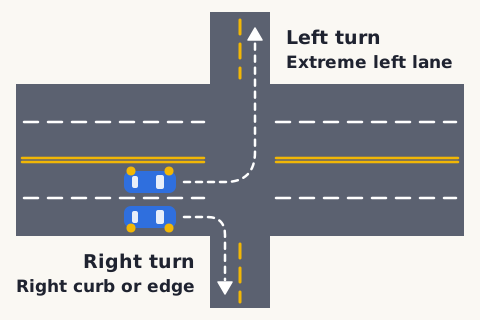
As of 30 October 2026, the Texas Transportation Code sets where a right or left turn is made. A Texas right turn is made as near to the right-hand curb or edge as is practicable, meaning as near as can reasonably be done (Section 545.101). A Texas left turn is made from the extreme left lane that is lawfully available, meaning the lane farthest to the left that the driver may legally use.
On a Texas roadway wide enough, a driver keeps to the right half of the road. The exceptions in Section 545.051(a)-(b) are when the driver is:
- passing;
- obstructed, if the driver yields to a vehicle on the unobstructed portion that is an immediate hazard;
- on a road with three marked lanes; or
- on a one-way road.
A Texas driver moving more slowly than the normal speed of other vehicles uses the right-hand lane, or stays as close as practicable to the right-hand curb or edge. The exceptions are passing another vehicle and preparing for a left turn at an intersection or into a private road or driveway (Section 545.051(b)).
A Texas driver also stays within a single lane as nearly as practical and moves out of it only when that can be done safely (Section 545.060(a)).
Texas drivers pass on the left, keeping a safe distance, and do not return to their lane until they are safely clear of the vehicle passed (Section 545.053). A Texas driver being passed must, on an audible signal (a sound) from the passing driver, move or remain to the right in favor of the passing vehicle, and may not accelerate (speed up) until completely passed. That duty does not apply when passing to the right is permitted.
A no-passing zone is marked by striping on the road or, in some zones, by signs only. A Texas driver may not drive on the left side of the road in a no-passing zone (Section 545.055(b)). The exception is a left turn: a driver may cross the striping, or the center line in a zone marked by signs only, to turn left into or out of an alley, private road or driveway.
Sources
Parking, lights and distances in feet
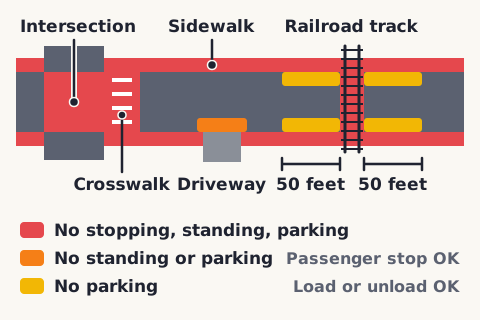
As of 30 October 2026, Section 545.302 of the Texas Transportation Code sorts parking bans into three tiers. None of the three tiers applies when avoiding conflict with other traffic is necessary, or when the driver is complying with the law or the directions of a police officer or an official traffic-control device (Section 545.302(f)).
The Texas Transportation Code defines parking as standing a vehicle, occupied or not, other than temporarily while loading or unloading merchandise or passengers, and standing as halting a vehicle, occupied or not, other than temporarily while receiving or discharging passengers (Section 541.401(6) and (9)). Where stopping is prohibited, stopping means any halt, even a momentary one, unless necessary to avoid conflict with other traffic or to obey a police officer or a traffic-control sign or signal (Section 541.401(10)).
In the first tier, a Texas driver may not stop, stand or park, among other places:
- in an intersection;
- on a crosswalk;
- on a sidewalk;
- on a railroad track;
- on a bridge or other elevated structure on a highway, or in a highway tunnel;
- on the roadway side of a vehicle that is stopped or parked at the edge or curb of a street; or
- where a sign prohibits stopping.
In the second tier, except momentarily to pick up or discharge (let out) a passenger, a Texas driver may not stand or park, among other places:
- in front of a driveway;
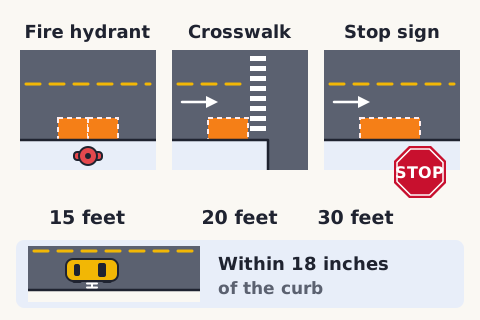
- within 15 feet of a fire hydrant;
- within 20 feet of a crosswalk at an intersection; or
- within 30 feet on the approach to a flashing signal, stop sign, yield sign or traffic signal at the roadside.
In the third tier, except temporarily to load or unload merchandise or passengers, a Texas driver may not park in two places:
- within 50 feet of the nearest rail of a railroad crossing; or
- where an official sign prohibits parking.
Parking near a railroad crossing is separate from stopping for a crossing warning, where a Texas driver stops 15 to 50 feet from the nearest rail.
On a two-way Texas road, a parked vehicle's right-hand wheels must be parallel to the curb or road edge and within 18 inches of it (Section 545.303(a)). The curb distance is in inches, not feet.
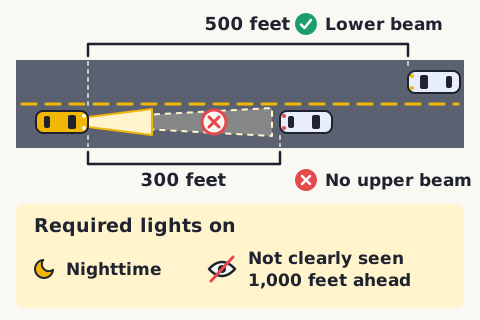
A Texas vehicle must show its required lights during nighttime and whenever a person or vehicle is not clearly discernible (cannot be clearly seen) 1,000 feet ahead (Section 547.302(a)). The Transportation Code defines nighttime as the period from one-half hour after sunset to one-half hour before sunrise (Section 541.401(5)).
The upper beam is the headlights' bright setting, and the lower beam is the dimmer one. A Texas driver within 300 feet behind another vehicle may not use the upper beam, and a Texas driver within 500 feet of an oncoming vehicle uses the lower beam, or aims the lights so that no part of the high-intensity portion projects into the oncoming driver's eyes (Section 547.333(c)).
Sources
Key facts
When a Texas driver must signal
A Texas driver must signal to show an intention to turn, change lanes or start from a parked position. The turn signal must run continuously for not less than the last 100 feet before the turn, a distance the Transportation Code sets for turns only. A driver may not stop or suddenly slow down without first giving a stop signal to the driver behind when there is an opportunity, and the Code states no distance for that signal. The Texas Driver Handbook further lists entering or leaving a highway, and pulling over, among the times a driver should signal.
Texas hand signals
A Texas driver gives hand signals from the left side of the vehicle. The arm held horizontal signals a left turn, the arm pointed upward signals a right turn, and the arm pointed downward signals stop or slow. A bicycle operator may instead signal a right turn from the right side, with the hand and arm extended horizontally.
Turning on a steady red in Texas
After stopping at a steady red signal and yielding, a Texas driver may turn right, or may turn left if both streets are one-way and a left turn is permissible. A posted notice can ban either turn. The Texas Transportation Commission, a city or a county may ban a turn at a steady red signal by posting notice.
Texas turn positions and the right half
A Texas right turn is made as near as practicable to the right-hand curb or edge, and a left turn from the extreme left lane lawfully available. On a wide enough road, a driver keeps to the right half unless passing, on a road with three marked lanes, on a one-way road, or forced left of center by an obstruction (then yielding to a vehicle that is an immediate hazard). A driver moving more slowly than other traffic uses the right-hand lane or stays as close as practicable to the curb or edge, unless passing or preparing for a left turn at an intersection or into a private road or driveway.
Passing on the left in Texas
Texas drivers pass on the left, keeping a safe distance, and do not return to their lane until they are safely clear of the vehicle passed. A driver being passed must, on an audible signal from the passing driver, move or remain to the right and may not accelerate until completely passed, unless passing to the right is permitted. In a no-passing zone, a Texas driver may not drive on the left side of the road, but may cross the striping, or the center line where signs only mark the zone, to turn left into or out of an alley, private road or driveway.
Texas parking bans in three tiers
Texas law sorts parking bans into three tiers: no stopping, standing or parking in an intersection, on a crosswalk, sidewalk, railroad track or highway bridge, or in a highway tunnel, among other places; no standing or parking in front of a driveway, except momentarily to pick up or discharge a passenger; and no parking within 50 feet of a railroad crossing's nearest rail, or where an official sign bars parking, except temporarily to load or unload. No tier applies when needed to avoid conflict with other traffic or to obey the law, a police officer or an official traffic-control device.
Texas parking distances in feet and inches
Except momentarily to pick up or discharge a passenger, a Texas driver may not stand or park within 15 feet of a fire hydrant, within 20 feet of a crosswalk at an intersection, or within 30 feet on the approach to a flashing signal, stop sign, yield sign or traffic signal at the roadside. These bans do not apply when needed to avoid conflict with other traffic or to obey the law, a police officer or an official traffic-control device. On a two-way road, a parked vehicle's right-hand wheels must be parallel to the curb or road edge and within 18 inches of it.
Texas lights at night and headlight beams
A Texas vehicle must show its required lights during nighttime, the period from one-half hour after sunset to one-half hour before sunrise, and whenever a person or vehicle is not clearly discernible (cannot be clearly seen) 1,000 feet ahead. A Texas driver within 300 feet behind another vehicle may not use the upper beam. A Texas driver within 500 feet of an oncoming vehicle uses the lower beam, or aims the lights so that no part of the high-intensity portion projects into the oncoming driver's eyes.
By the numbers
- Generally, Texas bars standing or parking within how many feet of a fire hydrant?
- 15 feet
- Generally, Texas bars standing or parking within how many feet of intersection crosswalks?
- 20 feet
- Generally, Texas bars standing or parking within how many feet before a stop sign?
- 30 feet
- Generally, Texas bars parking within how many feet of a railroad crossing's nearest rail?
- 50 feet
- Texas bars the upper beam within how many feet behind another vehicle?
- 300 feet
- Within how many feet of oncoming traffic must Texas headlights be lowered or aimed away?
- 500 feet
Matched pairs
Each item on the left goes with the one on the right.
- Texas hand signal for a left turn
- Arm held horizontal
Self-test
Answer each question from memory, then check your work against the answer key.
1. A Texas driver is about to stop or suddenly slow down. When there is an opportunity, what must the driver do first?
- AWait to signal until the vehicle has stopped
- BGive a stop signal to the driver behind
- CSound the horn to warn the driver behind
- DGive a stop signal to the oncoming driver
2. A Texas driver reaches a steady red signal, and no posted notice bans a right turn. What must the driver do before turning right?
- AWait for green, then turn right
- BSlow and yield, then turn right
- CStop, then turn ahead of traffic
- DStop and yield, then turn right
3. A Texas driver in a no-passing zone marked by striping must turn left into a private road. Which statement is correct?
- AThe driver may pass first and then make the turn
- BThe driver must wait until the zone ends
- CThe driver may cross the striping to turn
- DThe driver must turn at the next intersection
4. A Texas driver being passed on the left has moved right on the passing driver's audible signal. When may the driver being passed accelerate?
- AAfter being completely passed
- BOnce the audible signal ends
- CWhenever the road ahead is clear
- DOnce the pass has begun
5. A Texas driver wants to stop for only a moment to let a passenger out. At which place is that allowed?
- AOn a railroad track
- BInside a highway tunnel
- CIn front of a driveway
- DInside an intersection
Go deeper
- WatchTexas Parking in Feet 15, 20, 30, 50. Texas parking rules are full of feet. Which number goes where?
- WatchArm Up, Turn Right An arm points straight up from a Texas car. Which way will the driver turn?
- StudyU.S. Permit Test by State (Driving) in the FlashFeed app
Answer key
- 1. B Give a stop signal to the driver behindThe Transportation Code bars stopping or suddenly slowing down without first giving a stop signal to the driver behind, when there is an opportunity. The signal comes first and goes to the driver behind, not to oncoming traffic.
- 2. D Stop and yield, then turn rightAfter stopping at a steady red signal and yielding, a Texas driver may turn right unless a posted notice bans the turn. Slowing down is not stopping, and waiting for green is not required first.
- 3. C The driver may cross the striping to turnA Texas driver may not drive on the left side of the road in a no-passing zone. The exception is a left turn: the driver may cross the striping, or the center line where signs only mark the zone, to turn left into or out of an alley, private road or driveway.
- 4. A After being completely passedA Texas driver being passed may not accelerate until completely passed, so a pass that has begun, an ended signal or a clear road ahead does not lift the bar. That duty does not apply when passing to the right is permitted.
- 5. C In front of a drivewayA Texas driver may not stand or park in front of a driveway except momentarily to pick up or discharge a passenger. An intersection, a railroad track and a highway tunnel are first-tier places, where even stopping is barred.
Sources
- Texas Legislature — Texas Transportation Code, Chapter 545: Operation and Movement of Vehicles — tcss.legis.texas.gov/resources/TN/htm/TN.545.htm
- Texas Legislature — Texas Transportation Code, Chapter 544: Traffic-Control Devices — tcss.legis.texas.gov/resources/TN/htm/TN.544.htm
- Texas Legislature — Texas Transportation Code, Chapter 547: Vehicle Equipment (nighttime defined in Chapter 541, Section 541.401); Texas Legislature — Texas Transportation Code, Chapter 547: Vehicle Equipment — tcss.legis.texas.gov/resources/TN/htm/TN.547.htm
Image credits
- When a Texas driver must signal: FlashFeed original diagram · CC-BY-4.0
- Texas hand signals: FlashFeed original diagram · CC-BY-4.0
- Texas turn positions and the right half: FlashFeed original diagram · CC-BY-4.0
- Texas parking bans in three tiers: FlashFeed original diagram · CC-BY-4.0
- Texas parking distances in feet and inches: FlashFeed original diagram · CC-BY-4.0
- Texas lights at night and headlight beams: FlashFeed original diagram · CC-BY-4.0