
U.S. Permit Test by State (Driving) study guide · Lesson 18 of 18
Texas: Teen Licensing and the Permit Test
From permit to license · The provisional license and the video · The permit test
This is the lesson's study guide from the FlashFeed app, plus its key facts and a self-test.
What you'll be able to do
- Describe the stages from a Texas learner license to a provisional license, and the limits on a teen driver.
- Describe Texas's knowledge test: its subjects, the pass mark, the languages and the number of tries.
A Texas teen gets a driver license in two phases, a learner license first and a provisional license after it. The Texas Driver Handbook (DL-7, revised January 2026) outlines both phases. The steps carry their own ages, practice hours and driving limits, and the knowledge test has its own subjects, pass mark and languages. Knowing which rule belongs to which step keeps the path clear.
From permit to license
DL-7, the Texas handbook, describes the Graduated Driver License (GDL) program, through which Texas licenses minors, meaning people under 18, in two phases: the learner license and the provisional license. In Texas, the learner permit is called the learner license or the instruction permit. The route from permit to license includes the driver education classroom phase, the learner license, at least six months of holding it while practicing with a supervising driver, the in-car hours and the Impact Texas Teen Drivers program, and the driving test for the provisional license. Texas law fixes only part of that order.
A Texas learner license goes to a person who meets all of these conditions (Transportation Code section 521.222(a)):
- is 15 or older but under 18;
- has passed the classroom phase of an approved driver education course;
- meets the school-attendance rule;
- has passed each exam except the driving test.
A Texas learner license can be issued from age 15. The handbook words the age range differently, running through age 18, and a Texas Department of Public Safety (DPS) learner page gives ages 15 and 17, but the Transportation Code's wording is the rule.
A Texas learner license holder may drive only with a supervising driver (section 521.222(d)(2)), meaning a person in the seat next to the operator who:
- is licensed for that vehicle;
- is 21 or older;
- has a year or more of driving experience.
A Texas learner license holder who is accompanied as section 521.222(d)(2) requires is exempt from the driving-hours and passenger limits that apply to drivers under 18 (section 545.424(c)).
A Texas learner or hardship license must be held for six months or more before a Class A, B or C license, other than a hardship license, can be issued to a person under 18 (section 521.204(b)). A hardship license is a restricted license for a minor with a necessity to drive.
Texas DPS (page dated 27 November 2024) lists these hours for a teen license:
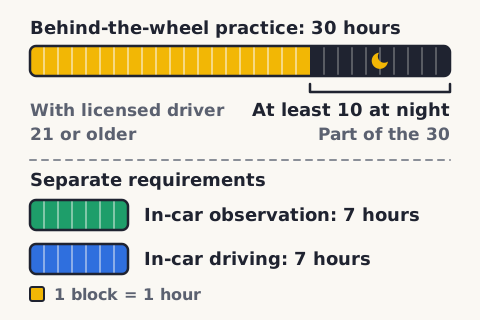
- 30 hours of behind-the-wheel practice, at least 10 of them at night, with a licensed driver 21 or older present;
- 7 hours of in-car observation;
- 7 hours of in-car driving.
That page requires at least 10 of the 30 practice hours to be at night, so the night hours are part of the 30, not extra. In-car observation and in-car driving are separate 7-hour requirements. A DPS page dated 29 September 2020 gives a Texas teen driver education course 24 classroom hours, and the block method completes all 24 first.
Sources
- Transportation Code, chapter 521
- Transportation Code, chapter 545
- DPS, Teen Provisional License
- DPS, Driver Education Course
- DL-7, pages 1 to 3
The provisional license and the video
A Texas license for a person under 18, the provisional license, requires the applicant to be at least 16 years old (Transportation Code section 521.204(a)). The minimum age is 16 for the provisional license and 15 for the learner license.
Under Transportation Code section 521.083, a Texas Class C license authorizes its holder to drive a vehicle or combination of vehicles not described for a Class A or B license, and a vehicle with a gross vehicle weight rating under 26,001 pounds towing a farm trailer rated at not more than 20,000 pounds.
A Texas Class C license for an applicant under 18 requires all of these (section 521.204(a)-(b)):
- age 16 or older;
- a driver education certificate;
- a high school diploma or equivalent, or qualifying school enrollment;
- written parental or guardian permission for school-record checks and absence notices;
- passing the exam;
- plus, except for a hardship license, a learner or hardship license held for at least six months.
A Texas learner license lets the holder drive only with a qualified supervisor beside them, while a provisional license allows driving alone with limits on night hours and passengers. The driving-hours limit says a Texas driver under 18 may not drive after midnight and before 5 a.m. unless for work, a school-related activity or a medical emergency (section 545.424(a-1)(1)). The passenger limit says a Texas driver under 18 may not carry more than one passenger under 21 who is not a family member.
A Texas hardship license, also known as a minor's restricted driver license (MRDL), can be issued when a necessity to drive is established. Its applicant is exempt from holding a learner license for six months first (Transportation Code section 521.204(b) and DPS's hardship license page).
A DPS page dated 22 September 2020 describes Impact Texas Drivers (ITD) as a DPS driver-safety program with a teen video, Impact Texas Teen Drivers (ITTD), and an adult video, Impact Texas Adult Drivers (ITAD). On that page, ITAD is a 1-hour video for ages 18 to 24 in adult courses and for those 25 and older. The page lists ITTD as a 2-hour video for ages 15 to 17 in parent-taught or minor driver education courses.
A Texas minor completes the Impact Texas Teen Drivers video after finishing the behind-the-wheel driver education requirements and before taking the skills examination (37 Texas Administrative Code section 15.62(a)(1)). Proof of completing an Impact Texas Drivers video counts for 90 days (37 Texas Administrative Code section 15.62(b)).
Sources
- Transportation Code, chapter 521
- Transportation Code, chapter 545
- 37 Texas Administrative Code 15.62
- DPS, Impact Texas Drivers
- DPS, GDL and Hardship License
The permit test
The knowledge test is one of the exams a Texas applicant passes before receiving a learner license, also called an instruction permit. Under Transportation Code section 521.161(b), the Texas driver license examination tests:
- whether the applicant can recognize and understand English-language highway signs that regulate, warn or direct traffic;
- knowledge of traffic laws;
- knowledge of a motorist's duties toward bicyclists;
- knowledge of the effect of wireless devices and other distractions;
- the applicant's vision.
A Texas applicant must score 70 percent correct or better on each knowledge test. That 70 percent is the pass mark, a share of correct answers rather than a count of questions. No official question count was found in DL-7, the DPS pages, the Transportation Code or the Texas Administrative Code rules.
The Texas driver license knowledge test is offered in English or Spanish only, under 37 Texas Administrative Code section 15.52 and a DPS page dated 22 September 2020. The Texas Spanish-language examination is identical to the English one except that directions and written material are in Spanish; the text of highway signs stays in English (section 521.162).
A Texas applicant gets three tries at each element of the examination per application. In the Transportation Code's terms, that is three examinations of each element (section 521.161(d)).
Age also changes the driver education an applicant needs. A Texas applicant under 25 needs a driver education certificate (section 521.1601), unless the applicant holds a valid driver's license issued by another state. The handbook links this requirement to the Less Tears More Years Act.
Texas DPS says an applicant aged 18 through 24 applying for a first Texas driver license takes a six-hour adult driver education course (DPS page dated 25 November 2024). DPS also says the course is waived for a new resident 18 or older surrendering a valid, unexpired license from another state, and that none is required from age 25. The six-hour adult course is separate from the teen course, which has 24 classroom hours (DPS page dated 29 September 2020).
Sources
Key terms
- GDL program
- The Texas handbook's two-phase program for licensing minors: a learner license, then a provisional license
Key facts
The Texas Graduated Driver License Route
Texas licenses minors through the Graduated Driver License (GDL) program, which the Texas handbook describes in two phases: the learner license and the provisional license. The route from permit to license includes the driver education classroom phase, the learner license, at least six months of holding it while practicing with a supervising driver, the in-car hours and the Impact Texas Teen Drivers program, and the driving test for the provisional license. Texas law fixes only part of that order.
Who Can Get a Texas Learner License
A Texas learner license, also called an instruction permit, goes to a person who is 15 or older but under 18, has passed the classroom phase of an approved driver education course, meets the school-attendance rule and has passed each exam except the driving test. A Texas learner license can be issued from age 15. The Texas handbook words the age range differently, but the Transportation Code's wording is the rule.
Supervision and the Six-Month Hold
A Texas learner license holder may drive only with a supervising driver, a person in the seat next to the operator who is licensed for that vehicle, is 21 or older and has a year or more of driving experience. A learner license holder who is accompanied as the Transportation Code requires is exempt from the driving-hours and passenger limits. A Texas learner or hardship license must be held for six months or more before a Class A, B or C license, other than a hardship license, can be issued to a person under 18.
Texas Teen Practice and Classroom Hours
A Texas Department of Public Safety (DPS) page dated 27 November 2024 lists 30 hours of behind-the-wheel practice for a teen license, at least 10 of them at night, with a licensed driver 21 or older present. The night hours are part of the 30, not extra. The page also lists 7 hours of in-car observation and 7 hours of in-car driving as separate requirements. A DPS page dated 29 September 2020 gives a Texas teen driver education course 24 classroom hours.
Requirements for the Provisional License
A Texas Class C license for an applicant under 18, the provisional license, requires age 16 or older, a driver education certificate, a high school diploma or equivalent or qualifying school enrollment, written parental or guardian permission for school-record checks and absence notices, and passing the exam. Except for a hardship license, it also requires a learner or hardship license held for at least six months. A Texas hardship license can be issued when a necessity to drive is established, and its applicant is exempt from holding a learner license for six months first.
Limits for Texas Drivers Under 18
A Texas learner license lets the holder drive only with a qualified supervisor beside them, while a provisional license allows driving alone with limits on night hours and passengers. The driving-hours limit says a Texas driver under 18 may not drive after midnight and before 5 a.m. unless for work, a school-related activity or a medical emergency. The passenger limit says a Texas driver under 18 may not carry more than one passenger under 21 who is not a family member.
The Impact Texas Drivers Videos
The Texas Department of Public Safety (DPS) describes Impact Texas Drivers (ITD) as a driver-safety program with a teen video (ITTD) and an adult video (ITAD). DPS lists the adult video as a 1-hour video for ages 18 to 24 in adult courses and for those 25 and older. DPS says the completion certificate is valid for 90 days.
Subjects on the Texas Driver Examination
The Texas driver license examination tests whether the applicant can recognize and understand English-language highway signs that regulate, warn or direct traffic. It also tests knowledge of traffic laws, of a motorist's duties toward bicyclists and of the effect of wireless devices and other distractions, as well as the applicant's vision.
Pass Mark, Languages and Tries
A Texas applicant must score 70 percent correct or better on each knowledge test, which is the pass mark. The Texas driver license knowledge test is offered in English or Spanish only, under Texas rules and a Texas Department of Public Safety page dated 22 September 2020. The Spanish-language examination is identical to the English one except that directions and written material are in Spanish, and the text of highway signs stays in English. A Texas applicant gets three tries at each element of the examination per application.
Self-test
Answer each question from memory, then check your work against the answer key.
1. Texas DPS (page dated 27 November 2024) lists 30 hours of behind-the-wheel practice for a teen license. What is the minimum number of those hours that must be at night?
- A15 hours
- B10 hours
- C20 hours
- D7 hours
2. A Texas learner license holder may drive only with a supervising driver who is licensed for that vehicle. What minimum age and minimum driving experience must that person also have?
- A18 or older, with six months or more of driving experience
- B21 or older, with six months or more of driving experience
- C18 or older, with a year or more of driving experience
- D21 or older, with a year or more of driving experience
3. What is the greatest number of passengers under 21 who are not family members that a Texas driver under 18 may carry?
- ATwo
- BNone
- COne
- DThree
4. For how many days does proof of completing an Impact Texas Drivers video count in Texas?
- A90 days
- B60 days
- C100 days
- D45 days
5. What is the minimum age for the Texas provisional license?
- A16 years
- B14 years
- C15 years
- D18 years
6. Which of these is a subject that the Texas driver license examination tests?
- AThe applicant's hearing
- BThe applicant's reaction time
- CDuties toward bicyclists
- DVehicle maintenance tips
7. What is the lowest share of correct answers that passes each Texas knowledge test?
- A75 percent
- B70 percent
- C60 percent
- D65 percent
8. How many tries at each element of the examination does a Texas applicant get per application?
- A2 tries
- B4 tries
- C1 try
- D3 tries
9. An applicant asks to take the Texas driver license knowledge test in Vietnamese. What does a Texas Department of Public Safety (DPS) page dated 22 September 2020 allow?
- AEnglish, Spanish or Vietnamese
- BEnglish or Spanish only
- CAny language, on request
- DEnglish only
10. Which parts of the Texas Spanish-language examination are in Spanish rather than English?
- ADirections and written material
- BOnly the directions
- CWritten material and the text of highway signs
- DDirections and the text of highway signs
Go deeper
- WatchAfter Midnight A Texas teen with a provisional license can drive alone. But not at 1 in the morning.
- WatchSigns Stay in English In Texas, the permit test can be taken in Spanish. Yet its highway signs still read in English.
- StudyU.S. Permit Test by State (Driving) in the FlashFeed app
Answer key
- 1. B 10 hoursTexas DPS requires at least 10 of the 30 practice hours to be at night, so the night hours are part of the 30, not extra. The 7-hour figures belong to in-car observation and in-car driving.
- 2. D 21 or older, with a year or more of driving experienceThe supervising driver is licensed for that vehicle, is 21 or older and has a year or more of driving experience. Age 18 is too young, and six months of experience falls short of a year.
- 3. C OneA Texas driver under 18 may not carry more than one passenger under 21 who is not a family member, so one is the most. The rule caps such passengers; it does not bar them all.
- 4. A 90 daysProof of completing an Impact Texas Drivers video counts for 90 days in Texas, so 60 days is too short and 100 days too long.
- 5. A 16 yearsA Texas license for a person under 18, the provisional license, requires the applicant to be at least 16 years old. The minimum age is 15 for the learner license.
- 6. C Duties toward bicyclistsThe Texas driver license examination tests knowledge of a motorist's duties toward bicyclists, along with highway signs, traffic laws, wireless devices and other distractions, and vision. The other options are not among its subjects.
- 7. B 70 percentThe pass mark is 70 percent correct or better on each Texas knowledge test. It is a share of correct answers, not a count of questions. A score of 75 percent passes but is not the lowest, and 60 or 65 percent falls short.
- 8. D 3 triesA Texas applicant gets three tries at each element of the examination per application, which the Transportation Code words as three examinations of each element. Two tries is one short of the rule.
- 9. B English or Spanish onlyA DPS page dated 22 September 2020 says it can offer the knowledge test only in English or Spanish, so a test in Vietnamese is not available. English alone is too narrow, since Spanish is offered too.
- 10. A Directions and written materialThe Texas Spanish-language examination is identical to the English one except that directions and written material are in Spanish; the text of highway signs stays in English.
Sources
- Texas Department of Public Safety, Driver License Division — Texas Driver Handbook, DL-7, revised January 2026 — www.dps.texas.gov/Internetforms/Forms/DL-7.pdf
- Texas Legislature — Texas Transportation Code, Chapter 521: Driver's Licenses and Certificates — tcss.legis.texas.gov/resources/TN/htm/TN.521.htm
- Texas Department of Public Safety — Texas Provisional License as a Teen — www.dps.texas.gov/section/driver-license/texas-provisional-license-teen
- Texas Legislature — Texas Transportation Code, Chapter 545: Operation and Movement of Vehicles — tcss.legis.texas.gov/resources/TN/htm/TN.545.htm
- Texas Department of Public Safety — Impact Texas Drivers (ITD) Program — www.dps.texas.gov/section/driver-license/impact-texas-drivers-itd-program
- Legal Information Institute, Cornell Law School (mirror of the Texas Administrative Code) — 37 Tex. Admin. Code section 15.52, Knowledge Examination — www.law.cornell.edu/regulations/texas/37-Tex-Admin-Code-SS-15-52
- Texas Department of Public Safety — Testing in Other Languages — www.dps.texas.gov/section/driver-license/testing-other-languages
Image credits
- Texas Teen Practice and Classroom Hours: FlashFeed original diagram · CC-BY-4.0