
U.S. Permit Test by State (Driving) study guide · Lesson 17 of 18
Texas: Alcohol, Insurance and Crashes
Alcohol and drug laws · Insurance and police stops · Duties after a collision
This is the lesson's study guide from the FlashFeed app, plus its key facts and a self-test.
What you'll be able to do
- In Texas, state adult and minor alcohol limits, open-container and implied-consent rules, insurance minimums, and steps at a police stop or after a collision.
Texas has clear rules for alcohol, insurance, police stops and crashes. The Texas Driver Handbook (DL-7, revised January 2026) and the Texas codes behind it cover them. They define when a person is intoxicated, list the alcohol acts barred to a minor, set minimum insurance limits and name a driver's duties after a collision. These rules matter because they protect other people on the road when a driver is impaired or a crash happens.
Alcohol and drug laws
Texas Penal Code section 49.01(2) defines intoxicated in two ways:
- "not having the normal use of mental or physical faculties" because of alcohol, a drug or any other substance;
- having an alcohol concentration of 0.08 or more.
In Texas, that figure is a legal line, never a safe amount.
An open container is a receptacle holding any amount of alcoholic beverage that is open, has been opened, has a broken seal or is partly emptied. In Texas, knowingly possessing an open container in a passenger area of a motor vehicle on a public highway is an offense. The offense applies whether the vehicle is moving, stopped or parked. Exceptions include passengers in buses, taxis and limousines.
For Texas alcohol offenses, a minor is a person under 21. A Texas minor commits an offense by operating a motor vehicle in a public place, or a watercraft, with any detectable amount of alcohol in the system. DL-7 calls this zero tolerance and applies it even if the minor is not intoxicated.
A Texas minor also commits an offense by:
- consuming alcohol, with a defense and exceptions;
- purchasing alcohol, except when purchasing under the immediate supervision of a commissioned peace officer enforcing the Alcoholic Beverage Code;
- possessing alcohol, with exceptions such as possession in the visible presence of the minor's adult parent, guardian or spouse;
- falsely stating that the minor is 21 or older, or presenting a document that indicates so, to a person selling or serving alcoholic beverages.
DL-7 also lists attempting to purchase alcohol among the acts barred to a Texas minor. For consumption, it is an affirmative defense that the alcohol was consumed in the visible presence of the minor's adult parent, guardian or spouse. The consumption offense does not apply, on conditions, to a minor who requests emergency medical help for a possible alcohol overdose or reports a sexual assault. The handbook omits the defense and these exceptions.
Implied consent is set by Texas Transportation Code section 724.011(a). It follows an arrest for operating a motor vehicle in a public place while intoxicated, or for the zero tolerance offense for minors. The arrested person "is deemed to have consented" to give breath or blood specimens (samples). Zero tolerance, by contrast, makes it an offense for a minor to drive with any detectable amount of alcohol. The handbook's glossary words implied consent more broadly, as consent that comes with a license.
Sources
- Penal Code chapter 49
- Alcoholic Beverage Code chapter 106
- Transportation Code chapter 724
- DL-7, pp. 13, 55-56, 58, 73, 76
Insurance and police stops
A person may not operate a motor vehicle in Texas unless financial responsibility is established by a policy, bond, deposit or self-insurance (Transportation Code section 601.051). On request, a Texas driver must show evidence of financial responsibility to a peace officer or a person in a collision. An insurer's image on a wireless device counts as evidence.
As of 30 October 2026, the Texas minimum liability coverage includes these amounts. Each is for one collision and has been in force since 1 January 2011 (Transportation Code section 601.072(a-1)):
- $30,000 for bodily injury to or death of one person;
- $60,000 for bodily injury to or death of two or more persons;
- $25,000 for property of others.
A Texas driver must stop when a police officer gives a visual or audible signal (section 545.421(a)-(b)). For the stop itself, DL-7 lists ten suggested steps to help the driver stop safely for the officer:
- The driver slows down and moves to the right.
- The driver parks as far to the right as possible.
- The driver sets the brake, turns the engine off and turns on the hazard lights.
- At night, the driver also turns on the interior light.
- The driver stays in the car, lowers the window if it is safe, keeps both hands visible on top of the steering wheel, and waits.
- The driver tells the officer if the driver is transporting any type of weapon.
- The driver says where documents are before reaching for them.
- If asked to exit, the driver checks traffic first.
- Passengers stay seated.
- The driver signals and re-enters traffic once the officer releases the driver.
The ten DL-7 steps fall into these groups:
- steps 1 to 4: pulling over and parking;
- step 5: waiting with both hands visible;
- steps 6 and 7: telling the officer before reaching;
- steps 8 and 9: exiting and passengers;
- step 10: re-entering traffic.
Sources
Duties after a collision
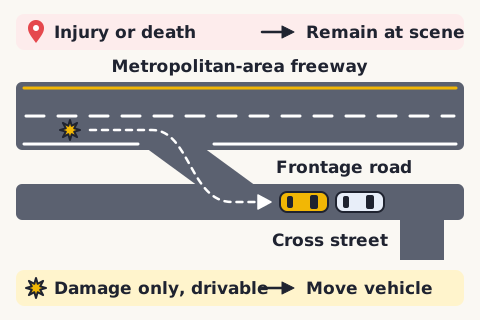
After a Texas collision likely to injure or kill, the driver must stop immediately at the scene or as close to it as possible (Transportation Code section 550.021). The driver must also return to the scene if the vehicle has not stopped there. If a collision results or is reasonably likely to result in injury or death, the driver must remain at the scene until complying with section 550.023. The driver must also stop without obstructing traffic more than is necessary.
Under section 550.023, a Texas driver in a collision gives a name, an address, the vehicle's registration number and the name of the driver's liability insurer. The driver also shows a driver's license if it is requested and available, and gives reasonable help.
A Texas damage-only collision damages only a vehicle that is driven or attended by a person. In one, the driver must stop at the scene, return if not stopped there, and remain until complying with section 550.023. The exception is a damage-only collision on a metropolitan-area freeway if each vehicle involved can be normally and safely driven. In that case, each driver must move the vehicle as soon as possible to one of these places:
- a designated collision investigation site, if available;
- a location on the frontage road;
- the nearest suitable cross street; or
- another suitable location.
The Texas Department of Transportation's (TxDOT) Access Management Manual defines a frontage road as a local street or road along an arterial highway allowing control of access and service to adjacent areas and property.
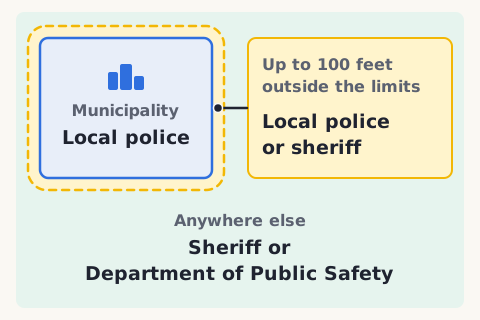
In Texas, the driver of a vehicle in a collision that injures or kills a person or leaves a vehicle unable to be driven normally and safely must notify police. The driver must do so immediately, by the quickest means. Whom to notify depends on where the collision happened:
- in a municipality: the local police department;
- not more than 100 feet outside the limits of a municipality: the local police department or the sheriff's office;
- anywhere else: the sheriff's office or the nearest Department of Public Safety office.
Stopping comes first, and the Texas code lists the later steps in this order without stating a sequence:
- The driver stops at the scene or as close to it as possible.
- The driver checks for people who need aid.
- The driver gives name, address, registration and insurer information, and shows the license if requested and available.
- The driver gives reasonable help.
- The driver notifies police if anyone was hurt or a vehicle cannot be driven normally and safely.
Sources
Key terms
- Open container
- In Texas, a receptacle holding any amount of alcoholic beverage that is open, has been opened, has a broken seal or is partly emptied
Key facts
Intoxicated and Open Containers in Texas
In Texas, a person is intoxicated when not having the normal use of mental or physical faculties because of alcohol, a drug or any other substance, or when having an alcohol concentration of 0.08 or more. That figure is a legal line, never a safe amount. Separately, knowingly possessing an open container in a passenger area of a motor vehicle on a public highway is an offense, whether the vehicle is moving, stopped or parked, with exceptions such as passengers in buses, taxis and limousines. These rules protect other people on the road when a driver is impaired.
Alcohol Offenses for a Texas Minor
For Texas alcohol offenses, a minor, a person under 21, commits an offense by consuming alcohol, with a defense and exceptions; by purchasing it, except when purchasing under the immediate supervision of a commissioned peace officer enforcing the Alcoholic Beverage Code; by possessing it, with exceptions such as the visible presence of the minor's adult parent, guardian or spouse; and by falsely stating that the minor is 21 or older, or presenting a document that indicates so, to a person selling or serving alcohol. The Texas Driver Handbook lists attempting to purchase alcohol.
Implied Consent Versus Zero Tolerance
Texas implied consent follows an arrest for operating a motor vehicle in a public place while intoxicated, or for the zero tolerance offense for minors: the arrested person is deemed to have consented to give breath or blood specimens. Zero tolerance, the name the Texas Driver Handbook gives the minor offense, makes it an offense for a minor to operate a motor vehicle in a public place, or a watercraft, with any detectable amount of alcohol in the system, even if the minor is not intoxicated. The handbook's glossary words implied consent more broadly, as consent that comes with a license.
Texas Financial Responsibility and Minimum Coverage
A person may not operate a motor vehicle in Texas unless financial responsibility is established by a policy, bond, deposit or self-insurance. As of 30 October 2026, the Texas minimum liability coverage includes 30,000 for bodily injury to or death of one person, 60,000 for bodily injury to or death of two or more persons and $25,000 for property of others. Each is for one collision and has been in force since 1 January 2011.
Stopping for a Police Officer in Texas
A Texas driver must stop when a police officer gives a visual or audible signal. For the stop itself, the Texas Driver Handbook lists ten suggested steps to help the driver stop safely for the officer, beginning with slowing down and moving to the right and ending with signaling and re-entering traffic once the officer releases the driver. They include telling the officer if the driver is transporting any type of weapon and saying where documents are before reaching for them.
Stopping First, Then Information and Help
After a Texas collision likely to injure or kill, the driver must stop immediately at the scene or as close to it as possible, and return to the scene if the vehicle has not stopped there. Stopping comes first; the code lists the later duties without stating a sequence. The driver gives a name, an address, the vehicle's registration number and the name of the driver's liability insurer, shows a driver's license if it is requested and available, and gives reasonable help. These duties protect other people on the road when a crash happens.
Remaining at the Scene, and the Freeway Exception
A Texas driver in a collision that results or is reasonably likely to result in injury or death must remain at the scene until giving information and reasonable help. A damage-only collision (damaging only a vehicle driven or attended by a person) brings the same duty, except on a metropolitan-area freeway if each vehicle can be normally and safely driven: each driver must move it as soon as possible to a designated collision investigation site if available, the frontage road, the nearest suitable cross street or another suitable location.
Whom a Texas Driver Notifies After a Collision
In Texas, the driver of a vehicle in a collision that injures or kills a person or leaves a vehicle unable to be driven normally and safely must notify police immediately, by the quickest means. In a municipality, that means the local police department. Not more than 100 feet outside the limits of a municipality, it means the local police department or the sheriff's office. Anywhere else, it means the sheriff's office or the nearest Department of Public Safety office.
Self-test
Answer each question from memory, then check your work against the answer key.
1. Knowingly possessing an open container in a passenger area of a motor vehicle on a Texas public highway is an offense, with exceptions. Which passengers fall under an exception?
- APassengers in borrowed vans
- BPassengers in private cars
- CPassengers in limousines
- DPassengers in pickup trucks
2. A Texas driver under 21 operates a motor vehicle in a public place, has alcohol in the system and is not intoxicated. What is the legal result?
- AAn offense since any detectable amount counts
- BAn offense only when the driver drives unsafely
- CNo offense unless the driver causes a collision
- DNo offense since the driver is not intoxicated
3. As of 30 October 2026, which pair of amounts is the Texas minimum liability coverage for bodily injury to or death of one person, then of two or more persons, in one collision?
- A$60,000, then $30,000
- B$30,000, then $60,000
- C$25,000, then $60,000
- D$30,000, then $25,000
4. Two vehicles collide on a Texas metropolitan-area freeway, damaging only the vehicles, and each can be normally and safely driven. What must each driver do?
- AEach driver remains where the vehicle stopped
- BEach driver drives away since only the vehicles are damaged
- CEach driver moves the vehicle only after police allow it
- DEach driver moves the vehicle as soon as possible
5. A police officer signals a Texas driver to stop. Which is the first of the ten suggested steps that the Texas Driver Handbook lists for the stop?
- AThe driver parks as far to the right as possible
- BThe driver turns on the hazard lights
- CThe driver slows down and moves to the right
- DThe driver says where documents are before reaching for them
Go deeper
- WatchUnder 21, Not 0.08 A Texas driver under 21 can break the law far below 0.08.
- WatchBoth Hands Visible An officer signals. A Texas driver must stop; the handbook suggests 10 steps.
- StudyU.S. Permit Test by State (Driving) in the FlashFeed app
Answer key
- 1. C Passengers in limousinesPassengers in buses, taxis and limousines fall under the exceptions to the Texas open container offense. Passengers in pickup trucks, private cars and borrowed vans are not among the exceptions named.
- 2. A An offense since any detectable amount countsA Texas minor commits an offense by operating a motor vehicle in a public place with any detectable amount of alcohol in the system, which the Texas Driver Handbook calls zero tolerance. It applies even if the minor is not intoxicated.
- 3. B $30,000, then $60,000The Texas minimum is $30,000 for bodily injury to or death of one person and $60,000 for two or more persons in one collision. The $25,000 figure is for property of others, so it does not belong in either person limit.
- 4. D Each driver moves the vehicle as soon as possibleOn a metropolitan-area freeway, when each vehicle involved can be normally and safely driven, each driver must move the vehicle as soon as possible to an investigation site if available, the frontage road, the nearest suitable cross street or another suitable location, not stay put.
- 5. C The driver slows down and moves to the rightThe Texas Driver Handbook lists slowing down and moving to the right first, and parking as far to the right as possible comes next. Turning on the hazard lights, and telling the officer where the documents are, both come later in the list, and the handbook calls all ten steps suggested.
Sources
- Texas Legislature — Texas Penal Code, Chapter 49: Intoxication and Alcoholic Beverage Offenses — tcss.legis.texas.gov/resources/PE/htm/PE.49.htm
- Texas Legislature — Texas Alcoholic Beverage Code, Chapter 106: Provisions Relating to Age — tcss.legis.texas.gov/resources/AL/htm/AL.106.htm
- Texas Legislature — Texas Transportation Code, Chapter 724: Implied Consent — tcss.legis.texas.gov/resources/TN/htm/TN.724.htm
- Texas Legislature — Texas Transportation Code, Chapter 601: Motor Vehicle Safety Responsibility Act — tcss.legis.texas.gov/resources/TN/htm/TN.601.htm
- Texas Legislature — Texas Transportation Code, Chapter 545: Operation and Movement of Vehicles — tcss.legis.texas.gov/resources/TN/htm/TN.545.htm
- Texas Department of Public Safety, Driver License Division — Texas Driver Handbook, DL-7, revised January 2026 — www.dps.texas.gov/Internetforms/Forms/DL-7.pdf
- Texas Legislature — Texas Transportation Code, Chapter 550: Accidents and Accident Reports — tcss.legis.texas.gov/resources/TN/htm/TN.550.htm
Image credits
- Remaining at the Scene, and the Freeway Exception: FlashFeed original diagram · CC-BY-4.0
- Whom a Texas Driver Notifies After a Collision: FlashFeed original diagram · CC-BY-4.0