
The 5 Love Languages: The Secret to Love That Lasts study guide · Lesson 5 of 7
Lesson 5: Love Language #4 — Acts of Service
5.1 Love in Action vs. Coerced Servitude · 5.2 Overcoming Stereotypes & Healthy Boundaries
Unofficial study guide for The 5 Love Languages: The Secret to Love That Lasts by Gary Chapman. FlashFeed is not affiliated with the author or publisher.
This is the lesson's study guide from the FlashFeed app, plus its key facts and a self-test.
What you'll be able to do
- Perform intentional Acts of Service with cheerful voluntary goodwill while avoiding resentful servitude.
- Overcome inherited gender role stereotypes and maintain healthy boundaries to prevent doormat exploitation.
Monograph Section: Lesson 5 of The 5 Love Languages: The Secret to Love That Lasts by Dr. Gary Chapman.
Executive Overview
Explores Acts of Service as tangible love in action, distinguishes voluntary loving service from coerced servitude, analyzes the thought, effort, and planning required to ease a partner's daily burdens, examines the necessity of overcoming inherited gender role stereotypes, and details how healthy boundaries prevent destructive doormat dynamics.
Love in Action vs. Coerced Servitude
Conceptual Foundations: Acts of Service, Actions Speak Louder Than Words, Voluntary Service vs. Coerced Servitude, Daily Domestic Chores
Core Insight: Acts of Service are actions done out of love to ease a partner's daily responsibilities, requiring thought, time, effort, and planning.
Acts of service range from cooking meals, washing dishes, and vacuuming floors to repairing cars, changing diapers, and paying bills.
Core Insight: For an Acts of Service spouse, actions speak far louder than verbal declarations; empty promises without follow-through cause deep frustration.
Proclaiming love while ignoring household chaos feels hypocritical to a service-oriented partner, whose emotional tank fills only when chores are lifted.
Core Insight: Acts of service must be given freely as an act of will, never performed out of guilt, coercion, fear, or resentment.
True service is motivated by altruistic desire to bless the partner; performing chores grudgingly with slamming doors poisons the emotional atmosphere.
Core Insight: Serving a partner requires intentional cognitive planning, asking what specific daily tasks would most effectively lift their mental burden.
Effective service is not random exertion, but targeted assistance that relieves the partner's most pressing stressors.
Core Insight: The biblical exemplar of Acts of Service is Jesus washing the feet of his disciples, demonstrating supreme humility in mundane physical labor.
Chapman references Christ's foot-washing to illustrate that genuine love is willing to perform the most menial, humble physical tasks for another.
Core Insight: A spouse's repetitive complaints about household chores are usually a clear diagnostic indicator of their primary love language.
If a partner constantly complains about dishes in the sink or an unpainted fence, they are crying out for love in the language of service.
Core Insight: Nagging and angry demands never inspire authentic acts of service, but instead trigger stubborn emotional defiance.
Constant nagging turns household tasks into power struggles, conditioning the criticized partner to resist out of self-defense.
Core Insight: Performing acts of service with a cheerful, willing attitude is just as critical as the physical completion of the task itself.
Emotional tone overrides physical action; service rendered with resentment leaves the spouse feeling guilty and alienated.
Core Insight: Asking your partner directly, 'What are three specific things I could do this week that would be a genuine help to you?' removes guesswork.
A direct service checklist focuses energy on tasks with the highest emotional payoff rather than assumed priorities.
Core Insight: Completing a task that your partner has repeatedly asked for demonstrates that their voice is heard and respected.
Resolving long-standing maintenance requests proves that their desires were not forgotten or dismissed.
Core Insight: Small daily micro-services—like packing a spouse's lunch or making the bed—consistently drip emotional fuel into their love tank.
Consistent micro-habits of daily care provide a continuous baseline of security that prevents tanks from ever running dry.
Core Insight: When an individual's love language is Acts of Service, laziness or chronic neglect of shared responsibilities feels like direct personal rejection.
Watching a partner remain idle while one is overwhelmed with domestic duties is perceived as a cold emotional abandonment.
Core Insight: Proactively anticipating a partner's need before they have to ask communicates profound, observant devotion.
Anticipatory care proves that you are actively scanning the environment to protect their energy and peace of mind.
Core Insight: Serving your spouse should never be used as a bargaining chip to extract favors or manipulate future outcomes.
Transactional service destroys authenticity; genuine love gives freely without keeping an accounting ledger of return favors.
Core Insight: Consistently practicing Acts of Service establishes an inspiring culture of mutual support that elevates the entire household.
A reciprocal cycle of service replaces domestic friction with playful generosity, making shared chores a source of connection.
Overcoming Stereotypes & Healthy Boundaries
Conceptual Foundations: Gender Role Stereotypes, Parental Imprinting, Modern Domestic Division of Labor, The Doormat Dynamic
Core Insight: Overcoming traditional or inherited gender role stereotypes is often essential to effectively speaking the language of Acts of Service.
Rigid expectations of 'men's work' and 'women's work' inherited from childhood can prevent partners from helping where aid is most needed.
Core Insight: Love requires the willingness to cross traditional domestic boundaries—such as a husband cleaning toilets or a wife changing car oil.
Prioritizing the spouse's relief over rigid social conventions reflects the humble adaptability of mature love.
Core Insight: Allowing oneself to be treated as a doormat, servant, or object of abuse is not an expression of love, but an act of destructive fear.
True love requires two autonomous persons with mutual respect; tolerating exploitation or degradation enables the abuser's destructive patterns.
Core Insight: Healthy love possesses boundaries that firmly declare: 'I love you too much to let you treat me this way.'
Enforcing boundaries protects the integrity of both individuals, preventing resentment and preserving the foundation for genuine relationship.
Core Insight: When one partner acts as a master and the other as an oppressed servant, genuine emotional intimacy cannot survive.
Power imbalances extinguish romantic affection, replacing companionship with fear, detachment, and smoldering bitterness.
Core Insight: Parental role modeling profoundly shapes an individual's subconscious expectations of domestic duties in marriage.
Unexamined childhood blueprints cause friction when spouses arrive with divergent assumptions about household management.
Core Insight: Couples must explicitly negotiate and redesign their domestic division of labor to match their unique modern schedules and careers.
Transparent conversation allows couples to build custom domestic arrangements based on mutual strengths, work hours, and fairness.
Core Insight: Refusing to perform a chore simply because it is perceived as 'below your station' is rooted in pride, which is poison to marital love.
Eliminating arrogance and embracing humility ensures that practical needs are met without emotional friction.
Core Insight: Service performed under manipulation or emotional blackmail breeds deep subconscious resentment that eventually explodes.
Emotional manipulation creates a toxic relational debt that erodes authentic affection over time.
Core Insight: A husband who actively shares child-rearing and domestic duties eases his wife's daily exhaustion, freeing the emotional and physical energy that closeness and romance need.
Relieving domestic exhaustion restores the emotional and physical energy required for intimacy and romance.
Core Insight: Expressing sincere verbal gratitude when an act of service is completed reinforces the partner's desire to serve again.
Appreciation validates the effort expended, creating positive reinforcement that motivates ongoing voluntary service.
Core Insight: Acts of service are especially critical during life transitions such as the arrival of a newborn, illness, or career changes.
High-stress seasons overwhelm baseline capacities; sacrificial service during crises provides essential emotional rescue.
Core Insight: Serving a spouse with physical limitations or chronic illness is one of the highest and purest expressions of covenant love.
Long-term caregiving embodies unconditional covenant devotion, transcending physical convenience to honor the partner's soul.
Core Insight: Teaching children to perform age-appropriate acts of service cultivates empathy and responsibility within the family unit.
Involving children in family responsibilities instills a lifelong ethic of teamwork, consideration, and empathy.
Core Insight: A marriage grounded in joyful, voluntary Acts of Service creates an efficient, peaceful sanctuary where both partners feel deeply supported.
Practical order and shared labor relieve life's daily friction, allowing partners to enjoy deep companionship and rest.
Key terms
- Acts of Service
- Voluntary actions done out of love to ease a partner's daily responsibilities, requiring thought, time, effort, and planning.
Key facts
Cognitive Planning in Service
The mental effort required to identify, prioritize, and execute the specific tasks that most effectively relieve a partner's stress.
Complaints as Diagnostic Clues
A spouse's repetitive complaints about household chores are usually a clear diagnostic indicator of their primary love language.
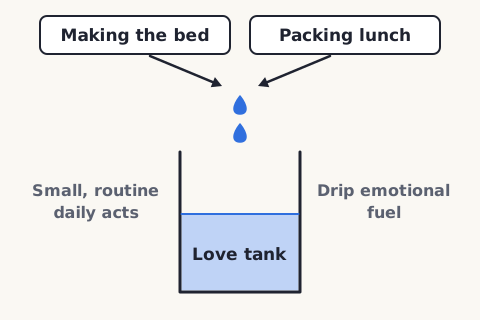
Domestic Micro-Services
Small, routine daily acts—such as making the bed or packing lunch—that consistently drip emotional fuel into a partner's love tank.
A Culture of Mutual Support
Consistently practicing Acts of Service establishes an inspiring culture of mutual support that elevates the entire household.
Protective Boundaries in Love
The courageous declaration that 'I love you too much to let you treat me this way,' preserving dignity for both partners.
Pride vs. a Servant's Heart
Refusing to perform a chore simply because it is perceived as 'below your station' is rooted in pride, which is poison to marital love.
Transition-Season Service Spikes
The dramatic increase in demand for physical support during major life milestones such as newborn arrivals or illnesses.
Caregiving as Covenant Love
Serving a spouse with physical limitations or chronic illness is one of the highest and purest expressions of covenant love.
Matched pairs
Each item on the left goes with the one on the right.
- Constant Nagging and Criticism
- Triggers stubborn emotional defiance and extinguishes the desire to love freely
- Transactional Service with Expected Payoffs
- Degenerates into domestic barter and destroys authentic intimacy
- Crossing Traditional Domestic Boundaries
- Demonstrates that your spouse's well-being is more important than outdated pride
- Service Extracted Through Emotional Guilt
- Creates toxic relational debt and breeds deep smoldering resentment
Step by step
How to create an actionable spousal Service Checklist
- Ask your partner directly: 'What are three specific tasks that would genuinely relieve your stress?'
- Write down their exact requested tasks on a clean index card or shared list.
- Complete one task each day with a cheerful, uncomplaining attitude.
- Inquire at the end of the week if those actions made them feel cared for and loved.
How to consciously negotiate and redesign the domestic division of labor
- List every recurring domestic task, from grocery shopping to bill payment.
- Discuss inherited childhood role assumptions and current weekly career hours.
- Assign tasks based on individual strengths, time availability, and mutual agreement.
- Revisit and adjust the division of labor periodically as life seasons and schedules change.
Self-test
Answer each question from memory, then check your work against the answer key.
1. Genuine Acts of Service must be motivated by which of the following?
- ACoercion
- BGuilt
- CVoluntary goodwill
- DFear of conflict
2. Which of these is NOT one of the destructive motivations to avoid in acts of service?
- ACoercion
- BAltruistic desire
- CGuilt
- DBitter, simmering resentment
3. A spouse washes the dishes while sighing and complaining the whole time. What does this communicate?
- AResentment
- BGenuine humility
- CAnticipatory devotion
- DCheerful willingness
4. What does 'cognitive planning' in Acts of Service mean?
- ATracking favors owed
- BFollowing gender-role habits
- CWaiting to be asked first
- DFinding the most helpful task
5. A husband makes his wife's lunch every morning without being asked. Which lesson concept best describes this?
- AA diagnostic complaint
- BA transactional bargain
- CA domestic micro-service
- DA gender-role blueprint
6. People enter marriage with subconscious domestic ___ inherited from their parents' patterns.
- ABlueprints
- BTraditions
- CHabits
- DRituals
7. A husband raised believing diaper-changing is 'women's work' decides to change diapers anyway. What does this demonstrate?
- AA lopsided transactional bargain
- BToxic relational debt
- CA diagnostic complaint
- DWell-being over outdated pride
8. Which of the following is NOT a healthy way to secure help from a partner?
- AVoluntary willing service
- BEmotional guilt-tripping
- CCheerful cooperation
- DDirect honest requests
9. What courageous declaration does the lesson describe as key to preserving healthy boundaries?
- AWhatever makes you happy, I'm fine
- BI will do anything you ask, always
- CI love you too much to allow contempt
- DI owe you for every favor you do
10. A wife taught 'a good wife never says no' forces herself to comply with every demand, even disrespectful ones. What is she missing?
- ACognitive planning
- BHealthy protective boundaries
- CRoutine domestic micro-services
- DAnticipatory care
Go deeper
- ReadThe 5 Love Languages by Gary Chapman · on Amazon ↗
- StudyThe 5 Love Languages: The Secret to Love That Lasts in the FlashFeed app
These are affiliate links: if you buy a book through one, FlashFeed may earn a small commission at no extra cost to you. The commission helps pay for FlashFeed's servers.
As an Amazon Associate we earn from qualifying purchases.
Answer key
- 1. C Voluntary goodwillActs of Service must be given freely as an act of will; guilt, coercion, and fear are explicitly named as the motivations that poison the emotional atmosphere.
- 2. B Altruistic desireGuilt, coercion, and resentment are destructive motivators; altruistic desire to bless the partner is the genuine, healthy motivation to aim for instead.
- 3. A ResentmentPerforming a service while grumbling communicates resentment rather than authentic love, regardless of the task getting done.
- 4. D Finding the most helpful taskCognitive planning means identifying which specific task would most relieve a partner's burden, not scorekeeping, passive waiting, or defaulting to old role habits.
- 5. C A domestic micro-serviceSmall, routine acts like packing a lunch are domestic micro-services that consistently drip emotional fuel into a partner's love tank.
- 6. A BlueprintsThe lesson specifically names these inherited, often-unconscious patterns 'blueprints' — mental templates for domestic roles absorbed from one's parents.
- 7. D Well-being over outdated prideCrossing traditional domestic boundaries shows a spouse's well-being matters more than outdated pride, unlike bargaining, incurring relational debt, or airing a chore complaint.
- 8. B Emotional guilt-trippingGuilt-tripping to extract service creates toxic relational debt and resentment; honest requests and willing cooperation build genuine connection instead.
- 9. C I love you too much to allow contemptThis declaration protects both partners' dignity by drawing a boundary against contempt while still affirming love, unlike blanket compliance or scorekeeping.
- 10. B Healthy protective boundariesWithout healthy boundaries, well-meaning service can slide into doormat exploitation; boundaries preserve dignity even in a service-oriented love language.
Sources
- The 5 Love Languages: The Secret to Love That Lasts — Gary Chapman
- The 5 Love Languages - Chapter 7
Image credits
- Domestic Micro-Services: FlashFeed original diagram · CC-BY-4.0